Editor's Note: This is the third post in a three-part series from Dave's trip to Salar de Uyuni, the Bolivian Salt Flats. Read Part One and Part Two.
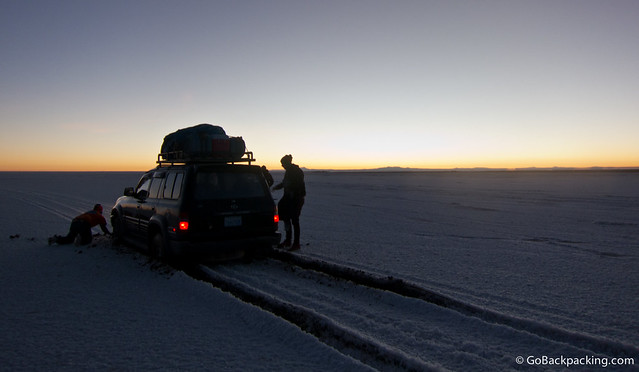
It was supposed to be a highlight of my travels in South America, but the excitement quickly gave way to a sinking feeling as we veered off the elevated dirt road, and onto Salar de Uyuni, the world's largest salt flat.
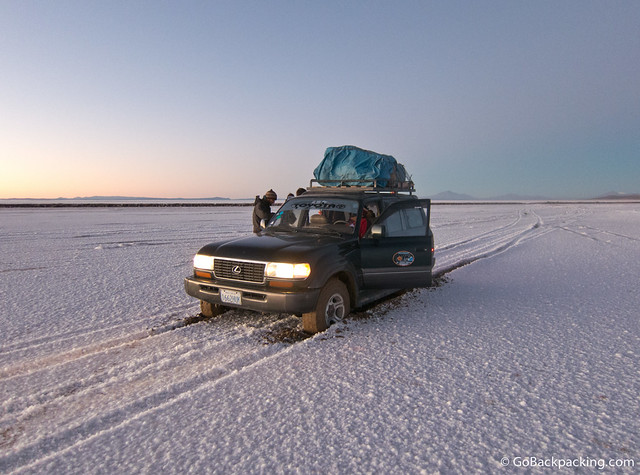
Within 60 seconds of our transition from dirt to salt, the Lexus SUV we'd used to cross southwestern Bolivia came to a complete stop.
Our driver, Pedro, attempted to accelerate, but it was no use.
The salt crust ranges in thickness from a few centimeters to a few meters, and we drove directly into a shallow spot.
The weight of the fully-loaded SUV was too much, and we had quickly broken through the salt layer, only to sink in the mud beneath.
In an unforeseen instant, the entire day I'd been waiting years to enjoy was in jeopardy.
Rise and Shine
We'd risen early, at roughly 5 AM, to pack our backpacks and get an early start on the day.
The goal was to have a tailgate breakfast on the salt flat while watching the sunrise.
Pedro was outside packing the SUV in the pitch black and bitter cold.
Unbeknownst to us, it was his birthday, and his friends had taken him out to celebrate while we'd been sleeping.
A few bottles littered the front passenger seat, leading to an uptick in my anxiety.
Despite my best attempt to secure a responsible and safe driver, I was now in the position of going with someone who at best seemed as though he didn't get much sleep, and at worst, was still a bit buzzed from the birthday celebrations.
Up until this point, I'd been 110% satisfied with his driving and vehicle.
It may seem hard to believe, but it doesn't even take a drunk driver for accidents to occur in one of the world's flattest places.
Lack of sleep, speeding, reckless driving, and unexpected changes in terrain have led to a series of fatal crashes involving several dozen tourists since 2008.
I don't share any of this to scare people, but it's important to recognize the inherent dangers of traveling in this remote region.
If you're paying $125 for a three-day trip, the average Bolivian driver is not going to have a satellite phone in case of emergency, first aid training, or even a first aid kit.
To travel with these higher safety standards, you have to pay more and book your trip through a Western-owned tour operator.
Related: Booking My Trip to the Bolivian Salt Flats
The Big Dig
The drive from the salt hotel to the elevated road that extends into Salar de Uyuni took about thirty minutes.
Once Pedro had surveyed the SUV, he got down on his knees and began to dig the mud out around the front left tire by hand.
I was surprised he didn't carry a shovel given we spent the first two days entirely off-road in very remote areas.
Without the sun, the temperature on the salt flats was still bitterly cold due to the 3,656m (11,995 ft) elevation.
I put on my alpaca gloves and began to dig around one of the rear tires.
He quickly waved me away, but not before I got a feel for how heavy, wet and cold the mud felt.
It was clear pride trumped expediency, so myself and the others were left to stand around and wait.
If there was a silver lining in getting stuck, it was that it happened 60 seconds off the elevated road.
We could clearly see other SUVs passing by, and they could clearly see us.
Within 10 minutes, an SUV had stopped, and a group of Bolivians had walked over to see how they could help.
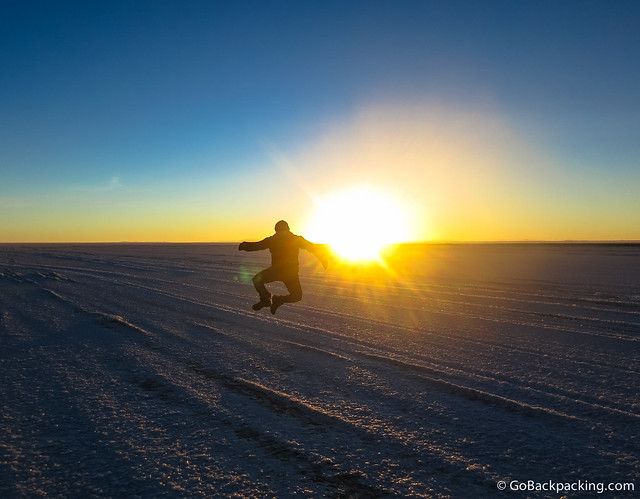
At 7 AM, as the big dig continued, the sun finally broke over the horizon, momentarily taking my mind off our situation.
The sky quickly turned bright blue; the sun's warmth felt reassuring.
Bolivian Ingenuity
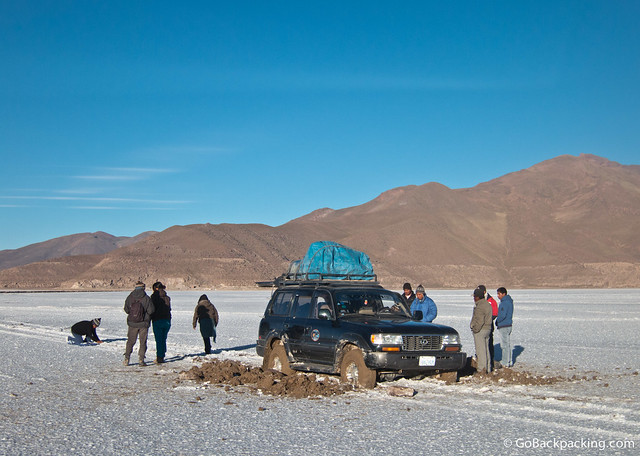
Simply digging the mud out from around the tires, and throwing some chunks of salt in for traction wasn't enough. The SUV went nowhere.
By this time, another SUV had stopped, bringing our headcount to at least a dozen Bolivians.
One of the men had brought a shovel, which sped up the digging process, and spared Pedro's hands, which were by this time covered in a thick cake of mud, and dangling lifelessly at his side.
Several young women began quietly carrying stones from the elevated roadway in their shirts, while the men stood around strategizing.
Placing the rocks against the front and back of the tires didn't work either. The SUV was still having trouble gaining traction.
The strategy evolved one step further when the propane tank we were carrying for cooking was used as a base for the tire jack.
By placing the tank next to each tire, and then elevating them one by one using the jack, it was then possible to place rocks directly beneath them. This made all the difference.
Once there were rocks underneath all four tires, Pedro took the driver's seat, pressed the gas pedal, and the SUV rolled onto what was clearly a thicker crust of salt directly in front of us.
Though it felt like an eternity, the delay had only cost us an hour and twenty minutes in Salar de Uyuni.
But without the kind help of the other Bolivians, it would've been much longer.
Related: The Landscape of Bolivia in Photos
Breakfast
With the SUV back on solid salt, Pedro wiped the mud off his arms with a rag, flipped open the tailgate, and set out a giant round loaf of fresh bread, granola, cookies, yogurt, juice, and instant coffee.
It was only then, when we began eating, that he put his head down on his arms on the SUV's hood in what appeared to be a giant sigh of relief.
We asked if he was OK, and he nodded yes. We were back on track.
After breakfast, I climbed up on the SUV's roof rack to help secure everything.
Pedro was normally the only one to go up there, but it was clear he needed the help.
Isla Incahuasi
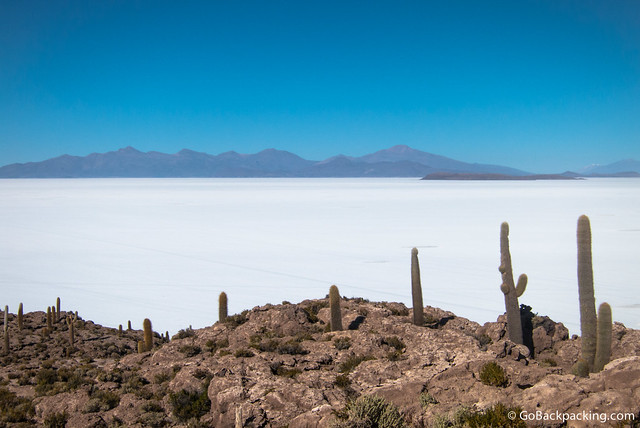
A little after 9 AM, we arrived at Isla Incahuasi, "the top of the remains of an ancient volcano, which was submerged when the area was part of a giant prehistoric lake, roughly 40,000 years ago."
The rocky island which means "Inca House" or "Home of the Incas" covers just 61 acres out of the 10,582 square kilometers that is the Salar de Uyuni.
In addition to its use as a refuge for the ancient Incas who use to cross the inhospitable salt flat, it's home to birds, Vizcacha and Giant Cactus, one of which was 9m (27ft) tall, and 900 years old.
Climbing up the hill requires a little effort given the altitude, but the 360-degree panoramic view from up there makes it a worthy endeavor.
Entrance onto the island cost 30 Bolivianos ($4.35).
Trick Photography
We spent a little over an hour at Isla Incahuasi before driving fifteen minutes out onto the salt flat again.
I don't know if it's a matter of routine, or he was feeling bad about us getting stuck earlier in the morning, but Pedro offered to let me drive the SUV.
He was proud of his Lexus (the only one I'd seen in three days), so it felt like a big deal for him to be handing over the wheel to me.
I purposefully drove much slower than him, given I wasn't familiar with the handling of the SUV when fully loaded, nor the terrain.
He offered the same opportunity to everyone else, but only two of the other five travelers accepted.
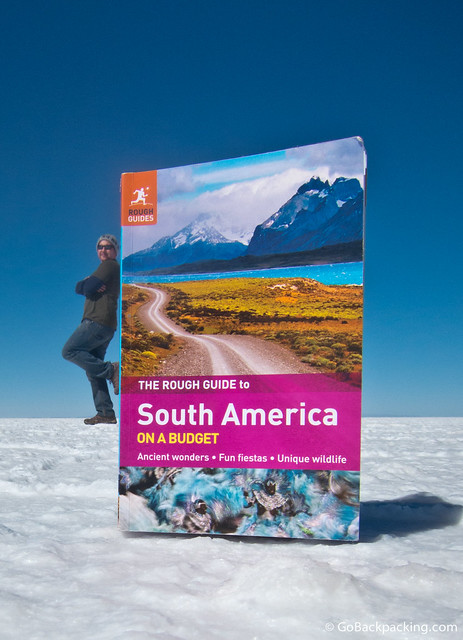
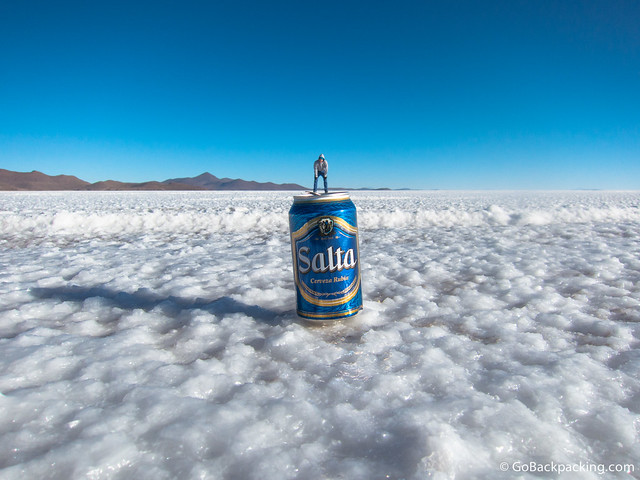
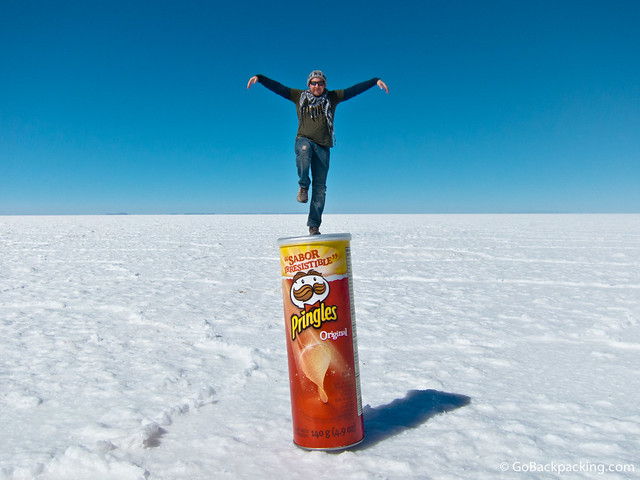
After our joy rides on the Salar de Uyuni, at around 11:30 PM, Pedro stopped the SUV in an area we had to ourselves and said we had 30 minutes to take photos.
This was the moment I'd been looking forward to for years, but it was only then that I realized I was the odd man out.
The three British backpackers immediately went off to take funny photos of each other, and the French couple didn't even know about the trick photography that was possible here!
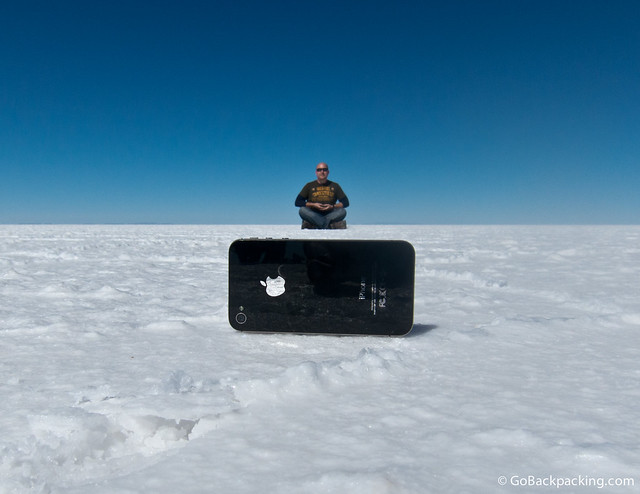
I did my best to explain, and then spent a lot of time running back and forth between the place where I had to pose and the props in the foreground where the Frenchman was also taking the pictures.
I realized I didn't know the best way to be capturing these photos.
I'd seen other people's images but had not done any research on the best way to take them.
I'd left it up to trial and error, and now I didn't even have as much time as I expected.

Pedro was on a mission to deliver us to Uyuni on schedule at 3 PM, but due to us getting stuck earlier in the morning, he had an hour and a half to make up.
I felt rushed and annoyed. I continued trying to squeeze in more photos, buying myself an extra few minutes to Pedro's consternation.
With everyone else seemingly happy to get back in the SUV after 30 minutes, I had no support to stay any longer.
After 40 minutes, we were on our way off the salt flat.
Salt Mines
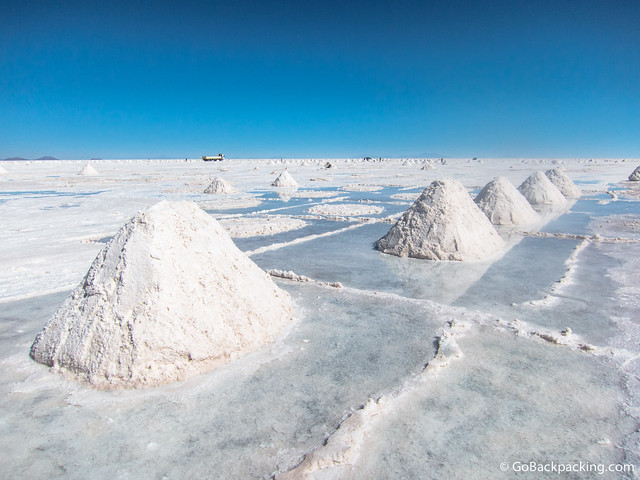
Before we arrived back on regular land again, we passed through the salt mines at the edge of the salt flat.
The world's largest salt flat contains about 10 billion tons of salt, of which 25,000 tons are extracted annually.
It's also estimated that beneath the salt surface lies 50 to 70 percent of the world's lithium reserves, or as much as 100 million tons.
Lunch Break
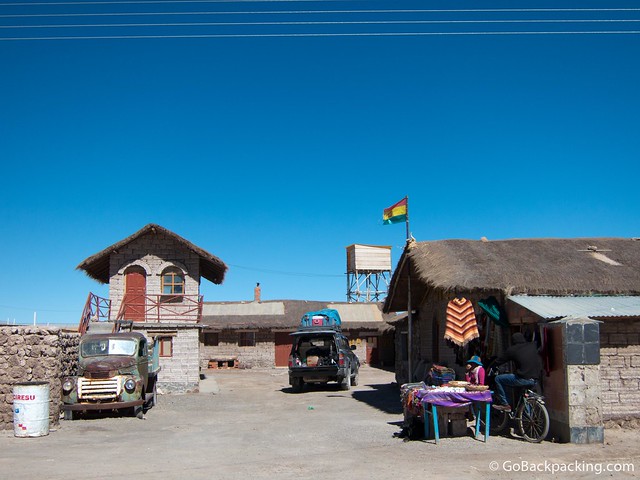
By 1 PM, we'd departed the salt flat, and entered a village.
Pedro parked the SUV outside a small complex of buildings and began to prepare lunch.
His car was completely covered in a thick film of white salt, which must be brutal on the paint if it's not washed off quickly.
Lunch consisted of chicken, pasta, potatoes, and a mix of carrots and string beans.
Train Cemetery
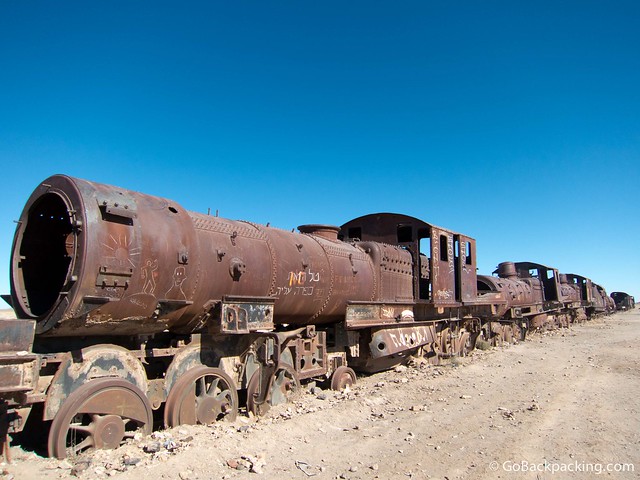
Our final stop of the day, and trip, was the Cementerio de Trenes ("Train Cemetery") located 3km outside of Uyuni.
The train lines were built by the British from 1888 to 1892 and were primarily used for mining purposes.
They were frequently sabotaged by indigenous people, and in the 1940s left to rust in the salty winds after the mining industry collapsed.
Today, the old rusted trains offer visitors the chance to be kids again, if only for a few moments, as they climb aboard and pose for photos.
On the drive to Uyuni, we passed acres of dry shrubs with thousands of plastic bags caught amongst them.
The massive amount of litter was a shock after coming from the unspoiled landscapes of the last few days.
Pedro dropped us off outside the Immigration Office, which was closed.
I was anxious to pay my $135 visa fee, get my passport back, and head to a lower altitude as my fingers still hurt, but it would all have to wait until morning.