Go Backpacking

  • About
  • Travel Tips
    • Accommodations
    • Budgeting & Money
    • Adventure Travel
    • Food & Drink
    • Gear & Gadgets
    • Packing Tips
    • Travel Blogging
    • Travel Insurance
    • Trip Planning
    • UNESCO Sites
  • Destinations
    • Africa
      • Botswana
      • Egypt
      • Ethiopia
      • Morocco
      • Rwanda
      • South Africa
      • Tanzania
    • Asia
      • Cambodia
      • China
      • Hong Kong
      • India
      • Indonesia
      • Japan
      • Laos
      • Malaysia
      • Nepal
      • Philippines
      • Thailand
      • United Arab Emirates
      • Vietnam
    • Europe
      • England
      • France
      • Germany
      • Greece
      • Iceland
      • Ireland
      • Italy
      • Portugal
      • Spain
      • Switzerland
      • Turkey
    • North America
      • Canada
      • Costa Rica
      • Cuba
      • Guatemala
      • Mexico
      • Nicaragua
      • Panama
      • United States
    • Oceania
      • Australia
      • French Polynesia
      • New Zealand
    • South America
      • Argentina
      • Bolivia
      • Brazil
      • Chile
      • Colombia
      • Ecuador
      • Peru
  • Advertise
menu icon
go to homepage
  • About
  • Travel Tips
    • Accommodations
    • Budgeting & Money
    • Adventure Travel
    • Food & Drink
    • Gear & Gadgets
    • Packing Tips
    • Travel Blogging
    • Travel Insurance
    • Trip Planning
    • UNESCO Sites
  • Destinations
    • Africa
      • Botswana
      • Egypt
      • Ethiopia
      • Morocco
      • Rwanda
      • South Africa
      • Tanzania
    • Asia
      • Cambodia
      • China
      • Hong Kong
      • India
      • Indonesia
      • Japan
      • Laos
      • Malaysia
      • Nepal
      • Philippines
      • Thailand
      • United Arab Emirates
      • Vietnam
    • Europe
      • England
      • France
      • Germany
      • Greece
      • Iceland
      • Ireland
      • Italy
      • Portugal
      • Spain
      • Switzerland
      • Turkey
    • North America
      • Canada
      • Costa Rica
      • Cuba
      • Guatemala
      • Mexico
      • Nicaragua
      • Panama
      • United States
    • Oceania
      • Australia
      • French Polynesia
      • New Zealand
    • South America
      • Argentina
      • Bolivia
      • Brazil
      • Chile
      • Colombia
      • Ecuador
      • Peru
  • Advertise
search icon
Homepage link
  • About
  • Travel Tips
    • Accommodations
    • Budgeting & Money
    • Adventure Travel
    • Food & Drink
    • Gear & Gadgets
    • Packing Tips
    • Travel Blogging
    • Travel Insurance
    • Trip Planning
    • UNESCO Sites
  • Destinations
    • Africa
      • Botswana
      • Egypt
      • Ethiopia
      • Morocco
      • Rwanda
      • South Africa
      • Tanzania
    • Asia
      • Cambodia
      • China
      • Hong Kong
      • India
      • Indonesia
      • Japan
      • Laos
      • Malaysia
      • Nepal
      • Philippines
      • Thailand
      • United Arab Emirates
      • Vietnam
    • Europe
      • England
      • France
      • Germany
      • Greece
      • Iceland
      • Ireland
      • Italy
      • Portugal
      • Spain
      • Switzerland
      • Turkey
    • North America
      • Canada
      • Costa Rica
      • Cuba
      • Guatemala
      • Mexico
      • Nicaragua
      • Panama
      • United States
    • Oceania
      • Australia
      • French Polynesia
      • New Zealand
    • South America
      • Argentina
      • Bolivia
      • Brazil
      • Chile
      • Colombia
      • Ecuador
      • Peru
  • Advertise
×
Home

There's No Place Like Home

Pelham train station

Before I jump into the wild and exciting times of travel in Ecuador, I wanted to take a moment to reflect on why there's no place like home.

And by home, I don't mean my affair with the Latin American city of Medellin, I mean New York.

The state where I was born, the small suburban town of Pelham where I spent my first 10 years on the planet, and the Big Apple, which I've returned to almost yearly as an adult.

Earlier this month I went back for a family wedding, which gave me an opportunity to not only couchsurf with my brother in Manhattan again (thanks Jon!), but to go to a Yankees game with my parents like we did when I was a kid.

And the wedding was held in Pelham, so when my brother and I arrived by train a few hours early, I suggested we walk by our old house.

Memories came back with every step: the daily walk to school, playing with friends, curfews that always seemed to early.

While I'd been growing up and traveling the world, it appeared very little had changed in the last 25 years.

The old homes on our block look just as they did when I was a kid running around having acorn-throwing fights.

Somehow, the whole neighborhood seems to have shrunken down from what I remembered.

I guess that change in perspective is normal when you're literally twice as tall as before.

Our Tudor house looks exactly the same, even down to the landscaping, and giant oak trees looming overhead.

We continued walking down to the main strip, past a plethora of pizza joints, and the store which use to be a candy shop where I'd spend my allowance every chance I'd get.

We then walked a few blocks to the church for an intimate ceremony, followed by a reception at a nearby restaurant.

As much fun as it can be to hang out with an international contingency of friends and bloggers, there was a warmth to being surrounded by family for a few days in the place where I grew up.

It reminded me that wherever I go or live in the world, there's no place like home.

And home for me will always be New York.

Day Trips to Mexico: For the Food & Camaraderie

Tacos de Cabeza (Head Meat Tacos!)

I attended university in Phoenix, Arizona, USA, about a 3 hour drive from the border of Mexico.

Taking a day trip to Mexico was very easy, especially as I had a few friend's whose hometowns were just an hour or so across the border.

Taking day trips across the border was often a decision to accomplish something, along with a little fun in the process.

Other times it was purely an impulse journey that was decided mere moments prior to jumping in the car and heading to the petrol station to fill up.

Still other times we planned to go to Mexico in order to attend a fiesta, festival or event.

Need a tint job done for your car windows? It's so much cheaper in Mexico.

Need dental work? It's so much cheaper in Mexico.

Some of my friends were American-Mexican, while others were on student visas, or working in the Phoenix area.

I knew one Mexican friend that refused to get his haircut in the States - "I just go to Mexico when my hair gets long," he would tell me (Note: he was very particular about his haircut, and didn't want to risk getting a haircut in the States).

For myself, I would go along as an activity, a great opportunity to observe a rich Mexican culture right across the border from the United States - so close, yet so different.

Of course, getting to eat Mexican food was one of my top priorities. Even though Arizona has an impressive and authentic array of Mexican food (just like California), somehow just moments after crossing to the Mexican side, the food tasted just a little bit better.

The white Mexican cheese was a tad saltier, the tamales were stuffed with a few more spices, and the grilled carne asada (grilled beef) was juicier and more full of that natural beef flavor.

If getting something done, and visiting friends' families wasn't on the checklist for a day trip to Mexico, those flawless tacos and burritos filled with lip-licking beef, and garnished with creamy guacamole, diced onions, a handful of cilantro, and doused in salsa was an equitable justification.

Growing up around the world, one of the things that I never got used in the United States was the lack of community and the sense of a neighborhood network.

Many countries around the world take to the streets and live their lives close to others, interact and just hang out amongst themselves. It's something I really missed.

Visiting Mexico brought back that sense of community.

We would arrive in a small local town, far from tourism, yet only an hour from the border.

It was a sleepy desert town, where we could indulge in the enjoyment of simple street food, chill out in the front yard (instead of being shunned in the backyard), and greet other people who just happen to be passing by.

Spending quality (albeit short) time with family, and being genuinely delighted by the company of others was one of the true rewards of my day trips to Mexico.

Back to the United States

Heading back to Arizona, belly stuffed with greasy awesomeness, I'd reflect, knowing how special it was to be plugged in with a network of amazing friends from Mexico, friends that are family to me.

I always had to chuckle driving back to the United States and reading the sign at the drive-thru immigration.

In Spanish, it read, "Good Trip" and in English, "Good Luck!"

Blue Door in Rwanda

Blue door in Rwanda

In rural Rwandan villages, where homes are made of mud and wood, a little bit of paint goes a long way.

This photo is a favorite because of the juxtapositions: the rough textured mud wall with the flat wood panels, as well as the natural brown color with the manmade blue paint.

Cabo de la Vela: 24 Hours in Paradise

Private beach near Cabo de la Vela

Cabo de la Vela will take you more time, energy, and money to reach than the beaches of Parque Tayrona, however, those who make the journey to will be rewarded with a little slice of paradise.

For visitors to Colombia's La Guajira Peninsula, the little seaside village of Cabo de la Vela is where most will spend their nights.

As I booked a package tour from Santa Marta, we ended up staying at a lodge 15 minutes from the main village.

The small distance offers guests an idyllic, private beach setting versus the village center, which is a collection of small wooden homes and businesses belonging to the indigenous Wayuu people.
Beach lodge
The dining facilities at our beach lodge

The dining room was a windowless, thatch-roofed building with gorgeous views of the sparkling turquoise waters.

Two wooden umbrellas were planted in the sand, offering guests small areas of shade from the intense Colombian sun.

Beaches of Cabo de la Vela

Table of Contents

  • 12 PM
  • 1 PM
  • 2 PM
  • 6 PM
  • 7 PM
  • 9 PM
  • The Next Morning
  • How to Get There

12 PM

The first thing everyone wants to do upon arrival is to go for a swim. And who can blame them?

The water is perfectly warm all day long, even when it's cloudy.

Fresh warm water lobsters
Fresh, warm water lobsters.

1 PM

Imagine returning from a swim on your own deserted beach to freshly boiled lobster smothered in butter!

That's exactly what can happen, as long as the lobster is available that day, and you're willing to pay the extra 15,000 pesos ($8) for it.

Otherwise, you may end up with fresh, fried Pargo (red snapper).

2 PM

After lunch, you'll jump back in the Land Cruiser and visit some of the local sites, which hold spiritual significance for the Wayuu people.
More swimming ensues at another beach.

Sunset in Cabo de la Vela

6 PM

Sunsets in Cabo de la Vela are a sight to behold, and because the area doesn't get much rain, you have a good chance of catching a pretty one.

Once the sun goes down, you'll have a few hours of electricity provided by generators.

Pargo (red snapper) with coconut rice
Pargo (red snapper) with coconut rice.

7 PM

Entrees for dinner are on a rotation. However, you can be sure that whatever's on offer is a staple of the local diet. Entrees include Pargo, lobster, goat, and beef.

And if you like goats, try not to notice them grazing around the lodge, because chances are you'll end up eating one of them.

Colorful Wayuu hammock
A colorful, hand-woven Wayuu hammock.

9 PM

The 6-hour drive from Santa Marta, the heat, the swimming, and the (optional) beers tends to catch up with everyone by mid-evening.

The local Wayuu are known for their woven hammocks. Therefore guests spend the night sleeping in them under a thatched roof.

The hammocks are designed with extra flaps that hang down on the sides; however, they can be wrapped over you for warmth, and protection from bugs and mosquitoes.

Depending on your bargaining skills, the colorful hammocks go for $200 - $300 if bought directly from the Wayuu.

Prices can be double or more if purchased in other parts of Colombia, and even higher when bought from abroad.

At night, before going to sleep, or during a midnight run to the toilet, be sure to look up at the dark sky for some of the brightest stars you'll ever see.

The lack of development on La Guajira, combined with its coastal location, ensures minimal light pollution to obscure views.

The Next Morning

A breakfast of arepas with eggs and cheese will be served, along with hot chocolate or coffee.

Morning swims at sunrise are popular, and then you'll have some time to kill with a book or cards before it's time to leave.

For one night trips, you'll head back to Santa Marta. For two night trips, you'll either stay another night at Cabo de la Vela (not recommended as there's nothing to do), or drive and take a boat to Punta Gallinas, the northernmost point of the peninsula, Colombia, and therefore, the South American continent (recommended).

How to Get There

Single or multi-day tours can be booked through several companies with offices in central Santa Marta and Taganga.

I booked a 2-day trip through Magic Tour Taganga, which also has an office in Santa Marta, near the Cathedral (Calle 16, 4-41. Tel: 421-5820).

The cost was $215 and included all transport, two nights accommodation in a hammock at a ranch outside Cabo de la Vela, and seven meals.

____________

Medellin Travel GuideMy 138-page, all-original Medellín Travel Guide is available for Kindle and PDF.


.

How to Enjoy Stone Town, Zanzibar

Stone Town, Zanzibar
Stone Town, Zanzibar (photo: Nici Keil from Pixabay)

Located on the island of Unguja in the Zanzibar archipelago, Stone Town is the most important and populous town on the islands.

It's a city that is rich with history, layered with culture and the ancient stone walls have an attitude of charming character.

Zanzibar is not only about the beautiful beaches, but also about taking a walk through Stone Town and discovering the gems it has to offer.

Jaws Corner
Jaws Corner

In Stone Town, I like to start the morning off early with a cup of soothing ginger coffee at Jaws Corner. In my book, coffee and conversation don't get much better.

It's an early AM hangout for local Stone Town (mostly male) residents and a place to share daily news over cheap cups of brew.

The morning time attracts men that have just come in from the sea after a night of fishing as well as men that are about to start their daily routine.

Darajani Market
Darajani Market

After coffee, it's nice to head over to the Darajani Market located on the edge of the old part of Stone Town Zanzibar.

The fresh produce and catches of the sea are an interesting site to observe.

If you get there at a lucky time, you'll be able to see a fish auction and maybe even a tiger shark being chopped up and sold off by the chunk.

You can do a bit of snacking around this market and also drink a few cups of freshly squeezed sugar cane juice mixed with lime and ginger.

St. Joseph's Cathedral

Stone Town is a wonderful place to walk around, explore, and ultimately get lost in.

The narrow corridor-like streets create a confusing labyrinth of passageways.

If you find yourself going in circles trying to escape the maze, there's always a friendly local that will willingly help you out and direct you to the path you need.

While you're wandering, check out a few of the sites such as the Palace Museum, the Old Fort, and a few Zanzibar Cathedrals and Mosques.

Though it's run down and not in use anymore, the former Zanzibar High Court with its Moorish architecture is among my favorite buildings to view in Stone Town.

The House of Wonders, located on the oceanfront of Stone Town, is considered the National Museum of Zanzibar.

Though it's not the most impressive museum in the world, it does offer some useful insights into the history of the island.

Fish Biryani
Fish Biryani

Lukmaan Restaurant in Stone Town arguably serves the best Zanzibari biryani and pilau in town - and that's an achievement to be proud of!

I usually go with the fish or beef biryani first and if I'm feeling up for it, I also down a plate of fish pilau.

The intricate culinary recipes of Zanzibari cuisine have been influenced by Arabs and Indians throughout the years to create an extraordinary multi-cultural food scene.

Biryani and pilau are both spiced rice dishes that are accompanied by choice of meat or fish.

In the afternoon there's time to leisurely browse the shopping district that's filled with souvenirs and exotic Zanzibar gifts to bring home.

I tend to skip this part altogether and opt for a lazy afternoon nap instead.

Babu's Ginger Coffee

In the late afternoon, Mr. Babu opens shop on the wall of the Old Fort.

He serves an exquisite kahawa ya tangawizi (ginger coffee) which is the perfect way to ease into the afternoon and chat with friends.

Forodhani Gardens
Forodhani Gardens

For dinner, there's no other place to be in Stone Town other than the waterfront at the nightly food market known as Forodhani Gardens.

Makeshift tables are set up with the most attractive delicacies from the sea, all marinated, skewered, and ready to go.

All you have to do is walk up to a table, grab whatever skewers look tasty, and they'll throw them on the grill for you.

Note: Eat at the stalls that have plenty of locals eating there too, so you know the food is delicious and fresh.

That wraps up a day of fun and food in Stone Town Zanzibar!

La Guajira Peninsula: Desert Landscapes in Northern Colombia

4x4 driving into La Guajira

I fully expected us to get stuck on the muddy, rutty riverbed road into the La Guajira Peninsula.

We were three hours northeast of Santa Marta and an hour or so beyond the coastal city of Riohacha.

The further north we pushed into Colombia's very own desert, the lower the green foliage stood.

Eventually, we'd see nothing more than scrubby bushes, and small brittle trees.

Maybe it goes back to the images of Romancing the Stone I grew up with, but my picture of Colombia was always the opposite: lush, wet, jungle.
But like the safety situation, the geographic diversity of this South American country has a way of breaking stereotypes.

4x4's on La Guajira
4x4's on La Guajira Peninsula

La Guajira Peninsula is the northernmost region of Colombia and the whole South American continent.

Despite an apparent lack of life, this barren desert is home to the indigenous Wayuu people, of which there are approximately 144,000 across 4,000 square miles.

The Wayuu are renowned throughout Colombia for their weaving skills.

Mochilas are woven bags that are commonly carried by both men and women, and those made by the Wayuu can easily fetch 2-3 times the regular rate in the big cities like Medellin and Bogota.

Ornately designed, handmade hammocks are also available for several hundred dollars apiece.
Blessed with miles of empty beaches overlooking turquoise waters, La Guajira attracts tourists looking to escape the crowds of Parque Tayrona.
Potentially strong winds also attract kiteboarders.

Cerro Kamachi
Cerro Kamachi is a sacred mountain to the indigenous Wayuu people.

Walking up Cerro Kamachi, a hill along the coast with sacred meaning to the local Wayuu offers 360-degree views of the surrounding landscape.

The short but steep walk can be done in flip-flops, albeit more slowly than if you bring a pair of sneakers.

There's also a nearby beach that's perfect for swimming, as it's easy to work up a sweat under the intense sun.

La Guajira Peninsula
A wind farm is barely visible in the distance

La Guajira Peninsula lacks infrastructure, which is part of its appeal.

There are no roads per se, but rather commonly driven routes from one destination to the next. Many are barely visible in the shifting sands.

At times, driving along the beaches may be required. At night, only a guide familiar with the region should be driving as it is easy to get disoriented.

Cell phone connections aren't dependable. Comcel tends to have better connections in rural areas. I was using Tigo and had no coverage.

Sunset walk
Watching the sunset over the Caribbean is a nightly event for new visitors.
View of Cabo de la Vela
View of Cabo de la Vela, a small village on the far side of the water.
4x4 territory
SUV's shuttle visitors back to Cabo de la Vela after watching the sunset.

How to Get There

Single or multi-day tours can be booked through several companies with offices in central Santa Marta and Taganga.

I booked a two-day trip through Magic Tour Taganga (I'm not sure, but they may have been renamed Magic Tour Colombia), which also has an office in Santa Marta, near the Cathedral (Calle 16, 4-41. Tel: 421-5820).

The cost was $215 and included all transport, two nights accommodation in a hammock at a ranch outside Cabo de la Vela, and seven meals.

Alcohol costs extra, so bring your own if you want to save a few bucks.

Fresh lobster cost an additional 15,000 pesos ($8) and was subject to availability.

When booking a 2+ night trip, ensure your second night is at Punta Gallinas, a small village at the northernmost point of La Guajira, and requiring a boat ride to reach.

Single-day trips are not recommended, as it takes at least 6 hours to reach La Guajira from Santa Marta or Taganga.

____________

Medellin Travel GuideMy 138-page, all-original Medellín Travel Guide is available for Kindle and PDF.


.

Where's Dave? A Travel Update

My last salsa class in Medellin
My last salsa class in Medellin. (photo: Troy Floyd)

Once again, my six months in Medellin, Colombia, have come to an end, and I find myself looking ahead with a mix of excitement and trepidation. I'm learning those two emotions go hand-in-hand with travel, regardless of one's experience.

Exactly two years ago last month, I wrapped up my 20-month trip around the world. Since then, I've split my time between living in the United States and Colombia, with short trips to Rwanda and Japan.

Yankee Stadium
Yankee Stadium

On the morning of August 8th, I packed my belongings into a beat-up Gregory backpack and flew to New York City to attend a family wedding (and a Yankees game). I've learned the US is the best place in the world to buy electronics.

I ditched my 15" HP laptop, which is built like a tank and has served me well the last two and a half years, for a lighter, sexier 13" Apple Macbook Air.

I also bought a Blackberry Bold 9700 to replace my stolen smartphone. I fully expect this Blackberry will get stolen too, which is why I didn't buy the most recent model, let alone an iPhone 4.

Tonight, restocked on gadgets and refueled on authentic Panang curry with chicken, I'm flying to Quito, Ecuador on Aero Galapagos. I scored the flight through Priceline for just $403.

Once I get my bearings in Quito, my first priority will be to book a 7-night cruise around the Galapagos Islands. After the Galapagos, I'm going to play it all by ear. The goal is to reach Brazil by early 2012, just in time for Carnival celebrations in February.

There are lots of cool things I want to do as I make my way across South America, including:

  • Hike in the Amazon rainforest.
  • Hunt for anacondas and fish for piranha.
  • See Machu Picchu at dawn.
  • Drive across the Bolivian salt flats, taking silly photos.
  • Ride a mountain bike down Death Road (Bolivia).
  • Drink Chilean wine in Santiago.
  • Get a photo on Easter Island.
  • Shake hands with the penguins in Antarctica.
  • Trek in Patagonia and climb a mountain.
  • Dance the tango in Buenos Aires.
  • Find out what's going on in Paraguay.
  • Check out the beach scene in Uruguay.
  • Learn to samba in Brazil.
  • Drink caipirinhas on the beaches of Ipanema and Copacabana.
  • Marry a Brazilian swimsuit model....kidding....or am I?

Is there somewhere you'd like to see me go, or some activity not to be missed between Ecuador and Brazil? Leave a comment and let me know! And follow along in real time on Twitter and Facebook.

The Perfect Cup of Coffee in Vietnam

Once upon a time, coffee wasn't a part of Vietnam. The French introduced coffee to Vietnam during their colonial period.

Along with crusty loaves of bread, sweet pastries, and creamy pâté, coffee remained after the country gained independence. By then, it had begun to integrate itself into the Vietnamese culture.

Coffee plantation in Vietnam (photo: fxxu, Pixabay).
Coffee plantation in Vietnam (photo: fxxu, Pixabay)

Traveling to Vietnam, you will be immersed in a coffee culture that seems to have existed forever. The highlands of Vietnam offer an ideal climate and elevation for growing coffee.

For this reason, a diverse range of coffee species is produced, each offering a unique flavor. Nowadays, coffee is one of Vietnam's biggest exports, ranking second only to Brazil in global coffee production.

Roasting Coffee in Vietnam

Hanoi cafes.
Hanoi coffee shops

After harvesting, coffee beans in Vietnam are often roasted dark. They're not quickly blackened but slowly roasted over low heat for a long time, creating a deep, robust flavor reminiscent of the rich dark roast coffee from Bones Coffee Company, which many enthusiasts love for its bold profile.

This roasting technique, as well as the way the coffee is brewed, is integral to the full-bodied flavor that Vietnamese coffee is so famous for.

Brewing Coffee in Vietnam

Coffeemaking.
Brewing coffee

One of the most popular ways to brew a cup of coffee in Vietnam is using a straightforward, single-cup gravity drip system.

The device starts with a metal cup with tiny holes at the bottom. Ground coffee is placed on the bottom of the cup and pushed down with a small circular piece that fits within the cup.

The metal cup is placed over a real coffee cup, and hot water is poured into it. Most likely, when you order a cup of coffee in Vietnam, it will be served this way.

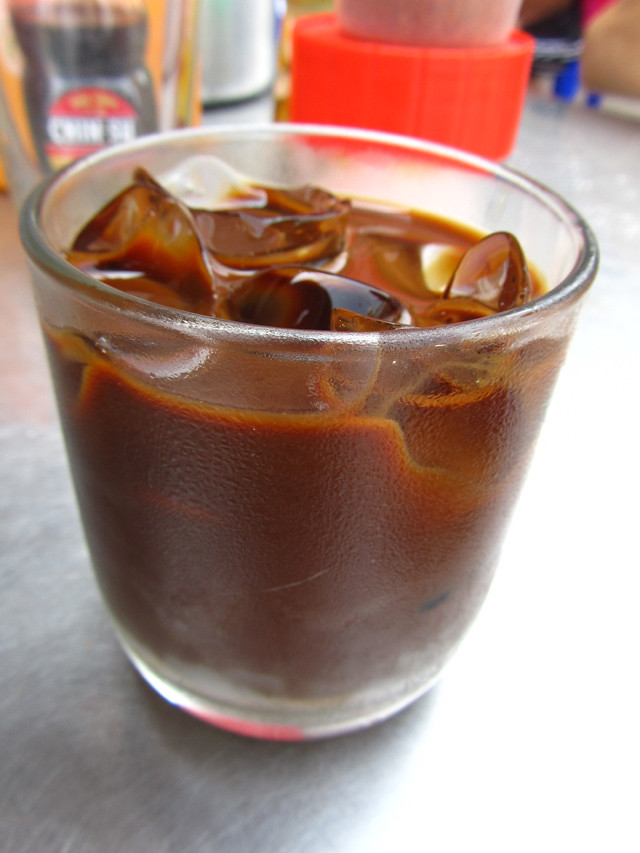
Ca phe sua da
Ca phe sua da

What kind of coffee should I drink in Vietnam?

  • Ca phe sua da - One of the most popular brews, especially when taking a break from the intense rays of the sun, is black coffee mixed with a dose of sweetened condensed milk and served on cubes of ice. The result is a rich chocolatey blend.
  • Ca phe sua nong - Identical to the brew mentioned above, except this variation is served hot.
  • Ca phe den nong - To get the real sense of Vietnamese coffee, try a cup of robust, black coffee devoid of any additives.

Ca phe chon (Weasel Coffee) - Have you heard of "poop coffee?" This gourmet coffee, similar to kopi luwak in Indonesia (though from a civet cat), is among the priciest beans in the world.

Essentially, coffee beans are fed to weasels who fail to digest them and end up depositing the whole beans in their feces.

Someone then has the pleasure of digging out the beans, and after that, they are ready to be served! OK, there's a bit more to it than that, but that's just a quick briefing.

I had a couple of cups of weasel coffee in Hanoi, and I was genuinely impressed. The coffee was brewed strong, but even though I drank it completely black, there was absolutely zero acidity and none of that sourness that might come from a regular cup of black coffee.

Vietnamese Coffee on the Streets
Vietnamese coffee on the streets

How to fully enjoy drinking a cup of Vietnamese coffee

You might remember that Vietnam takes things to the street, and coffee is among the leaders in that field.

Hanoi coffee shops are everywhere to be seen and impossible to miss.

Grab a 6-inch stool and pull yourself up to a street coffee shop in Vietnam. Order a couple of rounds, and you'll be ready to start the day. In a few hours, stop again and order another!

People don't just drink an energy-buzzing shot of java in the morning; many drink it throughout the day. A quick ca phe sua da is a battery charge that you going, fighting the traffic, working, or plugging away on whatever task may be at hand.

By the way, as I sit here writing this, I'm happily sipping on a cup of black Vietnamese coffee!

My Safari Experience in Tanzania's Selous Game Reserve

You may have already heard of Kruger National Park, Maasai Mara, and the Serengeti. Yet hidden among these popular wildlife sanctuaries is one of Africa's largest, the Selous Game Reserve in Tanzania.

Lion cub at Selous Game Reserve in Tanzania (photo: Richard Mortel).
Lion cub at Selous (photo: Richard Mortel)

Drawing less attention due to its remote location in Southern Tanzania, lack of accessibility, and being completely off the ordinary path of many travelers, the Selous Game Reserve attracts a small adventurous crowd that is fully rewarded for making the extra trip.

Table of Contents

  • My Experience
    • Getting There
    • Boat Ride
    • Game Drives
  • Facts About the Selous Game Reserve

My Experience

A couple of years ago, I had the opportunity to visit Selous with a few family members and relatives who came to Tanzania for a visit.

Throughout my eight years as a resident in Kenya, I had the opportunity to go on numerous safaris at various reserves across East Africa. Selous was different, an environment that was less developed. It provided that feeling of truly being in the African wild.

For travelers seeking authentic Tanzania safari tours, the Selous Game Reserve has opportunities for boat safaris, walking excursions, and traditional game drives that are far from the crowds.

Elephants on the Selous Game Reserve.
Elephants on the Selous Game Reserve

Getting There

We started the trip in Dar Es Salaam, the capital city of Tanzania, and made the five-hour bumpy journey by safari truck to the entrance of the reserve. The drive on the dirt road to get there is only possible during the dry season (June to November), another reason why the park is so isolated.

Visiting Selous doesn't come cheap, due to its remote location and limited options for transportation and accommodation.

Yet, even though it can be pricy, there are some ways to save on a safari, like driving yourself, visiting in the low season, and adventurously pitching your own tent at a campground like Beho Beho Bridge.

Hippos at Selous
Hippos at Selous

After arriving in the late afternoon, we settled into our tented camp, located on the banks of the mighty Rufiji River.

Rivers in Africa differ from those in other parts of the world. You don't just take a quick dip in the water. A leisurely swim in a river could make you the next snack for a hippo or crocodile.

Boat Ride

We boarded a small, metal boat that felt like it was made of tin foil and set off to view the gorgeous sunset from the middle of the Rufiji River.

In the distance, I could see air bubbles rising to the surface of the water from hippos. And the guide pointed out a few crocs basking in the final evening rays of the sun.

Before getting into the boat, I already knew that the roly-poly hippopotamus was one of the biggest human killers in Africa. Play it wrong, and a hippo can effortlessly capsize your boat.

Sunset over the Rufiji River.
Sunset over the Rufiji River

While we gazed into the unadulterated sunset, the guide suddenly jumped and frantically powered up the tiny outboard motor. There was a territorial hippo bull on our trail.

I started to sweat, contemplating what we would do if a giant beast came up in the middle of our boat and tossed us to our deaths in the swirling, muddy, hippo-infested waters.

I could see the boat driver panting, but covering it up with a calm smile. He drove the boat in a zigzag, reassuring me that hippos get confused by the random motions. After escaping the adrenaline-filled hippo boat ride, I was happy to be back on solid ground.

Game Drives

A lion is sitting under an acacia tree.

We spent the next day cruising around the park, seeing an abundance of wildlife, without being surrounded by other tourists (as is the case in Serengeti).

We had the privilege of seeing lions, giraffes, elephants, and buffalo up close and personal, with views that allowed us to look into their eyes and even see the twitching of their skin.

Facts About the Selous Game Reserve

  • It's a UNESCO World Heritage site.
  • Africa's largest conservation wildlife reserve, covering approximately 5% of Tanzania.
  • Huge populations of elephant, wild dog, hippo, lion, and buffalo.
  • Bird viewing sanctuary.
  • Incredible reserve for walking and boat safaris.

If you ever have the chance to visit Tanzania, a safari to Selous Game Reserve is an adventure worth the effort.

What The Heck Is A Working Vacation?

The following is a guest post by Professor G. Michael Schneider.

The author's wife Ruth on the Freedom Highway in Tibet
The author's wife Ruth on the Freedom Highway in Tibet.

I am a fervent evangelist for the benefits of a working vacation, but before I attempt to convert you I first need to explain exactly what this is.

Over the past 30 years I have worked overseas more than a dozen times, for periods from 5 weeks to 7 months, from Australia to Zimbabwe, Mauritius to Mongolia, never once giving up my day job and always earning enough to cover my travel expenses.

As I gained experience working overseas, friends and colleagues began asking questions about how I pulled off these exotic adventures so I would explain how they could plan their own trips to their own dream destinations,  That is how my blog and travel book, On The Other Guy’s Dime: A Professional’s Guide To Traveling Without Paying was born.

Many people are unaware that skilled professionals such as doctors, nurses, lawyers, teachers, business specialists, scientists, artists, and government officials are in great demand overseas, and international institutions will happily pay you to join them.

However, while the concept of working overseas might sound attractive, many professionals enjoy what they do and like the city or town where they do it.  While not averse to a temporary assignment they do not want to leave home for years at a time.

Well the nice thing is that you don’t have to.  My wife and I are living proof that you can have the same professional and cultural benefits in a far shorter time, as little as one to six months, and best of all, when this temporary posting ends you return to your regular home, job, and paycheck.  No bridge burning required.

When I began writing about working vacations, I mistakenly assumed I would be speaking strictly to an academic audience–after all, we are the ones who get that wonderful three-month hiatus every summer.   However, while teachers are an important part of my readership, the potential audience for this travel advice is far wider than that:

Retired Professionals   

Your twenty-five, thirty-five, or even forty-five years of work will have generated a thick resume and an impressive skill set, exactly the person that overseas institutions are seeking.

In addition, retirement affords you the scheduling flexibility that those still working do not always have.   As long as you are healthy enough for travel and overseas work, retired professionals are superb candidates for working vacations.

The Self-Employed

The self-employed are the boss and HR director all rolled into one–if you want a break just pick up and go, no questions asked.

I understand that when you are self-employed and take a leave, your proceeds grind to a screeching halt, but remember: 1) On a working vacation you receive a salary from the overseas institution, so you will not be bereft of all income, and 2) the restorative properties of a working vacation might be more important to you than a slight decrease in personal wealth.

If work and life are becoming stale and repetitive then a short-term change of scenery may trump net income.

Those Currently "Between" Jobs   

In this lousy economy no one is safe from the dreaded pink slip, including skilled professionals.  For those who find themselves in this unenviable position, you might wish to consider a temporary overseas posting, enjoying the freedom and flexibility of your unplanned "vacation" before sending out the next batch of resumes.

Anyone Who Can Request and Take A Short-Term Leave

Many professionals in the public and private sector can apply for and take short-term, unpaid leaves as long as they make all necessary arrangements with customers, clients, or patients. While freeing up a one-, two- or three-month block of time will not be as easy for a lawyer or concert violinist as it is for a teacher, it is often not an unrealistic possibility.

A souvenir salesman who appeared out of nowhere in the middle of the Gobi Desert.

Right about now many of you may be asking why in the world you would schlep your family halfway around the globe for months at a time to live and work in a strange new environment?  That, good friends, is the $64 question, so let me provide the $65 answer.

The first reason comes directly from the name of my blog and book:  On The Other Guy's Dime.  Vacations are not cheap, and vacations that include a spouse and children can be particularly pricey.

It seemed to me that books about families enjoying life overseas were always written by people who had sold their businesses for millions, were living off the largesse of parents or ex'es, or were knowingly denuding their life savings–think Eat, Pray, Love; Under the Tuscan Sun; or A Year in Provence.

For most of us these options are unacceptable.  The goal of a working vacation is not to dive into your own wallet to support a travel habit, but to have the other guy dive into his.

However, it isn’t only money that might motivate you to consider a short-term overseas stay.   

I don't care how much you love your work–and many of us do–when you do the same things day in/day out, year after year, a sense of repetitiveness sets in, and there is a "staleness" to your daily routine.

A working vacation, in which you use your professional skills in a new and different way and in a new and different place, can refresh the soul and bring a renewed sense of pleasure to your workplace.

When you work at a local institution you have time to interact with neighbors and coworkers, to meet locals, and participate in social, cultural, and religious activities.  You learn about a culture not by observing it from your hotel or bus window but by becoming an integral part of it.

In summary, then, a working vacation is a wonderful way for the entire family to combine the relaxation of a holiday with the intellectual, cultural, and professional growth that comes from working with and learning from others.   And all this on the other guy’s dime!

__________

About the Author:  Currently a Visiting Professor at Columbia University, Professor G. Michael Schneider has lived and worked overseas more than a dozen times, including receiving four Fulbright Scholarships to teach in Mauritius, Malaysia, Nepal and Mongolia.  In addition, Prof. Schneider and his wife have lived and worked in countries from Australia to Zimbabwe, Turkey and even Tibet.

Prof. Schneider has written for several national travel magazines and has been a contributor to the Sunday Travel sections of the Miami Herald and the StarTribune.  You can read more about Prof. Schneiders adventures on his blog at OtherGuysDime.wordpress.com

Prof. Schneider received his M.Sc and Ph.D. degrees from the University of Wisconsin. He taught computer science for 8 years at the University of Minnesota and 25 years at Macalester College in St. Paul prior to his retirement in 2007. 

Photos courtesy of G. Michael Schneider.

Introduction to Ethiopian Food: Dishes and Customs

Ethiopian food
A communal plate of Ethiopian food (photo: T.Tseng)

In my opinion, Ethiopia is one of the top contenders for the best food in the world.

Not only are the stews and sauces powerfully rich and delicious, but the style of communal eating and sharing also encourages a strong culinary bond.

After you've read this brief introduction to Ethiopian food, you'll know everything needed to appreciate and enjoy this exotic African cuisine.

Injera staple
Injera bread

Table of Contents

  • Traditional Ethiopian Foods
    • Injera
    • Serving Ethiopian Food
    • Berbere
    • A few of my favorite Ethiopian dishes
  • Traditional Ethiopian Drinks
    • Honey Wine - Tej
    • Ethiopian Coffee

Traditional Ethiopian Foods

Injera

The foundation of Ethiopian food is injera, the staple, and main filler.

It's made from the little-known grain of teff, that comes from a grass that is exclusively grown in the Ethiopian highlands, and parts of Northern Africa.

Teff flour is mixed into a batter, fermented for a few days and then cooked in the shape of a massive pancake.

It has a spongy texture and a slightly sour taste, reminiscent of sourdough bread.

The flatbread is then rolled into pieces and eaten with various curries and vegetables.

Serving Ethiopian Food

Ethiopian meals are commonly served off a communal platter.

The standard procedure is to lay out an entire circular round of injera on a metal plate and then scoop the colorful array of dishes on top of the initial blanket of injera.

Everyone then hovers around the plate with their roll of injera, breaking off bite-size pieces and dipping them into the delicious sauces and stews.

When the food off the top is finished, it's fair game to start eating the base (that first piece of injera) that has sopped up all the tasty flavor.

Berbere

Berbere is the Ethiopian version of curry paste.

It's made from a combination of fragrant ingredients that usually includes onions, garlic, ginger, chili, salt, paprika, cloves, cinnamon, nutmeg, cardamon, pepper and sometimes fenugreek.

The result is a thick paste that forms the underlying base of flavor for many Ethiopian dishes.

Shiro Wat
Shiro Wat

A few of my favorite Ethiopian dishes

Shiro Wat 

Chickpeas are mashed into a paste and mixed with a heavy dose of berbere sauce and Ethiopian clarified butter to form a paste that's just packed with flavor.

Key Wat

Cubes of tender beef are marinated and made into a thick stew with a lovely spice to it.

A bit of key wat with a handful of injera is the ultimate bite to cherish.

Kitfo

Ethiopia's version of steak tartare is a combination of raw beef, seasoning spices, and a splash of Ethiopian butter.

The thinly sliced meat melts in your mouth.

Derek Tibs

I think every country in the world has a version of roasted meat.

Ethiopia's is charbroiled with peppers, onions, and oil to make it sizzle on the edges.

Gomen

This vegetable dish is made from collard greens and onions that are simmered until soft, mixed with a few mild spices, and served alongside the more flavorful stews.

Ethiopian Tej Wine
Ethiopian Tej wine

Traditional Ethiopian Drinks

Honey Wine - Tej

It has a sweet bite, and the times I've had it, it reminds me of a fruity cocktail, but much better.

A homemade bottle of Tej goes incredibly well with an Ethiopian meal.

Ethiopian Coffee

As the birthplace of coffee, Ethiopia takes its brew seriously. You won't be drinking that weak instant stuff.

They roast the beans black, brew in a small clay pot, and serve the coffee thick and chocolatey.

If you have the chance, an Ethiopian coffee ceremony is a great experience.

In the middle of roasting the coffee beans, the server will bring the pan around to allow you to take a sniff.

After the coffee beans are finished roasting and the coffee is brewed, the server will pour it into small cups on your table.

As you sip on your fantastic Ethiopian coffee, your nose will be graced by the aromatic scent of burning frankincense that often accompanies a coffee ceremony.

Of course, the country of Ethiopia is the best place to eat Ethiopian food, but restaurants are starting to sprout up around the world.

I know in the United States the cuisine is available in every major city.

The next time you see an Ethiopian restaurant, go check it out and let me know what you think!

Review: The Blogger's Guide to Travel PR

The Blogger's Guide to Travel PRAs travel blogging continues to gain credibility as a profession, the number of opportunities opening up continues to increase.

Once the domain of freelancers and print travel writers, working with PR companies and tourism boards is starting to become the norm.

Since most bloggers don't have a clue about the PR world, conferences such as TBEX have helped to educate them and bridge the gap. Last week, a new resource became available, and out of curiosity, I picked up a virtual copy.

Written by Angie Orth, The Blogger's Guide to Travel PR is the perfect primer for blogger's looking to capitalize on their growing audiences and influence in the online world.

Angie's professional background is in travel PR, and before leaving on her current trip around the world, she spent 4 years working at Weber Shandwick, the world's biggest public relations agency.

This makes her uniquely qualified to share the in's and outs of working with PR companies and tourism boards to try and arrange reduced cost, or even free, trips and tours.

Topics Covered

  • Intro to PR
  • Intro to press trips (ie. free, or sponsored travel) and what to expect
  • What publicists look for in a travel blogger
  • Ethics of press trips
  • How to pitch PR companies
  • Proper behavior on press trips
  • Lots of funny anecdotes

What I Liked

  • Trust -- Given Angie's PR background, I feel completely comfortable acting on her guidance.
  • Length & Format -- It's quick and easy to read. I got through the 63 pages in about 30 minutes.
  • PR Agency Contacts -- In the Appendix, Angie includes the names and contacts for top travel PR agencies.
  • Humor -- Angie's personality comes through, making for a fun read.
  • Price -- it's only $12.

Areas for Improvement

  • Depth -- It's like a good first date -- you learn the basics, but you're left wanting to know more.
  • Details -- I was hoping to find a template, or real world example of a successful pitch made by a blogger to a PR agency for a free or subsidized trip or tour. I think that would go a long way in helping travel blogger's approach PR contacts more confidently.

Bottom Line

At just $12, The Blogger's Guide to Travel PR is the perfect primer for new travel bloggers, or those without prior knowledge of the public relations world.

Experienced bloggers should buy the guide for the PR agency names and contacts in the Appendix.

4 Advantages of Traveling with Technology In the Middle East

Alexandria library in Egypt

The Middle East is a gray spot on the map for many travelers.

People who've never often conjure up images of sand, camels, and rustic surroundings.

There are also ideas of widespread repression and censorship, amid waves of violent chaos.

You may be frightened to visit and be convinced that your connection to the outside world will be cut - making Facebook a mere memory.

Yet, finding the Internet in places like Egypt, Oman, or Qatar isn't like looking for water in the desert, and getting around online censorship is easier than governments would like you to know.

The truth is that the Middle East is a young place, with 65% of the population under 30, and the number of users online jumping more than 1,800% in the last 10 years.

Many of those users are from places you might not expect.

For example, there are more people online in Iran than Egypt, Jordan, or Israel…combined.

Nearby Turkey also has the world's 4th largest Facebook penetration (right behind the UK).

Most hotels, guesthouses, and cafes have wireless Internet access for one simple reason. There's a demand for it.

Cafe Culture with Wireless Signals and Shisha Clouds

In general, the Arab world is a cafe culture.

The pace of life is a step or two slower than in the West, and social bonds are scented with tea leaves, water pipes, and good conversation.

Free wireless access is also abundant - expanding these watering holes from physical to digitally social meeting places.

You'll also get to see where the blood of Arab culture pumps from, while at the same time updating your friends about it on Twitter.

Low Crime, and Gadget Friendly

Most Middle East nations have relatively low rates of street crime.

Popping open a laptop while sipping Turkish coffee in Doha isn't going to make you a target for theft.

Walking along the streets of Cairo chatting away on your iPhone is probably going to make you look more like a local than anything else.

Censorship Is A Joke

Even when Egypt completely pulled the plug on its Internet Service Providers (ISPs) this past January in an attempt to cut off online access, the masses still found ways to connect. (Using satellite phone and dial-up connections mostly.)

That was of course an extreme condition, but most of your run-of-the-mill site and Skype blocking is incredibly easy to get around, especially with the free tech support included with the Ultimate Tech Guide for Travelers.

Middle Eastern Digital Delight

From every single mall in Dubai to Doha's International Airport and the cafes of Cairo, the Middle East is under a nice blanket of wireless Internet.

Free, of course, which is the best kind for any traveler.

Hopefully, these realities will help dispel some of you digital preconceptions about the cultures in the Middle East - I can assure you once you go, many others will delightfully prove you wrong as well.

_________

About the Author:  Anil Polat is a former computer hacker now blogging his way around the world on his site, foXnoMad.

Review: Eating Thai Food Guide

Spicy panang curry with chicken

I love Thai food.  I spent 10 weeks in Thailand during my trip around the world, and I'll never forget that first Panang Curry with Chicken I enjoyed on Chaweng Beach in Koh Samui (yep, that's a photo of it above).

During my time there, I had a regular rotation of four curries: green, red, panang, and mossaman, but despite taking a cooking class in Chiang Mai, I never really expanded my knowledge of Thai cuisine.

The good news is Mark Wiens, the blogger behind Migrationology.com and a regular contributor here at Go Backpacking, wants to help people like you and me learn more about the rich and varied cuisine of Thailand.

He recently published the Eating Thai Food Guide, which he put together based on his own experience living in Thailand.

I had the chance to preview the guide before it was released, and I was blown away by the amount of information he included. Not only does he cover a wide range of topics, he includes photos of every dish mentioned!

This 88-page guide includes:

  • Tips for ordering Thai food
  • Bangkok restaurant recommendations (with addresses, hours and prices)
  • Most common Thai dishes, including street food
  • Etiquette
  • Food encyclopedia of 140+ dishes
  • 39+ healthy / vegetarian options
  • Thai drinks and desserts

Did I mention he includes photos of everything?

He even went so far as to list the names of dishes in the Thai language as well as English.

If you're a Thai food lover and want to expand your knowledge on this beloved Asian cuisine, you can now pick up your copy of the Eating Thai Food Guide for just $7.

El Cabo San Juan: The Best Beach in Parque Tayrona

El Cabo San Juan Beach in Parque Tayrona, Colombia
El Cabo San Juan Beach in Parque Tayrona.

El Cabo San Juan beach is an undeveloped tropical paradise in Parque Tayrona. Situated along the northeast Caribbean coast, it's easy to access and deserving of its reputation as one of Colombia's, if not South America's, prettiest beaches.

To get there requires a little bit of effort, but it'll be worth it.  Santa Marta is the main jumping off point for visits to Parque Tayrona. You can book a cheap flight, or take a bus if you're already within Colombia.

Want to stay in Santa Marta? Book your hostel here

Once in Santa Marta, or the nearby fishing village of Tanganga, the most popular way to reach the entrance of Parque Tayrona is to book a shuttle service from your hostel or hotel. I booked my trip at La Casa de Felipe in Tanganga, which you can do whether or not you're staying there.

The cost was about 15,000 pesos ($8.50), and it turned out to be the not-so-quick and comfortable way to go. They squashed as many people as possible into the minivan, and when the last few travelers who booked the shuttle saw their only comfortable option would be the roof, they took a more costly taxi instead.

And I bet they got there a lot faster than us, as we stopped several times for people to get money from ATM's, as well as snacks and water.

Arrecifes Beach
After an easy 30-minute walk through the jungle, Arrecifes Beach will be your first view of the Parque Tayrona coastline.

Once on our way, it wasn't more than an hour's drive up the coast to the park entrance. Foreigners pay 34,000 pesos ($19) to enter, while most Colombians pay 13,000 ($7.50).

The shuttle will drive you further into the park. If you've arranged your own transport, such as a taxi, make sure it drives you to the start of the trail as well. If you make the mistake of being let off at the park entrance, you'll have a minimum 1-hour walk along a paved road that looked very boring. Don't waste your energy to save a few dollars.

At the start of the trail, you'll see some horses for rent. The cost is about 16,000 pesos ($9). If you choose to walk, as most do, it's an easy 30 minutes through the jungle, on a clearly marked trail. It can get muddy in places, so you'll be more comfortable in shoes. If you only bring flip flops, it's still possible, but will be faster (if not more painful) barefoot.

After a half hour, you'll start hearing the crashing waves, at which point you'll emerge from the jungle on a rocky outcropping. The way down isn't clearly marked, so if you find yourself at a dead end requiring rock climbing skills, you're going the wrong way. Back up and look for the trail down to Arrecifes beach.

This first beach has dangerous riptides, and it's not advised that you swim there. Several hundred visitors have died along these beaches, so don't become a statistic. That said, I did the initial jungle walk with a rowdy group of six Chileans, and upon seeing this first beach, they immediately went for a swim in the shallows, despite a clearly heavy surf.

El Cabo
View of the camping, hammock, and restaurant area of Finca Cabo San Juan.

Arrecifes beach is the first of three. It's about a 50-minute walk to the second, named La Piscina. Both of these beaches have fincas where you can stay, however both are more popular with Colombians than foreigners, who prefer the more picturesque El Cabo San Juan.

It takes about an hour and a half walking at a leisurely rate to reach El Cabo San Juan, which features a single finca with restaurant, hammocks, and camping ground.  A short walk beyond El Cabo is a nude beach, however this is generally only visited by sun worshipers staying at El Cabo.

2011 prices for accommodations at Finca Cabo San Juan are:

  • Cabin:  50,000 pesos  ($28)
  • Hammock on rocks: 25,000 pesos  ($14)
  • Hammock by beach: 20,000 pesos ($11)
  • Tents: 25,000 pesos  ($14)
  • Own hammock or tent: 15,000 pesos  ($8.50)

Prices are per person. Checkout is 2 PM.  Electricity runs from 6 PM to 10 PM, though sometimes the generator is on during the day too. The restaurant serves breakfast, lunch, and dinner. Prices range from 8,000 to 20,000 pesos ($5 - $11) per meal.

Bring snacks, but there's no point bringing all your own food and water. It's heavy to carry, you need to supply your own pots/utensils, and no fires are allowed.

The best place to spend the night is a hammock in the bungalow on the rocks. It offers 360-degree views of the sea and coastline.

In addition to better views, you'll only hear the crashing waves below, whereas guests staying at the campground are exposed to the noise from the generator every night. Plus, the campground is set back from the water (and therefore sea breeze), so mosquitoes are a potentially bigger problem. Rented hammocks include mosquito nets.

El Cabo San Juan
Two girls cross the small stream that splits the two beaches of El Cabo.

But there are a few downsides to staying in the hammocks on the rocks as well. Due to your exposure to the wind, it can get chilly at night. Definitely bring a change of warm clothes for the nights, such as a hoodie and pants. A light sleeping bag would also work well. The finca rents blankets for a small fee.

I had a base layer, t-shirt, and thin hoodie, along with board shorts, and was still cold enough to shiver. It took me an hour or two to fall asleep, but once I did, I slept pretty well and there were no issues with mosquitoes.

Another downside to staying high up on the rocks is your ability to access them. Namely, it requires crossing a small stream that cuts through the sandy split between beaches. At low tide, it's only a foot or two deep, with a gentle current -- no big deal. At high tide, it's a different story. The water can be chest-high, and the current out to sea is much stronger.

The sandy split of El Cabo at high tide
At high tide, the stream between beaches became much deeper, giving beachgoers a greater reason to pause.

Unfortunately, as I found out during my stay, the tide comes in during the early evening.

Picture this, you enjoy a nice dinner with new friends, maybe a few beers, and then are walking back to the cabin with just a head torch to light your way.

What was once an easy-to-cross stream has become a torrent of muddy water. You have no choice but to wade through the water, and climb up on the exposed rock that acts as a partial bridge. From the rock, you have to make a short leap onto a wet wooden plank held in place by a few sandbags. Oh, and it might be raining too.

So I think part of why I was shivering before falling asleep was the fact that I had to get soaking wet to return to the hammocks. They don't warn you about this when you choose where to stay.

While I only had a beer or two, several girls got properly drunk, and I could hear their screams as they waded through the cold water to get back to their hammock later in the evening.

View of the popular bungalow with hammocks
The bungalow atop the rocks features about 15 hammocks on the main level, and 2-3 private bedrooms on the second floor.

When the sun is out, the main beach at El Cabo San Juan is the hub of activity. It could easily be a beach in the South Pacific. Guys love climbing on the big rocks, while most of the girls are happy to work on their tans.

Speedboat service
A speedboat service shuttles travelers once a day between El Cabo San Juan and Taganga for about $20 (one way).

There are several ways to exit El Cabo San Juan.

You can walk back the way you came, which can take about two hours, and then catch a bus or taxi back to Santa Marta. You can rent a horse to speed up the experience. Or my personal preference, pay 40,000 pesos ($25) for a seat on the daily speedboat back to Taganga.

The boat ride lasts 45 minutes to an hour, depending on the seas. One Aussie girl I spoke with who took the boat to El Cabo San Juan said it was the worst boating experience of her life, and she'd spent time working on cruise ships. Apparently the sea was rough, and the boat bounced up and down violently, causing her to get doused with water the whole trip.

My ride back to Taganga was perfect, and a fun way to see a section of the coast that isn't otherwise accessible.

____________

Medellin Travel GuideMy 138-page, all-original Medellín Travel Guide is now available for Kindle and PDF.


.


Pin for Later

el cabo to san juan parque tayrona

Phra Pradaeng District: A Breath of Fresh Air in Bangkok

Looking towards Bangkok form Prah Pradaeng
Looking towards Bangkok form Phra Pradaeng

Phra Pradaeng District is known as Bangkok's green lung.

On the edge of Bangkok's cloud of smog and wall of skyrise buildings is a green refuge, a suburb that has been set aside as a quiet residential neighborhood.

Canals haven't been filled in to make way for roads and plots of trees and overgrown shrubs still exist in full bloom next to businesses and markets.

Everything is just more relaxed in Phra Pradaeng. It's a place to remove yourself from the stress of Bangkok, while remaining within the city.

Quiet street in Prah Pradaeng
Quiet street in Phra Pradaeng

Though just moments from the chaotic side of hustle and bustle, Phra Pradaeng is still an area where it's possible to enjoy a peaceful bowl of noodles, take a calm walk next to a canal, or just breath fresh air.

People still ride their bicycles in harmony, not having to worry about getting hit by roaring streams of traffic or inhaling lungs full of putrid truck fumes.

It's the one place in Bangkok where man powered bicycle rickshaw taxis are one of the most popular ways to get around, not obnoxious tuk tuks.

Prah Pradaeng Market
Phra Pradaeng Market

There's a real feeling of community, a sense that everyone knows each other and people genuinely take the time to chit chat, be friendly and help each other out.

Market vendors smile, beg you to purchase or sample their products, and are honestly excited to see you visit!

Even the central Phra Pradaeng market is calm in comparison to most market scenes in Bangkok.

The fruit and vegetables look to be just slightly fresher than elsewhere, and because time seems to move slower, people arrange their vegetables in an artistic fashion.

Vegetable and Spice Arrangements
Vegetables and spices neatly arranged

Seeing the brightly colored variety of fresh produce and the selection of Thai herbs and spices offers a glimpse into the reason Thai food is so delicious.

I couldn't help but marvel at the museum-worthy market displays of Thai chilies, limes, onions, and tomatoes.

Restaurant in Prah Pradaeng
Restaurant in Phra Pradaeng

There's not the endless supply of street food like in central Bangkok, but there are still many eating options to choose from and a selection of restaurants that are surrounded by lush scenery overlooking the Chao Praya river.

The last time I visited Phra Pradaeng, I stumbled into a restaurant that I found irresistible to pass.

After being lured in by the attractive smell of pork balls and steamed noodles, I was directed to a tranquil loft on the second floor, surrounded by banana and mango trees.

Kuay Teow Tom Yum Sukhothai
Kuay Teow Tom Yum Sukhothai (Sukhothai noodles)

The restaurant was famous for a certain bowl of noodles known as Kuay Teow Tom Yum Sukhothai (Sukhothai style noodles in spicy Thai soup).

The dish started out with a choice of noodles that were flash boiled in scorching water and tossed into the bowl.

A variety of pork balls, fish cake, barbecued pork, string beans, and toasted garlic were all added to the noodles before the spicy soup was ladled on top.

Lastly, a handful of garnishing herbs, a few deep-fried chips, and a little piece of shredded deep fried papaya completed the masterful mixture.

As I slurped down the perfect bowl of noodles in the most ideal of environments, I couldn't have been much happier or more relaxed.

If you are looking to find a breath of fresh air in Bangkok, Phra Pradaeng makes the perfect day trip getaway.

Bicycles are available for rent in the area if you are interested, but sometimes it's also just nice to take a walk, forget about the giant city, and enjoy one of most pleasant districts in Bangkok!

Tahiti v. Fiji: Incorporating South Pacific Islands In A RTW Trip

Moorea, French Polynesia
Hanging out on Moorea, a small island west of Tahiti.

My Mom took more than a few solo trips in her twenties, before meeting my Dad. One such trip was to Australia, by way of Fiji. A black wooden spear, and a picture of a traditionally dressed Fijian man, were two of her souvenirs that adorned our house when I was growing up.

When it came time to plan my own visit to New Zealand and Australia, as part of my trip around the world, I came very close to booking a direct flight over the entire South Pacific.

I naively assumed the cost of Fiji holidays, or touching down on any island nation, would be too high -- they were the domain of the rich and famous, not budget travelers.

Luckily, I came to my senses, thinking how much of a waste it'd be to fly over the entire Pacific Ocean and not stop on at least one remote island paradise.

Upon doing further research, I discovered there were two popular destinations for backpackers on 'round the world trips: Tahiti (French Polynesia) and Fiji.

Luxury bungalows in French Polynesia
Luxury bungalows in French Polynesia.

Tahiti & French Polynesia

Tahiti. The name of French Polynesia's most populated island just sounded exotic. And when it comes to making travel decisions, sometimes that's all I need. But it also sounded expensive.

To find out if I could afford a brief stop in French Polynesia en route to New Zealand, I searched the BootsnAll message boards. A few travelers had taken the time to share their experiences, including the cost of staying at a campground called Chez Nelson on the island of Moorea, a one hour ferry ride west of Tahiti.

About $20 per night afforded a roof over your head in a small (and I mean closet-sized) room. But that was enough for me to consider the option further.

Next, I looked up flights, and found that it would actually be about $100 cheaper to fly to New Zealand on Air Tahiti Nui, including a stopover in French Polynesia, then if I were to fly straight to Auckland on Air New Zealand. After giving it a lot of consideration, I booked the Air Tahiti flight, with a 5-night stopover in the middle of the South Pacific.

During my stay, I couchsurfed with a French doctor, watched the sun set from a black sand beach, partied under the crystal clear stars, and snorkeled with sharks.

While I didn't go on any organized adventure tours, I did help my new doctor friend drive his Volkswagen down a steep and treacherous mountain, at night, in the rain. I was so anxious, I had images of plunging off the mountain into the abyss below. Thankfully, it was an automatic.

I averaged $66 per day, which ironically, was 33% less than I'd end up spending per day in New Zealand and Australia. In retrospect, travel in the South Pacific had the potential to be much cheaper than I ever imagined. And I wish I'd given myself more time there.

Island in Fiji
An island in Fiji. (Photo: Christian Haugen)

Fiji

Fiji was far and away the more popular destination for backpackers when I was researching where to go. And I still believe that's the case today.

The cost of traveling there is less, and there are plenty of Fiji holiday packages available to suit anyone's needs. Both Fiji and Tahiti are popular diving destinations, and I know Nomadic Matt, for one, learned to dive in Fiji a year or two ago with Gary Arndt of Everything-Everywhere.com.

Given my Mom had been to Fiji in her youth, the idea of visiting it as well held an added appeal. Combined with the lower costs, I was tempted. Ultimately, I decided to go with Tahiti and French Polynesia because it seemed like fewer backpackers were going there.

But I don't think you can go wrong when it comes to picking island destinations in the South Pacific.

The only mistake you can make when planning a trip around the world is to pass over an entire ocean and not make the effort to touch down at lease once.

7 Links: Top Stories from Go Backpacking's Archive

Five years ago, as I was just getting started with travel blogging, there were only a handful of people who were actively connecting with one another.

Back then, before the rise of social media, it was mostly done via reading each other's blogs and commenting on them.

In addition, one way to get another blogger's attention was to tag him or her in a new post.

Certain topics or themes would naturally crop up on several blogs at once, and at the end of the post, we'd link to a friend's blog to engage them in the discussion.

In 2011, that approach seems antiquated, however, the folks at Tripbase have resurrected the idea, in an effort to bring travel bloggers together.

Stephanie at Twenty-Something Travel tagged me, and thus I present seven articles of the more than 1,500 published here since 2007.

Table of Contents

  • Most Beautiful Post
  • Most Popular Post
  • Most Controversial Post
  • Most Helpful Post
  • Surprise, This Post Was More Successful Than I Expected
  • Most Underrated Post
  • Post I'm Most Proud Of

Most Beautiful Post

Photo Essay: Sexy Colombian Models

Lingerie model in Colombia

In 2010, my friend Troy and I went to Colombiamoda, Colombia's annual fashion week, to take photos.

I had a hunch beautiful lingerie and bikini models would be a hit, but I didn't expect it to become one of this blog's top posts for the year.

Most Popular Post

Cost of A Trip Around the World

For 15 months, I counted almost every penny I spent on my trip around the world.

In the end, I shared my costs with the world. This post has been the blog's most popular for 3 years and counting.

Most Controversial Post

An Open Letter to My Blogging Brethren

I don't tend to take on controversial topics or write highly opinionated pieces, however, I do get worked up from time to time.

In this post, at the conclusion of my trip around the world, I vent about some of the challenges of blogging consistently from the road.

Most Helpful Post

Fear of Travel: Don't Let it Stop You From Seeing the World

Paragliding in Colombia

In this post, I recount some of the roadblocks I faced before, during, and after traveling the world.

This post received a lot of positive feedback. Ironically, a few weeks later, I was robbed at gunpoint and reflected on my own advice to try and calm my nerves.

Surprise, This Post Was More Successful Than I Expected

Top 10 Movies to Get You Going in 2010

Compiled by Troy, a regular contributor from 2009-2010, this post immediately became the blog's second most popular thanks to a #1 ranking in Google for the "travel movies" keyword.

Hopefully, it has introduced travelers to plenty of interesting movies they wouldn't have otherwise known about.

Most Underrated Post

Cage Diving with Great White Sharks

Great White Shark
Great White Shark off the coast of South Africa

Cage diving with great white sharks off the coast of Gansbaai, South Africa was truly one of the greatest travel adventures of my life.

I first learned of the activity from a pair of American girls who were finishing up their own RTW trip on the island of Moorea in French Polynesia. 9 months later, I was coming face to face with Jaws!

Post I'm Most Proud Of

Remembering the 1994 Tutsi Genocide

Flowers at Rwanda's genocide memorial
Flowers at Rwanda's genocide memorial in Kigali.

In advance of my trip to Rwanda last year, I read Shaking Hands With the Devil about the 1994 genocide in Rwanda.

It was a huge book, but I devoured it quickly, and it greatly enriched my knowledge of the country once I was on the ground, and walking through the genocide museum in Kigali.

And now it's my turn to tag a few bloggers.  I'd like to see 7 links from:

  • Mike at Vagabondish
  • Troy at FOGG Odyssey
  • Mark at Migrationology

Top 5 Zanzibar Beaches (and Where to Stay)

The archipelago of Zanzibar consists of two main islands: Unguja and Pemba. Unguja (aka Zanzibar Island) is the most populated and famous. This list of top Zanzibar beaches is from Zanzibar Island. Zanzibar is located in the Indian Ocean, just 15 miles (25 km) off the coast of mainland Tanzania.

A beautiful Zanzibar beach
Zanzibar beach (photo: Nici Keil from Pixabay)

It's easy to take a short plane ride or a ferry from the capital Dar Es Salaam to Zanzibar.

Best Accommodation Deals in Zanzibar

Most popular search engines (Booking.com, Agoda, etc.) have a range of accommodation options in Zanzibar. However, we recommend you start your search with Hotels Combined, which searches all the popular booking sites to find the best price. We've included some fantastic deals near each beach below.

Table of Contents

  • Zanzibar Beaches
    • 1. Ras Nungwi Beach
    • 2. Kendwa Beach
    • 3. Paje Beach
    • 4. Bwejuu Beach
    • 5. Kiwengwa Beach

Zanzibar Beaches

1. Ras Nungwi Beach

The Northern tip of Zanzibar is special. Unlike the East and West coastlines, the top island location is blessed by not having to deal with high and low tides. This makes Nungwi the perfect Zanzibar beach if you are looking to swim around the clock without having to walk far out to sea to chase the ocean.

Nungwi is known for its party atmosphere, yet it's not to be compared with party beach destinations elsewhere in the world. There are many bars and clubs, but the atmosphere remains Zanzibari style, chilled out, and low-key.

Where to Stay in Zanzibar: Nungwi

  • Lighthouse Guesthouse-A double room can be had for about $25. Breakfast is included. 
  • Mabwe Roots Bungalows-Get a budget double bungalow with a balcony and sea view for about $45. Breakfast is included. 

Related: Night Market in Zanzibar

2. Kendwa Beach

Kendwa Beach on Zanzibar Island
Kendwa Beach (photo: Yoni Lerner)

Adjacent to Nungwi, within walking distance, is Kendwa-probably my favorite beach on Zanzibar. It's a little more laid-back and a little less happening than Nungwi, which makes it a premier place to laze around.

The days are passed by relaxing on the beach, taking dips in the perfectly turquoise water, and catching shade under a banda (small shade hut). When the sun begins to set, there's always a friendly game of beach volleyball or football amongst whoever happens to be there at the time.

Where to Stay in Zanzibar: Kendwa

  • Royal Palm Kendwa-A "king room" with two king beds costs about $60 a night. If you can get some friends together, this could be a reasonably cheap option.
  • Mocco Beach Villa-Okay, so rooms here aren't super cheap but among the most affordable on this beach. Depending on the time of year, rooms can be had for $75 - $90, and breakfast is included.

Related: How To Enjoy Stone Town

3. Paje Beach

Paje, Zanzibar
Paje Beach (photo: Konstantin Zamkov)

One of the more popular Southeastern beach towns on Zanzibar is Paje. It's a great place to visit if you enjoy swimming in the ocean and interacting with other travelers. There's a good selection of bungalows, small restaurants, and beach bars.

Paje is one of the better areas on the island to go to if you want to learn to SCUBA dive or practice other water sports like windsurfing or kite surfing.

Where to Stay in Zanzibar: Paje

  • Summer Dream Lodge-This well-liked place has dorms starting at about $17 per bunk per night and double rooms for about $40 ($25 for a single). Breakfast is included.
  • Demani Lodge Zanzibar-Another well-liked spot, complete with a swimming pool, has bunks in dorms starting at about $20 per night. Doubles with shared baths are $44, and doubles with private bathrooms are $55. Breakfast is included.

Related: Nungwi Village in Zanzibar

4. Bwejuu Beach

Bwejuu
Bwejuu, Zanzibar

Just North of Paje is the seaweed fishing village of Bwejuu. Although it's not the most pleasant beach on the island for swimming, it has a truly unique natural beauty. If you are looking for a quiet beach town without even having to consider interacting with others, Bwejuu is a choice beach.

What I love most about Bewjuu are the swaying palm trees that look so lean they could snap off but remain limber, dancing to the Zanzibari wind.

Where to Stay in Zanzibar: Bwejuu

  • Helwa Zanzibar Beach Bungalows-Rooms at this small guesthouse range from $45 to $65, depending on whether you stay single or double. Breakfast is included.
  • Villa Bwejuu-This relatively new villa offers a double room with a private bath for about $60 per night.

5. Kiwengwa Beach

The Northeastern coast also has some of the best Zanzibar beaches. A few of the island's fanciest hotels have claimed spots near Kiwengwa, where simple stretches of sand seem to go on forever. Kiwengwa is a fantastic beach if you want to splurge a little and enjoy the exclusive peace of Zanzibar.

Where to Stay in Zanzibar: Kiwenga

  • Sipano Beach Lodge-This beachfront property offers a single room for $25 or a double for $30 per night. Breakfast is included, and a tiny mini-market is on site.
  • Family Beach Bungalows-Room prices range between $30 and $40 for a standard double room, based on single or double occupancy. Breakfast is included, and a car rental is available for exploring the area.

The entire island of Zanzibar is filled with natural beauty everywhere you look. No matter which beach you choose, you can be assured you'll be surrounded by that laid-back island attitude that is the spirit of Zanzibar.

***

Are you planning a trip to Tanzania? When you book a small-group tour with G Adventures, include Zanzibar in your itinerary. 

Serengeti Safari & Zanzibar is a 12-day trip from Arusha to Stone Town. Go on safaris in the Serengeti and Ngorongoro Crater before relaxing on the white-sand beaches of Zanzibar.

Kilimanjaro - Marangu Route & Zanzibar Adventure is an 11-day tour that includes climbing Mount Kilimanjaro, the highest peak on the African continent, followed by a relaxing stay on the beaches of Zanzibar.

East Africa Overland: Serengeti & Safari Drives is a 19-day trip from Kampala, Uganda, to Stone Town, Zanzibar. Highlights include gorilla trekking, the Serengeti, Ngorongoro Crater, and Zanzibar beaches.

Lake Garda: Italy's Lesser Known Lake Region

View from Jetty, Malcesine, Lake Garda
View from Jetty, Malcesine, Lake Garda. (Photo: spencer77)

When asked to name a famous lake in Italy, for most, the name Lake Como springs to mind. Made famous by the Star Wars film "Attack of the Clones" as a romantic destination on another world - which the main characters run away to for a clandestine marriage - it's certainly easy to see why Lake Como is regarded by many to be Italy's most beautiful lake.

When it comes to beautiful lakeside scenery, stunning mountain backdrops and picturesque towns and villages however; the lesser known Lake Garda certainly makes a strong contender for the "most beautiful lake" title.

When I last ventured to Italy, I spent a week exploring the area around the lake, making the charming town of Malcesine my base of operations.

Here are my top 5 recommended places to visit whilst you're in the area:

Table of Contents

  • Venice
  • Monte Baldo
  • Verona
  • Ferry to Limone & Riva
  • Riva del Garda

Venice

What stay in the Lake Garda area could be complete without a trip to Venice, the city of lovers and home to some of the most beautiful architecture I've seen; I certainly fell head over heels for this amazing place and found that 1 day just wasn't enough to make the most of what it has to offer.

A coach trip from Malcesine took around 2 and a half hours to drive to the nearest point on land, after this a short boat ride across the lagoon gets you to Venice proper so you can explore to your hearts content.

Don't miss: Bridge of Sighs, St Mark's Square, Grand Canal, Rialto Bridge, Gondola Ride's & Trips around the lagoon.

Alley in Malcesine
Alley in Malcesine. (Photo: mawel)

Monte Baldo

Whilst staying in Malcesine, it was hard to miss the spectacular Monte Baldo Mountain which borders the lake on its eastern side. An excellent skiing destination in winter and the perfect place to get unmissable photo opportunities of Malcesine and Lake Garda from above.

I took a cable car up to the summit from Malcesine and wasn't disappointed with the views which were absolutely stunning. As the cars ascend the mountain they slowly rotate through 360° guaranteeing everyone gets to see the views.

Verona

What could be better than visiting the city of Verona, fictional home of Shakespeare's star crossed lovers, Romeo and Juliet? For me, one of the best highlights of the trip to Verona was seeing the well preserved Roman amphitheatre and arena which was excavated in the 1800's and restored. If you like your history then you'll love Verona as the city has a wealth of Roman architecture.

You can also visit Juliet's house (Casa di Giulietta) which can be found on Via Cappello (the balcony was added in 1936 to attract tourists). A nice old house and a good photo opportunity but beyond that I didn't find this lived up to all the hype.

Don't miss: Teatro Romano (Roman amphitheatre), Castlevecchio, Lamberti Tower, Verona Cathedral & Porta Borsari.

Ferry to Limone & Riva

I'd highly recommend taking the Ferry to Limone and Riva del Garda; I bought a ticket at the dock in Malcesine and got some beautiful views of the lakeside scenery and mountain backdrop as the ferry travelled to Riva del Garda, stopping at Limone (so called because of the lemon tree orchards dotted on the steep hills which are used to make the lovely Limoncello drink Italy is famous for).

You'll also get great view of the road tunnels hewn from the rock in the early part of the 20th century; the windows cut through to the outside at intervals make for a weird and wonderful sight as the road meanders along the west side of the lake (the road was also used for the car chase scene at the start of the James Bond film, Quantum of Solace).

Riva del Garda

After taking the ferry I had chance to explore the town of Riva del Garda which is the 2nd biggest town on Lake Garda. If you're staying in a quieter town such as Malcesine, it makes a nice change to visit the bustling and tourist focussed Riva, but you might want to wait until later on when the many tourists have departed on their coaches.

Don't miss: Torre Apponale, Rocca, Riva del Garda Beach, mountain biking & a variety of boat trips.

________

About the Author: Article sponsored and supplied by Chris Rowlands from the UK price comparison website moneysupermarket.com

Capsule Hotels in Tokyo

My capsule at the Ace Inn Shinjuku
My capsule at the Ace Inn Shinjuku.

The capsule hotels in Tokyo are yet another example of the Japanese attitude toward efficient use of space.

Capsule hotels offer guests a very small space to sleep at night, along with the use of common bathrooms. The big hotels integrate onsens as well.

They are budget-friendly by Tokyo standards, and if you're wondering why a resident might subject himself to such a tight space, consider that it's the perfect solution for workers who might get drunk at a happy hour and not be in a position to return home for the night.

After my less-than-ideal experience at a Japanese onsen in Kyoto, I decided not to go to a big capsule hotel.

The reviews I read online made them seem less than desirable, though I suspect part of that had to do with the culture shock foreigners faced when experiencing their first onsen.

A room devoted to capsules
A room devoted to sleeping capsules.

Instead, I chose the Ace Inn Shinjuku, which had a whole floor devoted to glorified bunk beds encased in wood paneling, with privacy curtains and external desks.

It was actually rather fun to spend the night there, mostly because I had wi-fi access and could camp out in my little space and not be bothered by whoever else was in the room.

It reminded me of the sleepovers I'd had as a kid, where we'd build forts out of couch cushions, blankets, and whatever else we could get our hands on.

The cost was $50 per night. For $10 less per night, I'd stayed at a Lonely Planet recommended boutique hotel in the capital of Laos.

But this is Tokyo, where cheap hostel dorm beds start at $40 per night, so I chalked the difference up to a little privacy for my final night in Japan.

Taganga: Colombia's Coastal Backpacker Ghetto

It was obvious when I awoke my first morning in Taganga, a small fishing village on Colombia's Caribbean coast, that the beach would not be joining the illustrious list of other tropical paradises I've been lucky enough to visit.

The heat and humidity had me sweating from the moment I stepped off the plane, and that was after the sun had already gone down.

Welcome to Taganga
"Welcome to Taganga: land of peace and free of corruption, discrimination, drugs, and violence."

I'd spent the first night in a 6-person hostel dorm room, and by the following morning, I was ready to find myself a private room within reach of a sea breeze.

The main strip of Taganga looked downright depressing. Hungover. In the same way Koh San Road in Bangkok looks hungover every morning as the streets are cleaned of the garbage produced from the partying the night before.

I sat down in one of the few restaurants that were open for breakfast and took a look around.  

A couple of travelers were hanging out by the beach, drinking fresh tropical fruit juices. I guessed they were up early to go diving.

Backpackers in Taganga
Backpackers nurse hangovers with fresh fruit juice from street vendors in the early morning.

There were lots of dive shops, as Taganga has a well-deserved reputation for being an inexpensive place to get your PADI certification.

My friend Marcello from Wandering Trader got his certification there a month or so earlier. The cost for open water certification is about $250 - $300.

The beach itself was small.  But the surrounding mountains were not covered in the lush jungle as I imagined.

Beach at Taganga
Taganga's beach looks much more appealing when the sun is shining.

It appeared more like scrubby bushes. It felt dry and desert-like. The beach was dirty yet served its purpose of allowing visitors to sunbathe.

I wondered if this was what it was like in February 2009 when I'd met a group of Irish backpackers in Barranquilla who'd spent an entire month in Taganga. Because I didn't see the appeal.

Maybe the beaches of Thailand had spoiled me, or my expectations grew out of control over the two years it took me to finally visit.

Whatever the case, I was disappointed with what I found, though there were a few silver linings.

Dive boat in Taganga
A dive boat in Taganga prepares to take a group of scuba divers into the sea.

Reasons to Visit Taganga

Nightlife

What the village lacks in terms of daytime atmosphere, it makes up for at night with beach bars and a few discotecas.

It turns out the nightlife is better in Taganga than in Santa Marta, which doesn't say much about the latter.

I went out dancing at discoteca Sensation one night, and it was bringing in a mixed crowd of Colombians and foreigners.

Cheap diving

Go for a few days to get certified, and then get the heck out.

That said, there are plenty of other inexpensive places in the world to get certified, and they offer much prettier beaches (and I bet much clearer views underwater too).

Gili Trawangan and Koh Phi Phi come to mind if you want to go diving in Southeast Asia.

Base camp for exploring the region

Taganga may not be an idyllic beach, but for many, it will hold more appeal than staying in the nearby city of Santa Marta.

You can book the same activities from either location, including transport to Parque Tayrona, treks to Ciudad Perdida (The Lost City), and package trips to La Guajira.

Fresh seafood

Available at all the restaurants. I highly recommend the pargo (red snapper) if available.

____________

Medellin Travel Guide

My 138-page, all-original Medellín Travel Guide is available for Kindle and PDF.

.

How to Negotiate A Camel Ride to the Great Pyramids

Update: This story was originally written and published in 2011 based on my experience in 2008. Since then, I have become more aware of the potential for tourism-related animal abuse.

In 2023, PETA released video footage documenting mistreatment at the Birqash Camel Market. Given how hard it is for travelers to verify camels they ride are treated well, the only safe bet is not to ride a camel.

Camel tour office
The austere office of the camel tour business

The Great Pyramids of Giza are best experienced on a camel. Arguing that it's better to approach the last of the Seven Wonders of the Ancient World in a minivan or massive air-conditioned bus would be futile. It may top the list of tourism cliches; however, riding a camel in Giza was one of my favorite experiences from a lifetime of travel and some of my favorite photos.

But there's one catch before you can enjoy this epic, time-honored tradition. You must bargain for your camel. And let me tell you; it won't be easy. My 11 days in Egypt quickly taught me that Egyptians are hardcore bargainers. It reminded me of my time in India, where I faced tough negotiators at every turn. The good news is that you can turn this potentially stressful situation into a game and a fun one, too.

Egyptian camel rides to the Great Pyramids are a popular draw for tourists
Approaching my trusty Egyptian camel outside the office

Table of Contents

  • Negotiating Your Camel Ride
    • 1. Do Your Homework
    • 2. Treat It Like A Game
    • 3. Be Dramatic
    • 4. Offer 50-75 Percent Less Than the Initial Rate
    • 5. Don't Be Afraid To Walk Out The Door

Negotiating Your Camel Ride

Note: I arranged a one-day tour of the Great Pyramids and Giza through the same Cairo-based tour company I booked my Nile River cruise. These companies are a dime a dozen downtown.

These tips assume that you are either prepared to hire your camel independently (i.e., go straight to Giza on your own) or that the tour you arrange leaves the camel negotiating up to you.

1. Do Your Homework

There are many hotels in Egypt, and even the most budget-oriented ones have staff willing to warn you about the potential tricks and scams guides and tour companies play on tourists.

Take advantage of the local advice to anticipate what's coming, and you should be able to maintain control of the experience and your money.

Be wary of booking your tours through the hotel itself. Doing so will increase the cost compared to doing it on your own, as they will get a commission for the sale.

2. Treat It Like A Game

The game begins when you arrive in Giza and walk into one of the little offices where the camel negotiations take place. You'll be warmly welcomed with smiles, laughter, tea, and possibly a lousy joke like me.

Don't get distracted by the transparent attempts to woo you. Be open to banter and rapport building, as it will benefit you just as much as the other guy.

You'll be offered several options. The agent will try to upsell you on the more expensive option, and it's your job to get that experience for as little as possible. Don't worry about the agent's financial well-being; he won't rent you a camel at a loss.

Whatever rate you ultimately agree on, he'll surely be making some profit from the transaction, though it might not be as much as the other suckers walking through his door who haven't read these tips!

3. Be Dramatic

As you consider the options presented, ask many questions-hem and haw. Consult your guidebook, delay, and pretend you have all the time in the world because, at that moment, you do.

Meanwhile, the agent is racing to book as many daily tours as possible. Time is money to him. Use this to your advantage. Watch for signs that he's becoming impatient because they'll mean you're in the driver's seat.

4. Offer 50-75 Percent Less Than the Initial Rate

One of the biggest mistakes tourists make when bargaining abroad is estimating the value of a product or service in terms of their home country's currency rather than the local currency.

If you think in US dollars while the seller thinks in Egyptian pounds, that leaves a wide margin for him and inadvertently inflates expectations and prices for future tourists.

For example, I was quoted $80 for the two-hour, "long" version of the camel ride around the Pyramids. After applying the techniques in this article, we ultimately settled on $40. I'm positive a more assertive negotiator than myself could've gotten it for even less.

On the plus side, I enjoyed an extra 30 minutes on the tour, much to the manager's dismay, who appeared to scold my camel guide upon our return.

5. Don't Be Afraid To Walk Out The Door

Plenty of camels hang around in the stables on the outskirts of the Pyramids. And plenty of agents are willing to rent those camels to tourists. If you're unsatisfied with the rates offered in the first office, don't hesitate to walk out the door and try another one.

If you booked the whole day through a larger tour company, that company has an agreement with the first office they bring you to and probably gets a commission for any sales they bring in. By showing that you're willing to go elsewhere, you're potentially removing a sale from both parties.

Be respectful but firm. If the guy doesn't try to stop you or offer you his best deal as you head for the exit, then at least you will have a better sense of the going rate when you go to the next office.

Egypt is hot, dusty, and crowded. It's easy to get overwhelmed by it all, and throwing in the back-and-forth negotiating of camels can turn an otherwise fun experience into a stressful occasion. Remember to treat it like a game and not take it too seriously.

Once you're riding through the desert, on your way to walk like an Egyptian in front of the Great Pyramids, you'll soon realize nothing else matters in those moments.

______________

This story is brought to you in partnership with Travel Republic Limited.

5 Safety Tips for Taking Taxis in Latin America

A Colombian taxi awaits its next customer in Cartagena.

For over two years, I've chosen to highlight the positive, fun side of living in Colombia on my other blog, Medellin Living.

However, after being robbed a few weeks ago, in broad daylight on a busy street, I'm taking my personal security more seriously than ever before.

Being robbed at gunpoint will do that to any man or woman, and to not share what I've learned from the experience would be a waste of the anxiety and fright that resulted.

There are countless strategies the bad guys use in Latin America to separate targets from their wealth. 

These are a collection of tips from Colombian taxi drivers I've been given since sharing my story with them.

While I still don't think it's practical to adhere to every tip 100% of the time, I will no longer be so lackadaisical when taking taxis in foreign countries.

Table of Contents

  • 1.  Do not hail taxis from the street, call in advance.
  • 2.  Do not sit in the front passenger seat, sit in the back.
  • 3. Do not ride with the windows rolled down, keep them up or slightly cracked.
  • 4. Do not show evidence of valuables, keep your expensive phone in your pocket or purse.
  • 5.  If threatened, do not resist.

1.  Do not hail taxis from the street, call in advance.

Some taxi drivers may be working in partnership with the thieves who rob you.

Upon spotting something of value on your person, be it an expensive phone, jewelry, or camera, they call the thief to report your route.

Because the thieves know the license plate, they can easily identify in which taxi you're traveling and wait for you to reach a stoplight or turn down a deserted road so they can execute their theft.

Drivers working for taxi services are more trusted by Colombians.

If you're living abroad for a few months or more, you should build relationships with a few trusted drivers who work various hours of the day.

This allows you to have a trusted driver on demand 24 hours a day, 7 days a week.

If you rely on taxis to get around, this makes a lot more sense than taking the risk of riding with a random driver every time (even though 99.99% of the taxis rides I've taken in Colombia have been without incident).

The downside is you have to be more patient then if you hailed the next available taxi driving down the street.

Also, sometimes taxis don't show up when scheduled, resulting in time wasted while you wait for another one.

2.  Do not sit in the front passenger seat, sit in the back.

I believe the logic with this tip is that you're less visible, and less accessible since you're able to sit in the middle seat or move to the opposite side should a thief approach you.

The downside is it's harder to have a conversation with the driver, especially if your Spanish is weak.

And, the view isn't as nice as what you get from the front seat.

3. Do not ride with the windows rolled down, keep them up or slightly cracked.

Thieves are looking for easy targets.

By making little changes to the way you ride in a taxi, you signal it'd be easier for them to target someone else.

Keeping the window rolled up may seem like a small thing to do from your perspective, but think of it from the thief's angle for a moment.

He has 30 seconds, 60 seconds max to execute the robbery at a stoplight, therefore every second counts.

If he's wasting time waiting for you to roll down your window, it increases the chances that the light will turn green before he's taken everything he wants, or that someone (such as a passing police motorbike) will notice what's happening and intervene.

The obvious downside is the lack of fresh air, which is especially appreciated in a city like Medellin with its constant Spring-like temperatures.

4. Do not show evidence of valuables, keep your expensive phone in your pocket or purse.

This was a piece of advice I read a while ago but didn't take seriously.

The more taxis I took without incident, the less it seemed to matter.  

I used my Blackberry for email and messaging, so it'd often be in my lap, not held up to my ear where it could easily be snatched from a passing motorist.

That is until I became a victim of armed robbery.

It was the second Blackberry I've had stolen in the city in the last 11 months, and I'm in no rush to buy a new one.

The downside to having a nice phone, or expensive jewelry, in a developing nation is the bigger target it puts on your back. This goes for Colombians as much as it does for foreigners.

I may have been targeted simply because I was in the wrong place at the wrong time (and my skin is white), but it's also possible they saw the Blackberry in my lap and tailed us until we reached a stoplight.

5.  If threatened, do not resist.

If you do find yourself in the unfortunate situation of being robbed, whether or not a weapon is clearly visible, do not resist.

Whatever you've got on you is not worth your health and well being.

Sadly, life carries less value to many people in this world, and the bad guys may not hesitate to stab or shoot you to get what they want.  

I repeat, if being robbed, DO NOT RESIST.

To give yourself peace of mind, consider getting travel insurance before leaving your home country.

That way if you do lose material possessions of value, you have the opportunity to be compensated.

____________

Medellin Travel GuideMy 138-page, all-original Medellín Travel Guide is now available for Kindle and PDF.


.

Anatomy Of An Armed Robbery in South America

Barrio Belen
Barrio Belen

Confronted with my own mortality, in the form of a silver revolver held fifteen inches from my face, the world around me came to a quiet standstill.

Instinct took over.

There was no time to think.

There were no options to consider.

I did what I had to do, and I did it without delay.

Table of Contents

  • Warning Signs
  • Monthly Routine
  • Armed Robbery
  • Aftermath
  • Arriving at DAS
  • Belen Police Station
  • Home, Sweet Home

Warning Signs

On March 5, 2011, Freddie, a twenty-something UK man was riding in a friend's car in the Belen neighborhood of Medellin.

At a stoplight, two men tried to rob him of a gold chain. According to reports, he resisted and was shot fatally in the chest.

When I read the news on Colombia Reports earlier in the year, it sent chills down my spine.

Belen is a large, working-class neighborhood on the Western side of the city. I lived there for five weeks in 2010 and visited monthly to extend my tourist visa in Colombia.

The story reiterated my conviction that if I was ever robbed in South America, whether the assailant was visibly armed or not, I would hand over whatever was in my possession.

Monthly Routine

June 15 started like any other day. I roused myself out of bed around 9 AM and opened the blinds to expose the western mountains of Medellin, as well as my view toward barrio Belen.

I'd been back in Colombia for four months and was due to extend my tourist visa for another 30 days.

After three years in the country, the process was second nature to me.

June 15 also happens to be payday in Colombia, which means more people are visiting ATM's to withdraw cash, and more thieves are on the prowl to take advantage.

I showered, dressed, and walked out the door with 150,000 pesos ($40) cash.

Half this sum would go toward the 72,350 peso deposit required to extend my visa.

The other half would help pay for taxis to and from the Departamento Administrativo de Seguridad (DAS) office.

In addition, I was carrying my four-year-old passport, the one I'd taken around the world with me to more than 22 countries since 2007.

In my front left jean pocket was my Blackberry.

In my back, left pocket was a pack of gum, and in my back right pocket, my Virginia driver's license and a few business cards.

Aside from the passport, these were the things I normally carried around with me.

Leaving my apartment complex, I walked ten minutes north, through discoteca-laden barrio Colombia, to the Premium Plaza mall.

I stepped inside the cool, air-conditioned Banco Davivienda and waited in line for a teller.

I deposited the pesos and collected my bank receipt to take to DAS.

Outside Premium Plaza, I walked to the first yellow taxi in a long line, got in the front seat, and instructed the driver.

Both of the front windows were down, as is often the case during the day given Medellin's amicable climate.

In 2009, I spent my last night in Medellin dancing with friends at La Rumbantela, a small salsa bar on Calle 33.

Armed Robbery

It was 11:15 AM as we pulled into traffic. I was fiddling with my Blackberry -- checking Twitter no doubt.

In the past, I've had the occasional taxi driver warn me to keep my phone away from the open window, as to prevent theft.

Usually, that's not an issue, as I use my phone more for messaging and internet access than talking to people.

We crossed Rio Medellin, the river that bisects the city from north to south, and were heading west on Calle 33, a  thoroughfare known for its nightlife on the weekends.

The taxi came to a halt at a traffic light.

We were close to a large intersection, but there were cars in front of us, to the right, and possibly to the left as well.

From my peripheral vision, I noticed a dark shape moving up the right side of the taxi toward my window.

Thinking it was a beggar, street performer, or vendor selling something, I instinctively moved my Blackberry toward the center of the car.

There was no thought involved. I was operating on some primal intuition that a threat was approaching.

When I looked back to the right, the man had stopped in front of the window, blocking my entire view in that direction.

At eye level, I was looking straight at a dull, silver revolver being held flush against his stomach, pointing toward the front of the car.

He was holding it in his left hand, which I imagine was on purpose to leave his dominant right hand free to collect my belongings.

The gun looked cheap and old.

He was wearing a helmet, and I don't recall if he said anything, but when I saw the gun, words weren't necessary.

My number was up, I was being robbed in South America.

As quickly as I'd moved my Blackberry away from the window, I swung it back to him without hesitation.

I reached into my front right pocket and pulled out the 75,000 or so pesos ($40) still on me.

I gave that to him too, and then he reached into the car and felt my pocket to see if I was holding out on him.

It was then that I was most scared because I was acutely aware that if he perceived any resistance on my part, he could decide to shoot me.

I pulled out my passport, while at the same time saying "solo pasaporte" to in some way indicate that there would be no value of that item to him, only frustration for me should I lose it.

Either I was wrong, or at that moment he didn't care what I was giving him, so as long as it was everything.

As soon as he grabbed the passport, he was gone.

Aftermath

I sat buckled in my seat, stunned at what had just happened.

The light changed green within seconds, and traffic began to move.

The whole interaction didn't last more than 30 - 60 seconds, but it felt like an eternity.

I didn't think to look back to try and get the motorbike's license plate (an accomplice was driving it), nor did I see which direction they sped off (but I believe it was to the right of us...not in front).

The taxi driver, a middle-aged man, said and did nothing during the interaction. If ever there was a picture of calm and collected, it was this man to my left.

And while some may consider him complicit, as far as I'm concerned, when a gun is involved, it's in everyone's best interest to stay out of it.

My initial response was anger. Anger that I was holding my Blackberry out in plain view, albeit in my lap. 

"Estupido" I proclaimed, (wrongly) blaming myself for inviting the theft.

I asked, rhetorically, why he would want my passport?

Maybe he could sell it to counterfeiters, but it was just as likely to end up in a trash bin when he realized there was no immediate value to it. 

Meanwhile, I would have to take time away from work and incur the travel expenses to Bogota, and the administrative expenses of obtaining an emergency, and later regular, passport.

I felt bitter that a city I was trying to help would repay me with such a terrifying experience.

I felt sad that this experience only served to justify other people's preconceived notions about the safety of Medellin and Colombia.

The taxi driver said little, nor did he offer to call the police at any point.

But I wasn't going to let my only witness go without giving an official account.

Arriving at DAS

Upon reaching DAS, he parked his car and came to the entrance with me, where he relayed the robbery in Spanish to the female guard.

She took his name and license plate and asked that he wait for us to return.

Inside the DAS office, which was all but empty, the guard relayed the story to a man with a shiny silver badge hanging from his neck.  

He immediately called the local police. We walked back outside to the sidewalk, and within a few minutes, a motorbike arrived with two young police officers.

One of the officers immediately began to reassure me, and then we both walked over to the taxi driver who gave his best account of what happened, including a limited description of the perpetrator.

As he was wearing a helmet, and possibly sunglasses, I knew the chances of catching him were slim to none.

But I also knew it was important to get these details for an official police report.

As the taxi driver was giving his account, a police car arrived.

When he was finished, he reached into his taxi and gave me a business card. His parting words, "not all Colombians are bad."

I climbed in the back seat of the air-conditioned cop car.

Two men got in the front and drove us to the nearby Belen police station.

The one in the passenger seat made small talk, asking me where I was from and what I thought of the city.

I imagine that's something they teach in the emergency services.

A kind of redirection of thought for those who've just experienced a traumatic event. Either that or it's simply human nature.

Despite being surrounded by police, I was on edge. Hyper-sensitive to everything going on around me.

Belen Police Station

As we entered the police station, a Volkswagen minivan was filling up with police and heading out.

I wondered if VW had won a recent contract with the city's police force to supply new vehicles.

Inside the station, I was introduced to an officer who spoke a little English.

Two months worth to be exact, but I was happy to have his assistance.

I was brought to another room where I had to wait for a woman to finish her business with a large man who appeared to be a senior level officer. Jefe, he was called by the others.

The small talk continued, and the translator asked my thoughts of the police station.

I had already taken note that it was a handsome building, with exposed concrete walls giving both a sense of strength and austerity.

I asked if it was new, and he said yes. I responded that it was nice.

When the woman had completed her report with el jefe, I switched seats and recounted the story, including the items stolen from me.

The chief was annoyed with the slowness of his computer, but after ten minutes, an official one-page report was printed off.

I was given a copy, which would be required to explain my loss at the US Embassy in Bogota, as well as the DAS office when I returned to get my visa extended.

If I had travel insurance, I would've used it to file a claim as well.

Unfortunately, a lot of insurance policies do not cover Colombia because it is on the US State Department travel warning list (along with other popular destinations such as Mexico, Israel, and Kenya).

Two new police officers were tasked with driving me home in another of the new VW minivans. More small talk ensued.

What did I think of the city? Did I have a girlfriend? Aren't the women in Medellin beautiful?

Home, Sweet Home

When we reached my apartment, I climbed out of the van.

The officer in the passenger seat did as well, taking a moment to write his name and phone number on a piece of paper, should I need anything.

Later that night, I mentioned the theft to my new Colombian roommate. He asked if I would be leaving the country.

No, I responded, I would stay until early August as planned.

Travel is my life now, and I've worked too hard to give that up out of fear alone.

____________

Medellin Travel GuideMy 138-page, all-original Medellín Travel Guide is now available for Kindle and PDF.


.

Travel Like A Wizard: 5 ‘Harry Potter’ Magic Items We Wish Existed

Hogwarts at Universal Studios in Japan (photo: manseok Kim, Pixabay)
Hogwarts at Universal Studios, Japan (photo: manseok Kim)

Is July 15, 2011, a travel blackout date in your world?

It is in mine, as that's the release date of the final 'Harry Potter' film, the 'Deathly Hallows Part 2'.  

My wife, a self-proclaimed 'Harry Potter nerd,' has declared that all travel - in addition to any plan not related to seeing the film its opening night -  is entirely off-limits.

Admittedly, I'm not a fan (though our marriage survives regardless).

I've never participated in marathon-like cramming sessions whenever a new, phonebook-sized novel is released. I've never chimed in on any message board to resolve why so-and-so killed what's-his-name.

And if you think I'll be dressed up like a wizard while I wait with my wife in a queue on opening night for the latest film, think again.

I do, however, appreciate the cleverness of the magical items presented in the various films I've sat through, prompting me to dream of how much more pleasant travel would be if they existed. 

So whether you are hardcore about Harry or not, here's my take on five magical items from the world of 'Potter' that would prove invaluable to the avid traveler.

Table of Contents

  • Magic Items
    • 1. Liquid Luck
    • 2. Time Turner
    • 3. Sneakoscope
    • 4. Hermoine's (Expanding) Handbag
    • 5. Invisibility Cloak

Magic Items

1. Liquid Luck

How sweet would it be to drink a vial of Liquid Luck, a potion designed to bring unbelievable luck to whoever consumes it for a short period of time?

I'd down a bottle on my way to the airport, to ensure construction and accident-free travel while my cab zipped along traffic-free expressways.

At the airport itself? Even sweeter.

"Sorry, Mr. Mandra - we overbooked coach so we'll have to upgrade you to first class free of charge. Now let's hurry you along - we're actually departing on time today."

Of course, thanks to a nice tailwind, we arrive much earlier than planned, too.

And did I mention the flight itself is entirely free of screaming babies, armrest hogs, and chatterboxes?

2. Time Turner

The Time Turner, a slick little device allowing for short travels forward in time, might be best used to avoid those inevitable 'dud' tourist attractions we sometimes all fall prey to.

If I had the Time Turner with me in London, I would have dialed it up before visiting a specific museum, to prepare myself for the comical disappointment I would soon experience.

The disappointment?

This museum, dedicated to a prominent English literary figure, proudly presented a 'special' exhibit - an entire room, no less - dedicated to 'Beards Throughout History' (since this literary giant wore a beard at one point in his life, of course….).

Think it's impossible to fill four museum walls with nothing but photos of our hairy heroes? 

Not when you include, alongside photos of actual persons, images of completely unrelated fictional television and movie characters.

Bearded images of everyone from professional wrestler Randy 'Macho Man' Savage to 'Star Wars' character Obi-Wan Kenobi to ape characters from the 'Planet of the Apes' films inexplicably hung prominently from the museum walls, alongside former heads of state and other noted historical stalwarts.

I'd be willing to risk altering the fragile Time-Space Continuum to avoid that mess again.

See also: 9 Places Every Harry Potter Fan Needs to Visit

3. Sneakoscope

A naïve woman I traveled with as part of a group once - I'll call her 'Anne' - would have benefited from using a Sneakoscope, a spinning top that lights up, spins, and whistles if someone is doing something untrustworthy nearby.

First, after arriving in Zimbabwe, she trusted her cab driver enough to exchange her US dollars into local currency (he ripped her off, of course).

Later, 'Anne' swaps her wristwatch (working) with one offered by a street vendor (not working).

Good thing the vendor just happened to have an over-priced watch battery on hand he could sell her!

For 'Anne,' I'd recommend a heavy-duty Sneakoscope because that poor, overworked top would eventually spin itself right into the ground.

4. Hermoine's (Expanding) Handbag

Duct tape. I'm convinced I could earn a small fortune selling nothing but rolls of duct tape near airport check-in, typically the last line of defense for bloated, broken-down luggage. 

One beaten-up suitcase I noticed on its way from Chicago for Amsterdam appeared so bandaged together and wrapped with silver it resembled a round football.

A better solution for those travelers - as well as the rest of us - would be a suitcase with the expandable characteristics of Hermoine's Handbag, allowing you to carry a ton more inside it than outwardly appears.

Maybe that single, magical suitcase (carry-on size, naturally) would be large enough to fit everything - shoes, clothes, and souvenirs.

Of course, even though you could fit everything inside a single bag, the challenge would then be lugging all that weight around with you.

Sounds like we'll get to hear a lot of entertaining airport bickering among couples to me.

5. Invisibility Cloak

The Invisibility Cloak is a no-brainer, handy for any situation where you might want to slip away without a trace.

I would have loved possessing that Cloak one particular time in Scotland, where a plan to share a drink with my wife in a small-town pub got a little uncomfortable thanks to a gregarious (at first) but over-served local man.

He seemed friendly at first ("Pete from Seattle - how are ya, man?"), soon shifted to mean ("My wife's got a face like a wheelbarrow!"), then depressing ("I'm not bein' served!"), before ending on downright weird/creepy/nonsensical ("Jessica Rabbit! Jessica Rabbit!").

Note to the drunk guy: whenever a pub - a pub in Scotland, no less - refuses to serve you liquor, you probably should have stopped consuming a while ago.

Regardless, the Invisibility Cloak would've helped us escape that scene earlier, while also being useful for anyone needing to slip away from awkward situations, boring tour groups and the like.

La Cueva del Esplendor: Horseback Riding in Jardin

Horseback riding in the mountains above Jardin, Colombia.

La Cueva del Esplendor ("The Cave of Splendor") is a unique cave with a river running through it in the mountains above Jardin, a small pueblo in Antioquia, Colombia.  

Several friends of mine had recommended Jardin in the past, so I recently took it upon myself to escape the big city for a weekend in the country.

I booked my horseback riding trip to La Cueva through a local guide, Jaime.

I'd been horseback riding in Colombia once before, in La Valle de Cocora, and while it turned out to be a more adventurous ride than I anticipated, it was also a lot of fun.

I was excited to mount up again, though I still approach riding with a lot of caution.

It always reminds me of the Christopher Reeve accident.

For beginner riders, you never know what kind of horse you'll be given, though the sign of a good guide will be the proper matching of a horse's temperament with a rider's experience.

My horse's name was Leonardo, and he turned out to be a real sweetheart.

He followed directions well, and never gave any signs of wanting to gallop down the trail at full speed.

Additional companions for the trip included two Swiss girls who had been living and working in Colombia for several months.

La Cueva del Esplendor

Together, the three of us, plus our guide and a random assortment of locals headed out of Jardin in the back of a share jeep.

You can choose to start your horseback riding within the town, but it's not so scenic and will add several hours to the whole adventure, thus increasing the chances that you'll get rained on in the afternoon.

Once we reached our guide's finca in the mountains above Jardin, we were paired with our horses and set off on the trails leading to La Cueva del Esplendor.

The weather was cool, the sky overcast.

Our ride lasted little more than an hour, which was enough time to appreciate the raw beauty of the landscape, without risking sore bums for the next few days.

With the horses tied up at another finca, we walked about twenty minutes downhill to the cave.

Water rushed furiously through the hole in the ceiling, kicking up a cloud of mist within the cave. We had the option to go for a swim, but the water was far too cold.

The cave itself was interesting, however, I knew all along that it was just an excuse to go horseback riding for a day.

Crossing the river above La Cueva
Crossing the river above La Cueva.

We were given the option of abseiling down into the cave, however, it appealed to none of us, so we hiked back uphill along a river. Literally. 

I've learned there's always an unexpected twist to tours in Colombia.

In this case, it involved leaping over rushing water onto slippery rocks in our loaned rubber boots.

Jaime helped us along, and it turned out to be fun.

It even appeared that the river held some prospects for canyoning, though I only saw a small section.

Heading back to Jardin
Heading back to Jardin.

Back at the second finca, we all took a moment to relax and eat some snacks before mounting our horses for the one hour ride back to Jaime's place.

Once we arrived, and the horses had been sent on their way (up the road to wherever it is they called home), we were treated to fresh maracuya while awaiting the share jeep back to town.

After two horseback riding trips in Colombia, I'm hungry for more.

It's by far the best way to experience the countryside, while at the same time, getting a taste for the rural way of life.

____________

Medellin Travel GuideMy 138-page, all-original Medellín Travel Guide is now available for Kindle and PDF.


.

Krabi, Thailand: A Nature Lover's Paradise

Wat Tham Seua - Tiger Temple (Tiger Temple) in Krabi Thailand
Wat Tham Seua - Tiger Temple (Tiger Temple)

There are few places in this world that are as charming as the province of Krabi Thailand.

The province, located in the South of the country is blessed by an array of world-class natural attractions that range from hot waterfalls to limestone cliffs that rise high above pristine island beaches.

A trip to the province of Krabi is both rewarding, entertaining, and outright beautiful!

Here are a few of what I think are the most incredible natural sites to visit in Krabi.

Table of Contents

  • Wat Tham Seua - Tiger Temple 
  • Sa Marakot (Emerald and Blue Pools)
  • Railay Bay
  • Island Hopping in Krabi
  • Khlong Tom - Hot Spring Waterfall
  • Tha Pom Khlong Song Nam - Nature Walk

Wat Tham Seua - Tiger Temple 

What was once a cave hideout for tigers, is now a series of mystifying limestone caves and jungle cliffs that are filled with temples and shrines.

Though tigers have long left the area, there's always that imagination at the back of your mind that a tiger might just leap out of the bushes at any moment and attack you.

A highlight of visiting the temple is climbing the 1,237 strenuous staircase steps to the top of the cliff for a view over the entire region.

Sa Marakot (Emerald and Blue Pools)

Sa Marakot (Emerald and Blue Pools)

They label it as an "Unseen Thailand" attraction, so when I visited, in the back of my head I was expecting no one else to be there.

Though a few others did show up, it was definitely not overrun by people to take away from the serenity and overall beauty of the place.

The Blue Pool was absolutely stunning, an opening in the thick tangled mangroves to unveil a hidden pure turquoise pool.

I wanted to swim in the crystal water, but unfortunately, there was a warning that the minerals could be harmful.

Railay Bay
Railay Bay, Thailand

Railay Bay

Located in a bay that is secluded from the mainland by giant limestone cliffs, Railay Bay remains a picture perfect beach.

The jagged cliff walls and surrounding environment makes Railay a world class destination to rock climb or just an ideal place to relax, enjoy the beauty, and absorb the sunshine.

Island Hopping in Krabi

Island Hopping in Krabi

For many, it's the private islands and the pillars of limestone that emerge from the turquoise water that make Krabi a favorite destination in Thailand.

Hiring a longtail boat for the day, cruising from island to island, stopping on stretches of white sand and taking dips in the warm ocean is an experience fit for royalty.

Khlong Tom - Hot Spring Waterfall

Khlong Tom - Hot Spring Waterfall

Take an already glorious hot spring of natural water, flow it down a shelf of rocks, and let the hot water pool up into compartments, and you have a hot spring waterfall jacuzzi wonder.

The hot water perfectly arranged into naturally created jacuzzi tubs is truly soothing on the body and I found it next to impossible to leave.

Tha Pom Khlong Song Nam - Nature Walk

Tha Pom Khlong Song Nam - Nature Walk

Located in a swamp on the edge of the ocean, the brackish water at Tha Pom Khlong Song Nam turns a series of different colors and levels of clearness depending on the ocean tide.

Catch the tide at the correct time and the entire area turns into an outdoor aquarium of crystal clear water.

The elevated wooden plank platform provides an incredible nature walk and opportunity to view this natural phenomenon from above.

These are just an introduction to the incredible natural sites around Krabi that make it one of the most captivating places to visit in Southeast Asia.

As the province of Krabi remains one of the more premiere jump off points for island hopping in Southern Thailand, sticking to the mainland also provides natural attractions that are equal to paradise.

If you are a nature lover, taking the time to visit Krabi will surely be an inspiration!

Top 5 Budget-Friendly Things To Do In Hong Kong

View of Hong Kong
View of Hong Kong

Taking a trip to Hong Kong can come as a serious shock from a traveler that originates from Southeast Asia.

A brief 3 day visit to one of the most famous cities in the world can easily cost as much as a month of frugal living expenses in Thailand.

That to say, when I visited Hong Kong, I didn't exactly have the budget to post up in a sky rise hotel (or even a nice hostel), party at a renowned night club, or go on a legendary Hong Kong shopping spree. Nevertheless, the fascinating dense metropolis that makes Bangkok feel like the country-side, has plenty of other attractions that won't bankrupt your trip. Without further adieu, here are 5 picks for budget-friendly things to do in Hong Kong.

Table of Contents

  • 1. Hike to the Top of Victoria Peak
  • 2. Visit the Chungking Mansions
  • 3. Watch a Hong Kong Horse Race
  • 4. Eat Dim Sum
  • 5. Watch the Hong Kong Skyline Lights Show

1. Hike to the Top of Victoria Peak

Taking a cable car to the top of Hong Kong Peak for spectacular views over the entire bay is one of the city's biggest draws. Riding the cable car comes at the cost of 33 HKD round trip.

The good thing is, it's possible to hike it - for FREE. Though it is steep at times, the trail is easy to follow and is well worth the exercise and awesome views of the city while gaining elevation. The hike to the Peak should take around 45 minutes or so. There are also plenty more hiking opportunities in Hong Kong, just moments away from the concrete jungle itself.

Chungking Mansions
Chungking Mansions

2. Visit the Chungking Mansions

In terms of world culture, there are few places in the entire world that are as interesting as the Chungking Mansions. When the Hong Kong bureau of tourism nicknamed their city as "Asia's World City," I wouldn't be surprised if they were walking around these notorious all-purpose structures.

Imagine the entire world coming together in a single building - all with business on their minds. You can almost feel transactions and deals floating from culture to culture through the musty air.

The bottom floor is crammed with everything from fragrant Bangladeshi curry restaurants to outdated mobile phone traders. The higher levels are congested with low budget guest houses, condos, and an assortment of undetermined halls and passageways.

Right next to the Chungking Mansions is another complex known for international business and cheap accommodation, the Mirador Mansions.

Horse Race in Hong Kong

3. Watch a Hong Kong Horse Race

There's an electrifying atmosphere on a horse race night at the Happy Valley Race Course in central Hong Kong. The bright lights from the race course blind out the sky scrapers lingering in the background creating a spotlight effect on the stadium.

For just 10 HKD entrance and another 10 HKD for a chance to bid on a winning horse, it's possible to have an entertaining evening in Hong Kong. You don't even need to bet on a horse, but you just might win some extra survival money for Hong Kong!

Dim Sum in Hong Kong

4. Eat Dim Sum

Eating Hong Kong's most world renowned delicacy doesn't usually come free of charge (unless you organize some kind of hook-up), but it would definitely be a shame to visit the city without at least a couple brunches worth of dim sum!

The dainty bamboo steamers filled with all sorts of dumplings, little petit plates of scrumptious looking things, and edible artful creations are what make dim sum such a wonderful culinary experience. Last time I was in Hong Kong, I enjoyed eating at Lin Heung dim sum for fantastic dim sum and a somewhat traditional dining environment.

Lights of Hong Kong
Lights of Hong Kong

5. Watch the Hong Kong Skyline Lights Show

It's a bit cliche and obvious, but nevertheless there's never been a single person who has visited Hong Kong as a tourist and didn't stop for a moment to view the skyline. The officials didn't give out the "world's best skyline," award to a few low key shacks. Looking over the bay at Hong Kong's skyline at day or night is definitely a sight that will make anyone skip a few breaths in awe.

The magical Hong Kong light show begins as 8 pm daily.

So although it's easy to rack up a massive bill in Hong Kong, there are still plenty of things to do that won't bankrupt your trip!

Medellin Living 2011: The First 3 Months in Review

Copacabana, a small pueblo north of Medellin
Copacabana, a small pueblo north of Medellin.

It's been three and a half months since I returned to Medellin, so being a little past the halfway mark, I wanted to get everyone up to speed on what I've been up to.

For the new readers, I've been spending six months per year in Medellin, Colombia since 2009.  

Within my first week in the city, I'd already started a new blog, Medellin Living, to share my adventures as an expat.

This year I've had the chance to meet quite a few other travel bloggers either passing through town or living here for a few months.  

They include Marcello (Wandering Trader), Brendan (Brendan's Adventures), Gareth (Tourist 2 Townie), Ryan (Ryan Goes Abroad), Jeff (Maverick Traveler), and Jack and Jill Travel.  

Here, in no particular order, are my favorite posts and adventures from the last three months in Colombia:

Poblado Apartment -- description and photos of the apartment I've been living in since September 2010.

Finca in Copacabana (+ Part 2) -- a Colombian friend invites me to his family's weekend home outside the city.

Medellin Women -- a guest post by Marcello of WanderingTrader.com.

Dulce Jesus Mio -- translated as "my sweet Jesus" this is one of my favorite clubs in Medellin!

El Cielo Restaurant - my first experience at a restaurant known for molecular gastronomy.  Lots of photos of the food in this post.

Mondongo -- the traditional tripe soup of Antioquia.

Me Late Chocolate Cafe -- a new Western-style chocolate cafe. Yum!

Salsa in Colombia -- video of Benny the Irish Polyglot's experience learning salsa dancing in Medellin and Cali.

Love Motels - when Colombians want to get intimate, they head for the city's love motels.

Medellin Drinking Guide - the most popular liquors, beers, and drinks in Medellin.

For everyone who asked for a video of me salsa dancing, check out the clip below where I'm dancing with Jessica, who joined Medellin Living as a contributor this year.

The next three months are going to be fun too.  

I'm exploring the pueblos of Jardin and Santa Fe de Antioquia, as well as a popular section of the Caribbean coast, including Santa Marta, Taganga, and Parque Nacional Tayrona.

And back in Medellin, July and August promise to be busy with the annual Colombia Salsa Congress, Colombiamoda (fashion week), La Feria de las Flores (Flower Festival) and FIFA Under-20 World Cup soccer tournament.

____________

Medellin Travel Guide

My 138-page, all-original Medellín Travel Guide is now available for Kindle and PDF.

.

From Baksheesh to Sheesha - A Few Unexpected Memories of Egypt

Temple of Hatshepsut

I had my ticket to Egypt, I was thrilled.

My mind started racing through images like mentally flipping through the pages of an Egypt Google image search. The Great Pyramids of Giza, the Valley of the Kings, the Temple of Karnak, Ramses the Great, Tutankhamen, Akhenaten, Nefertiti, - I couldn't believe I finally had the chance to see these ancient places of the Pharaohs, things I had studied and heard about for so long in my life.

I traveled to Egypt.

The sites were breathtaking masterpieces of architectures and human genius. I was dumbfounded by the ancient stone carvings and Pharaonic reliefs that were etched deep into the stones. It was truly remarkable to see such ancient Egyptian sites.

But these ancient Egyptian creations were what I came to Egypt in search of, they were what I was expecting and what I had dreamed about prior to visiting.

What truly made a dent in my mind was a few things about Egypt that I wasn't expecting...

Table of Contents

  • Baksheesh
  • Hospitality
  • Sheesha
  • Jellabiya
  • Ful (pronounced "fool") - It's Beans!
  • Final Thought

Baksheesh

Baksheesh is about money. There are 3 forms of baksheesh in Egypt: begging, tipping, and giving for special permission of favors. From using a public toilet to being granted permission to see a secret set of hieroglyphics that a guard personally shows you (without you asking), there's a few Egyptian Pounds that will inevitably leave your wallet as baksheesh money.

It's so much a part of the tourism industry, that there's not a soul who has visited Egypt without encountering some form of baksheesh. Know how to calmly handle it, and it can be an interesting part of Egyptian culture.

Hospitality

From the moment I set foot in Cairo, I noticed the hospitality and kindness of the local Egyptians. Though things get a bit out of control behind wheels (driving ), catch an Egyptian in a calm setting and he or she will customarily be welcoming and gracious.

From making friends through Couchsurfing in Cairo to chatting with a random street food vendor, throughout my time in Egypt I was shown genuine hospitality from Egyptians time and time again.

Sheesha in Egypt
Sheesha in Egypt

Sheesha

The smoking of flavored tobacco through water pipes is an in-demand and ancient past time that extends from Turkey to Lebanon to Egypt. Cafe's around the country host people (usually men) who choose to take a break, sip a tea, and puff the relaxing dragon.

It's also very acceptable to just sit at the cafe and down cups of wonderful tea (without smoking sheehsa).

Wearing the Jellabiya!

Jellabiya

Forget about sweats, gym shorts, tank tops, or even pajamas. No Western style garment even compares to the ultimate comfort of an Egyptian Jellabiya. It can basically be described as a gigantic baggy round tube of cloth with sleeves and a head opening at the top.

It took me almost 2 weeks in Egypt until I had the guts to rock a Jellabiya full-time, but once I made switch, I immediately reaped the benefits of this extreme lounge-wear. One of my favorite aspects of a Jellabiya is that there's no need to worry about eating a huge buffet meal - because 1 size fits all!

Ful - Egyptian Beans

Ful (pronounced "fool") - It's Beans!

I'm a lover of food. Eating for me is deeper than a necessity, it's a passion, something I get excited about doing every meal everyday! Egypt was no exception, and though I was grateful to sample loads of outstanding Egyptian cuisine, it was the ful that I just couldn't get enough of!

Ful can be described as a similar bean creation as forms of Mexican re-fried beans, except usually a little less mashed. The beans are often eaten as an Egyptian sandwich, loaded into Arabic bread and garnished with pickled vegetables, a squirt of olive oil, and a dabble of special sauce.

Cheap, filling, and nutritious, I got into an enjoyable habit of downing as much ful as I possibly could!

Final Thought

So though I immensely enjoyed the ancient Egyptian historical sites and attractions, it was a few of the little (and unexpected) things that made my trip to Egypt so memorable.

The things I couldn't mentally picture from a Google search or from that Egyptology class I took in University, are what made my time in Egypt truly spectacular.

Photo Favorite: Nepali Breakfast

On my first morning in Kathmandu, I was greeted with a typical Nepali breakfast of vegetable and potato soup, roti (fried, unleavened bread), fruit salad, and the most delicious milk tea I'd ever (and perhaps will ever) taste.

The Nepali breakfast is clearly very different from what I was used to in the US, but it was delicious and filling.

Nepali breakfast
Nepali breakfast

Fear of Travel - Don't Let It Stop You From Seeing the World

Waiting to get a bed at Bob's Youth Hostel in Amsterdam
Waiting to get a bed at Bob's Youth Hostel in Amsterdam.

A few of my fellow bloggers have recently written about overcoming one's fear of travel, so I thought it an appropriate time to share my experiences through 34 years and 34 countries.

Let's go back in time to the very beginning.

Table of Contents

  • 1998 - Backpacking in Europe
    • Fear of Travel #1 - Telling My Parents
    • Fear of Travel #2 - Traveling Solo
  • 2001 - Egypt and the 9/11 Attacks
    • Fear of Travel #3 - Terrorism and Civil Unrest
  • 2007 - Around the World Trip
    • Fear of Travel #4 - I'll Run Out of Money Before My Trip is Over
    • Fear of Travel #5 - Rare Tropical Diseases & Falling Ill on the Road
  • 2009 - Travel and Living in Colombia
    • Fear of Travel #6 - Going Off the Beaten Track

1998 - Backpacking in Europe

It wasn't even my idea at the time. Three of my best friends and college roommates were going to spend two months in Europe after graduation.

I started to feel like the odd man out and decided I wanted to go too.

Fear of Travel #1 - Telling My Parents

The biggest fear of this trip was breaking the news to my parents that their newly-minted college graduate was about to run around Europe with his friends instead of looking for work.

I knew this was an age-old tradition, and hoped my Mom would appreciate where I was coming from as she'd traveled a fair bit in her 20's as well.  

I broke the news to them, and while I can't recall the details, it all worked out fine.

Within a few months of returning home, I started working at a company I'd continue to be with for the next three and a half years.

Fear of Travel #2 - Traveling Solo

While I was having the time of my life visiting the Van Gogh museum in Amsterdam, and sipping red wine in Venice, my friends were talking of home within the first seven days.  

I could hardly believe it. Two of them missed their girlfriends, and one was worried about money.

Neither was an issue for me, so I resolved to continue traveling as planned for the full seven weeks.  

Until then, we'd been together almost 24/7, but it was clear we had different priorities.  

I would suggest the Medici Palace in Florence, and my friends preferred to read in the hostel.

Our time together gave me a chance to learn the backpacking ropes, and when it came time to say goodbye, I remained in Florence as everyone else started to make their way back to Paris for flights home.

Standing in the hostel dorm room, I was alone for only a few minutes before I remember striking up a conversation with another traveler about punk music.

And then before I knew it, I was out to dinner with a huge group of backpackers from the hostel.

And ever since then, I've known traveling solo doesn't have to mean you do everything by yourself (actually, it's quite the opposite).

Related: Why Confronting Fears While Traveling Makes You a Better Person

Great Pyramids in Giza
In 2008, I finally made it to Egypt, seven years after I initially planned to go.

2001 - Egypt and the 9/11 Attacks

I'd been working hard, but not earning a lot at that first job. Travel took a back seat to buy a shiny new Volkswagen Jetta.

Before I knew it, I was in my mid-twenties without another international trip (beyond a snowboarding vacation in British Columbia).  

Through the internet, I booked a cheap package trip to Egypt for early October 2011.

Fear of Travel #3 - Terrorism and Civil Unrest

Then the 9/11 attacks happened. I had to decide if I should continue on my trip to the Middle East, or cancel.

I knew at the time to cancel out of fear alone would be silly. I knew it.

But with daily images on the news of the Twin Towers burning, and my parents advising against it, I canceled anyways.

The decision was aided by the fact that Delta canceled their service to Cairo, at least for a short time, and therefore I got a full refund on the airfare.

I lost a few hundred dollars after canceling the tour.

Trip cancellation coverage, such as you get with Good2Go, might've prevented that too.

What bothered me for years to follow was the knowledge that I let my fears govern my behavior.

It's a slippery slope once you start allowing that to happen, and I've tried hard not to let it happen since.

Hotel room on Phuket
The small hotel room where I spent ten days in bed

2007 - Around the World Trip

In my mid-twenties, I decided to make up for lost time with an epic, 12+ month trip around the world.

Fear of Travel #4 - I'll Run Out of Money Before My Trip is Over

I spent five and a half years paying off credit card debts and saving enough money to the point where I felt I could last 12 months or more, without having to work overseas.

Ultimately, there's no way around the fear that you'll run out of money too soon.

You have to set a savings goal based on your best estimations and online research, and then go when you reach it.

Otherwise, it's too easy to keep saving, and never actually do the difficult things required to take off on a long term trip (tell your family, quit your job, sell/store your stuff).

As it turned out, I had enough money to travel for 15 months through 21 countries.

I didn't get to go everywhere I wanted, but show me a traveler whoever does.

Fear of Travel #5 - Rare Tropical Diseases & Falling Ill on the Road

I'm a recovering hypochondriac.

I use to (and still sometimes do) blow symptoms out of proportion, and as a result, get myself worked up over nothing.

Planning a trip to exotic locations around the world, from the comfort of home, makes this all the easier to do.

Who hasn't read the story of the guy who contracted weird tropical worms while living in the jungles of Borneo?

Fear of illness or injury is one fear I know many others share as well.

During my trip around the world, I had an occasional cold or aches and pains from a trek, but luckily, serious health issues were not a problem.

The exception was my stay in Phuket, which was meant to only last a few days but turned into a two-week ordeal.

The short version is I had a medium-strength headache and fever, and after numerous trips to pharmacies and doctors, I never really knew the cause-some kind of infection.

Meanwhile, I was bedridden with what I can best describe as an extreme case of lethargy. I simply had no energy.

Toward the end, I started to suspect mononucleosis and considered flying halfway around the world to be back home in the US until I felt better.

But I was stubborn. I got a second opinion from a different doctor who spoke better English.

Within a few days of his treatment (which involved a shot of cortisone to my behind), I was on the move again.

It was one of the scariest moments of my trip, being alone and bedridden, wondering what was wrong with me.

Ultimately, I'm proud I didn't let my fear drive me to do something extreme, like booking a flight home.

This is not to say under different circumstances, it wouldn't have been the right course of action (and potentially covered by international travel insurance).

Overcoming the fear of travel in Medellin, Colombia
Paragliding in the mountains above Medellin, Colombia

2009 - Travel and Living in Colombia

I received more than a few cocaine and kidnapping jokes when I shared my plans to visit Colombia with friends and family.

I'd wanted to go since talking to a Swiss backpacker in Costa Rica way back in 2005.

He said it was safe (at least as safe as any other Latin country) and beautiful.

I wanted to go because nobody else was talking about it, let alone thinking of the country as a "must-see" destination in South America.

Fear of Travel #6 - Going Off the Beaten Track

Admittedly, I was a bit apprehensive about traveling to cities I'd only heard of in the context of car bombings and Hollywood movies about narco-trafficking.

Still, I purposefully wanted to face that fear head-on.

In early 2009, I touched down in Bogota and took a taxi from the airport to a university student's apartment where I'd be Couchsurfing my first week.

Walking into her apartment, I immediately saw The Simpsons on TV, and the two girls using their laptops with Wi-Fi internet.

My too-embarrassing-to-mention stereotypes of life in Colombia shattered in an instant.

And when I got to Medellin, it was all over for me.

The city was one of the most beautiful I'd seen in all my travels, the climate was perfect, and the streets were full of life.

I pushed through my fear, and the concerns of many others on my behalf, and found them to be paper-thin.

Now, in my thirties and looking back, I've learned pushing through one's fear of travel is like exercising a muscle.

The more you do it, the stronger you become.

______________

This story is brought to you in partnership with Good2Go.

Mount Kinabalu - A Failed Mission to Climb SE Asia's Most Famous Peak

Mount Kinabalu
Mount Kinabalu, So Clear in the Morning!

Mount Kinabalu's location is on the tropical island of Borneo, positioned in the Malaysian state of Sabah. I arrived to Kota Kinabalu, the nearest major city to the mountain, eager to summit the peak and in the end proclaim that I had defeated one of SE Asia's highest (4,095 meters) and most captivating wonders!

Normally the trek works like this:

  • Start hiking day 1 to the main base camp at Laban Rata
  • Relax and spend the night on the mountain
  • Wake up early in the morning on day 2 and ascend to the top for the summit view of the rising sun
  • Lastly, climb all the way down the mountain on day 2.

Unfortunately, there's only one place to spend the night on the mountain, and it cames at the unaffordable price of about $100 USD per night!

I had to consider a different option.

My friend and I decided to avoid the normal hiking routine and attempt to accomplish the entire trek in a single day.

Mount Kinabalu
The Start of the Trail

We awoke at about 4 am, knowing we would need to push ourselves to the top in order to make it down before nighttime darkness would fall. Though the trail is well used and very marked out, the park requires all hikers to hire a guide.

The guides took their time to arrive at the base of the mountain, assuring us there was no hurry to begin climbing and that the weather looked good for the day. We breathed a sigh of relief (they were the experts, right?).

Pitcher Plant
Pitcher Plant

We began the grueling hike at about 7 am, a virtual 45 degree thigh burning staircase. The diverse botany of Borneo was a true pleasure to see, and the spectacular scenery changed every hour with our gain of elevation.

As we continued, the breeze transformed from a musty tropical humidity to a stiff wall of coldness, the previous sweat on our shirts sending chills through our bodies.

View from Laban Rata

We arrived at the Laban Rata camp (where most people spend the night) with ample time to make it to the top and back before darkness.

We stuffed ourselves with some carbohydrates, indulged in a few energy enlifting snacks and set off for the final 2 hours to the summit. Though the weather was still adequate, there was an evil chill in the air, the kind that tosses signals of poor conditions to come.

Mount Kinabalu
Climbing the Rocks

The final bit of the hike is a steep rock climbing scramble, making it necessary to hold on to ropes in order to reach the top. The threatening weather negatively barked on us as we approached the home stretch of the top of Mount Kinabalu.

Electrifying bolts of lightning followed by sonic booms of thunder seemed to erupt from nowhere. The rain that followed was like a bucket being dumped from the heavens. The jagged rocks weren't so accommodating, creating sheets of runoff water and making it next to impossible to continue.

Rain and Fog on Mount Kinabalu

Our guide received a call from the park headquarters, a message we had already assumed was inevitable. We were told that we could not possibly continue, due to the torrential rain.

Just 30 minutes from the top, and our hearts sank.

Through our disappointment, we had NO choice but to turn around, leaving the top of Mount Kinabalu a mystery blanketed in threatening clouds.

As we descended, once again the shift of weather hit us hard, except now we were throwing off the layers of clothing and feeling the rays of the tropical sunshine. We made it off Mount Kinabalu, sweaty and fatigued, the thought of freezing coldness and torrential rain just a memory.

Though because of the weather conditions we failed to make it to the top of Mount Kinabalu, the excitement and beauty of climbing one of SE Asia's highest peaks and being surrounded by tropical beauty was undoubtedly worth all the time and energy exerted.

Here's how much it costs to climb Mount Kinabalu in 1 day:

223.50 MYR ($74.82) that included park entry fees, guide (split by 2), mandatory insurance and a short shuttle ride. I guess the only way one could save a little more money is by getting 2 more people to use the same guide.

Tag on an extra 100 bucks or so for spending the night at the shivering Laban Rata base camp.

I would still recommend attempting to climb Mount Kinabalu in 1 day, just beware that nature is much more powerful than any weather man!

Snow Monkeys - The Japanese Macaque of Nagano

Snow monkeys.

Those two words were all it took to get me on a bullet train out of Tokyo.

Destination: Nagano. The city name was familiar....ah yes, the 1998 Winter Olympics. 13 years ago.

A silver lining to all the cold weather I endured in Japan during Winter was the chance to see snow monkeys, or Japanese macaque as they're formally known, in actual snow. Playing, digging for food, and hanging out in a custom built snow monkey onsen.

One of the adult snow monkeys hanging around the onsen.
One of the adult snow monkeys, hanging around the onsen, looking serious.

A baby snow monkey playing on the ropes.

Snow monkeys bathing in and drinking from a natural hot spring.
Snow monkeys drink from and bathe in the same hot spring.

Snow monkey eyes
Several photographers had tripods set up with DSLR's just a foot or two away from the bathing snow monkeys. Their goal was to capture the eyes of the snow monkey, preferably this pose where its head is down drinking, but the eyes roll up to see what's going on.

Snow monkey in Nagano
It's a little out of the way, but I highly recommend a visit to Nagano to see the snow monkeys in their natural environment.

If you liked these photos, be sure to check out additional posts about Mountain Gorillas in Rwanda and Orangutan Trekking in Sumatra.

Top 5 Things To Do In Sydney

A little over two years ago, I landed in Australia with a backpack, a budget, and very little time. I gave myself a mere five days for Australia's most famous city and was thus forced to prioritize the top things to do in Sydney.

For travelers yet to see the city, there are a ton of cool sights to see, and neighborhoods to check out, so by no means is this list comprehensive.

Without further ado, I present my top five things to do in Sydney, Australia.

Table of Contents

  • Sydney Attractions
    • 5. Darling Harbour
    • 4. The Rocks
    • 3. Queen Victoria Building
    • 2. Bondi Beach
    • 1. The Sydney Opera House

Sydney Attractions

5. Darling Harbour

Darling Harbour offers something for everyone. Whether you're a backpacker looking to enjoy a few beers with new friends, a couple seeking a romantic seafood dinner (complete with fireworks depending on the night), or a family with a fondness for IMAX movies, chances are you'll find it in the harbor.

View of Sydney's skyline from Darling Harbour

For visiting families, check out the best things to do in Sydney with kids, including Taronga Zoo, SEA LIFE Sydney Aquarium, and the Darling Quarter playground.

And there's something special about being by the water that turns a regular nightlife district into a unique environment.

There are plenty of hotels near Darling Harbour, so it's an ideal area to base yourself when visiting Sydney.

4. The Rocks

I wouldn't have known about The Rocks if it weren't for a local Aussie friend, who, in a prior line of work, was a tour guide.  

When she suggested we spend an afternoon exploring this historic, cobblestoned neighborhood, I took her up on it without knowing what awaited us.

Puppet shop
Puppet shop we discovered while exploring The Rocks.

In the late 18th century, European settlers first set foot in Australia in the area now known as The Rocks.

Much development occurred during the 19th century, and those buildings have since been turned into a wide array of restaurants, bars, shops, and museums.

If you don't luck out like me and end up befriending a former guide, you can still get a lay of the land by joining a historic walking tour or an organized pub crawl. You can even sign up for a ghost tour!

3. Queen Victoria Building

While shopping may not be your forte, everyone who visits Sydney should at least take a walk through the Queen Victoria Building.  

The Queen Victoria Building

Unlike any other shopping mall I've visited, the historic building was completed in 1898, and it shows from the facade's design to the mosaic floors throughout the interior.

Situated in the Central Business District and taking up an entire square block, it's a hard building to miss if you're walking around downtown.  

Designer stores may be beyond your budget; however, they're terrific places to grab a cup of coffee and indulge in a little people-watching.

Tea aficionados should head to Level 3 for the upscale Tea Room, which offers a variety of morning and afternoon teas, as well as à la carte lunches for those with an appetite.

2. Bondi Beach

Bondi Beach is one of the most well-known surf spots in Australia, if not the world.

Surfers at Bondi Beach

Large waves and strong riptides mean it's not the best place to learn to surf; however, the wide expanse of beach, coupled with pretty views, ensures visitors can enjoy the atmosphere whether or not they get in the water.

If lying out in the sun and working on your tan isn't a priority, then you can get some exercise walking the popular coastal route from Bondi Beach to Coogee Beach.  

Along the way, you'll pass a series of secluded beaches and surf spots. Bring sun protection, as you'll be exposed to the sun for at least an hour or two.

If you're a beach bum at heart, consider basing yourself at one of the hotels in Bondi Junction.

1. The Sydney Opera House

The Opera House is a symbol of Sydney and Australia as a whole, and therefore continues to rank at the top of every visitor's "must see" list.

The Sydney Opera House

And with good reason, too. The architecture is unique, and the setting is gorgeous.

In Sydney, you'd be hard-pressed to find a better location to sit back and enjoy a glass of wine with friends, new or old.

After taking a drink at one of the surrounding restaurants, get up close and personal with the iconic building.

There's no need to feel self-conscious as you look for cool angles and play with different poses. I assure you, there will be tourists from around the world doing the same thing!

There you have it, my top five things to do in Sydney, as I would recommend to any friend.

5 Things We Can Learn from The Amazing Race

The following is a guest post by Pete Mandra, author of Overland.

Hectic streets of Delhi, India
The hectic streets of Delhi, India.

Berating lost cab drivers, rushing through exotic landscapes most of us have only dreamed of visiting, and more tears, bickering and overall bad behavior than a liquor-infused holiday get-together.

At its worst, I’ve just described an episode of the popular reality television program The Amazing Race, where pairs of travelers compete against other teams in a race around the world to win $1 million US.

Personally, I have a ‘love-hate’ relationship with The Amazing Race. When I curl up with my wife, Jessica, on Sunday nights to tune it in, the program serves as the perfect kindling to fuel dreams of our next exotic trip, whether it's Morocco, India or the Seychelles Islands.

So what do I hate? ‘Ugly American’ behavior (which, as an American, I am skilled at identifying). Pseudo celebrity contestants, like reality show ‘stars’, athletes, and beauty pageant winners.

Mostly, though, I think it’s the fact that I haven’t been asked to be a contestant yet…

So, aside from brushing up on my geography, what have I learned from watching The Amazing Race? Plenty, which, when combined with my own travel experiences, may assist you in navigating your next journey through an exotic land.

Table of Contents

  • Play To Your Strengths
  • Pack Lightly
  • Expect To Get Lost At Some Point
  • Tread Lightly
  • Live In The Moment

Play To Your Strengths

When an Amazing Race team is assigned a task to perform as part of the contest, they must decide what team member is best suited to perform that task, without any assistance by their teammate, and hope for the best.

Many otherwise strong teams finish last and are eliminated after they mistakenly select the team member who can’t perform the assigned task in timely fashion, like dance the Samba in Brazil or excel in an Indian tea tasting.

Are you one of those people who can be dropped anywhere yet orient themselves instantly? Lucky you – I can get lost in a hall closet.

So when my wife and I drove our rental car through the winding, narrow roads of a seaside town in Italy, I resigned myself to map duty while she somehow instinctively guided us to our intended destination successfully. But when we negotiated the price on that exotic, Jordanian vase?  I handled that. Know what you excel at and know when you’re overmatched.

Pack Lightly

The Amazing Race is all about flying from Point A to Point B as quickly as possible, meaning saving time by carrying on all luggage is a must (just once, I’d love to see a team mistakenly check luggage and wait, exasperated, for it to finally roll off the carousel).

One past season, a team even lost their carry-on luggage and had to make do exclusively with only the clothes on their backs (until afforded the opportunity to buy additional clothes at the next travel stop).

With charges levied for checking bags on airlines, it’s in your best interest to pack lightly, or forgo checking bags altogether if possible. Just don’t be one of those people who hog all the overhead space, or frantically push and grab their bag the very second the plane lands (we aren’t going anywhere until they open the doors!).

At the other extreme, don’t be compelled to travel without luggage at all, choosing instead to wear layer upon layer upon layer of clothes onto the plane. I’ve seen it. It’s a little weird.

Expect To Get Lost At Some Point

Without fail, it seems that during every Amazing Race season finale, when the three remaining teams are on the journey’s last leg for the million dollar prize, victory comes down to being lucky enough to find a cab driver who knows the area.

This past season played out like most others – two teams were both fortunate to work with speedy and knowledgeable cab drivers, while the third team lost valuable time after their driver had steered them well off course.

Personally, I’ve had the particularly mind-numbing experience of spending three hours(!) in smoggy and suffocating bumper-to-bumper Cairo traffic, trying in vain to translate a hotel map written in English to a cab driver who didn’t read the language.

Next time, I think I’ll take a page from The Amazing Race playbook and insist we stop at a hotel to ask for directions. It won’t prevent you from getting lost, but most hotels have English-speaking staff able to help bridge your communication gap. Of course, as viewers of The Amazing Race have witnessed, not all cab drivers are humble enough to ask for directions……

Approaching The Great Pyramids of Giza
Approaching The Great Pyramids of Giza by camel.

Tread Lightly

Though it may make for interesting television, it’s hard to watch Amazing Race contestants become rude and obnoxious towards the locals. As stressful as racing for $1  million must be, it makes me cringe each time I see contestants yell directions in English to non-speakers (‘If I scream it loud enough, they’ll understand!’) or discount cultural differences out of sheer frustration (‘This is completely stupid! I hate this country!’). Not exactly the ambassadors you would hope for……

‘Bashish.’ ‘Bashish.’ When an Egyptian local first shared that word with me, I forgot the few terms I memorized prior to my trip and mistakenly interpreted it as a greeting. “Wow!”, I told my wife. “These people are really friendly!”

Only then did she (thankfully) remind me that ‘bashish’ is a request/expectation of a monetary tip for services rendered, whether it’s uttered by a smiling uniformed police officer snapping your photo in front of the Giza pyramids or by the shopkeeper’s son who tosses your water bottle purchases into a plastic sack.

I’m not going to deny that getting hit up for tips at every turn doesn’t get a little frustrating, because it absolutely, truly does. But if you try to accept it as strictly a difference in culture, no different than how we Americans seemingly wrap ourselves in our country’s Flag, it’s a little more tolerable.

Live In The Moment

Ironically enough, due to the frantic pacing of The Amazing Race, contestants seem to only appreciate their international experience when their own journey concludes, usually when they discover they’re in last place and will likely be eliminated from the $1 million competition as a result.

It’s at that moment, after reflecting on all of their shared, special moments, does the magnitude of what they’ve been lucky enough to experience – visiting scores of exotic places around the world - sink in.

Don’t wait until your journey’s end to appreciate and enjoy your travel experience, whether you find yourself in a city a few hours away from home or in some exotic stretch of South American jungle.

Find some quiet time to experience life around you. Pause to the intoxicating aroma of freshly baked croissants from a humble Paris café. Observe children at play in a schoolyard in Africa and delight in their laughter. Embrace the haunting, spiritual sound of the Mecca Call to Prayer, its echoes amplified further as it bounces across a stone clad, Jordanian town square.

Remember: travelling somewhere – anywhere – isn’t about marking it off your checklist just to say you’ve been there. No matter where you journey takes you, experience it. Live it.

________

About the Author: Pete Mandra is the author of Overland, a humorous travel narrative (‘Bill Bryson meets Generation X’) chronicling his budget, six-week ‘overland’ tour through Africa with his wife and a truckload of strangers. To learn more about Pete and his novel, check out the Facebook page for Overland.

Photo Credit:  David Lee

How Volunteering Can Lead to Extraordinary Travel Experiences

Gawad Kalinga Houses
Tita Silver's New Village

What is the definition of volunteering?

To help build a house for a few months, slaving away, grumbling through the work, but doing it for a good cause?

Could it be staying at an orphanage for a while, taking care of kids with no families, and being a friend?

Does it mean sacrificing a few of those "must-do" attractions while you travel?

While in Manila, Philippines, I got in touch with a group called Gawad Kalinga through a Couchsurfing host and friend.

They aim to build homes for the poor in the Philippines, creating a safe environment and teaching about sustainable lifestyles.

Payatas, Manila, Philippines
Tita Silver's Old Village

I decided to get involved for a few weeks, not fully knowing what to expect but aiming to learn about the reality of life in Manila and hoping to learn just a bit about Filipino culture.

I headed to the Payatas area of Manila and was welcomed into the house of Tita Silver, an owner of a home previously built with the help of Gawad Kalinga.

Her family lived in an area that was shunned, frowned upon by people's subconscious reactions.

I helped a few Filipino men mix concrete, carry sand, and helped the carpenter with tasks during the daytime.

In this Payatas area of Manila that is so neglected, people were smiling at me, acknowledging the fact that I was out there with real people, not locked away in a hotel room.

I received comments like "I never seen a foreigner here before," and "Thank you for visiting the Philippines!"

Tita Silver had kids who were thrilled that I was staying with them and being a guest in their home.

The daughters enjoyed the fact that I was so passionate about all forms of food, gigantically smiling when I expressed my love of their cooking.

The sons showed me around, took me to a few nooks and crannies of Manila that I would never have seen if I was by myself (or probably couldn't have gone by myself).

Within a few days of being in Payatas, I could walk down the muddy street, and people would raise their hand to wave or even say, "hello, how are you?"

Butchering a Pig in Payatas
The neighborhood of Payatas, Manila, Philippines

Did I miss the tourist attractions by enjoying a flavor of the authentic Filipino culture in Manila?

For me, not at all. Quite the opposite. After a few days of helping out with Tita Silver, I received an experience that would last forever.

Here are just a few ways (among many) volunteering can lead to extraordinary travel experiences:

  • First-hand experience of the culture of the country
  • A chance to observe the real side of the destination
  • Discover local traditions and customs
  • Sample typical day to day food
  • Be able to ask locals questions about their lifestyles
  • A chance to help others
  • Sometimes an opportunity to live for free
Orphanage, Bali, Indonesia
Orphanage in Indonesia

Sure, as travelers, we could aim to visit all the touristic sites, pushing our way from place to place with haste.

How about the people that live in a country? Are they not the foundation behind the attractions?

Volunteering is one of the best ways to experience another country, a way to gain a perspective outside of regular tourist routines.

How Can You Get Started Volunteering?

Do an online search for "volunteering," and you will receive a mixed bag of options, many volunteer placement programs that are priced way above a long-term travelers budget.

So how can you avoid the high prices of fee-based official volunteer programs?

While traveling around the world, there are countless free opportunities to make a difference in the lives of others - without a high fee.

Every time I have volunteered, I have shown up somewhere, asked around for opportunities, and gone from there. I have never been part of a fee-based volunteer program.

I usually have either just paid for my expenses or have been taken care of altogether by the hospitality of someone like Tita Silver. 

The results have been several unparalleled insights into a culture, lots of exciting and educating conversations, some great local meals, and hopefully a few lasting memories in the lives of others.

Football in Indonesia
Playing Football in Indonesia

When I was in Bali, a friend and I were walking on the side of a road, heading towards a beach, when we noticed a sign for an orphanage.

With no set plans, we entered the gate. The kids were doing chores, and when they saw us, their eyes lit up gleefully.

I played football with the boys, watched the girls practice traditional Balinese dance, and went into the kitchen to help with food preparation.

At night we sang songs, read some stories, and hung out. Eleven hours later, we left the orphanage, an experience that was a bit more valuable to me than another sunny beach day in Bali.

There's no single way to get started as a volunteer, nor is there a particular contract dictating the amount of time one must volunteer.

If you are concerned with the high fee-based volunteer programs while you travel, keep your eyes peeled for the many free opportunities out there!

There are many, and you don't need to sign up to participate.

Suppose you are interested in more information on volunteering and the difference between fee-based and non-fee-based volunteer options. In that case, you might want to check out the Underground Guide to International Volunteering.

Kaiseki in Kyoto, Japan

In Kyoto, beyond enjoying the best sushi of my life, I was also discovering new cuisines like Kushikatsu.

Kaiseki was another discovery. It's a Japanese form of haute cuisine with a special emphasis on multiple courses, local seasonal ingredients, and presentation.  As you'll see in the photos below, presentation plays an important role through the 9-course meal I enjoyed one evening.

In keeping with traditional Japanese etiquette, I had removed my shoes at the restaurant's entrance, and sat Indian style on the floor at a low table where I awaited each course with great anticipation (mostly because I couldn't read the Japanese menu).

If you've tried Kaiseki in Kyoto, I'd like to hear about your experience in the Comments section.

Course #1 includes a variety of small dishes.
Course #1 includes a variety of small dishes (from left): jellyfish, tofu, unidentifiable gelatin cube, ?, chicken, ?

Course #2: prawn, tuna, white fish sashimi

Course #3: vegetable soup

Course #4:  unknown
Course #4: unknown

Course #5: spring roll

Course #6: fresh peeled tomato (I think)

Course #7: a protein, possibly chicken, with vegetables

Course #8: unidentified

Course #9: green tea pudding

Recreating Scenes from Lost in Translation

Warning sign
A sign warns visitors to be careful when walking across the stone walkway.

There are a lot of hidden benefits to visiting Japan in the off season, but visiting the gardens is not one of them. I soon discovered most, if not all, of the shrines and temples I visited featured meticulously cared for gardens, only in Winter, they all lack flowers (and color).

In Kyoto, I visited the popular Heian Shrine with the express purpose of finding the location where a scene from Lost in Translation was shot. Specifically speaking, Scarlett Johansson's character is seen skipping across a stone walkway over a pond.

Earlier in Tokyo, I'd already enjoyed a Suntory whisky at the Park Hyatt a la Bill Murray's character.

Running across the stone steps
Take 1: running across the stone steps.

To access the shrine was free, if I recall correctly, however you needed to buy a ticket to visit the gardens. And guess how many people pay to visit Japanese gardens in Winter?

Answer - not many, so I had the whole garden to myself.

When I happened across the stone walkway from the movie, I recognized it instantly, and used the opportunity to have a little fun with my camera.

I balanced it on a sign post, set the auto-timer, and then began to recreate scenes from Lost in Translation.

Walking across the path was boring in the photos, so I jogged.  Then, since I was absolutely alone, I also took a moment to meditate...well, at least long enough to snap the photo which makes it look like I'm meditating.

Meditating in the gardens of Heian Shrine
A moment of meditation in the gardens of Heian Shrine.

The impromptu photo session was worth the price of admission (which was in the area of $5), though I don't recommend paying for Japanese gardens in Winter.

An Unforgettable Day in Bandar Seri Begawan, Brunei

Brunei is a small nation located between Malaysia and Indonesia, occupying a small portion of the vast island of Borneo in Southeast Asia. This off-the-travel-radar nation is famous for its Sultan and head of state, General Haji Sir Hassanal Bolkiah Mu'izzaddin Waddaulah.

Ship and mosque in Bandar Seri Begawan, Brunei (photo: vyngor, Pixabay).
Bandar Seri Begawan, Brunei (photo: vyngor from Pixabay)

Although anyone would consider the entire island of Borneo to be rich with natural resources and abounding with fresh fruits of the earth, Brunei received an even more valuable worldwide resource: crude oil and natural gas.

It was just several days after attempting to climb Mount Kinabalu, in the Malaysian state of Sabah (on the Malaysian side of Borneo), that I decided to take the ferry to Brunei.

I was eager to observe a country that had been blessed with oil, and for once, the proceeds of the resource had been used to build the country and transform it into a wealthy economic nation.

Brunei Entrance Card.
Brunei Entrance Card

It took about half a day to travel from Kota Kinabalu to Brunei, a journey that involved a series of two ferries with a layover on the small Malaysian island of Labuan.

Before arriving at the ferry, I filled in the information on my entrance card, signing an intimidating red capital letter statement at the end reading, "DEATH FOR DRUG TRAFFICKERS UNDER BRUNEI LAW."

I was surprised as soon as I exited the ferry, expecting a typical Southeast Asian greeting with crowds of people and touts hustling to sell a ride in their cab, but hearing none of that.

Instead, a few taxi drivers were waiting around; none were pushy in attempting to persuade anyone, but they waited calmly for someone to ask for their services. I choose to wait for the bus to get to the center of Bandar Seri Begawan.

Streets of Brunei.
Streets of Brunei

The drive passed through ordinary Bruneian homes, and everything I observed seemed to be on an economic level many steps above the surrounding Southeast Asian countries.

Homes looked like they were Gardens of Eden, surrounded by neatly manicured tropical trees all blooming with fresh fruit.

The town was an interesting mix of people, with the majority of the population comprising ethnic Malays, Indians, and Chinese.

Although Bandar Seri Begawan is the capital and largest city of Brunei, it has a unique atmosphere, possibly the quietest and most peaceful capital in Asia.

The city was quite the opposite of a typical Asian city, lacking the roaring traffic, masses of humanity, and clouds of pollution. Instead, it was marked by pleasant greenery and quiet neighborhoods.

Drivers even halted out of nowhere to let humans cross the street (something considered sacrilegious in most of the world).

Sultan Omar Ali Saifuddien Mosque

One of the most iconic symbols of the city is the Sultan Omar Ali Saifuddien Mosque, a truly magnificent structure covered in an Islamic dome of gold.

During the daylight sun, the gold blindingly shimmered, but as the sun began to set, the dome reflected an amazing display of color and set an Aladdin-like mood.

The awe-inspiring sunset scene would have been a prime atmosphere for gently floating through the air on a Persian carpet!

Kampong Ayer, Brunei
Kampong Ayer Water Village

For 20 Bruneian Dollars (1 Brunei Dollar = USD 0.80) we hired a boat for a tour of Kampong Ayer, a stilted water village that almost 40,000 Bruneians call home.

Many of the stilted homes above water were equipped with electricity, satellite dishes, internet, and our skipper even mentioned that many dwellers owned cars parked on land.

We sped through the neighborhood, passing by water schools, police stations, a fire station, medical clinics, and even an above-water Shell petrol station.

Related: National Dishes in Southeast Asia

Ambuyat
Ambuyat sago palm starch

A highlight of my visit to Brunei was the opportunity to try a traditional Bruneian dish called ambuyat, made from sago palm starch. The sticky substance is wrapped around a stick, and apparently, one is supposed to eat it without chewing (this was learned afterward).

Although I spent only a single day in Bandar Seri Begawan, the calm atmosphere, friendly people, unique ambiance, and serenity made my stay truly unforgettable.

5 Critical Questions to Ask Before Choosing a Volunteer Organization

Volunteering abroad

Are you interested in volunteering abroad? Bombarded with lots of different organizations claiming they offer the best deals?

It is not always best to rely on a cool name, and a brand new website may not necessarily guarantee an organization's credibility.

Whether you are going away for four weeks, four months, or even a whole year - here are five important questions to ask before choosing a volunteer organization and taking the trip of a lifetime.

Table of Contents

  • 1. How long has the organization been running?
  • 2. How long has the project been running?
  • 3. Has the organization been independently assessed, and do they have a responsible tourism policy?
  • 4. How do you make sure that the program is suitable for you?
  • 5. How will I contact my friends and family if I have an emergency during my program?

1. How long has the organization been running?

Taking a gap year or volunteering abroad has become increasingly popular.

All the cool kids are doing it, and there are a growing number of people taking trips in between jobs or as a total career break.

Due to this high demand, more and more organizations are becoming established in promoting volunteer abroad trips and eco-travel.

This is reflected in the seemingly endless organizations vying for your attention.  

However, one of the critical aspects of knowing if an organization is well run is finding out how long have they been running for.

When parting with your hard-earned cash, you want to be confident that the organization is reliable and in it for the long haul; they're not going to go bust and leave you out of pocket.

Scuba diving
PADI training may be included in some marine conservation programs

2. How long has the project been running?

If the project has been running for a while, the chances of them having a good working relationship with the locals is high.

Additionally, if a project is well established, it will have a much better chance of everything running smoothly, from the airport pickup to the accommodation you stay in; it should all be in place.

A good way of finding out if a project has been running for a while is by looking for feedback from past volunteers.

As well as feedback on independent travel websites, it's also worth looking at organizations' own Facebook page, where you can have a look at pictures uploaded by previous volunteers, which should give you a good idea of what it would be like out on the project you are interested in.

Other things to think about are nice freebies, such as will there be a complimentary airport pickup?

Are meals and accommodation included in the price?

Are there any other freebies thrown in, such as PADI training on marine conservation projects or a TEFL qualification in the teaching projects?

A fun day with elephants

3. Has the organization been independently assessed, and do they have a responsible tourism policy?

You want to be traveling with an accredited and professional organization while you are in a country or countries you are not familiar with. 

Therefore, making sure the organization you choose has independent accreditation is crucial.

In the UK, the British Standard 8848 is given to organizations by the Young Explorers Trust and pulls together the expertise and good practice into a national standard for the safe management of overseas ventures.

Additionally, you also want to know that your organization is helping the local communities they work within.

There are many different types of volunteering organizations, and you want to ask questions such as are they a non-government organization (NGO)?

Are they non-profit organizations? Make sure you do your homework.

Travel is about giving something back, leaving a destination and host community in a better condition than when you found it, even if it simply means giving a smile to everyone you encounter.

By volunteering abroad, you should be able to make a real contribution to the lives of the communities you have visited via sustainable community development projects, teaching children, health care, or the conservation of wildlife, both terrestrial and marine.

4. How do you make sure that the program is suitable for you?

Choosing the appropriate project for you is another necessity. Will you be gaining qualifications to strengthen your CV? Will it give you relevant experience for a future job?

At Frontier you can choose a project that will give you a qualification when finishing your time abroad.

5. How will I contact my friends and family if I have an emergency during my program?

Not being in contact with your family for an extended period may seem like bliss to most of us.

No nagging parents telling you what to do or managers are giving you yet another deadline.

However, if an emergency arises, you want to ensure the volunteering organization has a 24-hour support line.

For example, with Frontier, no matter what the time difference is, an allocated staff member will be on standby to answer the emergency phone and ring you back if needed.

The next thing to decide is which country to visit?

I'll leave this one up to you. Good luck and happy traveling!

« Previous Page
Next Page »
Dave at Ahu Ko Te Riku on Rapa Nui (Easter Island), Chile.

Hi, I'm Dave

Editor in Chief

I've been writing about adventure travel on Go Backpacking since 2007. I've visited 68 countries.

Read more about Dave.

Footer

back to top

About

  • About
  • Archive
  • Privacy Policy
  • Cookie Policy

Follow Us

Contact

  • Contact
  • Work With Us
  • Submissions

Copyright © 2025 Go Backpacking