Go Backpacking

  • About
  • Travel Tips
    • Accommodations
    • Budgeting & Money
    • Adventure Travel
    • Food & Drink
    • Gear & Gadgets
    • Packing Tips
    • Travel Blogging
    • Travel Insurance
    • Trip Planning
    • UNESCO Sites
  • Destinations
    • Africa
      • Botswana
      • Egypt
      • Ethiopia
      • Morocco
      • Rwanda
      • South Africa
      • Tanzania
    • Asia
      • Cambodia
      • China
      • Hong Kong
      • India
      • Indonesia
      • Japan
      • Laos
      • Malaysia
      • Nepal
      • Philippines
      • Thailand
      • United Arab Emirates
      • Vietnam
    • Europe
      • England
      • France
      • Germany
      • Greece
      • Iceland
      • Ireland
      • Italy
      • Portugal
      • Spain
      • Switzerland
      • Turkey
    • North America
      • Canada
      • Costa Rica
      • Cuba
      • Guatemala
      • Mexico
      • Nicaragua
      • Panama
      • United States
    • Oceania
      • Australia
      • French Polynesia
      • New Zealand
    • South America
      • Argentina
      • Bolivia
      • Brazil
      • Chile
      • Colombia
      • Ecuador
      • Peru
  • Advertise
menu icon
go to homepage
  • About
  • Travel Tips
    • Accommodations
    • Budgeting & Money
    • Adventure Travel
    • Food & Drink
    • Gear & Gadgets
    • Packing Tips
    • Travel Blogging
    • Travel Insurance
    • Trip Planning
    • UNESCO Sites
  • Destinations
    • Africa
      • Botswana
      • Egypt
      • Ethiopia
      • Morocco
      • Rwanda
      • South Africa
      • Tanzania
    • Asia
      • Cambodia
      • China
      • Hong Kong
      • India
      • Indonesia
      • Japan
      • Laos
      • Malaysia
      • Nepal
      • Philippines
      • Thailand
      • United Arab Emirates
      • Vietnam
    • Europe
      • England
      • France
      • Germany
      • Greece
      • Iceland
      • Ireland
      • Italy
      • Portugal
      • Spain
      • Switzerland
      • Turkey
    • North America
      • Canada
      • Costa Rica
      • Cuba
      • Guatemala
      • Mexico
      • Nicaragua
      • Panama
      • United States
    • Oceania
      • Australia
      • French Polynesia
      • New Zealand
    • South America
      • Argentina
      • Bolivia
      • Brazil
      • Chile
      • Colombia
      • Ecuador
      • Peru
  • Advertise
search icon
Homepage link
  • About
  • Travel Tips
    • Accommodations
    • Budgeting & Money
    • Adventure Travel
    • Food & Drink
    • Gear & Gadgets
    • Packing Tips
    • Travel Blogging
    • Travel Insurance
    • Trip Planning
    • UNESCO Sites
  • Destinations
    • Africa
      • Botswana
      • Egypt
      • Ethiopia
      • Morocco
      • Rwanda
      • South Africa
      • Tanzania
    • Asia
      • Cambodia
      • China
      • Hong Kong
      • India
      • Indonesia
      • Japan
      • Laos
      • Malaysia
      • Nepal
      • Philippines
      • Thailand
      • United Arab Emirates
      • Vietnam
    • Europe
      • England
      • France
      • Germany
      • Greece
      • Iceland
      • Ireland
      • Italy
      • Portugal
      • Spain
      • Switzerland
      • Turkey
    • North America
      • Canada
      • Costa Rica
      • Cuba
      • Guatemala
      • Mexico
      • Nicaragua
      • Panama
      • United States
    • Oceania
      • Australia
      • French Polynesia
      • New Zealand
    • South America
      • Argentina
      • Bolivia
      • Brazil
      • Chile
      • Colombia
      • Ecuador
      • Peru
  • Advertise
×
Home

Escape from Uyuni, Bolivia

Despite getting stuck in the mud for an hour and a half at the start of our day on the Bolivian salt flats, our driver made sure we arrived in Uyuni on schedule at 3 PM.

If the Immigration office was usually open on Sundays, it was closed by the time we arrived, so I had no choice but to spend the night in Uyuni and pay the $135 visa fee the following day.

Only then would the driver return my passport.

Clock tower in Uyuni, Bolivia
Clock tower

I had two goals for the afternoon, and both were related to the persistent pain that continued to afflict all 10 of my fingertips.

First, I needed to figure out the fastest way from Uyuni to Santa Cruz de la Sierra, Bolivia's largest city and one of its lowest at 416 meters.

I knew a significant reduction in elevation would alleviate the problem. And second, if possible, I wanted to see a doctor.

I found a cheap hotel room near the city center, dropped my backpack, and went for a walk.

Sunday fair
Sunday fair

There was a street fair in full swing, complete with a Ferris wheel for the kids.

Vendors were selling all sorts of street food, including chocolate-covered strawberries and candy apples.

One of the hotels I'd looked at while searching for a room had a TAM flight schedule posted at the reception desk.

Unfortunately, all the flights out of Uyuni to cities like Santa Cruz and Sucre weren't until Friday, and I had no intention of spending the week in Uyuni.

The only flight out of Uyuni on that airline was to La Paz (3,640m), which wasn't going to do me any good.

I ran across another airline that did offer a flight direct to Santa Cruz Monday morning, and I paid around $80 to buy a ticket and confirm my spot.

I figured it was better to be safe than sorry.

The alternative was traveling overland by bus, which would take days.

I also checked the bus schedule to be safe.

Here, there were a lot of options, including 9:30 AM and 10:30 AM buses direct to Potosi, the nearest big city and home to what was once the world's largest silver mine.

But at an elevation of 4,000m, it would be taking my body in the wrong direction before I could get to Sucre (2,810m) and later Santa Cruz.

Related: Booking My Trip to the Bolivian Salt Flats

Train car
Train car in Uyuni

Whether it was from walking around town on my own or I had asked some locals to point me toward a clinic, I soon found myself sitting in a waiting room.

The clinic was new and still in the process of being set up.

When the doctor was ready to see me, he took a brief history of my symptoms and attached a blood-oxygen monitor to one of my fingers.

At sea level, a normal blood-oxygen level is in the range of 95-100.

At higher elevations, it's expected to be a little lower because the air is thinner, and there's less oxygen in it.

I don't recall the exact figure, but it was lower than it should've been.

He advised me to get to a lower elevation and prescribed two kinds of vitamins and Diamox. 

I was already familiar with Diamox from the research I did before trekking in Nepal.

The drug helps the blood cells in your body carry more oxygen and thus allows you to adapt to higher altitudes more quickly.

I went to a pharmacy, and picked up all three recommendations, and began taking them immediately.

One of many cool sculptures around town
One of many fantastic sculptures around town

Early that evening, I went out to dinner at a restaurant popular with tourists. There wasn't much else open, given it was a Sunday.

There weren't any tables available, so another solo traveler invited me to sit at his table.

As we got to talking, it turned out he'd owned several skate shops in the northeast US, and that got us on a long conversation about skateboarding.

It was random but cool to run into someone so familiar with the business aspect of skating, as well as many of the pro skaters I grew up with.

My only night in Uyuni was not a good one.

I was cold in my room for much of the time, taking the blankets off the other bed to try to stay warm.

Related: Stunning Landscape Photos from Bolivia

The bus to Potosi
The bus from Uyuni to Potosi

I was up and awake early in the morning, hopeful that the Immigration office would open early enough that I'd be able to make my flight.

But, it opened late, and by the time I paid my fee and got my passport back from the driver, there was little hope I'd catch my flight.

I tried anyway, paying a taxi to take me to the tiny Uyuni airport, but it was empty. The flight had left, and I had no choice but to travel overland.

I paid 30 Bolivianos ($4.40) for the 10 AM bus to Potosi. The road out of Uyuni started unpaved, but we soon hit fresh asphalt.

If there was a silver lining in my day, it was the incredibly smooth highway that covered much of the distance between Uyuni and Potosi.

It took five to six hours to reach Potosi, and by then, it was 3 PM. I debated whether to push onward to Sucre.

The truth was if I had to go through Potosi, I wanted to go on one of the infamous mining tours.

I wasn't familiar with the details, other than I'd heard you could buy dynamite, and the tours involved going into real working mines.

The chances of me ever returning to Potosi were slim to none, so I decided to roll the dice, spend the night and do the mine tour in the morning.

Learning About Tokyo's History at the Edo-Tokyo Museum

Edo-Tokyo Museum
Edo-Tokyo Museum

[T]he Edo-Tokyo Museum is one of the most famous museums in Tokyo.

Edo is the old name for Tokyo, so the museum aims to preserve the history and culture of the city.

I have to admit, the museum sort of looks like a UFO when you're approaching it, but as I read more, I discovered the architecture was designed to looks like an old Tokyo warehouse raised on stilts. Anyway, it's pretty futuristic modern looking and has some character to it.

You first pay your entrance fee downstairs, and then take a long escalator to the museum entrance.

Planning to explore more of Japan? Book budget-friendly train passes here!

Nihonbashi Bridge
Nihonbashi Bridge

As soon as you get off the escalator, you're directed into an absolutely massive cavern like room. According to the official website, the total area of the museum covers 30,000 square meters, pretty huge.

You can choose to get a guide, which is complimentary along with your ticket purchase (volunteer guides) or you can use one of the personal audio guides while you're walking around.

The very first exhibition is a replica of the historical Nihonbashi Bridge, which you actually cross over to get to the main part of the museum. The bridge played an important part in conducting business and transportation in the early years of Tokyo.

Exhibitions at the museum

There are numerous extremely detailed models of buildings and parts of the city, all recreated and scaled down, showing the Edo-period of Japan, which lasted from the beginning of 1600 to the middle of 1800.

Details of the exhibitions

Many of the models are so detailed, you could spend quite a few minutes just looking at all the costumes the tiny models are wearing.

The museum even offers binoculars so you can get a closer look into some of the models that are hard to see.

A lot of artistic care and accuracy went into the thought of the displays.

Waterside scene of Tokyo

Another one of my favorite exhibitions showed a waterside scene from Edo-Tokyo, complete with the bridge, boats, and a waterside market area.

Life-size construction at the Edo-Tokyo Museum

Along with models and exhibits preserving important items from Tokyo's history, what I really liked about the Edo-Tokyo Museum was that there were plenty of hands-on exhibitions.

For a guy like me, who learns much better doing things hands-on, it was pretty cool.

For instance, there were life-sized displays of rebuilt homes and shops which you could actually peek inside to see how people in Tokyo formerly lived.

Model of a theater performance

The exhibition above showed the elaborate costumes and stage setting from the theatrical performance of a play called Sukeroku.

On the other side of the exhibition was a replica model scaled down, of a traditional Japanese theater.

An early automobile in Tokyo

Moving through the museum, the exhibits proceeded to more modern-day Tokyo with the rise of automobiles, and modern technology. Every display included a very detailed explanation in both English and Japanese.

There were also a few really recent exhibits, like one that focused on the recent devastating earthquake and tsunami that hit Japan in 2011.

Since the Edo-Tokyo Museum includes such good information about the history of Tokyo, and since it's such an impressive and spacious facility, it's a favorite field trip for local students.

The day I went, I shared the museum with countless busloads of school kids, which made the experience even more culturally enjoyable.

As far as museum go, the Edo-Tokyo Museum is definitely worth a visit if you're interested in learning about the history of Tokyo and how it grew to become one of the world's biggest and most influential cities.

Open: 9:30 am - 5:30 pm Tuesday - Saturday (Monday closed)
Admission fee: 600 JPY

Koh Samui: Remembering My First Week on a Thai Island

There are moments in every traveler's life that can never be repeated.

Spending my first week on a beautiful Thai island ranks up there with the best of them.

It was a week of firsts. My first time renting a bungalow. My first experience eating tasty Thai food on beautiful beaches.

Chaweng Beach on Koh Samui

The first time I lit a lantern to carry my wishes up into the night's sky.

To kick off what would become two-and-a-half months of island hopping, I chose Koh Samui's Chaweng Beach.

I'd paid $14 for a trip to Koh Samui in Bangkok, which involved an overnight bus ride and ferry ticket. The journey was tiring but effortless.

As usual, I didn't have a plan for when I arrived on Chaweng Beach or a list of my must-do activities on Koh Samui, but I was carrying a Lonely Planet Thailand, which pointed me toward bungalows lining a beach access road.

Writing in my bungalow on Koh Samui
Writing a new blog post from my bungalow on Koh Samui (2008)

I took a private one for $15/night and began settling into island life.

The first order of business was food. At the end of the access road was a beach restaurant.

I grabbed a table in the shade, perused the options, and ordered my first spicy Panang curry in Thailand.

To this day, it remains one of the best Thai meals I've ever eaten, and the Panang curry against which I measure all others.

Rotisserie pig
Rotisserie pig

I spent my days walking along the soft, white-sand beaches, people watching and reading "Do Travel Writers Go To Hell" by Thomas Kohnstamm, and later Anthony Kiedis' autobiography, "Scar Tissue." 

To escape the mid-day sun, I'd sit in my bungalow, my little ASUS netbook propped up on a pillow, and write drafts for future blog posts.

At sunset, I'd return to the beach and inevitably take a seat at whichever beach bar and restaurant looked most popular that night.

Sometimes I'd strike up conversations with those nearby and join them for the night. Other times, I'd be content to read and sip a Singha alone.

Later, I'd walk back to my bungalow through the streets, taking in the sights and smells of all the food on display.

Kayaking
Kayaking

A big part of my excitement about finally reaching Thailand on my trip around the world was the chance to see Alex Garland's inspiration for "The Beach," a book I'd read in China before arriving, though it was the movie that had inspired me first.

Sea kayaking in Ang Thong National Marine Park is a full-day experience and well worth the effort (and sunburn).

It was another first for me. I'd never been sea kayaking before I signed up for the day trip from Koh Samui.

Everything was included, from the boat transport to the park to our bodybuilder-of-an-Aussie kayak guide who took us around the rocky islands.

We had a buffet-style lunch and beers (ok, those weren't included) on the boat before spending the afternoon hanging out on a beautiful beach inside the park.

Koh Samui may have been an island of firsts for me, but I would go on to visit five more Thai islands before my visas ran out.

Each island, and often each unique beach within the islands, lead me to many more firsts. But I'll save those stories for another day.

The Landscape of Bolivia in Ten Stunning Photos

The world's largest salt flat may be the most famous landscape of Bolivia, but the entire Bolivian Altiplano features breathtaking scenery.

The region between the city of Uyuni and the Chilean border near San Pedro de Atacama is dotted with mineral-rich lagoons, snow-capped volcanoes, and barren deserts.

The photos from my three-day trip to Salar de Uyuni are some of the best I've taken; they'd make a wonderful travel photobook album.

These are ten of my favorite Bolivian landscape photos. I hope they inspire you too.

A perfect reflection at the aptly-named Laguna Verde, one of the many beautiful landscapes of Bolivia.
A perfect reflection at the aptly-named Laguna Verde ("Green Lake" / 4,400m).
Laguna Blanca (4,350m) owes its white hue to the mineral Borax.
Laguna Blanca ("White Lake" / 4,350m) owes its white hue to Borax.
Sol de Mañana Geothermal Field (4,850m), a unique landscape in Bolivia.
This mud boiled at the Sol de Mañana Geothermal Field ("Morning Sun" / 4,850m).
The blood-red Laguna Cordoba (4,278m) in Bolivia.
Laguna Cordoba ("Red Lake" / 4,278m).
Árbol de Piedra (
Árbol de Piedra ("Stone Tree")

Related: Day 2 in Bolivia - From the Stone Tree to a Salt Hotel

Desierto Siloli in Bolivia
Desierto Siloli
Laguna Cañapa, one of my favorite Bolivian landscapes.
Laguna Cañapa is a popular lunch spot for a good reason.
Steam rises from Volcán Ollagüe (5,868m)
Steam rises from Volcán Ollagüe (5,868m).
Scenery like this is the norm when crossing the Bolivian Altiplano
Scenery like this is the norm when crossing the Bolivian Altiplano.
Giant cactus on Isla Incahuasi
Giant cactus on Isla Incahuasi ("Home of the Incas"), a rocky island in an ocean of salt.

How to Experience Japan for Less

Welcome to Japan!
Welcome to Japan!

[J]apan has rightfully earned itself a reputation as one of the most expensive countries to visit in the world.

But even though you will need some money, there are ways that you can save, and experience Japan for less.

I recently spent two weeks in Tokyo with my wife, and Dave spent some time traveling in Japan a few years back. Here are a few of our savings tips.

Planning a trip to Japan? Book budget-friendly train passes here!

Accommodation in Japan

Accommodation

Paying for a place to stay is without doubt one of the biggest expenses when it comes to traveling in Japan.

A budget double room at a hotel will cost $60 - $80, and a hostel bed normally runs in the $20 - $50 range. You could also try a capsule hotel, but even that will cost you around $50 per night.

Since I traveled to Japan with my wife, we stayed in a budget double room in Tokyo for most of our trip, which cost $70 per night.

If you want to really save money, you can always search for a host on couchsurfing. Dave was able to save at least $80 by couchsurfing in Tokyo for his first four nights.

Another option is to visit during the offseason. Sure, it's a bit colder in Winter, but great deals can be found at hostels and hotels. Dave's hostel dorm room in Kyoto was 50% off, so he ended up paying $12 per night instead of $25.

Train station
Train station

Transportation

In Tokyo there are a number of different train lines run by different companies.

Transfer from one line to another line and you'll pay two fees. But the thing is, depending on where you're going, you can often walk the distance instead of paying another train line (keep your map handy).

For instance, going to Tsukiji fish market, I took the Ginza line to Ginza station, and while I could have paid more and transferred right to Tsukiji station, I walked from Ginza, which only took about 15 minutes and saved about 160 JPY ($1.57).

As for traveling around Japan and seeing other parts of the country, a Japan Rail Pass is one of the great ways to spend less.

When you purchase a JR Pass, it basically allows you to take any JP train, wherever you want to go in the country, and as many rides as you want in the time that your ticket is valid.

So if you plan to travel a route from Tokyo, Nagoya, Osaka, Kyoto, Hiroshima, or other cities in Japan, definitely do some research about how long you wish to travel and how many places you want to go.

A seven-day ordinary pass runs about $272. I personally stayed in Tokyo the entire time I had in Japan, but Dave was able to save hundreds of dollars by using a JR Pass instead of purchasing all of his tickets individually.

He even used it to do some long day trips, like visiting Nagano from Tokyo and Hiroshima from Kyoto.

Grilled saba fish with miso soup, rice and tofu

Food

Despite everyone telling you the food in Japan is going to be outrageously expensive, and expecting that all meals will cost a fortune, you can actually get some great deals on food.

Budget meals, like bowls of delicious ramen or rice topped with pork and a soft-boiled egg, are pretty tasty and you can find them at restaurants for around $5 a meal - not bad.

I frequently went to a restaurant in Tokyo that served a big piece of grilled saba fish, rice, and a side of miso soup and tofu, all for 590 JPY ($5.80).

When it comes to nicer sit down restaurants in Japan, making lunch your main meal is also a way to spend less.

During lunch in Japan, you'll find menu specials which are often two to three times cheaper than dinner prices. A nice plate of sushi might cost $15 at lunch, but at dinner you'd pay $40 for the same thing.

Hotels in Japan normally come furnished with a hot water boiler. I normally travel with a bag of oatmeal, and was able to make myself some oatmeal for breakfast most days. This saved a lot.

Sensoji Temple, Tokyo

Attractions

Public sites and attractions are reasonably priced in Japan. Many temples are free to enter, and there are many parks to explore for free as well. If you're in Tokyo, you can go to Mt. Takao to climb the main mountain in the city, which has no entrance fee either.

I found that Japan is also one of the best places in the world for walking. Sidewalks are spacious, and you can see so much by walking around on foot.

If you happen to be a student, you can often get discounts on admission fees using your student ID.

Also, for Tokyo specifically, if you pick up a free tourist guide pamphlet, there are some deal coupons in the back of the guide.

The Edo-Tokyo Museum entrance in Tokyo costs 600 JPY ($5.90), but when I showed them my coupon I got a 120 JPY discount, so we paid 480 JPY ($4.72) for entrance.

You can pick up the free Tokyo tourist guide at any official Japan Tourism Office.

My last word of advice for saving money on attractions in Japan, and this goes for anywhere you travel, is to only do the things you're most interested in, and also do only the things you have enough budget for - if you don't have enough money to go to the top of the Tokyo Skytree look for something else to do.

Use self-control to decide what you really want to do and see. You're in Japan after all, walking around and enjoying the place itself is one of the best attractions anywhere you go.

It wouldn't be the smartest travel plan to show up in Japan with an empty bank account, but there are some ways to spend less and still have an amazing time.

Yes, you're going to need a little savings, but if you can make the trip, Japan is an amazing country with so much to offer.

Been to Japan? Share your money-saving tips in the Comments below.

Clothing Arts Giveaway: Win a Free Pair of Pants and Travel Shirt

Dave wearing Clothing Arts pants in Guatemala
Dave wearing the Pick-Pocket Proof Convertible Pants near Lake Atitlan, Guatemala

Today I'm excited to announce one lucky reader will win a free pair of pants and a travel shirt of their choice from Clothing Arts by the end of this week.

After publishing my review of the Pick-Pocket Proof Pants earlier this month, I reached out to Adam, Founder of Clothing Arts, and asked if he'd be willing to share a pair with one of Go Backpacking's readers.

He didn't hesitate to say "yes" and generously offered a shirt and international shipping too!

It's a prize worth approximately $200, but beyond the cash value, these clothes are well constructed and will last for years.

About Clothing Arts

Clothing Arts was born in 2007 after its founders spent a year on the road.

During the trip, a pickpocketing incident in Xian, China, inspired the development of its trademark Pick-Pocket Proof Pants (P^cubed), which combines an urban look with the utility of travel cargo pants.

The same anti-theft design has been applied to their whole line, including adventure and business shorts, adventure and business pants, convertible pants, and women's pants.

P^cubed Pants are made in India or Bangladesh, and Cloth Heart Collection shirts are made in Turkey, with 20% of the proceeds from each shirt going to a charity in the country which inspired the shirt.

How to Enter

For this contest, we're using Rafflecopter to collect entries and pick a winner at random. There are several ways to earn entries. Complete them all to improve your odds.

Contest Begins:  8:00 am (EST), Monday, March 24, 2014

Contest Ends:  11:00 pm (EST), Friday, March 29, 2014

The winner will be chosen at random over the weekend and announced on Go Backpacking's Facebook Page Monday, March 31, 2014.

Their email address will be shared with Clothing Arts to facilitate the ordering process.

Nicaragua Travel Tips: Notes from the Road

The final destination of my Central America trip was Nicaragua.

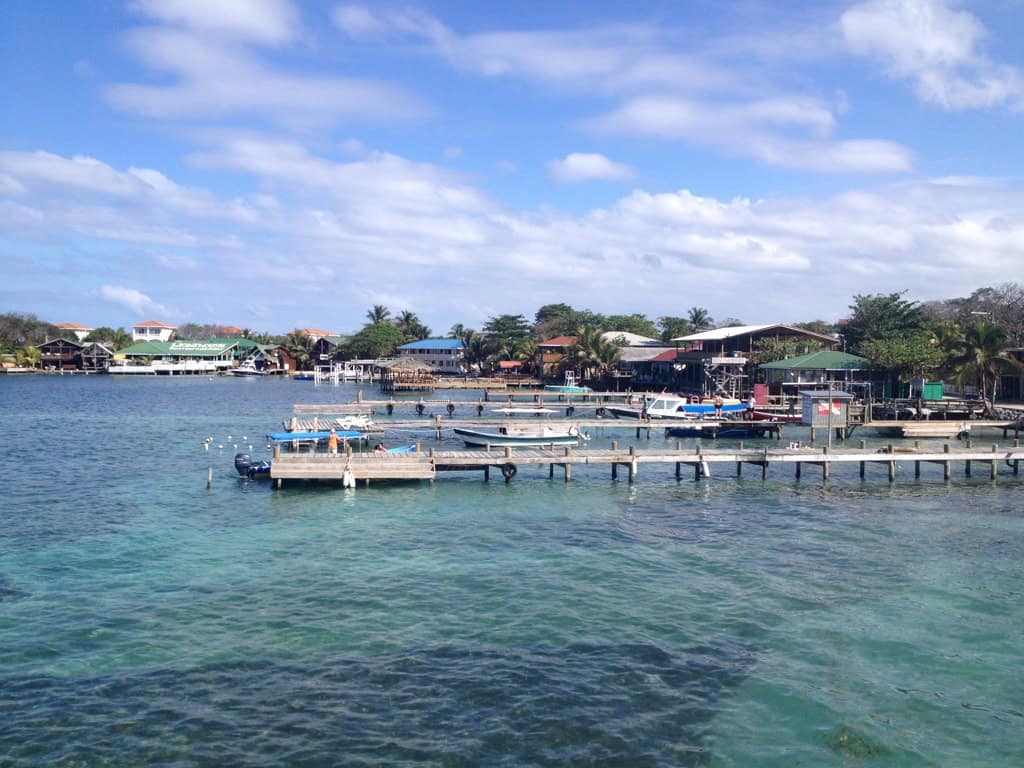
After moving quickly through Guatemala, rushing El Salvador, and almost going broke on the island of Roatan in Honduras, I was left with three weeks to explore Nicaragua. It was the most time of any country on the trip.

Momotombo Volcano as viewed from Leon Viejo
Momotombo Volcano (1,258m) as viewed from Leon Viejo

I'd heard "Nicaragua is the next Costa Rica" for a while. Cheaper, with lots to do, excellent surfing, partying for those who want it, and less attention than its neighbor.

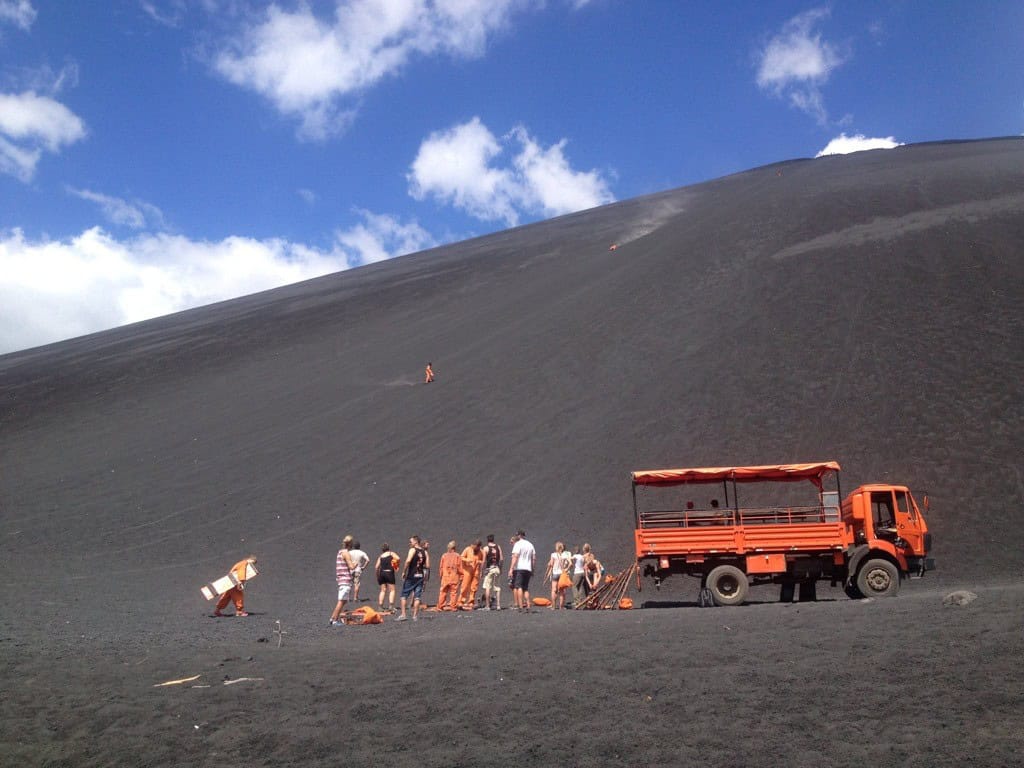
But I would've gone regardless for one reason - it's the only place in the world where you can go volcanoboarding.

Almost all of the hostels, restaurants, and cafes I used had Wi-Fi, but the download speeds were better for checking email and social media on a smartphone than getting work done on a laptop.

Nicaragua is great for traveling by truck or a small campervan, too. Well-paved highways connect the major cities.

Here are my Nicaragua travel tips, fresh from my three-week trip.

Managua airport
Managua airport

Table of Contents

  • Managua
  • Leon
    • Where to Sleep
    • Where to Eat and Drink
    • Things to Do
  • Granada
    • Where to Sleep
    • Where to Eat and Drink
    • Things to Do
  • Ometepe
    • Where to Sleep
    • Where to Eat and Drink
    • Things to Do
  • San Juan del Sur
    • Where to Sleep
    • Where to Eat and Drink
    • Things to Do

Managua

Nicaragua is considered one of the safer Central American countries to visit, except for Managua, the country's largest city and capital.

There's nothing significant for tourists to see, and since the potential for street crime targeting foreigners is high, it's best to limit your time here.

Unfortunately, it's a central transportation hub and home to its largest airport, Augusto C. Sandino International Airport.

The good news is that the airport is modern, with excellent air conditioning, Wi-Fi, and plenty of places to eat before and after security.

I wanted to fly from San Salvador directly to Leon, but it's not an option.

Travelers must fly into Managua and then take an express colectivo or private taxi.

If you arrive by plane, you'll see several private tax company booths once you enter the baggage claim area. What you pay will depend heavily on your ability to negotiate.

They'll start high, around $25, for taxis to the UCA bus station, where you can pick up the express colectivo to Leon.

I negotiated it down to $16. Hiring a taxi to take you from the airport to Leon costs about $80.

The UCA bus station is barely a station at all. Your taxi should drop you off before the colectivos heading to Leon.

The colectivo costs $2 and takes one and a half hours on straight, flat highways.

Make sure to secure and watch your belongings.

Granada, a base for travelers exploring Nicaragua, is less than an hour away.

A private taxi from the airport should cost around $25 to $30. Express colectivos depart from UCA bus station.

My taxi driver gave me a full briefing on staying safe in Nicaragua, including a warning not to hail taxis off the street or walk around Managua at night.

Read the Managua Wikitravel guide for more safety tips.

Leon Cathedral
Leon Cathedral

Leon

Leon doesn't receive as much tourism as Granada, but there's still lots to see and do. Namely, it's the place to go if you want to try volcanoboarding.

Where to Sleep

Latina Hostel - Small but super friendly hostel with a large courtyard and bar. A great alternative to the larger party hostels.

Via Via Hostel - This is more like a hotel, as there are only one or two very cramped dorm rooms, and they have no trouble filling them.

A bar attracts locals in the front, and a popular restaurant is in the interior courtyard.

Bigfoot Hostel - The original owner of this party hostel, an Australian, is credited with developing volcanoboarding as an activity. It is located across the street from Via Via.

Hotel Los Balcones - I needed a reliable Wi-Fi signal for work, so I switched to this hotel for my last night.

Even though I didn't have a balcony, I did have a direct view west toward the Leon Cathedral (and the sunset) from my second-floor room.

Where to Eat and Drink

Pan & Paz French Bakery - Popular with travelers and expats, offering excellent sandwiches and desserts. Wi-Fi-friendly and a fantastic spot to hang out if you need to get some work done. I ate here three times in five days.

El Sesteo - Located across the street from Leon Cathedral, it's an excellent spot to sample traditional Nicaraguan food.

Via Via - Offers a mix of typical Nicaraguan and Western dishes. The tables are located in an interior courtyard, and Wi-Fi is available.

Volcanoboarding at Cerro Negro
Volcano boarding at Cerro Negro

Things to Do

Volcano Boarding at Cerro Negro

The only place in the world where you can ride a wooden sled down an active volcano. It's easy to control your speed, so you can go as fast (70+ km/h) or as slow as you want. The cost is $25 for the tour plus a $4 park entrance fee.

Leon Cathedral

A UNESCO World Heritage Site. The roof is currently being renovated. You can still pay $2 to visit a cupola, but the view is limited.

Fundacion Ortiz-Gurdian

Art museum housed in neighboring 18th and 19th-century buildings. Walking through the beautiful interiors and inner courtyards is worth the price of admission alone.

Myths and Legends Museum

A former prison now houses displays depicting ancient Nicaraguan myths and legends. A free guided tour is included with admission ($2) and is necessary if you want to understand anything. This is one of the strangest museums I've ever seen.

Flor de Caña Factory Tour

Forty-five minutes north of Leon is the Flor de Caña rum distillery. Group tours can be booked from Leon but may require a minimum number of people. I wish I'd made a more considerable effort to go.

Rum Tasting

They are held regularly at Via Via Cafe. In addition to tasting a variety of rums, you'll also learn some Nicaraguan history.

Ruinas de Leon Viejo

The second of Nicaragua's two UNESCO World Heritage Sites is the ruins of Leon's original city, located near the shores of Lake Managua.

Visiting independently requires a few bus changes, but it's not too complicated. Admission is $2; give yourself six hours roundtrip if relying on public transport.

Telica Volcano

Join a night hike to the top of Telica Volcano to peer into the crater and see red lava.

When it's time to leave, it's possible to book tourist shuttles through the hostels to the airport ($12), Granada ($12), and San Juan del Sur, or you can take the local transport to save money.

Related: Climbing Volcanoes in Nicaragua - 4 Popular Hikes

Granada
Granada

Granada

Granada is to Nicaragua, as Antigua is to Guatemala. It's here on Lake Nicaragua's shores that most tourists base themselves on, and it's not hard to see why. 

Colorful buildings, a large central park, horse-drawn carriages, and old cobblestone streets evoke life in Spanish Colonial times.

Where to Sleep

Hostal El Momento - Recommended by many, but it was booked when I arrived. Make reservations in advance.

Hostal Entre Amigos - Small but friendly hostel where I stayed in Granada. $12/night for a private room. Dorm beds are available.

Where to Eat and Drink

The Garden Cafe - One of the most popular restaurants in the city. The tables are situated around a lush inner courtyard.

ChocoMuseo - Has a good "all you can eat" breakfast buffet. The melted chocolate used for the pancakes is excellent.

El Tercer Ojo - Great atmosphere at this open-air restaurant located along the main tourist street behind the cathedral.

Cafe de Los Sueños - Currently ranked the #1 restaurant on Tripadvisor.

Reilley's Tavern - an Irish pub with a good beer selection and typical bar food. I watched the Superbowl here.

Japanese Dining Bar Kanpai - Sushi restaurant run by a Japanese chef. I thought the quality was average at best, but given the lack of options, Granada is probably the best place to get your sushi fix.

Kathy's Waffle House - Killer chocolate waffles and an excellent spot to try traditional Nicaraguan breakfasts.

Lake Apoyo
Lake Apoyo

Things to Do

Granada Cathedral - The iconic yellow cathedral in the main square. Behind it is a pedestrian street with restaurants, cafes, bars, and hotels.

Iglesia de Merced - Climb to the bell tower for 360-degree views of the city.

Islets de Granada - Take a relaxing boat tour of the 100-plus islands upon which some of Nicaragua's wealthiest business owners have built vacation homes.

Mombacho Volcano - Go for a relatively easy day hike on this nearby volcano.

ChocoMuseo - Chocolate museum owned by the same folks as the one in Antigua. The chocolate tour is highly recommended.

Hotel Spa Granada - A relaxing way to escape the city. Pay for pool access; you can hang out all day, use the Wi-Fi, order drinks and food from the bar, and arrange spa services like massages, manicures, and pedicures.

Lake Apoyo - Visit as a day trip or book ahead to spend a night or two at this gorgeous and relaxing crater lake a half-hour from Granada.

I recommend Paradiso Nicaragua with its lovely gardens, excellent food, great little bar, free use of kayaks, and decent Wi-Fi.

They can also arrange transport to/from the airport and other places in Nicaragua.

Volcan Concepcion (1,610m)

When it's time to leave, booking tourist shuttles through the hostels to the airport, Leon, and San Juan del Sur is possible.

It might be possible for Ometepe too, but I'm not sure. I relied on public transport.

Ometepe

Lake Nicaragua is the largest lake in Central America and the 19th largest in the world.

Ometepe is the largest island in the lake, formed by two volcanoes, one of which is still active.

I don't suggest taking the ferry directly from Granada as it takes longer and deposits you on the north of the island, where you may need to spend the night at Altagracia before catching public transport in the morning.

Private taxis may be available at night but will be expensive.

Instead, take the bus/ferry approach:

  1. Take the chicken bus from Granada to Rivas ($1.15). If traveling with several people, it'll be cheaper and half the time (45 to 60 minutes) if you hire a private taxi to San Jorge.
  2. Take a taxi from Rivas bus terminal to San Jorge ($2).
  3. Small ferry from San Jorge to Moyogalpa on Ometepe ($1.35). The large boat is more comfortable, and on my return to San Jorge, it cost me $2.75.

All my accommodation and restaurant suggestions are in Moyogalpa unless otherwise noted.

Where to Sleep

Hostel Ibesa - Small, family-run hostel was recommended to me. They're friendly, but the private rooms ($10/night) don't have walls that go to the ceiling. I woke up at one point to the couple next door having sex, and the birds outside were extremely loud at sunrise.

The Landing Hostel - Located a block or two from the boat dock, I didn't stay here but wish I'd chosen it.

Hotel Ometepetl - I spent a night here after having trouble sleeping at the hostel. The room was much quieter, which was all I cared about.

Hacienda Merida - Located on the island's southeast side, near Maderas Volcano, this hostel was highly recommended by other travelers. It takes longer to get to as the roads are not fully paved.

El Zopilote - Another eco-hostel on the island's eastern side that's well recommended.

Hotel Villa Paraiso - The best hotel on Ometepe, situated along Santo Domingo Beach.

Where to Eat and Drink

Restaurante La Galeria - The power in the city went off while I was eating my lemon fish filet at this small, artsy restaurant. It is located on the main road.

Pizzeria Buen Appetito - Decent thin-crust pizza.

Hotel Villa Paraiso - The restaurant features beach views and terrific food. I had a charcoal-grilled whole fish caught from the lake. To save money, eat elsewhere, and grab a drink here.

Ojo de Agua
Ojo de Agua

Things to Do

Climb Concepcion Volcano (1,610m, more difficult)

Climb Maderas Volcano (1,394m, easier)

Island Tour - I hired a private taxi for $50 to visit the most popular tourist spots (listed below).

Be sure to confirm where you want to go ahead of time, as adding extra stops to the itinerary may result in a higher cost.

Punta de Jesus Maria - A sandy strip extends out into the lake. Not much to see here.

Charco Verde Ecological Reserve - A pleasant park with a one-hour self-guided walk. An excellent place to spot the Blue Jays, and admission is $1.50.

El Ojo de Agua - Sparkling natural springs under a canopy of trees. Get there as early as possible to avoid crowds (both Nicaraguan and foreign).

Beer and cocktails are available, and there's a large restaurant on site, a hundred meters from the pools. This was a highlight of Ometepe for me, and admission is $3.

Santo Domingo Beach - Nice views of Maderas Volcano and an excellent swimming place.

To get off the island, catch a ferry back to San Jorge. From here, taxis compete for your business. I negotiated a $16 ride to San Juan del Sur.

Related: The Corn Islands in Nicaragua

San Juan del Sur
San Juan del Sur

San Juan del Sur

An essential stop on the backpacker trail through Central America, San Juan del Sur has made a name for itself thanks to gorgeous sunsets, access to excellent surfing on nearby beaches, and a big party scene at some of the hostels.

Where to Sleep

Hotel Estrella - Located in the middle of town, this historic building still rents rooms cheaply. Stay here if you can get an ocean-view room with a balcony (like I did). The cost is $10/night per person, or $20 if you're alone but worth it.

Yajure Surf Hostel - Recommended for its relaxed vibe and lovely garden with a small pool. The downside is the location, which seems like it could be sketchy at night.

Naked Tiger Hostel - One of Central America's top party hostels. Known for its pool parties, don't stay here unless you are in a party mood and don't mind putting up with everyone else feeling the same way. It requires a shuttle to reach the town.

Casa de Olas - Located adjacent to the Naked Tiger, it's supposed to be a more relaxed vibe. It requires a shuttle to reach the town.

Where to Eat and Drink

Resturante El Timon - Foreigner favorite with good happy hour deals on drinks and snacks.

Nacho Libre - Expat-owned gourmet burger joint in the center of town. Wi-Fi is available.

El Gato Negro - Large cafe and bookstore with a very opinionated owner who adds many pages to the menu explaining the challenges of running a business in Nicaragua.

Simon Says - A tiny cafe with friendly service, a fun atmosphere, and good (vegetarian-friendly) food and smoothies.

Italian Gelato Shop - Located in the same building as Hotel Estrella.

Things to Do

  • Hang out, watch the sunsets
  • Swimming/sunbathing on the main beach
  • The scenic outlook from Cristo de la Misericordia
  • Visit nearby beaches via boat, shuttle, or taxi
  • Surf lessons
  • Spanish lessons
  • Yoga retreats

Salar de Uyuni: Driving on the World's Largest Salt Flat

Our driver uses his hands to begin digging out the SUV in Salar de Uyuni.
Our driver uses his hands to begin digging

Editor's Note: This is the third post in a three-part series from Dave's trip to Salar de Uyuni, the Bolivian Salt Flats. Read Part One and Part Two.

It was supposed to be a highlight of my travels in South America, but the excitement quickly gave way to a sinking feeling as we veered off the elevated dirt road, and onto Salar de Uyuni, the world's largest salt flat.

Within 60 seconds of our transition from dirt to salt, the Lexus SUV we'd used to cross southwestern Bolivia came to a complete stop. 

Our driver, Pedro, attempted to accelerate, but it was no use.

The salt crust ranges in thickness from a few centimeters to a few meters, and we drove directly into a shallow spot.

The weight of the fully-loaded SUV was too much, and we had quickly broken through the salt layer, only to sink in the mud beneath.

In an unforeseen instant, the entire day I'd been waiting years to enjoy was in jeopardy.

Not the best way to start your day on the Salt Flats

Table of Contents

  • Rise and Shine
  • The Big Dig
  • Bolivian Ingenuity
  • Breakfast
  • Isla Incahuasi
  • Trick Photography
  • Salt Mines
  • Lunch Break
  • Train Cemetery
  •  

Rise and Shine

We'd risen early, at roughly 5 AM, to pack our backpacks and get an early start on the day.

The goal was to have a tailgate breakfast on the salt flat while watching the sunrise.

Pedro was outside packing the SUV in the pitch black and bitter cold.

Unbeknownst to us, it was his birthday, and his friends had taken him out to celebrate while we'd been sleeping.

A few bottles littered the front passenger seat, leading to an uptick in my anxiety.

Despite my best attempt to secure a responsible and safe driver, I was now in the position of going with someone who at best seemed as though he didn't get much sleep, and at worst, was still a bit buzzed from the birthday celebrations.

Up until this point, I'd been 110% satisfied with his driving and vehicle.

It may seem hard to believe, but it doesn't even take a drunk driver for accidents to occur in one of the world's flattest places.

Lack of sleep, speeding, reckless driving, and unexpected changes in terrain have led to a series of fatal crashes involving several dozen tourists since 2008.

I don't share any of this to scare people, but it's important to recognize the inherent dangers of traveling in this remote region.

If you're paying $125 for a three-day trip, the average Bolivian driver is not going to have a satellite phone in case of emergency, first aid training, or even a first aid kit.

To travel with these higher safety standards, you have to pay more and book your trip through a Western-owned tour operator.

Related: Booking My Trip to the Bolivian Salt Flats

Making the most of a once-in-a-lifetime sunrise in the Salar de Uyuni.
Making the most of a once-in-a-lifetime sunrise

The Big Dig

The drive from the salt hotel to the elevated road that extends into Salar de Uyuni took about thirty minutes.

Once Pedro had surveyed the SUV, he got down on his knees and began to dig the mud out around the front left tire by hand.

I was surprised he didn't carry a shovel given we spent the first two days entirely off-road in very remote areas.

Without the sun, the temperature on the salt flats was still bitterly cold due to the 3,656m (11,995 ft) elevation.

I put on my alpaca gloves and began to dig around one of the rear tires.

He quickly waved me away, but not before I got a feel for how heavy, wet and cold the mud felt.

It was clear pride trumped expediency, so myself and the others were left to stand around and wait.

If there was a silver lining in getting stuck, it was that it happened 60 seconds off the elevated road.

We could clearly see other SUVs passing by, and they could clearly see us.

Within 10 minutes, an SUV had stopped, and a group of Bolivians had walked over to see how they could help.

At 7 AM, as the big dig continued, the sun finally broke over the horizon, momentarily taking my mind off our situation.

The sky quickly turned bright blue; the sun's warmth felt reassuring.

At one point, there were a dozen Bolivians trying to help us

Bolivian Ingenuity

Simply digging the mud out from around the tires, and throwing some chunks of salt in for traction wasn't enough. The SUV went nowhere.

By this time, another SUV had stopped, bringing our headcount to at least a dozen Bolivians.

One of the men had brought a shovel, which sped up the digging process, and spared Pedro's hands, which were by this time covered in a thick cake of mud, and dangling lifelessly at his side.

Several young women began quietly carrying stones from the elevated roadway in their shirts, while the men stood around strategizing.

Placing the rocks against the front and back of the tires didn't work either. The SUV was still having trouble gaining traction.

The strategy evolved one step further when the propane tank we were carrying for cooking was used as a base for the tire jack.

By placing the tank next to each tire, and then elevating them one by one using the jack, it was then possible to place rocks directly beneath them. This made all the difference.

Once there were rocks underneath all four tires, Pedro took the driver's seat, pressed the gas pedal, and the SUV rolled onto what was clearly a thicker crust of salt directly in front of us.

Though it felt like an eternity, the delay had only cost us an hour and twenty minutes in Salar de Uyuni.

But without the kind help of the other Bolivians, it would've been much longer.

Related: The Landscape of Bolivia in Photos

Playing with perspective

Breakfast

With the SUV back on solid salt, Pedro wiped the mud off his arms with a rag, flipped open the tailgate, and set out a giant round loaf of fresh bread, granola, cookies, yogurt, juice, and instant coffee.

It was only then, when we began eating, that he put his head down on his arms on the SUV's hood in what appeared to be a giant sigh of relief.

We asked if he was OK, and he nodded yes. We were back on track.

After breakfast, I climbed up on the SUV's roof rack to help secure everything.

Pedro was normally the only one to go up there, but it was clear he needed the help.

View from atop Isla Incahuasi in Salar de Uyuni, Bolivia.
View from atop Isla Incahuasi

Isla Incahuasi

A little after 9 AM, we arrived at Isla Incahuasi, "the top of the remains of an ancient volcano, which was submerged when the area was part of a giant prehistoric lake, roughly 40,000 years ago."

The rocky island which means "Inca House" or "Home of the Incas" covers just 61 acres out of the 10,582 square kilometers that is the Salar de Uyuni.

In addition to its use as a refuge for the ancient Incas who use to cross the inhospitable salt flat, it's home to birds, Vizcacha and Giant Cactus, one of which was 9m (27ft) tall, and 900 years old.

Climbing up the hill requires a little effort given the altitude, but the 360-degree panoramic view from up there makes it a worthy endeavor.

Entrance onto the island cost 30 Bolivianos ($4.35).

Crane Kick on a can of Pringles

Trick Photography

We spent a little over an hour at Isla Incahuasi before driving fifteen minutes out onto the salt flat again.

I don't know if it's a matter of routine, or he was feeling bad about us getting stuck earlier in the morning, but Pedro offered to let me drive the SUV.

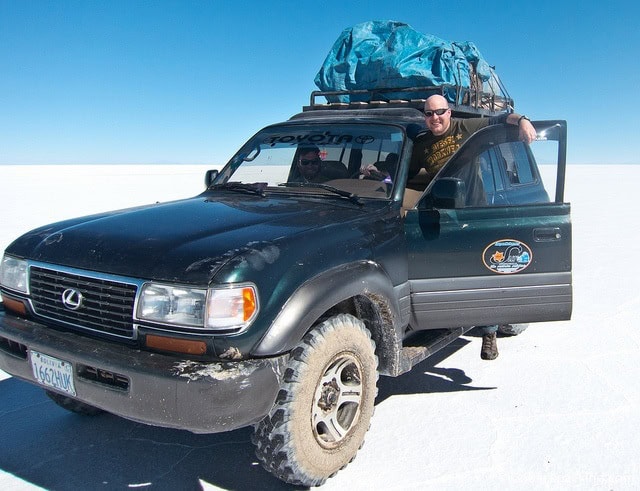
He was proud of his Lexus (the only one I'd seen in three days), so it felt like a big deal for him to be handing over the wheel to me.

I purposefully drove much slower than him, given I wasn't familiar with the handling of the SUV when fully loaded, nor the terrain.

He offered the same opportunity to everyone else, but only two of the other five travelers accepted.

The larger-than-life Rough Guide to South America

After our joy rides on the Salar de Uyuni, at around 11:30 PM, Pedro stopped the SUV in an area we had to ourselves and said we had 30 minutes to take photos.

This was the moment I'd been looking forward to for years, but it was only then that I realized I was the odd man out.

The three British backpackers immediately went off to take funny photos of each other, and the French couple didn't even know about the trick photography that was possible here!

Levitating over Salar de Uyuni.
Levitating, there's an app for that

I did my best to explain, and then spent a lot of time running back and forth between the place where I had to pose and the props in the foreground where the Frenchman was also taking the pictures.

I realized I didn't know the best way to be capturing these photos.

I'd seen other people's images but had not done any research on the best way to take them.

I'd left it up to trial and error, and now I didn't even have as much time as I expected.

Taking calls on the world's largest salt flats -- Salar de Uyuni
Taking calls on the world's largest salt flats

Pedro was on a mission to deliver us to Uyuni on schedule at 3 PM, but due to us getting stuck earlier in the morning, he had an hour and a half to make up.

I felt rushed and annoyed. I continued trying to squeeze in more photos, buying myself an extra few minutes to Pedro's consternation. 

With everyone else seemingly happy to get back in the SUV after 30 minutes, I had no support to stay any longer.

After 40 minutes, we were on our way off the salt flat.

Salt, and lots of it at Salar de Uyuni.
Salt, and lots of it

Salt Mines

Before we arrived back on regular land again, we passed through the salt mines at the edge of the salt flat.

The world's largest salt flat contains about 10 billion tons of salt, of which 25,000 tons are extracted annually.

It's also estimated that beneath the salt surface lies 50 to 70 percent of the world's lithium reserves, or as much as 100 million tons.

Lunch stop
Lunch stop

Lunch Break

By 1 PM, we'd departed the salt flat, and entered a village.

Pedro parked the SUV outside a small complex of buildings and began to prepare lunch.

His car was completely covered in a thick film of white salt, which must be brutal on the paint if it's not washed off quickly.

Lunch consisted of chicken, pasta, potatoes, and a mix of carrots and string beans.

The train graveyard
The train graveyard

Train Cemetery

Our final stop of the day, and trip, was the Cementerio de Trenes ("Train Cemetery") located 3km outside of Uyuni.

The train lines were built by the British from 1888 to 1892 and were primarily used for mining purposes.

They were frequently sabotaged by indigenous people, and in the 1940s left to rust in the salty winds after the mining industry collapsed.

Today, the old rusted trains offer visitors the chance to be kids again, if only for a few moments, as they climb aboard and pose for photos.

On the drive to Uyuni, we passed acres of dry shrubs with thousands of plastic bags caught amongst them. 

The massive amount of litter was a shock after coming from the unspoiled landscapes of the last few days.

Pedro dropped us off outside the Immigration Office, which was closed. 

I was anxious to pay my $135 visa fee, get my passport back, and head to a lower altitude as my fingers still hurt, but it would all have to wait until morning.


Savage Harvest: A Tale of Cannibals, Colonialism, and Michael Rockefeller's Tragic Quest for Primitive Art

November 21, 1961 - Michael C. Rockefeller disappears off the coast of southwest New Guinea after his small catamaran capsized in rough waters.

Twenty-four hours later, he decides to leave the vessel and try and swim for shore.

His last words were, "I think I can make it."

He was never seen alive again.

Savage Harvest

The official cause of death was drowning, and that's the explanation the family accepted, but there were rumors he met a much more gruesome fate at the hands of local Asmat tribesmen.

Not only that they killed him, but they cut him up and ate him too.

The detailed account of how this would be done kicks off the Savage Harvest.

But is this really what happened?

Carl Hoffman, the bestselling author of The Lunatic Express, embarks on an incredible journey through Dutch archival records and visits to the same villages Michael Rockefeller visited in his search for primitive art.

Along the way, he unravels the Asmat's spiritual beliefs, learns Indonesian, and befriends critical witnesses.

It's a fascinating story of how colonialism and religious missionaries began to change an indigenous people's way of life, slowly steering them away from their own ancient beliefs and toward The Bible.

The author tells parallel stories, alternating chapters from the late 1950s and early 1960s for historical context, with his modern-day journey to New Guinea in 2012.

As taboo as headhunting and cannibalism may be to us, when Hoffman puts these activities into the context of the Asmat's spiritual world, a world driven by cyclical violence and the need to create balance, they begin to make sense.

I had the chance to read an advance copy for this review and couldn't put it down once I got started. Read the first page, and I guarantee you'll be hooked too.

Savage Harvest goes on sale today, March 18, and is available on Amazon.

An Australian Winter Holiday is Summer's Best Kept Secret

Uluru
Uluru (photo: Alex Healing)

With the hot summer seasons fast approaching those in the northern hemisphere, there is always a question of what exactly is the best way to spend your summer.

Have you ever thought about a trip to Australia – one of the most unique places in the world?

Climate and Temperatures

June, July and August are the best times to consider a budget trip because it's the winter season for the Aussies.

The prices for traveling and accommodation will be lower because it's not in the holiday season timeframe.

The weather during this season is very mild, considering they're the cooler months.

The temperatures generally range somewhere between 15 to 25 degrees Celsius (or 59 to 77 Fahrenheit) along with great sunshine on most days.

Recommended Destinations

Campervan rental suits the Aussie laid-back culture; it's relaxed, casual, and people are always willing to welcome a new face with a story to tell.

The Australian winter is less busy for the tourism industry, so at this time of year, a clued-in traveler can snap up the very best serviced sites without having to pay high seasonal rates.

If you've always wanted to visit Uluru – the iconic big red rock in Alice Springs, then winter is the time to go.

Better yet, it is a perfect destination for backpackers because of the beautiful surroundings and unique landscapes around it.

It averages a beautiful sunny daytime temperature 22°C (which is about 72 degrees Fahrenheit), which is perfect for traveling around without getting too hot or too cold.

July/August is the best time to visit the World Heritage-listed Uluru-Kata Tjuta National Park, and you'll be stunned by the iconic feature of Australia's most famous and photographed landmark.

There are also activities available like camel riding through the beautiful red dunes and learning about native Anangu culture at the visitor's center.

If you're a food lover, then we recommend taking the Sounds of Silence experience, which features superb dining under the desert stars.

If you're a fan of gourmet food and alcohol, then Margaret River, located in Western Australia, is another excellent place to v.

It is known as one of the best places for excellent food and wine destinations, and winter is the best time to dine on a budget.

For the budget traveler, we recommend renting out a campervan and doing some backpacking along the way to absorb the beauty of the region thoroughly.

There are also a lot of great caravan and camping parks around the area – with low rates around the Australian wintertime.

Just imagine waking up next to the pristine waves of the Indian Ocean right next to you – it doesn't get better than that.

There are some fantastic surfing opportunities along the beautiful Western Australia coastline with irresistible white sand beaches.

(Although a thick wet suit is probably needed for surfing in the cooler months of the year!)

If you're into arts and creative crafts, then you must check out the picturesque local villages surrounding the Margaret River area. They feature a lot of local arts and crafts and fresh local produce.

Margaret River has always been a massive draw for artists and creative people, so after you leave your campervan at your preferred site, you can wander around the galleries and experience the local talent and creativity.

At Margaret River, you very easily be inspired by their unique artwork and the region's natural attractions.

________

This post was brought to you by Travellers Autobarn.

Day Two in Bolivia: From Stone Tree to a Salt Hotel

Editor's Note: This is the second post in a three-part series from Dave's trip to the Bolivian Salt Flats. Read Part One here.

I woke up a little after midnight to a pitch-black room in the middle of the Bolivian Altiplano.

Elevation 4,280m (14,000ft).

My fingertips hurt-all 10 of them and all to an equal degree.

"This is new," I thought.

Of all the altitude sickness symptoms I'd read about over the years, painful fingertips were never mentioned.

"Early frostbite? Was I too cold?"

I mentally checked in with the rest of my body, from the tip of my toes to the top of my head.

"Nope, I don't feel cold."

Packing up the SUV to leave on our second morning

I spent the rest of the night pushing my thumbnails against alternating fingertips on each hand to make sure I still had sensation.

The pain itself wasn't too bad, but losing feeling altogether would be a bigger problem.

I barely got another hour of sleep and looked forward to the moment the sun began to bask us in its light and warmth again.

We sat down to breakfast around 7 AM and promptly shared notes on how everyone slept. Quite well, it turned out.

When I mentioned concern for the pain in my fingers, two of the young British backpackers brushed it off, saying it's normal and they'd experienced the same thing while climbing Mt. Kilimanjaro.

There was nothing for me to do but try to take comfort in their response. We weren't going to reach Uyuni any faster than the itinerary suggested.

Related: Booking a Trip to Bolivia's Salt Flats

Árbol de Piedra
Árbol de Piedra ("Stone Tree")

Table of Contents

  • Árbol de Piedra in Desierto Siloli
  • Laguna Honda and Laguna Hedionda
  • Laguna Cañapa
  • Mirador Volcán Ollagüe
  • Salt Hotel

Árbol de Piedra in Desierto Siloli

Leaving the lodge a few minutes after 8 AM, it took less than an hour to arrive at our first stop of the day.

The Siloli Desert, one of the driest places in the world, features a rocky outcropping with one formation, in particular, getting all the attention.

The Árbol de Piedra, or "Stone Tree," has the naturally sculpted qualities of a tree, which is fascinating given the location.

It's a testament to the power of high winds, sand, and water to erode solid rock if given enough time.

Our best "boy band" pose
Our best "boy band" pose.

Once we all took our photos of the Stone Tree, it was time to climb around on the other rocks in the area.

I had to hand it to the British backpackers; they had some funny poses in their repertoire.

I never thought to do a "boy band" pose, but the location turned out to be perfect. How did we do?

A Viscacha keeps watch
A Viscacha

A twenty-minute drive from the Stone Tree was another rocky outcropping.

Pedro, our driver, said it was an excellent place to spot Viscachas, small rodents related to chinchillas, with an appearance similar to rabbits.

Sure enough, when we rolled up alongside the rocks, he was able to spot one perched above us, peering out into the great expanse.

His fluffy orange and grey coat camouflaged him well and looked appropriate given the low temperatures of the Bolivian Altiplano every night.

Pedro tossed him a piece of food, which he held in his front paws and nibbled.

I know it's not ideal to train local wildlife to anticipate food from humans, but I was glad I had the chance to see the little guy, and I suspect most other tourists are too.

Pink flamingos at Laguna Honda

Laguna Honda and Laguna Hedionda

Another hour of driving across the desert lead us to more flamingo-filled lagoons.

Located at an elevation of 4,121m (13,520ft), Hedionda Lake was dotted with hundreds of white and pink flamingos feeding on algae in the water.

Interestingly, according to Wikipedia, "Hunter-gatherers of the paleo-ceramic or Paleo-Indian period (8,000 BC) lived in the vicinity of the lake."

Related: Stunning Landscape Photos of Bolivia

Laguna Cañapa
Laguna Cañapa

Laguna Cañapa

More impressive to me was the crystal clear reflections in nearby Laguna Cañapa.

This is also where we stopped for lunch a little before Noon, with Pedro preparing a mix of canned tuna and potatoes, corn, rice, and fresh cucumber and tomato salad (with pieces of white cheese thrown on top).

The sunlight, food, and copious amounts of bottled water I'd been drinking had so far done little to reduce the pain in my fingertips.

I continued to press my thumbnails into them from time to time and tried to focus on the sublime scenery surrounding us.

Volcán Ollagüe
Volcán Ollagüe

Mirador Volcán Ollagüe

It was another hour's drive to reach the lookout point for Volcán Ollagüe. At 5,868m (19,252ft), the volcano towers over the surrounding area.

According to the Smithsonian Institution's Global Volcanism Program:

"Active sulfur mines on the upper western and southern flanks of Ollagüe are reached by a road that climbs to about 5,500m elevation.

No historical eruptions have been recorded from Ollagüe; activity has been restricted to periods of intense fumarolic activity, and a persistent steam plume emanates from a fumarole on the south side of the summit dome."

Suri are an Ostrich-like bird
Suri is an Ostrich-like bird

From the volcano, we drove another hour and a half to a small town where we had to stop for some reason (I can't remember why) before heading to our accommodation for the night.

Detail of an archway constructed of salt blocks

Salt Hotel

At 4:30 PM, we arrived on schedule at The Hotel de Sal ("Salt Hotel") at the edge of the Salar de Uyuni, the world's largest salt flats.

Elevation 3,600m (11,811ft).

Pedro went inside while we all waited in the SUV. When he returned, it was to say there was no space available. Do they not make reservations at these places?

For a moment, I felt disappointed. Where else in the world would I have the chance to stay in a building made entirely of salt bricks?

Luckily for us, Pedro's mother owned her salt hotel, and it was no more than 100 meters away.

The salt hotel trend began in the mid-'90s after the first one was built on the salt flats. Now, it appeared, they were a dime a dozen.

The moon rising over the world's largest salt flats
The moon rising over the world's most extensive salt flats

Entering the hotel, there was no mistaking that it was made of salt. And lots of it. Even the floors in our bedroom were covered in it.

The six of us were offered two rooms. They were cramped but sufficient. We dropped our bags and began to unwind.

Chicken dinner our second night

Dinner consisted of vegetable soup with bread and a heaping pile of chicken.

There was electricity in the evening to recharge our batteries, but not much else to do besides play some cards and head to bed early.

My room for the second night

My fingertips still hurt, but they were no worse than when it began almost 24 hours earlier.

We were sleeping 900m lower in elevation than the first night, and I hoped that would help relieve whatever was going on with my body.

The following day would be an early one.

The plan was to pack up the SUV and leave the hotel at 5:30 AM to allow us enough time to drive onto the salt flats to watch the sunrise.

It sounded simple enough. Pedro has been leading these trips for nine years. We were staying at his mom's hotel.

The salt flats were his backyard. Our third and final day would be a slam dunk of awesomeness.

But this is Bolivia, and what happened next would test us all in more ways than one.

Bolivian Altiplano: Incredible Lagoons and Landscapes

Editor's Note: This is the first post in a three-part series from Dave's trip to the Bolivian Altiplano and Salt Flats.

I propped my backpack against the dusty exterior of Estrella del Sur's tour office and waited patiently in the early morning cold for my Bolivian adventure to begin.

It was 7:30 AM, and the main dirt road in San Pedro de Atacama was still cast in long, dark shadows.

The Bolivian border post at Hito Cajon

Within an hour, a French couple, three young British backpackers, and I had been whisked away in a blue and white shuttle bus to the Chilean immigration office.

Upon receiving our exit stamps, we returned to the bus and began the 45-kilometer drive to the Bolivian border.

Table of Contents

  • The Chile-Bolivia Border Crossing
  • Laguna Blanca
  • Laguna Verde
  • Desierto de Salvador Dalí
  • Termas de Polques Hot Springs
  • Sol de Mañana Geothermal Field
  • Laguna Colorada
  • Nightfall

The Chile-Bolivia Border Crossing

In the hour it took us to reach the Bolivian border at Hito Cajon (4,480m), we'd gradually gained 2,000 meters in elevation.

Welcome to the Bolivian Altiplano. At 9:30 AM in the middle of nowhere, we first met our driver for the trip. We'll call him Pedro.

Unlike most other drivers who used Toyota Land Cruisers, Pedro owned a dark green Lexus LX450.

It was a source of pride for him, and despite the rough terrain in which it operated daily, it was clean and well-kept.

We were told to take our passports to the small building sporting the red, yellow, and green Bolivian flag. It seemed out of place in the middle of such a barren landscape.

The line wasn't long, but apparently, I was the only American because I was asked to step aside and wait while they wrote down everyone else's information first.

Only then, after everyone else had been recorded, did they inform me that my driver would have to hold my passport until I paid the $135 visa and reciprocity fee in Uyuni.

I was annoyed at having to give up my passport as collateral to a driver I'd only met minutes earlier.

This is a detail the guy at the tour agency should've told me about in advance.

My passport was sealed in an envelope and given to Pedro, who had finished loading the SUV and wandered over to see what was taking me so long.

All the other SUVs heading into Bolivia that day had already packed up their clients and departed.

Laguna Blanca

Laguna Blanca on the Bolivian Altiplano.
Laguna Blanca

Upon entering Bolivia, you enter the Eduardo Avaroa Andean Fauna National Reserve and must pay a 150 Bolivianos ($22) park fee.

The reserve covers an area of just over 714,000 hectares (1.7 million acres) and is home to all of the lagoons we would see on our first day. Despite the extreme conditions, life exists at these altitudes.

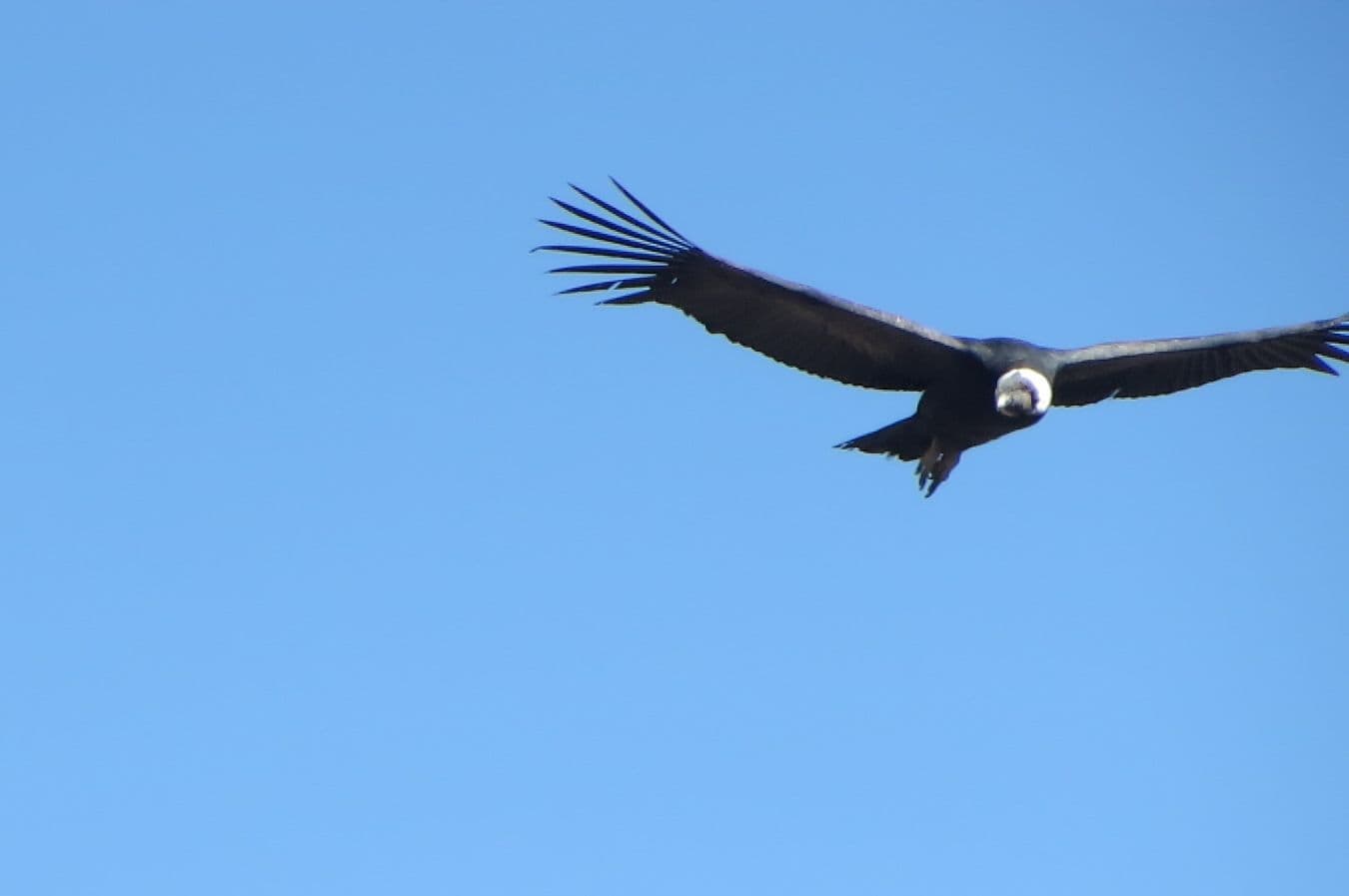
Three of the world's six species of flamingos spend time here, as do 77 other species of birds, including the Andean condor.

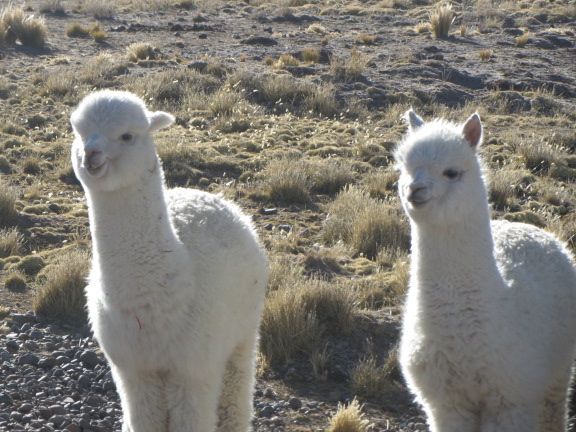
Mammals include Puma, the Andean fox, Viscacha (similar to rabbits), and Vicuña (deer).

Less than a half-hour from the border crossing is Laguna Blanca (4,350m, "White Lake"), which owes its white hue to the mineral Borax.

Laguna Verde

Dave at Laguna Verde in Bolivia
Taking calls at the shore of Laguna Verde

The even more spectacular Laguna Verde (4,400m, "Green Lake") is a 30-minute drive from Laguna Blanca.

The turquoise-green color can be attributed to arsenic, lead, copper, and other minerals suspended in the water.

This unique chemical composition keeps the water from freezing due to the subzero temperatures.

Forming a perfect backdrop is the inactive, snow-capped Licancabur Volcano (5,868m). The volcano straddles the Chile-Bolivia border, with the summit and (frozen) crater lake entirely within Chile.

It's one of the highest lakes in the world, and archaeological evidence near the top suggests people were climbing it hundreds of years ago for what were surely spiritual reasons.

Desierto de Salvador Dalí

Dave in the Desierto Dali
The Desierto Dali was the least exciting stop of the day.

We arrived at Desierto de Salvador Dalí (Salvador Dalí Desert) a few minutes before noon, after a little under an hour's drive from Laguna Verde.

This region of the Bolivian Altiplano is named after the Spanish surrealist painter whose work is reminiscent of such scenery.

Termas de Polques Hot Springs

Taking a dip in the hot springs on the Bolivian Altiplano.
We were taking a dip in the hot springs.

At 12:30 PM, we arrived at Termas de Polques hot springs. Dipping in these mineral-rich waters is a backpacker right of passage for those traveling through South America.

The small adjacent building, which appeared to house changing rooms or bathrooms, was locked, so we each did our best to find an angle that allowed some semblance of privacy.

For those who prefer not to risk a flash of indecency, there's a shop across the road that charges three Bolivianos ($0.45) to use the restroom. You can also buy snacks like Pringles and bottled water.

We had the hot springs to ourselves for the first 10 to 15 minutes before additional SUVs arrived and unloaded.

Sol de Mañana Geothermal Field

Sol de Mañana Geothermal Field (4,850m)
Boiling mud

Thirty to forty minutes from the hot springs is the 10 square kilometers Sol de Mañana geothermal field (4,850m "Morning Sun").

These boiling mud pools present another unique and interesting facet of this otherworldly region. The stench of sulfur was so pungent in places. I had to cover my nose and mouth to breathe.

Tours that begin in Uyuni visit Sol de Mañana at sunrise on their third morning, but if you're coming from San Pedro de Atacama, you'll see them in the early afternoon.

This suited me fine as I'd already woken up too early to visit the Tatio Geysers in Chile.

Laguna Colorada

The blood-red Laguna Colorada

After another thirty to forty minutes of driving across the vast emptiness of the Bolivian Altiplano, we arrived at our humble accommodations for the night.

It was only 2:30 PM, but I'd already seen some of the most fantastic landscapes of my life, and we still had one more lake to visit before sundown.

But first, we sat down to a late lunch of hot dogs, mashed potatoes, salad, and bananas. It appeared to be an odd combination, but nobody cared.

There was always more than enough food at every meal, and the quality improved every day of the trip.

A little after 4 PM, we took a short drive to the Laguna Colorada (4,278m, "Red Lake").

The blood-red color is due to sediments and the pigmentation of algae that grows there. The reddish color provides a sharp contrast to the islands of white Borax.

Pink flamingos flock to lagoons in the Bolivian Altiplano.
Feeding flamingos

Despite its appearance, the lake is very shallow, with an average depth of only 35 centimeters (14 inches).

This is good news for the endangered James's Flamingos, which fly here to feed on the pink algae.

A herd of Vicuña
A herd of Vicuña

While walking around the lake, we also spotted another animal indigenous to the region, the Vicuña.

Vicuña is found throughout the Andes at altitudes between 3,200m to 4,800m. According to Wikipedia, the wild population was down to 6,000 animals before they were declared to be endangered in 1974.

Since then, they've recovered to a healthier population of 350,000. It amazed me that any animal, whether a bird or mammal, could sustain itself off so little vegetation in such a harsh environment.

Nightfall

Under the moonlight
Under the moonlight

Speaking of harsh environments, the temperatures at these altitudes on the Bolivian Altiplano plummet quickly once the sun goes down.

Back at the ranch, we sat down to an early dinner. Soup and spaghetti were served at 5:30 PM, with canned fruit for dessert.

All the food we ate on the trip was carried with us in the SUV, including the propane tank used to cook it.

This lodge had a generator they used for a few hours in the early evening to light the rooms. It also provided electricity for us to recharge our camera and phone batteries.

At 7:15 PM, I stepped outside our accommodation and peered skyward to look at the brightly glowing stars.

As my adrenaline from the day wore off, I began to feel the altitude's effects. Even walking a few meters left me short of breath.

My bed was surprisingly warm and comfortable
My bed was surprisingly warm and comfortable.

While I'd trekked as high as 4,500 meters on the way to Machu Picchu the year before, this would be the first time I slept above 4,000m.

The trekking rule of thumb for altitudes over 3,000m is to sleep no higher than 300m above where you slept the previous day.

Gradual ascents give your body time to acclimatize to the lower oxygen levels in the air.

In choosing to begin my tour of Bolivia's Salt Flats from San Pedro de Atacama, I went from 2,400m one night to 4,280m the next. I knew a change of 1,880m in a single day would challenge my body.

In addition to the potential for cold, I expected any or all of the classic Acute Mountain Sickness (AMS) symptoms to hit me that night: headache, nausea, lack of appetite, inability to sleep, and shortness of breath.

Not much later than 8 PM, I climbed into my rented sleeping bag fully clothed, closed the zipper, and pulled four blankets over me.

Putting on my alpaca wool hat completed my cocoon of warmth. But it wasn't the cold temperatures of the Bolivian Altiplano that would wake me up in the middle of the night.

Continue reading part two here.

Ryogoku: Tokyo's Sumo Town

Mural on Tokyo's sumo stadium

[I] have to admit, I was pretty bummed when I found out there weren't any sumo fights taking place during my visit to Tokyo.

(Note: Sumo wresting in Tokyo normally takes place in January, May, and September. More info here)

Sumo wrestling is not only a part of Japanese traditional culture and famous worldwide, but I've always thought it was such an awesome sport.

What could be better than eating as much as possible every single day and then taking to the ring to push your opponent out of bounds, and then going to eat some more!?

Actually, there's a lot more to sumo wresting than that, and when I was in Tokyo, though I didn't get to see any of the wrestling action, I did have a very fun time wandering around the Ryogoku area of Sumida in Tokyo, also known as sumo town.

Planning to explore more of Japan? Book budget-friendly train passes here!

Sumo wrestling statue

Even when you exit the metro station at Ryogoku, you're greeted by statues of sumo wrestlers, and there was even a snack stall that was selling sumo wrestler snacks - must be high calorie snacks!

The entire neighborhood is dedicated to sumo wrestling.

Ryogoku Kokugikan Sumo Hall

The main place where sumo wrestling in Tokyo takes place is the Ryogoku Kokugikan Sumo Hall, the big sumo stadium.

Like I mentioned before, I unfortunately wasn't in Tokyo during a month of wrestling, but there's still a small sumo museum which is open year round.

My first stop on our sumo tour of Tokyo was the museum, which is free to enter.

The museum is located right at the base of the stadium and is filled with small wooden models of sumo wrestlers in fighting positions, demonstrating the different methods of winning a fight. I had no clue there were so many methods and strategies of beating an opponent.

The museum is open on weekdays from 10 am - 4 pm daily (closed weekends and holidays). Entrance is free.

Sumo area map
Sumo area map

Another thing you'll find at the museum for free is a Ryogoku area map.

The map includes information about sumo wrestling and then goes through and lists some of the most famous restaurants in the area where you can eat a traditional sumo meal.

I didn't have plans to eat a sumo meal until I saw the map, and then a feast of a lunch became my immediate priority.

Chankonabe meal
Chankonabe meal

There were a bunch of different restaurants listed in the guide, so we just ended up choosing number 3 on the list. The outside was marked by sumo flags with big Japanese colorful letters written on them.

We stepped inside to be greeted by a kind lady and led upstairs to the dining room which was filled with people.

I ordered the chankonabe lunch special, a hotpot stew of vegetables and pork cooked in a rich pork and miso broth. The set also came with a big bowl of rice, a couple of different pickles, a side of sashimi, and some small deep fried fritters.

The stew, rich in calories, and known as a favorite among sumo wrestlers, was a pretty well rounded meal, and it was extremely delicious as well. The meat and vegetables were tender and the soup was seasoned with a light miso flavor and packed with pork broth.

It was an excellent satisfying meal.

Sumo shop
Sumo shop

After our delicious sumo sized lunch, we wandered around for another hour or so, browsing through various sumo shops in the area, and then headed back to our hotel.

There is so much Japanese tradition and rituals that surround the sport of sumo wrestling.

I hope that next time I'm in Tokyo, I'll be able to attend a tournament and maybe even tour one of the sumo stables.

Sumo wrestling in Tokyo

If you happen to be visiting Tokyo when a sumo wrestling tournament is taking place that would be awesome, but even if you visit when there are no tournaments, you can still have a great time wandering around Tokyo's sumo town.

How to Enjoy the World Cup in Rio de Janeiro

Now that the Winter Olympics in Russia is behind us, the world's attention is moving to Brazil, host of the 2014 World Cup.

While I haven't been to Brazil (yet), I did have the experience of landing in Paris the same day France beat Brazil in the 1998 World Cup Final.

Marching through the streets amongst so many ecstatic, singing, firecracker-throwing French people was an experience I'll never forget.

The Maracanã stadium in Rio will be the site of the 2014 World Cup Final (photo: Leandro Neumann Ciuffo)

For that moment, Paris was the center of the universe, and I was right there in the middle of it.

Will Brazilians have the same opportunity to celebrate a World Cup victory on their home turf in Rio on July 13?

For those heading to Brazil's #1 city to partake in the world's biggest sporting event this June and July, I have some advice to share, and it applies whether or not you plan to attend matches in person.

Gusto's favéla in Rio (photo: Daniel Julie)

Arrive Early

Soccer fanatics from around the world started planning their trips to Rio years ago, so if you're starting to think about it now, you're playing catch-up.

I recommend arriving in Rio as early as possible for numerous reasons.

First, you'll be in a better position to pin down decent accommodation at a reasonable rate.

If you're going months ahead of time, you can try to negotiate a good deal on an apartment and avoid the double, triple, and even quadruple mark-ups on hotels, hostels, and short-term apartment rentals.

My friend Gareth arrived in early January, giving him six months to experience the city and learn his way around before the rest of the world arrives.

Second, you'll have time to connect with a Rio tour guide who can help acquaint you with the city.

There's more to Rio than the famous beaches of Copacabana and Ipanema.

A good guide can tailor a tour to suit your interests and curiosities, and many are also multilingual (French readers may want to check out this Guide à Rio).

Third, it gives you a chance to make local friends, which will make watching the Brazilian matches a heck of a lot more fun than if you're in a bar full of gringos.

BRT Bus
BRT Bus (photo: World Resources Institute)

Be Patient, Be Flexible

Despite improvements, Rio's infrastructure will be under a lot of stress as people move around the city during the World Cup.

It may lighten up a little as the tournament continues and teams fail to advance, but with the Final happening there, it's likely to be crowded until the very end.

In Paris 16 years ago, there were a lot of drivers honking their horns during the day, and some stranger on the street threw a lit firecracker next to me.

When it exploded, my ears immediately began to ring, and I wanted to slug the guy.

After a long afternoon of searching for accommodation because we didn't reserve a room ahead of time, we finally settled for a relatively cheap, mouse-ridden hotel near a northern train station.

It was not our first or even fifth choice, but we were lucky to find anything with the hostels all booked.

Ipanema
Ipanema (photo: Luiz Ramos)

Have Fun

Attending a World Cup event requires a lot of planning and money unless you take the opposite approach and arrive last-minute, relying on friends or simply good luck like I did.

However, you arrive in Rio for the 2014 World Cup, make the most of your time there because it'll indeed be a once-in-a-lifetime experience.

And if we have any French soccer fans heading over to Rio to cheer on their country's team, be sure and check out Guide Rio for support.

_________

This post was brought to you by My Rio Travel Guide. 

Fishing in Wales: 4 Beautiful Places to Cast Your Reel

Llyn
Llyn, Wales [ThinkStock - iStock]
[W]ales has some stunning scenery, with lakes and rivers contributing to the beauty of the landscape.

If you are one for an activity while you are away that allows for quiet reflection at the same time as doing something practical, fishing could be for you.

Be sure to research the rules and permits necessary for the areas you intend to fish in so that you are not breaking any laws.

Once this is done your active holiday in the UK with your fishing rod can begin. Here are some of the places you may wish to visit.

1. Cwm Hedd Lakes

In the south of Wales, not far from Cardiff and Newport, you will find the picturesque Cwm Hedd Lakes. So pretty is this area of the countryside, you will be surprised that it sits so close to such major cities.

The English translation of Cwm Hedd is 'a haven of peace and tranquillity' - you really can't argue with that. The lakes are fed by a spring and stretches out for eight acres. On a clear day the sun glistens on the still water, creating a stunning effect.

Here you will find some of the best fly fishing in the country, with 40 platforms from which to dangle your rod. In the main lake you will find rainbow and blue trout, as well as brownies and tigers.

Alternatively, the smaller Lodge Pond is perfect for beginners as it is home to much more manageable rainbow trout. It has the added advantage of being accessible for those with mobility problems and is close to somewhere to get a brew on cold days.

2. Llyn Carnguwch

The Llyn Peninsula is a popular destination for tourists, but it is possible for those who like to fish to find their own little corner of the area. Head to the two and a half-acre Llyn Carnguwch at the foot of the Yr Eifl Mountains and take in the scenery.

All possible amenities are provided as the lake is found inside the five-star eco-friendly Organig Parc complex. The spring water-fed lake is full of rainbow trout and all conventional dry and wet flies are permitted for fishing.

3. Seven Springs Trout Farm

This pleasant fishing site in Flintshire gained new owners in 2008 and since then has undergone a large amount of restoration.

Firming up the banks and restocking the lakes mean that it is better than ever to fish at Seven Springs Trout Farm.

All four of the lakes are fed by springs and feature rainbow trout reared at the farm. Visitors can use both bait and fly fishing techniques at the location, which is an enjoyable place to pass a few hours.

4. Tyddyn Sargent Coarse Fishery

Right in the north of Wales sits the Isle of Anglesey, which offers plenty of attractions to keep you entertained on non-fishing days.

For those times dedicated to the sport, you won't find anywhere much better than the Tyddyn Sargent Coarse Fishery.

It has gained a reputation for the variety of coarse fish found in both of its lakes, but 2014 looks set to be a better year than ever.

400 pounds of roach, rudd, bream and perch were introduced to the lakes in 2013 and have proved popular with fishermen and women.

Tickets to fish in the lakes are issued by the half and full day, but those captivated by the beauty of the spot may wish to take advantage of the on site accommodation and do multiple days of fishing.

You can rest assured it is a difficult place to leave, surrounded by the natural Welsh countryside.

_________

This post was brought to you by Visit Wales.

The Best Cities in Northern Europe

Northern Europe's cultural currency is at an all-time high. On top of this, cities such as Copenhagen are perennial contenders in those 'best cities in the world' type lists.

We can't all move to the Nordic countries to test these theories, but we can certainly visit them - and with MSC Cruises, you get to see everything that these island nations have to offer and plenty more. 

Nyhavn in Copenhagen, Denmark
Nyhavn in Copenhagen, Denmark [ThinkStock - iStock]

Including the fjords, aurora borealis, and beautiful winter wildlife. Back to the cities, though. You'll find plenty of choices if you browse through the various Southampton cruise deals. 

But here are our favorite destinations for Baltic and fjord cruises around Northern Europe.

Copenhagen

In 2013, Copenhagen was selected as the world's most 'livable' city by Monocle Magazine, based on a range of criteria, and it's easy to see why.

Offering a middle ground between continental Europe and Scandinavia, this cosmopolitan city is famed worldwide for its creative output, which extends beyond the arts to the civic landscape - with several attractive green spaces highlighting the excellent use of space within the Danish capital.

If you're on a cruise, remember to visit one of the city's exquisite pavement cafes and enjoy a peaceful walk among the many parks dotted around.

You'll also find great shopping opportunities here if you're looking to pick up a souvenir from your Northern Europe sojourn.

As Monocle puts it: "World-conquering urban quality of life requires the trickiest balancing acts between progress and preservation, stimulation and security, global and local.

Perfection is unobtainable, but Copenhagen is striking one of the best deals right now."

Goteburg

Goteburg may not be Sweden's first city, but it is arguably its most exciting.

Ranked by Forbes Magazine as one of the most inventive cities in the world, it has many fantastic sights to behold, including the beautiful harbor and the Gotaplatsen public square.

Casting its gaze over Goteburg, the Svenska Massan - its exhibition and conference center - is an iconic point in the cityscape.

At the same time, Gamla Ullevi, the home stadium of Sweden's biggest football club IFK Goteburg, is also well worth a visit, especially if you can catch a game.

Oslo Opera House
Oslo Opera House, Norway [ThinkStock - Keith Levitt Photography]

Oslo

When cruising around the fjords, you really should take the time to visit Oslo.

The Norwegian capital, which is in the running to host the 2022 Winter Olympic Games, is a modernist's dream, with an incredible city skyline reflected along the edge of the river Akerselva and the stylish Oslo Opera House making a statement every bit as impressive as some of its more famous brethren.

Visiting by cruise ship, you cut out the more industrial part of the city that serves as a cold welcome to those who enter by plane.

Instead, you get to witness the city of Edvard Munch - painter of 'The Scream' - in all of its glory.

You can visit the very spot depicted in that picture, while Frogner Park is also worth your time, boasting as it does an array of 150 impressive sculptures.

________

This post was brought to you by MSC Cruises.

San Pedro to Uyuni: Booking a Trip to the Bolivian Salt Flats

It was one of the most memorable adventures of my life.

Traveling off-road in a 4x4 for three days from San Pedro de Atacama to Uyuni across the Bolivian salt flats.

It felt bittersweet to be leaving the Atacama Desert, but there was only one way forward, and I knew it too would involve high altitudes and spectacular landscapes.

Taking a turn behind the wheel on the Bolivian salt flats

Booking the Trip

As with most multi-day treks and tours I've taken around the world, it's easy to book your Bolivian salt flats trip once you arrive in San Pedro.

There's little to no difference in itineraries offered by the local tour companies, though the prices do vary from $20 to $30.

You can pay a little more than average in the hopes that the SUV and food are nicer, but there are no guarantees.

And the variance in the dozen or more SUVs that I saw was negligible. Most are Toyota Land Cruisers, and all appeared quite capable.

One piece of advice I did try to heed was the importance of booking a trip with a driver who owns his own SUV and is thus more likely to take good care of it and you.

Drunk driving amongst Bolivians is an ongoing issue in the region, not to scare anyone away, but serious traffic accidents have occurred on the salt flats.

It's a good idea to have comprehensive travel insurance before embarking on this kind of trip.

Lunch the second day included canned tuna, potatoes, rice, corn, salad, cheese and fresh fruit
Lunch on the second day included canned tuna, potatoes, corn, salad, cheese, and fresh fruit.

By Western standards, my tour was astoundingly cheap.

I paid just $135 for the three-day, two-night trip, and this was considered on the expensive side compared to some of the other agencies with tours priced around $120.

Included in the price were:

  • 4x4 transport from San Pedro to Uyuni
  • Two nights basic accommodation
  • Six meals, starting with lunch the first day and ending with breakfast on the last
  • Water and drinks during meals

The following were not included:

  • Bolivian entry fee ($135 for Americans, paid in cash in Uyuni)
  • National park fee ($27)
  • Sleeping bag rental ($3)
  • Drinks outside of those included at meals
  • Bottled water

The tour agency didn't tell me in advance that the driver would hold my passport as collateral until I paid for my Bolivian visa in Uyuni.

I learned that tidbit at the border crossing, where I was given no alternative but to hand over my passport to the driver I'd just met minutes earlier.

My backpack
My belongings

It is recommended you bring the following:

  • Snacks and water (I took 1.5-liter and 6-liter bottles)
  • Sunscreen
  • Sunglasses
  • Toilet paper
  • Warm clothes (dress in layers)
  • Bathing suit
  • Sleeping bag
  • Passport
  • Camera

Seven and a half liters of water may seem like a lot, but it turned out to be about right.

The rule of thumb is to drink one liter of water for every thousand meters of elevation.

I can't overstate how important it is to bring warm clothing. 

On arrival in San Pedro, I'd already bought an alpaca sweater, hat, and gloves in the local market as night-time temperatures plummet quickly in the desert.

This is especially true at higher altitudes.

In the Western sense, you may view your driver as your guide.

Still, from the Bolivian perspective, I discovered my driver saw himself as a taxi driver who just happened to be transporting people in a place with no roads and exotic scenery.

The lodging where we spent our first night (4,200 meters)

Acclimatization

If you arrive in San Pedro from Santiago, whether by bus or plane, you'll want to allow as much time as possible to acclimatize to the higher elevation before leaving for Bolivia.

In San Pedro, you're sleeping at 2,400 meters, while your first night in Bolivia will be at 4,200 meters.

The second night will be a bit lower at 3,600 meters.

As a reference, in mountaineering, it's not advised to sleep higher than 300 meters above where you slept the previous night to allow your body to acclimatize.

Otherwise, you increase your risk of developing Altitude Sickness.

To help your body adapt, you should also take day trips from San Pedro to higher altitudes, such as the nearby Salar de Tara and Tatio Geysers.

This is the first in a series of posts from my wild ride through the Bolivian salt flats. Stay tuned.

_______

This post was brought to you by Southern Cross Travel Insurance.

Pick-Pocket Proof Pants by Clothing Arts (Review)

I glanced down at my left pants pocket and noticed the zipper was pulled up more than an inch. It rested against the button closure of my Pick-Pocket Proof Pants, unable to be pulled further unless the flap was first unbuttoned. Did I forget to close it all the way?

Wearing Pick-Pocket Proof Pants somewhere in Guatemala
Somewhere in Guatemala

Did the young Nicaraguan woman talking with her friend in the seat behind me while we waited for the colectivo to fill up attempt to pick my pocket?

She'd had ample time if that were the case. I was the only person on the colectivo when she and her friend took their seats directly behind me. We were there alone for at least ten minutes before more people got inside, and I recalled at least once feeling her skin against my left arm.

I hadn't noticed it initially, but now I couldn't believe what I saw. The space between my front-row seat and the left side of the van was wide enough for me to fit my entire upper arm. It would've been effortless to have slid her hand through the gap and toward my pocket.

With the zipper down, and the flap closed, any pickpocket would be unable to access your belongings without you noticing
Button closures on the cargo pants deter pickpockets.

My heart was beating faster as the questions swirled through my mind. I felt my pocket, confirming my iPhone was still there.

Then, I fully closed the zipper on my Pick-Pocket Proof Pants and wedged my left arm in the gaping space between my seat and the one behind me. It remained there for the hour-and-a-half drive from Managua to Leon.

While I'll never know for sure whether it was my mistake or I was nearly the victim of a third successful pickpocket (the first time was in Barcelona after a soccer match and the second at a horse parade in Medellin), I do know if it was the latter, the design of the pants prevented my phone from being stolen.

Table of Contents

  • Meeting Adam, Founder of Clothing Arts
  • Pick-Pocket Proof Pants on the Road
    • Medellin, Colombia
    • Cartagena, Colombia
    • Guatemala, Honduras, El Salvador, and Nicaragua
  • Final Thoughts

Meeting Adam, Founder of Clothing Arts

I first met Adam Rapp, the man behind the P^cubed Pick-Pocket Proof Pants and founder of Clothing Arts, at TBEX, a travel blogging conference.

He introduced me to high-tech clothing designed to prevent pickpockets and offered to send me a complimentary pair of pants in Colombia and a travel shirt.

I knew exactly how I planned to test them out. I would take them to the same parade where a pickpocket stole my cell phone from my front jean pocket in 2010.

Pick-Pocket Proof Pants on the Road

Medellin, Colombia

Crowds gather for a horse parade in Medellin.
Horse parade in Medellin

They arrived just in time for the 27th annual horse parade, which I attended with my girlfriend then. We walked much of the parade route over three to four hours.

I secured my wallet (with cash and credit cards) and phone in my left front pocket and used my right front pocket for my point-and-shoot camera whenever I wasn't taking photos. There are small hidden pockets in each of the side pockets; however, I didn't feel the need to use them.

In the beginning, there was plenty of space around us, but once we crossed a bridge to the side with more partygoers and tailgating, it was another story.

It was late afternoon, and the crowd had swelled with onlookers and drunken revelers. At one point, we tried to walk a certain way, but it was so crowded that we had to reverse course.

There were also some choke points that only one person could pass through at a time, and you were shoulder-to-shoulder with strangers for what seemed like an eternity. These tight spots can make you an easy target.

The great thing about the P^cubed pants is that once you close that button flap on a pocket, nobody will get in there without you at least noticing (and hopefully, that awareness alone scares them away). 

As a result, I felt secure moving through the crowded sections. After the parade, my Pick-Pocket Proof Pants quickly became a part of my regular wardrobe in Medellin.

Cartagena, Colombia

Wearing a white Pick-Pocket Proof Shirt to my birthday dinner at Don Juan in Cartagena
Wearing a travel shirt by Clothing Arts

A month later, I was in Cartagena for my birthday. The heat and humidity along Colombia's Caribbean coast can be unbearable.

During the day, I'd wear my P^cubed convertible pants as shorts, which is as simple as unzipping the legs. Adopting convertible travel pants took me a long time, but now I'm a huge fan.

On the night of my birthday, I paired the pants with the white button-down shirt they sent me.

We began with dinner at Don Juan, a restaurant favored by a previous Colombian President, and ended with a romantic carriage ride through the Old Town. The shirt was stylish and breathable, and to my surprise, I didn't feel stifled by wearing long sleeves.

Guatemala, Honduras, El Salvador, and Nicaragua

The following year, I spent six weeks backpacking in Central America, and the convertible Pick-Pocket Proof Pants were the only pants I had with me.

I wore them as pants throughout Guatemala due to the cold evening temperatures and as shorts in Nicaragua, even when I went volcanoboarding.

Atop Cerro Negro in Nicaragua, before I suited up to go volcanoboarding in my Pick-Pocket Proof Pants
Atop Cerro Negro in Nicaragua, before going volcanoboarding.

During my 23 hours of transit in various chicken buses and colectivos to/from Copan, Honduras, I'd zip up the pockets and close the button flaps to relax, knowing my wallet and phone were safe.

I'd never experienced such secure pockets on a pair of travel pants, and I enjoyed them. I also did this while taking photos in urban settings such as Antigua, San Salvador, Leon, and Granada.

Final Thoughts

While my review has focused on the security features of the two front pockets and the secret pockets inside them, there are also two back pockets. Each of the rear pockets has a zipper and button closures.

These adventure pants also have two cargo pockets with button closures, are stain-resistant, moisture-wicking, and fairly quick-drying.

Overall, I was and continue to be completely satisfied with these great pants. Consider a pair of Clothing Arts pants if you want an alternative to an uncomfortable money belt.

The travel clothing I've tried from Clothing Arts is high-quality products designed and made by a fellow traveler.

To learn more about Pick-Pocket Proof Pants, available in various designs, fabrics, and colors, as well as travel shirts and new product releases, check out the Clothing Arts website.

A Weekend in the Yarra Valley

Chapel at Stones in Yarra Valley
Chapel at Stones in Yarra Valley (photo: Andrew Braithwaite)

Located just an hour’s drive from hustle and bustle of Melbourne, the picturesque Yarra Valley is home to a plethora of award-winning and boutique wineries, as well as many artisanal food producers, art galleries, quaint shops, and stunning scenery.

Indeed, the region is a wonderful place to explore on holiday or weekend getaway, with plenty to see and do.

If you are planning a trip to the Valley, a great way to explore the region is via campervan.

A campervan provides you the freedom to enjoy tasting plenty of the local specialties and catching a quick nap before you hit the road.

Luxurious campervan company Maui, have their Platinum Beach camper available from just $1,848AUD for seven days hire.

The Platinum Beach camper comfortably sleeps four adults, has modern bathroom facilities including shower and toilet, and a 4 burner gas stove as well as a grill.

For those wine connoisseurs, the Yarra Valley is a mecca for lovers of bold, complex reds or crisp, clear whites and for your first day visit it is recommended that you visit some of the amazing vineyards in the region.

TarraWarra Winery Estate
TarraWarra Winery Estate (photo: Edwin Lee)

The TarraWarra Winery Estate is one of the more popular wineries in the region.

Operating with a respect for sustainability across 400-hectares, the winery produces some first-rate Pinot Noir and Chardonnay varietals with prices starting from around $22AUD per bottle.

If you are looking to taste test the winery’s produce, the TarraWarra Cellar Door has a comprehensive selection of quality tasting wines and while you there, also sample the local fresh produce, expertly prepared by Chef Robin Sutcliffe, at the on-site restaurant.

After filling your belly with fine food and drink, you can set up camp for the night at the nearby BIG4 Badger Creek Holiday Park in Healesville.

The park contains a variety of powered site options for campervans, with prices starting from around $37AUD per night.

The park features a convenience store, games room with open fireplace, separate TV room, large laundry and an adventure playground for kids.

On Day Two, after a refreshing night’s sleep, head off to Marysville.

On February 7, 2009, most of this quiet bush town was destroyed by the Black Saturday bush fires, including the primary school and police station.

However, the village is being rebuilt and is a fine example of the resilient Aussie spirit.

For visitors to the region, Marysville and its surrounds are chock full of peaceful walks and waterfalls to explore, such as the popular Steavensons Falls.

Kokoda Track
Kokoda Track (photo: nixwilliams)

Don’t miss a visit to the fascinating Marysville Crystal Gardens and Shop where you can wander the crystal-filled gardens, explore the sweet fairy village, or browse the gift shop for an assortment of items for the home and garden.

After you’ve worked up an appetite, stop for lunch at the Lazy River Cafe, situated on the Steavensons River.

The broad menu features everything from wood-fired pizzas and seafood, to steak, vegetarian meals, and a kids menu for the little ones.

Finish your day with a visit to the beautiful Dandenong Ranges National Park.

Entry to the park is free and once there you can take in the stunning Mountain Ash trees and lush fern gullies; spot a variety of native wildlife; picnic in the grounds; or explore the area via one of the many walking trails.

Some of the most popular tracks are the Sherbrooke Falls Walk, the Living Bush Nature Walk, or the 1,000 Steps/Kokoda Track Memorial Walk.

______

This post was brought to you by Maui campervans.

The Ultimate Western Australia Road Trip

Highway in Western Australia
Western Australia (photo: dioshotspot)

As far as states go, Western Australia is a bit of an overachiever.

For example, in 2013, the little inland settlement of Leonora hit 49 degrees Celsius, making it last year’s hottest locale.

Over one thousand kilometers north, the state holds another record with the mining town, Marble Bar, breaking the longest consecutive days above 38 degrees at 160 days. This record had stood since in 1924.

While the heat is something that will take getting used too, Western Australia’s expansive size is something you need to consider, especially if you are planning on exploring the state by road.

King among the state’s roads is the Northwest Coastal highway.

Going from fishing town Geraldton to iron ore hub Port Headland, the highway stretches an impressive 1,320 kilometers – roughly the same as driving one and a half times from Sydney to Melbourne.

If you’re a road trip fan (and you should be), it doesn’t get more ultimate than that. A word of warning, don’t try to do the distance in a Mini Cooper.

The landscape can be harsh and at times you won’t see a town for hundreds of kilometers.

If you are planning on cruising the Northwest Coastal Highway, you’re going to need a kitchen, a bed, and plenty of room for storage - in short, a campervan.

Campervan rental company, Britz, have a beast called the ‘Safari’.

Carrying a five-man tent, this car may look like a mere 4WD, but it will transform before your eyes into a kitchen, complete with a gas stove and yes, even a 32-liter fridge for the beer.

You can pick it up from Perth starting at $89AUD per day.

For those after a more romantic ride, Britz also has the ‘Challenger’, a campervan with a two-person bed that pops up in a compartment on top of the car.

But good road trips are not just about driving, they are also about the stops along the way.

If you do power up the Northwest Coastal highway, here are our top picks for driving destinations.

Monkey Mia
Dolphins waiting to be fed (photo: Eric Titcombe)

Monkey Mia

An eight-hour drive from the WA capital, Perth, you’re probably ready to get your legs moving again.

Monkey Mia is one of Australia’s best dolphin watching destinations.

You won’t have to look very hard, as these mischievous creatures come to shore almost daily to be hand fed.

The site is also a marine behavioral research center and is the only places in the world where wild dolphins have been seen using tools.

Situated on a premium stretch of endless coastland, there is more to do at Monkey Mia than just watch dolphins.

Take a sunset walk through the sand dunes on the Monkey Mia Trail, and see some bird life unique to the area.

Go fishing and catch your own dinner, or if you’re looking for something a little more unusual, ride a camel along the beach.

There are four caravan parks in the Shark Bay region, including the Monkey Mia Dolphin Resort, which has powered sites from $44 a night.

Fish at Ningaloo Reef
Fish at Ningaloo Reef (photo: Angelo DeSantis)

Ningaloo Reef

Seven hours drive north from Monkey Mia, Ningaloo is home to another rare form of marine life, the whale shark.

These sharks grow up to 16 meters long and have distinctive white spots and stripes.

Between March and July, you can even take a swim with them – since these beasts are krill feeders, you should end the experience with all limbs intact.

Ningaloo is also home to one of the largest fringing coral reefs on earth.

Grab a snorkeling mask and jump in the water to see manta rays, turtles, exotic fish, and the occasional humpback whale.

Millstream National Park

Jump back in the car for six hours, and turn off right near the highway’s endpoint for the spectacular Millstream National Park.

Homeland and tribal meeting place of the Yindjibarndi people, this region is steeped in Aboriginal history and legends.

Millstream National Park is almost like being in three different landscapes at once.

The area features wetlands, tropical vegetation, and Western Australia’s iconic spinifex laden hills.

Take a bushwalking track along the Chichester Range, and cool off in the frequent swimming holes.

If your legs really need a stretch, climb to the top of Mount Herbert.

From there, you can take happy snaps of the picturesque view of the natural landscape and the historic Millstream Homestead.

_______

This post was brought to you in partnership with Britz.

10 Things You'll Need to Pack to Get a House for Free While Traveling the World

How to Barter for Paradise

The following is a guest post by Michael Wigge, author of How to Barter for Paradise.

I had set a goal: I wanted a house in Hawaii. To get it, I would travel around the world, bartering an apple for bigger and better items, finally ending with the Hawaiian home.

Think it isn't possible? It is, and I went through 14 countries, making 42 trades along the way to reach that goal. But this challenge didn't just happen spontaneously.

It required almost a year of planning, specifically about what I should bring. Here are ten things I packed for my journey.

Table of Contents

  • Packing List
    • 1. A "Barterman" costume
    • 2. A video camera
    • 3. Diamond manual
    • 4. Two Strong Guys
    • 5. A Notebook
    • 6. Media contact lists
    • 7. A painting of a Hawaiian House Surrounded by Flowers
    • 8. 14 Different SIM Cards
    • 9. A Passport with 14 Visas
    • 10. Medication

Packing List

1. A "Barterman" costume

This costume looked like an American superhero similar to Superman, but on the front, it said "Barterman."

I wore it several times to attract the attention of a possible barter partner. It worked well, especially in America, where people started queuing to barter with Barterman!

2. A video camera

Yes, I admit it. A camera in your hand always makes you look more important, so people are more likely to join your wild project.

Some millionaires joined this barter ordeal, most likely because they wanted to be filmed as the hero who helped Barterman reach his goal.

3. Diamond manual

The third item I put in my backpack was a manual that explained how to distinguish a natural diamond from a fake.

I know this sounds random, but I needed it in Tanzania, where I planned to barter three ounces of gold for tanzanite, a diamond only available in Tanzania.

The manual came in handy as I realized the diamond presented to me was not as valuable as its owner claimed. Tanzanite Trade canceled!

4. Two Strong Guys

Yes, I took two guys with me on that trip around the world, mainly for logistical reasons. When you barter for bigger and better, be prepared to carry huge goods around-at one point, I had a table and a surfboard.

The apple was just a small start of a long chain of goods I needed to barter to reach the house. You really need people to carry this.

5. A Notebook

This was extremely important for me because, during that 200-day world trip, I contacted about 1,000 people by mail to ask them for a barter deal.

Social media also facilitated several barter deals, like a jade stone trade in New Zealand.

Apple in Germany
The author with his apple in Germany

6. Media contact lists

Before leaving to travel the world, I ordered contact lists for media outlets in several countries. Publicizing myself was important. I wanted people to know that Barterman is in town to barter!

For example, I dressed up as Barterman on a Comcast TV Show in California.

7. A painting of a Hawaiian House Surrounded by Flowers

It just fit into my backpack. This somewhat kitschy image of my dream house in Hawaii was a great support during the trip. Looking at it daily motivated me to continue bartering and not give up.

Always keep an image of your dreams with you. It will help make it happen!

8. 14 Different SIM Cards

No joke, I had to take cell phone SIM cards from every country with me to communicate quickly with local people for possible barter deals.

I still have that collection that ranges from Indian Vodaphone to Ukrainian UTEL cards.

9. A Passport with 14 Visas

Don't forget that before you leave, because you won't reach that dream house otherwise.

10. Medication

I didn't take any with me, which was a big disaster. I got parasites in India, which made me seriously sick for three weeks.

And I also had substantial back issues and an endless flu at one stage. No medication, no good!

________

Michael Wigge

About the Author: Michael Wigge is a German journalist, filmmaker, and author of How to Barter for Paradise and How to Travel the World for Free.

Learn more at www.howtotraveltheworldforfree.com.

Sights and Sounds of Kuala Lumpur

Tops of the Petronas Towers

Towering above the rolling green tropical hills surrounding Kuala Lumpur are the Petronas Towers, the icons of the city.

Skyline of Kuala Lumpur

The twin towers look huge from far, much higher than the rest of the skyline.

Up close, they are equally as spectacular, truly a remarkable feat of design and construction.

KL Tower
KL Tower

Another one of Kuala Lumpur's skyline dominating structures is the KL Tower, one of the world's tallest communications towers.

It's home to a number of restaurants at the top and also hosts the annual KL Tower BASE jump event.

KL Lake Gardens
KL Lake Gardens

Adjacent to downtown is the KL Lake Gardens, a wonderful place to take a stroll and relax.

It's hard to believe you're so close to skyscrapers when you're walking past lakes and gardens.

You'll also find the KL Bird Park and the butterfly park in this area.

Historical KL
Historical KL

Another thing I like to do in Kuala Lumpur is walk through the historical district. 

There are some well-preserved buildings and sights to see.

Little India
Little India

Little India is another wonderful area of Kuala Lumpur to explore.

You'll find marvelous south Indian restaurants, markets full of produce, Hindu temples, and marigold vendors.

Thean Hou Temple
Thean Hou Temple

Another side of the city is the large population of ethnic Chinese, and the Thean Hou temple is one of the largest Chinese temples in the city.

Located on the quiet side of the hill above Little India, you can get a great peaceful view of KL from the temple.

Central Market
Central Market

Central Market is one of the original markets of Kuala Lumpur.

Though it's now mostly a touristy market mainly selling souvenirs, it's still worth a visit.

Roti canai
Roti canai

Food is, without a doubt, one of the best reasons to visit Kuala Lumpur.

For a snack or breakfast, one of the easiest and tastiest things to find is roti canai, a fried flaky flatbread served with a curry dipping sauce.

Street food street in KL
A street food street in KL

Jalan Alor is a street with great Chinese street food during the evenings, and Pudu Wai Sek Kai is another great street food option.

Night market in Kuala Lumpur

Kuala Lumpur is a city with everything from markets to skyscrapers, and modern facilities to ancient-looking street food stalls.

Though it's a big city, it has a friendly feeling, and it's a great place to explore and experience.

Visiting Pearl Harbor in Hawaii

Along with being famous for its beaches and mountains, Hawaii is also well-known for Pearl Harbor. It's not so much of an attraction to visit when you're in Honolulu, but instead, it's a memorial, a place to learn about, remember, and honor the lives lost on the quiet morning of December 7, 1941.

Recovered anchor from the USS Arizona, as seen while visiting Pearl Harbor.
Recovered anchor from the USS Arizona

Pearl Harbor is on the west side of Honolulu. It's a deep water lagoon on the island of Oahu, a natural harbor that makes the perfect place for ships to dock. Due to its position, it became a strategic US military base.

What happened at Pearl Harbor?

Japan was already at war, invading and expanding into parts of China and the Dutch East Indies. The US had been paying attention, and they decided to cut off supplying resources to Japan and go into parts of Southeast Asia to help secure them.

However, the Japanese had other plans and thought the US entering Southeast Asia might interfere with their goals, and that's when they decided to attack Pearl Harbor to prevent the US from doing anything.

On the morning of December 7th, 1941, Japanese aircraft made a surprise bomb attack on the US battleships in Pearl Harbor, destroying numerous ships with many casualties. The attack on Pearl Harbor caused the US to declare war on Japan, and they entered into World War II.

What to expect when you visit?

At the memorial
At the memorial

The Pearl Harbor memorial, or more specifically the USS Arizona Memorial (the most major ship that was bombed during the surprise attack) is one of the most visited places on the island.

Every day, countless tourists by the busload and those driving their cars arrive at the memorial. If you drive yourself, there is plenty of parking, and the parking is free.

Remember that you can't carry any bags into the Pearl Harbor National Memorial. Cameras are fine to take, but you have to remove them from your bag before entering. Lockers are available if needed; otherwise, carry what you can in your hands and pockets.

Due to the volume of visitors and the limited number of groups that can visit the USS Arizona Memorial at a time, there's often a long line.

The first step is to request your ticket at the ticket counter. You'll be given a ticket with the time it is valid for, which is often a couple of hours later. Tickets to the USS Arizona are free.

I arrived at 10 am, and my ticket was for the 12:45 pm tour. With a few hours to spare, you could walk around to various exhibits or even pay the $12 to go inside the USS Bowfin, where you can enter a World War II submarine, or if you're like me, you could go to eat and then come back.

Part of the sunken ship

When you arrive at your ticket time, you'll meet up with your group outside the theater. At your scheduled time, you'll enter the theater and watch a film, which lasts about 30 minutes.

I thought the film was terrific. It concisely explained the conflict and why Japan made a surprise attack on Pearl Harbor. I knew a little bit of Pearl Harbor's history before, but it was good to listen to the film's details to better understand before going to the memorial.

Related: Take a Scenic Drive Around Oahu

Visiting Pearl Harbor and the USS Arizona memorial
The memorial

After the film, you get on a boat for a 5-minute ride to the white Arizona Memorial. It's a platform floating over the sunken Arizona ship. Though you can only see a few rusty parts of the boat below the water, it's a quiet and solemn reminder of those who lost their lives in the attack.

Visiting Pearl Harbor is not the most fun thing to do in Hawaii, but it's a place to learn about history, honor those involved, and remember the past.

McDowell Mountain Hiking in Phoenix

One of the best reasons to visit Phoenix, Arizona is for the McDowell Mountain hiking opportunities near the city.

Though the summer can be too hot and dry, the winter in Phoenix usually has perfect weather for hiking.

Since there are plenty of mountains located right in the city or on the outskirts of town, there are many convenient trails to choose from if you enjoy hiking.

Sunrise in the mountains around Phoenix, Arizona
Sunrise in the mountains

When I'm in Phoenix, along with visiting family and friends, there are basically only two things I do when I'm there: eat my fill of Mexican food and go hiking.

There are many different hikes and mountains to choose from, located right in the center or on the city's outskirts.

Within central Phoenix, you'll immediately notice mountains like Camelback and Piestewa Peak (before known as Squaw Peak). 

Cactus in the McDowell Sonoran Conservation
McDowell Sonoran Conservation

These two mountains are the most popular and iconic mountains in Phoenix to climb, and because they are so popular, they are nearly always swamped.

Positioned smack dab in the middle of the city, both Camelback and Piestewa Peak make great exercise climbs, but sometimes the foot traffic can be too heavy for it to be fun.

Nevertheless, each mountain takes about 1.5 hours roundtrip, and once you're at the top, you'll be presented with some great views of Phoenix and get a good workout too.

McDowell Mountain hiking brings you in close contact with desert plants.
Even the desert has a few plants

McDowell Mountains

If you're looking for something quieter, where you can escape the city and especially the crowds of people, you have to drive to the edges of the city (but still in the city).

A few of the best places I've been to hike in Phoenix include the McDowell Sonoran Preserve mountain conservation in Scottsdale and certain areas of South Mountain in South Phoenix.

The McDowell Sonoran Mountain Conservation is one of the nicest mountain preserves in the Phoenix area.

I think the desert has been nicely preserved, and there are many trails you can take where you'll feel like you're far removed from the city, yet you're still right on the edge.

One morning we decided to head out on a day hike in the McDowell Mountains, beginning at the main trailhead, trekking our way to Windgate Pass, and coming up the backside of the mountain towards a famous rock monument known as Tom's Thumb.

Windgate Pass as seen on a McDowell Mountain hiking trip
Arrived at Windgate Pass

We started early in the morning to avoid the strong sun. Plus, it just feels good to wake up early and get your legs moving.

By mid-morning, we had reached Windgate Pass, a saddle within the mountains where the wind always howls as it's channeled through the mountain.

Tom's Thumb as seen on a McDowell Mountain hiking trip
Tom's Thumb

After pausing there for a moment, we continued on to Tom's Thumb, the climax of this McDowell Mountain hiking trip.

Tom's Thumb is basically a giant boulder that, from certain angles, looks sort of like a thumb.

It's often visible from freeways and roads in North Phoenix and Scottsdale.

The thumb looks small until you're right up next to it, where it's actually a giant boulder.

Many serious rock climbers make the hike up to Tom's Thumb for climbing.

The views are not quite like the Makapu'u lighthouse hike, but they are pretty nice, and the desert is well preserved.

Trail mix consumed during a McDowell Mountain hiking trip
Trail mix

We took a short, yet relaxing, stop at Tom's Thumb, devoured a bag full of trail mix and some fruit, and then continued on our way.

It was mostly downhill on our way back to the park headquarters where we left the car.

It's worth visiting Phoenix for McDowell Mountain hiking, especially given the great weather in winter.

Even if you're based elsewhere in Arizona, it's easy to take a bus from Tucson to Phoenix and arrive in under two hours.

Spotlight on Thailand’s Elephant Tourism

Asian Elephant
Asian Elephants in Thailand

[A] little under three months ago I knew very little of the lucrative elephant tourism trade that is suffocating Thailand’s population of wild Asian elephants.

Had you asked me at that time whether I would pay to ride an elephant on one of the many tours offered by those locals who have captured or domesticated an elephant, I’m not entirely sure what my response would had been.

I’ve never really endorsed the captivity of wild animals. Zoos do not appeal to me and I find it very difficult to stomach any form of animal cruelty or exploitation.

However, my knowledge of Thailand’s elephant tourism was almost nil.

I knew that tourists were offered the chance to ride atop elephants on tours which claimed to take in the majesty of the country’s landscape, however I knew nothing of the repercussions such a seemingly innocent act could have.

In my mind elephants were strong and apparently docile creatures capable of ferrying western tourists to and fro. Sure, I understood that they were in captivity but in my mind I equated the practise to that of riding a horse.

Having recently learnt of the distressing reality in which these elephant tours operate, I can tell you that should I ever visit Thailand I will not be supporting those businesses that offer elephant rides.

Education is of paramount importance in today’s modern world. Without knowledge we are reduced to ignorance, and ignorance leads to ill-informed actions.

More Asian Elephants
Happy elephants

The Reality of Elephant Tourism

The elephant is a prominent symbol within Thai culture.

Once respected and revered, elephants were domesticated purely for use in warfare and working the land.

A brutal process which pushes the animal to the very edge of its existence, domestication or ‘breaking’ as it is commonly referred to is designed to rid the elephant of its wild heart.

Over the course of the process those animals captured as young or born into captivity are tortured, beaten, chained, starved and attacked until they submit their soul to their captor.

For those with the desire to fully comprehend the extent of the abuse, this photo blog by news outlet NBC illustrates the violent reality of domestication.

While the practise of domestication dates back thousands of years, it is only in recent history that it has been abused in the pursuit of profit. Devoid of an ethical conscious, tour operators who provide elephant rides are at the centre of a heinous cycle of abuse which plays out across Thailand each day.

Sadly the population of Asian elephants has dwindled dramatically in recent decades. Today we live in a world where the possibility of extinction is not just a notion but an imminent reality.

Why then are so many of these endangered animals held captive to entertain visiting tourists?

Baby Asian Elephant
The babies are always the cutest

Ethical Travel in Thailand

With the country's capital ranked as the world's most visited city, tourism dollars are flooding through regions of low socioeconomic status and the locals are doing all they can to get their share.

While there is a demand for elephant tourism, Asian elephants will remain a valuable commodity.

By paying to ride an elephant you are effectively making a financial vote in support of this exploitation. You are financing the capture and torture of baby elephants and standing alongside those who choose to enslave these wild animals.

I am aware that there are conflicting views on what exactly constitutes ethical and sustainable travel. However I’ve no doubt you’ll agree that exploiting the natural environment and its endemic flora and fauna for financial gain, is far removed from any definition of ethical that you might care to offer.

Hope for Asian Elephants

For the elephants of Thailand there is hope.

That hope comes in the form of organisations like the Save Elephant Foundation that are educating international travellers and local people about the dark undertone of elephant tourism.

Save Elephant Foundation Founder Lek Chailert and the team at the Elephant Nature Park in Chiang Mai, also offer sanctuary to captive and abused Asian elephants. They treat the mental and physical scars of domestication and provide a safe environment where the animals can recover.

The foundation is a light amongst the darkness for Thailand’s gentle giants.

However, Lek’s facility has reached capacity. The Save Elephant Foundation does not have the resources or land available to rescue any more elephants.

How Can YOU Help?

Having seen first hand the impact unethical tourism has had on Thailand’s elephant population, a team of travel bloggers have come together in support of Lek’s organization.

Working hard to raise much-needed funds so that Lek and the Save Elephant Foundation may continue to pick up the pieces of a local industry devoid of ethics, they have put together a digital Travel Blogging Calendar and are offering those who donate the chance to win a trip to visit the Elephant Nature Park in Chiang Mai.

Channelling 100 percent of every dollar raised into the charity, this is a grassroots project which packs punch.

Partnering with travel giant Flight Network and niche adventure travel operator Where Sidewalks End, the team behind the Travel Blogging Calendar are offering those who donate the chance to win USD$2,000 towards return flights to Thailand and an eight-day, seven-night tour for two including transport, hotels, city tours and a visit to the Save Elephant Foundation.

Not only that, but everyone who donates will be granted access to an exclusive blog packed full of inspired travel articles and destination inspiration. Weekly posts detailing religious festivals, holidays and celebrations taking place across the globe have been penned by the talented travel bloggers involved, and will be available throughout the year on a purpose-built blog.

So, if your plans for 2014 involve travel, take a minute to research the ethos of the operators with whom you plan to make your bookings, and spare a thought for those caught up in an industry exploiting the world you plan to explore.

If you’d like to support the Save Elephant Foundation and get the chance to WIN a trip to Thailand* DONATE via the Travel Blogging Calendar now.

________

Charli MooreAbout the Author:  Freelance writer and blogger Charli is a digital nomad currently travelling the world with her other half Ben. Whether backpacking through Central America or road tripping around Australia they embrace each and every opportunity for adventure. Read more about their insatiable wanderlust on their blog, Wanderlusters.

All images in this article used with the permission of Jeremy Foster.

*To be eligible for the prize, you must donate by February 28, 2014. The winner will be announced in early March.

Fried Chicken and Waffles: Classic American Comfort Food

Fried chicken and waffles

[I] had my very first plate of chicken and waffles at a restaurant called Roscoe's in Los Angeles. My friends had raved about it, and I thought it sounded good and unique to give it a try.

It wasn't until about 10 years later when I had my second chance to try chicken and waffles, at a restaurant known as Lo-Lo's in Phoenix, Arizona.

What is fried chicken and waffles?

It's exactly as you think; it's a big giant waffle topped with a huge piece (or pieces) of fried chicken.

The waffle normally comes served with a big ball of fluffy butter on top and a side dish of sweet maple syrup. The chicken, is of course, deep-fried to a crisp, and salty.

Served together, a piece of fried chicken and a sweet waffle is one of those sweet and salty combinations that can be so pleasing on the taste buds. It's not that much different from eating a fried chicken sandwich, with a little sweet syrup on it.

There's a bit of a debate where exactly the combination of eating fried chicken and waffles originated.

Some say it was originally started in the southeastern part of the US, where fried chicken is nearly an everyday meal, and sweet breads, like waffles, are also typical.

Others say it stemmed from Dutch influenced areas of the US, such as Pennsylvania, where waffles with chicken and gravy have been popular for years.

The taco method
The taco method

To eat the dish, you can either choose to eat the waffle the traditional way by cutting off pieces with a fork and alternating bites of chicken, or by using the taco method, tearing off pieces of waffle and wrapping up pieces of fried chicken into little tacos.

Is it good?

Well, I'm going to have to let you be the judge when you taste your first plate of chicken and waffles.

I personally didn't grow up eating waffles, so I'm overall not a huge fan of waffles (or really any kinds of breads, I'm a rice man).

That being said, I do love a good piece of fresh fried chicken, when it's real chicken (not the fake tasting, overly soft fast food variety), and at restaurants serving this combo, they usually make no mistakes with the southern style fried chicken.

Also, as a lover of Thai food, I'm a huge fan of combining sweet and salty to complement each other, but I also need some spice with it.

So for me personally, I liked it a lot, but I preferred the fried chicken doused in Louisiana chili sauce, along with the waffle. That was delicious.

Fried Okra
Fried Okra

Nowadays, most of the restaurants that serve chicken and waffles consider themselves soul food restaurants - the comfort style food popular especially in the southeastern United States.

Along with serving fried chicken and waffles, often the restaurant will also have a full menu of traditional southeastern American dishes like collard greens, corn bread, fried okra, or macaroni and cheese.

There are no specific time that chicken and waffles should or can be eaten. Breakfast, lunch, dinner, or even snack, are all acceptable times.

It's sort of the type of meal you need to get a craving for, be in the right mood to eat, and then you head straight to the nearest chicken and waffles restaurant and satisfy that craving for sweet and salty chicken and waffles!

Explore Hidden Fiji: The Lau Islands

Fiji
Fiji (photo: FrontierOfficial)

[W]hile all the regions of Fiji are beautiful, pristine and provide a memorable holiday location, there is one area that remains largely undiscovered and offers the ultimate quiet, relaxing holiday spot – the remote Lau Group of islands.

If you’re looking for a holiday location where you can get off the beaten track and explore a region that has been virtually untouched by human intervention so far, then the Lau Islands is the perfect choice.

Undeveloped, unspoiled, offering a unique culture, and breathtaking scenery, the Lau Group is located in the southern Pacific Ocean, east of the Koro Sea and covers an area of just under 500 square kilometres.

The chain includes approximately 60 islands and islets (only about half of these are inhabited) and is the perfect destination for intimate honeymoons and romantic retreats, as well as surfing holidays or relaxing family get-togethers.

Accommodation

Being such a uncrowded, undeveloped region of Fiji, there are only two official accommodation options in the Lau Islands and no restaurants or large hotels to choose from. Instead, visitors can stay at an authentic, budget guesthouse on Vanua Balavu or on Lakeba.

Moana’s Guest House is located on Vanua Balavu and consists of two large, traditional bures that are set on the beach. Each bure comes equipped with mosquito nets, solar power and private facilities, and accommodation includes three meals per day. Rates at Moana’s bungalows start from F$95 per person per night.

The other accommodation option is Jeke Qica’s Guesthouse in Tubou on Lakeba Island. The guesthouse contains one bure and three rooms with private bathrooms and costs from F$70 per person per night, including meals.

Activities

Travellers who wish to holiday at the Lau Group can enjoy a variety of activities during their time in the area.

Some of the most popular options including sightseeing trips around the various islands and to meet local villagers; surfing at some of the world’s best reef breaks; swimming, diving and snorkelling in the crystal-clear waters in the region (the Bay of Islands, in particular, is a stunning location); hiking the surrounding landscape; swimming with sharks; fishing and sailing; or visiting the Qilaqila Marine Reserve on the island of Vanua Balavu.

Getting There and Away

Fly into Nadi, via Fiji Airways and then charter a yacht (apply for customs’ permission with the Ministry for Fijian Affairs) or book a ticket on a cargo/passenger boat, for the final leg of the journey to the islands.

Alternatively, tourists can fly within Fiji with regional airline Fiji Link – it flies directly to Vanua Balavu, the second-largest island in the Lau archipelago.

Although Fiji is beautiful year-round, tourists are likely to prefer a visit during the dry season, which runs from around April through to October.

________

This post was brought to you by Fiji Airways.

El Salvador Travel Tips: Notes From the Road

El Salvador is a small Central American country that is often overlooked in favor of better-known neighbors like Guatemala and Costa Rica. In this article, I'll share my travel tips for El Salvador, based on my brief visit.

Taking local buses is one of my El Salvador travel tips for backpackers.
The bus from El Poy at the border with Honduras to San Salvador.

My original plan was to spend one of the six weeks on my Central America backpacking trip in El Salvador. However, when I paid $400 for airfare to Roatan, Honduras, I wanted to ensure I had at least a week there. Ironically, by spending less time in El Salvador than planned, I arrived during a very wet week in Roatan.

If I had spent more time in El Salvador, I would have arrived five days later and probably had a few more pleasant days during my stay. Read my Honduras travel tips to see what's involved with reaching San Salvador by public transport from Copan.

Table of Contents

  • San Salvador
    • Where To Sleep
    • Where To Eat and Drink
    • Things To Do in El Salvador
    • Taxi to/from the Airport

San Salvador

By the time my chicken bus from the border arrived in San Salvador, the sun had set. I stepped off the bus into the darkness of what was supposed to be a bus terminal. It didn't take long for a taxi driver to approach me. I was anxious, but I didn't have a choice at that point.

Once we agreed on the fare to Joan's Hostel ($10), he pointed me toward his car, which was parked in what must have been the darkest corner of the street, behind both a giant garbage container and a parked bus.

I laughed nervously, shook my head "no," and said I'd wait where I was until he brought the car around.

Church in San Salvador

I began chatting with him in Spanish. During the ride, I learned he was in his tenth (and hopefully final) year of trying to get a visa for the United States. He'd visited several times before and wanted to live and work in Los Angeles.

My driver needed to stop three times to ask for help with directions to the hostel, and each time I was worried I'd get robbed while he was away from the car. We would've arrived faster had I noted the hostel's phone number.

Due to gang violence, San Salvador is one of the most dangerous cities in the world. I had every desire to reach the hostel as quickly as possible.

My concern for safety in San Salvador is ironic, considering I'm based in Medellin, but at least I'm familiar with the latter. I always find it unsettling to arrive in a new city after dark, regardless of the country.

Ruins at Joya de Ceren in El Salvador.
Ruins at Joya de Ceren

Where To Sleep

Joan's Hostel lived up to the positive reviews on Hostelworld. The owner used to live here, and she has furnished it to make it feel like you're staying in somebody's home.

The WiFi is some of the strongest I've found on this trip, and it's conveniently located near several restaurants and ATMs, as well as a large, modern supermarket, so you don't have to go far to resupply. A dorm bed costs $15 per night.

Where To Eat and Drink

Across the street from Joan's Hostel is an inexpensive Italian restaurant and cafe serving excellent personal pizzas. I ate here on my first night.

Things To Do in El Salvador

Joya de Ceren

The main thing I wanted to see from San Salvador was Joya de Ceren, El Salvador's only UNESCO World Heritage Site.

Some reviews on TripAdvisor stated that there's not much to see, but I found it worth the effort. It's not every day you visit a 1,400-year-old village buried and preserved by 32 to 39 feet of volcanic ash.

The instructions to get there using public transport are posted at Joan's Hostel, and it's easier than it seems. In short, you walk about five blocks from the hostel, catch the 201 bus toward Joya de Ceren ($1).

Tell the driver where you're going, and he'll signal when you need to get off. From there, walk a little bit around the traffic circle, and hop a collectivo for $0.25.

The entrance fee is $3, and signs are available in both English and Spanish. I was joined by two young men from California, making it a little more enjoyable than going alone.

El Tunco

El Tunco is a popular surf beach about an hour south of San Salvador. You can get private shuttles directly from Antigua. Otherwise, you will need to take public transportation (unless you rent a car) from San Salvador. The beach is considered reasonably safe for tourists to visit.

Taxi to/from the Airport

Taxis to the international airport cost $30 and can be booked through Joan's Hostel. The trip takes 45 minutes without traffic.

Honduras Travel Tips: Notes from the Road

This is the second post in my new series, "Notes from the Road," where I share my raw travel notes and thoughts soon after leaving a country.

When most backpackers and travelers plan to visit Honduras, they refer to the Copan ruins or Bay Islands.

West End
West End

These are the two places I visited, and while there's still the danger of street crime, it's relatively safe for foreigners.

Mainland Honduras, outside of Copan, is another story.

Unfortunately, Honduras currently has the world's highest homicide rate, and not by a small margin.

San Pedro Sula, through which some travelers pass on their way to the Bay Islands, is the world's most violent city (outside of actual war zones like Syria).

The capital of Tegucigalpa ranks fourth and also has one of the world's most dangerous airports.

It is also a transit point and should be treated with extreme care or avoided altogether.

Last year I met Sarah on an island in San Blas, Panama.

She taught English for three years in mainland Honduras and told me there are many beautiful places in the country, but the dangers are real.

I've asked her to write a guest post for those seeking to travel more deeply in Honduras.

As for me, I stuck to the well-worn backpacker trail due to both time constraints and an abundance of caution.

Here are my Honduras travel tips.

The main plaza in the town of Copan Ruinas, one kilometer from the Mayan ruins
The central plaza in the town of Copan Ruinas, one kilometer from the Mayan ruins

Table of Contents

  • Copan
    • Where to Sleep
    • Where to Eat and Drink
    • Things to Do
  • Traveling Overland to San Salvador
  • The Bay Islands (Roatan)
    • Getting to/from Roatan
    • Ferries, Taxis and Collectivos
    • Where to Sleep
    • Where to Eat and Drink
    • Things to Do
  • Overall Impressions

Copan

Copan is a Mayan ruin site and one of Honduras' two UNESCO World Heritage Sites.

It's a significant draw in Central America, pulling in tourists based in Antigua, Guatemala, on overnight trips.

In retrospect, this might have been an easier and more comfortable way to visit.

There's nothing much around it, so if you don't want to backtrack, you'll need to travel north overland toward the Bay Islands or south overland toward El Salvador.

It took me 11 hours to reach Copan from Livingston, Guatemala traveling overland by public transport, including a stop at Quirigua, a minor Mayan ruin and UNESCO site.

See my Guatemala Travel Tips post for more info on the route.

I was exhausted upon arrival and had to deal with a new case of TD before the sun rose the following morning.

Where to Sleep

There are a lot of budget options in Copan, though you won't find much on Hostelworld. Check Tripadvisor too.

Hostal Berakah - I had a private room with a bath for three nights. It was OK for a short visit, but the common area with the best WiFi signal was minimal and outdoors, subject to the elements.

It happened to be colder than usual during my stay, so I didn't spend much time there.

La Casa de Cafe - Recommended by my friend Leif and currently ranked #1 B&B on Tripadvisor. The downside is it's about five blocks from the town center.

Where to Eat and Drink

British Colonial House - Great location overlooking the central plaza. I ate my first dinner here, an Indian curry. Owned by a South African/British man who previously ran a place on Roatan.

Cafe Welchez - Fully indoor cafe makes it a great place to sit down with a laptop and get some work done. Had a delicious slice of Oreo cake. Good WiFi.

Casa Ixchel - A super friendly cafe with indoor and outdoor seating. The owner is the daughter of a local coffee farmer and speaks fluent English. I ate here twice. The fruit salad is an excellent value. WiFi.

The Ball Court at Copan

Things to Do

Copan Ruins

The main attraction is one kilometer from the center of town. Admission is $15. Access to the tunnels is an additional $15 and NOT worth it.

The tunnels were created by archaeologists to study the earlier temples, and you don't see anything more interesting than what's on the outside.

The official rate for a tour guide is $25. My bilingual guide had worked at Copan for over 30 years and was very knowledgeable.

A typical tour lasts two hours.

If you do get the ticket for the tunnels, the guide may try to charge you extra. Do NOT pay extra, as you're only in the tunnels for a few minutes.

Suggest he can wait outside, at which point he'll probably say he'll join you at no extra cost.

Maybe it was because I was tired, but Copan didn't WOW me as much as Tikal in Guatemala or Palenque and other ruins in Mexico.

I also found it harder to photograph.

Copan Hot Springs

Another recommendation from my friend Leif was a visit to the Copan Hot Springs, located in the jungle about 45 minutes from town.

Organized trips leave every afternoon for about $25, giving people something to do after visiting the ruins in the morning. I skipped it.

There are some other minor things to do around town, including a Macaw Bird Park, but nothing appealed to me.

Most visitors to Copan only stay a night or two. I spent the third night only because I was sick.

Traveling Overland to San Salvador

During my visit, Hostal Berakah ran a private shuttle to San Salvador every Wednesday, but unfortunately, it departed at noon on my first full day in Copan.

Even though I'd already seen the ruins by 11 am, I wasn't feeling well enough to make the journey. The cost was $30, and it was estimated to take six to seven hours.

Instead, I gave myself two more nights and started taking some leftover Cipro I had from a similar problem the previous year in Mexico.

Luckily, it worked quickly because it was another seriously exhausting day on collectivos and chicken buses to reach San Salvador.

1. Collectivo at 6:30 am from Copan to Santa Rosa (I paid double to get the two front seats to myself). The trip was close to three hours over relatively poor roads.

2. Coach bus from Santa Rosa to the border with El Salvador. Another two and a half hours at the cost of $5.

3. Took the wrong chicken bus and ended up heading toward the Guatemala border. Add an extra two hours to my day at the cost of $1.25.

4. Took the proper collectivo to the El Salvador border. It took fifteen minutes at the cost of $0.60.

5. The border crossing was easy. The only option is a chicken bus from the border to San Salvador.

Waited 45 minutes for enough people, and then it was a slow-as-hell three and a half hours to reach the bus terminal in the capital. The cost was only $1.70.

6. Taxi from the bus station to Joan's Hostel took about 20-30 minutes at the cost of $10 (negotiated).

Western Roatan
Western Roatan

The Bay Islands (Roatan)

I'm guessing the Bay Islands receive the lion's share of tourist dollars in Honduras.

Whereas visitors to Copan stay a night or two, visitors to Utila and Roatan often stay much longer, even weeks or months at a time.

I met several expats who'd been living there for years.

The main draw is easy access to the second-largest barrier reef in the world and the diving and snorkeling opportunities that come along with it.

Utila is known as one of the cheapest places in the world to get your PADI certification.

It has cheaper accommodation and restaurants, and a very active nightlife scene due to all the backpackers.

Roatan, by comparison, is quite a bit more expensive.

It has increasingly catered to the cruise ship industry in the last five years, and the popular beaches (West Bay, French Cay) are flooded with cruise passengers whenever a ship (or ships) is in port for the day.

If trying to choose between Utila or Roatan, check out Alex's post as she does a good job comparing them.

I spent my whole week on Roatan for various reasons, and unfortunately, there was only one full day of sunshine the entire time. A late-running rainy season was to blame.

Getting to/from Roatan

I chose to fly from San Salvador direct to Roatan on Avianca (formerly Taca). The cost was $397, as it had gone up to $87 the night before I booked it.

Still, it saved me an arduous one to two days of traveling overland via buses and a potentially nauseating ferry ride.

Plus, I got to see the western part of the island from the air on arrival.

Once on the island, I planned to fly Avianca to the Honduran capital of Tegucigalpa for $120 and then take a bus to Leon, Nicaragua.

I changed my mind for two reasons.

First, the airport is super dangerous, and second, the flight arrived in the afternoon, and I would've had to spend the night in the city before catching a bus the following day.

Instead, I flew Avianca to Managua, Nicaragua via San Salvador.

The cost was $380. A private taxi from the Managua airport to the UCA bus station was $15 (negotiated), and then it was another $2 by collectivo to reach Leon.

Ferries, Taxis and Collectivos

The official rate for a taxi from the airport to the West End, the most popular place for foreigners to stay on Roatan, is $20.

It's posted at the airport, making it easy for taxi drivers to point directly at it when they try to negotiate a lower rate.

Consider it a success if you can get anything below $20.

Try asking for $10, and you can probably settle at $15.

Alternatively, walk across the small parking lot to the road, and you'll probably have better luck by hailing a passing taxi.

I couldn't do better than $15 for any of my three taxi rides on Roatan (airport to West End, Coxen Hole to French Cay, West End to the airport).

But, when you hear the locals need only to pay 45 lempiras ($2.25) to go from West End to the airport, you realize how much negotiating room you've got.

Here's the thing, the taxi drivers can tell a tourist from an expat or someone living on the island, and they won't get nearly as much to the tourist who comes and goes within a few days.

Whatever you end up paying, don't be surprised if the driver slows down to try to pick up more passengers en route to your destination.

Among locals, taxis are shared with multiple passengers to make the cost so affordable.

Drivers knowingly try to apply this same tactic to the higher-priced tourist fares, but tell them "no," and they should respect your wishes.

I had to do this on two of my three taxi rides and did so out of concern for my safety and not realizing it's normal for locals to share taxis.

On the bright side, a local collectivo from West End to Coxen Hole (or vice versa) is only $1.25 whether you're a local or tourist.

If you want to travel between Roatan and Utila, a direct and private boat ride costs $50 per person and requires a minimum number of people.

For about the same cost, you can take the Roatan ferry back to the mainland and transfer to the Utila ferry. This option takes around four hours.

Related: Beaches, Ruins, and Jungles of Honduras

The Splash Inn is located on the main road in West End

Where to Sleep

These rates are for the high season.

Buena Onda Hostel - This is one of the few hostels located in the West End, thus making it popular with backpackers.

A big downside is that it's located near the gas station, which is a good five to ten-minute walk from the main road in West End.

It doesn't sound like much, but it can be dangerous to walk it at night, especially alone. Robberies are known to occur, as the street is not fully lit.

Casa del Sol - A block from the main strip, this hotel is popular with expats working on the island. I spent two nights in a garden-level room for $40/night, including a basic kitchen.

The second-floor Deluxe rooms are nicer, with porches, hammocks, and better WiFi signals.

These are harder to get as the expats rent them by the month. It's located a block from the main road in West End.

Georphi's - Located on the main drag, they offer everything from dorms to private rooms. I looked at a huge second-floor private for $60/night, but it was more space than I needed.

WiFi depends on which room you're in. Located next to a big club, the music can be loud until 2 am on the weekends.

Posada Arco Iris - One of my favorite places that I saw but didn't stay at. One of the few places I looked at where you can see a sliver of the beach and waves from your porch at $40/night. Good WiFi, but the signal varies depending on the room.

Splash Inn - I spent my first four nights here at $60/night, and it was a good value. I had decent WiFi in my room, air-con (though I rarely used it), and cable TV.

There was also a daily maid service, and the Italian restaurant has one of the better views of the water.

Coconut curry chicken wrap at Earth Mama's

Where to Eat and Drink

Much of the food (aside from locally grown fruit) is imported from the mainland, which drives up cost. That and this is a tourist area.

Street food is an option at night and can cost you less than $5.

There are also some local joints selling chicken and such that are cheap by island standards.

In other words, look where the locals are eating, and go there too.

A typical cafe or restaurant meal will run $10 to $15 for a main dish and drink, plus tax and tip.

Seafood and steaks can drive the prices up to $20 to $25 per person.

Cafe Escondido - Owned by a former expat dive instructor, it's one of my favorite spots. Good sea views, food, and WiFi.

Earth Mama's Garden Cafe - Canadian-owned. It offers healthy organic dishes. Friendly staff. WiFi. Primarily outdoor seating, so not a good option if it's rainy.

Sundowners - Canadian-owned. A popular place for happy hours, and sunsets of course. The huge burgers are an excellent value (about $7 or $8).

The Buena Vida - Expat owned. Don't judge the food by the small informal setting. The food quality is good, though I fond the portion sizes a little on the small side.

Tong's Thai Island Cuisine - Pretty good Thai food with a sea view.

Little French Cay
Little French Cay

Things to Do

Beach at West Bay - Resorts have been built up along this beautiful sandy beach. This is the place to work on your tan, and it's only a $3 boat taxi ride from West End. On cruise ship days, the beach is packed.

Diving - West End is saturated with dive shops.

Fishing - Plenty of opportunities to catch big fish. The boats can be small, and the seas can be rough.

French Cay - It's expensive, but a great way to spend a day, whether visiting the island on your own or a cruise. Visiting French Cay from West End cost me around $90, including transport (collectivo, taxis, boat ride).

Rent a Scooter or Truck - Explore the eastern part of the island via your own transport. A friend said it could cost $70 to rent a vehicle, which is a good deal if you can split it amongst several people considering the cost of taxis.

Snorkeling - You can rent a mask and fins just about anywhere and go for a snorkel in Half Moon Bay (West End) or near the rocks at the far end of West Bay. I did neither.

Full-day trips to other islands closer to the mainland are between $150 to $180, including lunch with champagne and lobster.

They're supposed to be beautiful if the weather's nice, but this was too steep for me even if the sun were out.

Based on my findings, there's little in the way of two or four-hour trips. It's either DIY or a full-day trip.

Anything in between is hard to do cheaply as a solo traveler.

Stanley Submarine rides - Starting at $500 per person for a 1,000-foot dive, this is what may be the only place in the world where a tourist can go on a submarine ride to these depths.

A 2,000-foot dive will cost you $900.

Overall Impressions

Copan was underwhelming, and Roatan was overpriced. I have to admit the high costs, and rainy weather dimmed my view of the island.

I didn't feel like I got to know Honduras as a country, nor its culture, people, or food by visiting either Copan or Roatan. 

But, I'm glad I went to both and would consider going back to see more of the mainland if and when the security situation improves.

The Sights and Sounds of Delhi, India's Capital

You've likely already seen some of the incredible architecture of Delhi, India. Along with the amazing historical structures, the action, and energy while navigating the city streets are also enough to keep anyone entertained.

Lodi Gardens in Delhi
Busy lanes of Old Dehli

Wandering through Old Delhi, specifically the back lanes is always an adventure.

Sometimes the lanes are packed with so many people you have to walk single file... and then a motorbike will attempt to pass through.

Students smiling for a photo

When I was in Delhi, nearly everywhere I went, groups of students and even some adults would kindly ask for their picture to be taken.

They didn't want a copy of the photo; they just wanted me (a tourist) to have a photo of them - pretty cool.

Getting around in a rickshaw

One of the easiest and quickest ways to get around congested areas of Old Delhi is by bicycle rickshaw. They dominate and control the streets.

Sitting in the back of a rickshaw

Though it seems nearly unbelievable, somehow, the rickshaw drivers manage to navigate their way through never-ending crowds of people, traffic, animals, and all sorts of other unimaginable chaos on the streets. It's always a fun ride.

Porters taking a break

Old Delhi is one of the trade and distribution hubs for things like spices.

Porters carry giant gunny sack bags from trucks on the main road to stores deep into the footpath lanes.

A normal market store in Delhi, India
A normal market store

Walking through markets you'll be amazed at how many products are stacked inside the smallest stores.

I was almost scared to enter some of these stores, fearing that I might bump into a stack of jars and watch as the entire store collapsed like dominoes... luckily that never happened.

Street food in Old Delhi

Street food vendors cram themselves into closet-sized facilities where they whip up some amazingly tasty snacks.

This particular vendor, located on Chawri Bazar road, served something known as fruit chaat, one of the greatest snacks I ate during my visit to Delhi.

Jalebi in Delhi, India
Jalebi

Another snack, especially if you have a sweet tooth, is a jalebi. It's like swirls of pancake dough deep-fried in butter, then soaked in a sweet syrup.

The result is like a crunchy donut dripping with syrup that tastes like extra sweet honey.

Indian curries
Indian curries

And finally, let's not forget about the wonders of north Indian curries.

Slow simmered with a perfect blend of spices, butter, and meat, north Indian curries are extraordinarily rich, tasty, and satisfying.

Delhi, India
Delhi, India

With a mixture of architecture, history, culture, and food, combined with the never-ending flow of energy and chaos, Delhi is a recipe for fascinating sights and sounds.

Guatemala Travel Tips: Notes from the Road

In recognition that it can now take me months to write about a country after I visit, I'm going to start a new series called "Notes from the Road."

The series' goal will be to close the gap between brief, real-time social media updates and the more detailed content that usually appears on Go Backpacking.

The information will be a combination of tips from friends and readers, travelers I've met along the way, and my online research.

These posts will be more informal to get the information out as quickly as possible, though I'll still aim to make them easy on the eyes.

Kicking off the new series are my Guatemala travel tips. Let's get started.

Antigua
Antigua

Table of Contents

  • Guatemala City
  • Antigua
  • Lake Atitlan
  • Things to Do
  • Lanquin (and Semuc Champey)
  • Livingston
  • Quirigua (and onward to Copan, Honduras)

Guatemala City

My flight arrived in Guatemala City, the largest Central American capital city, but I immediately left for Antigua. There's not much to see there.

In the airport arrivals area, you can easily catch a 45-minute minivan shuttle to Antigua. The cost is $10 per person.

To see what's available for ground transport, you can also check out routes on Bookaway.

If you need to spend a night in Guatemala City, such as an early flight to catch, or are in transit, a friend recommended Quetzalroo Hostel.

Antigua

Antigua attracts all kinds of tourists, from backpackers to luxury travelers.

Organized trips can be arranged anywhere in Guatemala (including Flores/Tikal) and to Copan in Honduras and the beaches of El Salvador. Probably Belize and Mexico too.

Where to Sleep

El Hostal - Very popular with backpackers, so book ahead. WiFi.

Hacia el Sur - Across the street from El Hostal, occupying the lower floor of the building with Sky Cafe.

I spent three nights in a three-bed dorm and another three nights in a private room with a bath. The private room was a good deal for about $18/night. WiFi.

Where to Eat and Drink

Hector's Bistro - Very small, so you're better off trying to go for lunch instead of dinner. Ranks high on Tripadvisor. WiFi.

Sobremesa - Try the artisanal ice cream flavors, like bacon chocolate and peanut butter coffee.

They have a separate ice cream shop around the corner from the restaurant if you don't want a full meal. WiFi.

Cafe Sky is known for its rooftop bar happy hour, but its food and WiFi are also good. I ate here several times since it was above my hostel and a good value. Foreign-owned.

The Refugee Coffee Bar - Small, expat-owned cafe. WiFi.

Things to Do in Town

Must-see buildings/locations include the Main Plaza, Cathedral de Santiago, La Merced (church), Arco de Santa Catalina, Convento Santa Clara (worth the price of admission), Casa Santo Domingo (hotel/restaurant/museum).

Great city for photo walks in the early morning and at sunset.

Watch the sunset from Sky Cafe's rooftop bar.

The chocolate tour at ChocoMuseo is well worth the $22.

Visit Cerro Santo Domingo for views of the city and volcanoes (catch the free shuttle from Hotel Santo Domingo).

There's also a restaurant up there (go early to get a table for breakfast) and many fantastic outdoor sculptures.

Take salsa or bachata lessons. There are several dance studios located around the historic center.

Learn Spanish at Maximo Nivel.

See also: Top 10 Things to Do in Guatemala

Beautifully framed volcano and lake view from La Iguana Perdida

Lake Atitlan

Once called the "most beautiful lake in the world" by some dude, it's worth a visit, if only for a night or two.

It's a two-and-a-half-hour private shuttle (minivan) ride from Antigua, so it could even be done as a long day trip if you're pressed for time.

There are 14 towns around the lake, with the largest being Panajanchel (or "Pana" for short).

This is where you'll find the most diversity concerning restaurants, including a Japanese place, a Mayan-Vietnamese fusion place, and several good coffee shops.

The backpacker favorite is San Pedro de Laguna, which takes four hours to reach from Antigua, the last sixty to ninety minutes being on steep dirt roads leading down to the lakeside.

The view from San Pedro is boring because the volcanoes are behind you.

I preferred the view from Panajachel, which allows you to see all three peaks across the lake. Sunsets are also prettier in Pana.

I went from Antigua to San Pedro for a night, then took the boat thirty minutes across the lake to Pana for another two nights, where I hung out with Leif from The Runaway Guide.

Where to Sleep

San Pedro

Zoola Hostel

It has a nice little pool and bar at the lake's edge.

It's known as a party hostel, but most rooms are far enough from the bar that noise shouldn't be an issue.

I couldn't find a way to book online in advance and lucked out by getting the last private room for the night I arrived.

Panajachel

Apartamentos Don Moises

There's not much to choose from in Pana, so I took a room where Leif was staying, a ten-minute tuk-tuk ride out-of-town.

It was a proper lodge, with much better views of the volcanoes, lake, and sunset than you can get in town.

Some units have kitchens. I paid $25 per night. WiFi, but the signal was weak when I was there.

Santa Cruz

La Iguana Perdida

I visited this hostel on a day trip from Pana with Leif and his friend.

I'd have liked to spend a night here if I had more time. The views are stunning, and it's super laid back.

This is more my style than San Pedro these days. No WiFi.

Where to Eat and Drink

San Pedro

The Buddha's rooftop is chill, plus plenty of Asian-style food.

Nick's place by the boat offers excellent views, especially in the mornings.

Buy a loaf of homemade chocolate banana bread from the local women in the streets--delicious and cheap!

Shanti Shanti offers lovely views of the lake and cheap specials.

Panajachel

Pana Rock is the local rock bar, and it's rumored to have the best pizza in town, but the oven wasn't working when we went there.

The burgers were OK. Live music, nightly, fun atmosphere.
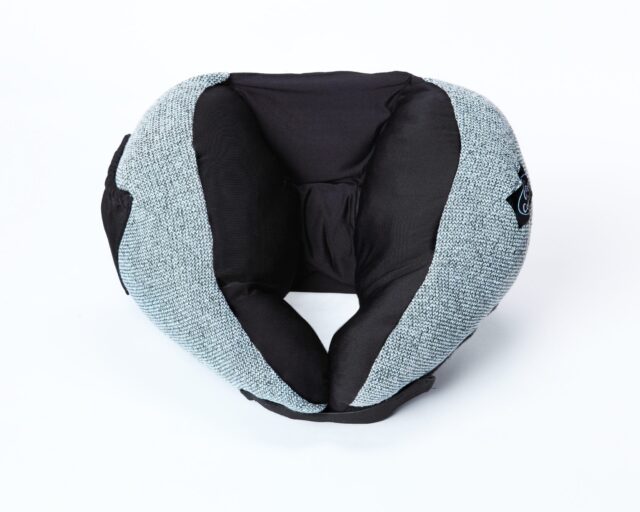
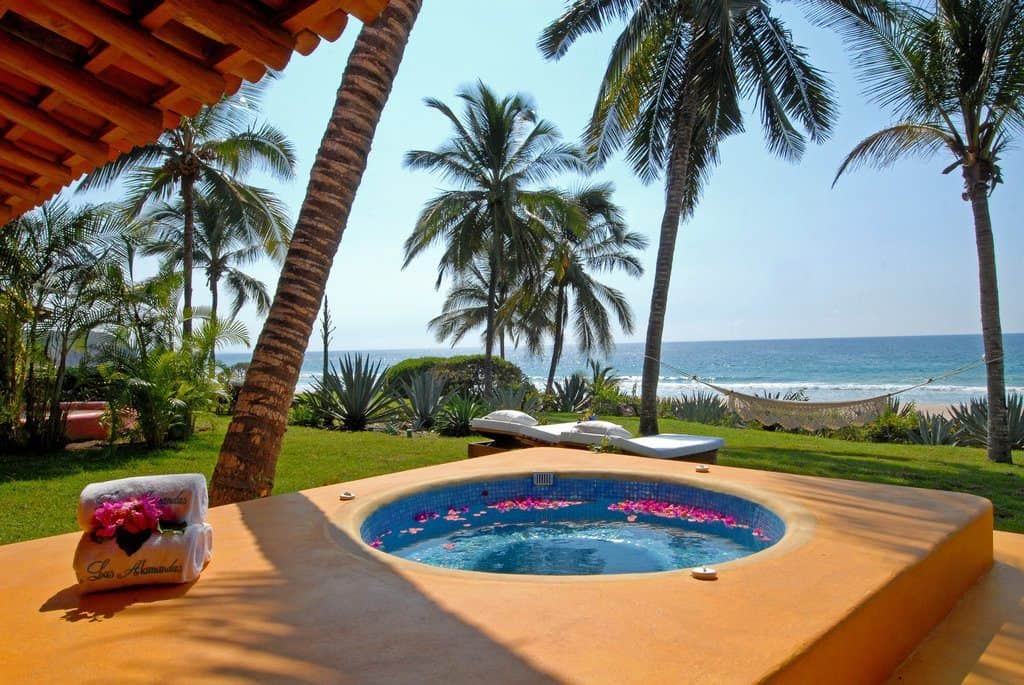
Cafe Kitsch is a German bakery on the main street. Lots of chocolates and pastries.
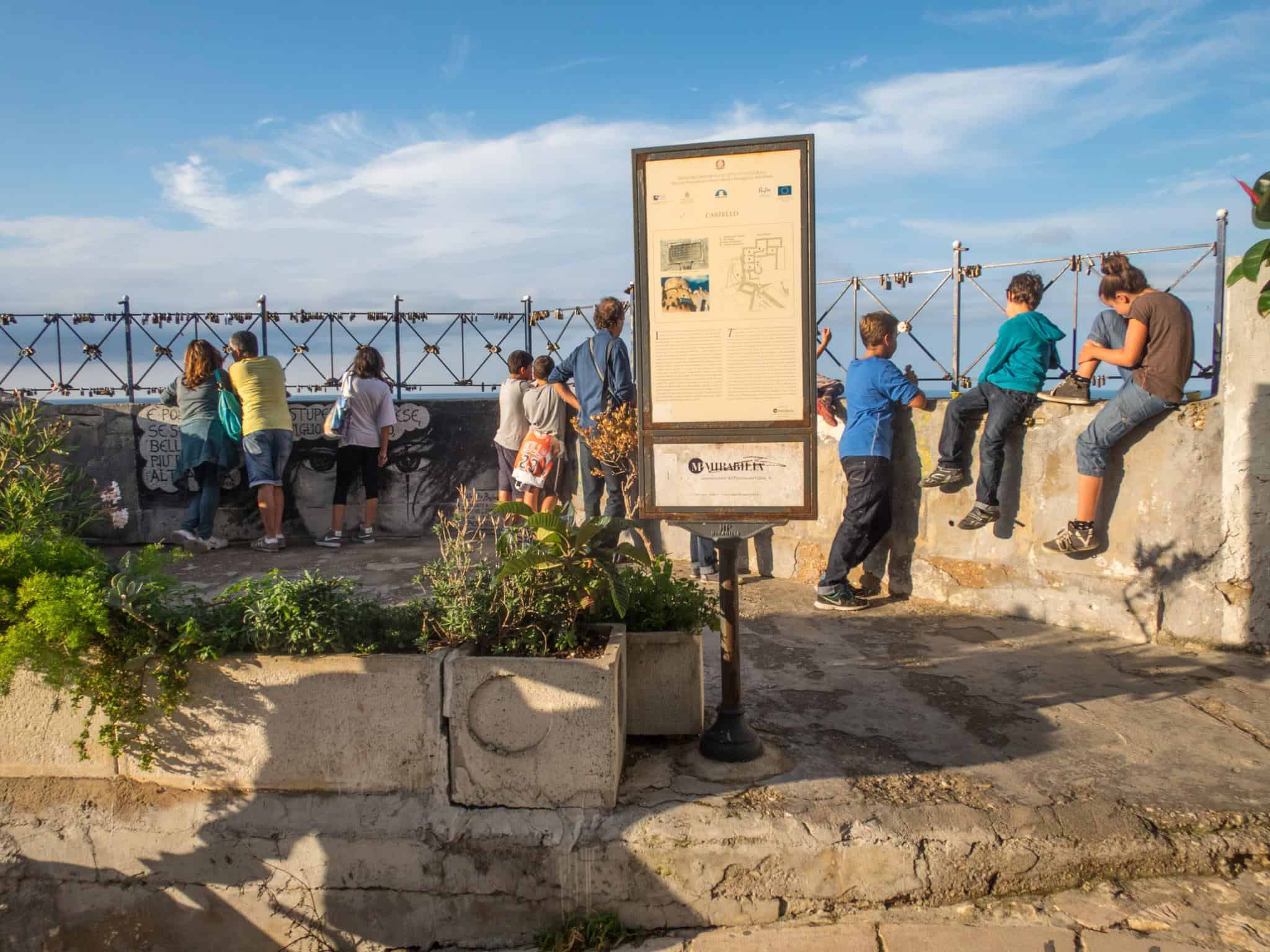
Cafe Loco, also on the main street, is owned by two Korean guys. It's small but with a good vibe and locally grown coffee.

Santa Cruz

Cafe Sabor Crucero is a student-run cafe offering excellent food, service, views, and value. WiFi too!

I recommend people visit and support them wherever they stay on Lake Atitlan.

Things to Do

  • Relax. Get in touch with your inner hippie
  • Yoga
  • Watch the sunsets
  • Rent a kayak
  • Day trip to the various villages around the lake
  • Hike the San Pedro volcano
Seeing Semuc Champey is one of my top Guatemala travel tips
Semuc Champey

Lanquin (and Semuc Champey)

I took a private shuttle from Antigua to Lanquin, the closest town to Semuc Champey. The road is paved the whole way.

I think it took about five hours. There's not much to look at in Lanquin, and most people eat meals at their accommodation.

Where to Sleep

El Portal

A few meters from the park entrance. It requires taking an hour's ride off-road after the shuttle lets you off in Lanquin, but this would've been my preference.

You're right on the river, and you can get to the pools immediately after the park opens (when you can hopefully have them to yourself for a little bit)-no WiFi or Claro signal.

Zephyr Lodge

Party hostel. You either love it or hate it.

Situated in a valley in town, it has nice views, but they blast rock and alternative music all day and night, so it's not that relaxing around the common/dining/bar area.

A guy was stung by a scorpion while lying in bed the night before I arrived.

Worse for me was hearing rats running through the rafters at night in the dorm room. I had trouble sleeping as a result.

Good food. Minimal WiFi (no more than five people at a time), but the signal for Claro 3G is solid. $7.50/night for a dorm bed.

Things to Do

Semuc Champey

Beautiful. There's no need to hire a guide. You can walk up to the viewpoint on your own.

It's a marked trail, and it takes 25 minutes to get up and the same to get back down. 

Try and get to the pools as early as possible to avoid a crowd. I went on a Sunday, and there were a lot of Guatemalan families there too.

The families stick around the shallower pools, so you can always go to the deeper ones instead. I skipped the rock slides.

Caving

A lot of people do a candlelit cave experience as part of a full-day tour to Semuc Champey.

One Israeli I met who did this said he was so tired from the caving and subsequent cliff jumps and a rope swing that he didn't have much energy to enjoy the natural pools. 

To me, this is backward. I say, skip the cave. Another cave option is the bat cave, which is visited at sunset, so you can watch them all fly out (watch out for guaro).

Whitewater Rafting

There are Class III and IV rapids. People who went from Zephyr said it was fun, and the steep sections were brief.

Tubing

Drink beer while floating down the river.

Go off the beaten path in Livingston on Guatemala's Caribbean coast.
Livingston

Livingston

It was a long travel day from Lanquin to Livingston. First, I took a private shuttle ($19) arranged through Zephyr Lodge to the town of Rio Dulce.

The first two and a half hours were off-road and very bumpy. Once we hit the pavement, it was smooth sailing.

Then, I took a boat ride ($16) from Rio Dulce to Livingston.

It was windy, so I got soaked on the boat ride down the river. Thankfully none of my belongings got wet.

Be prepared in case it's windy or raining. The boats don't have side flaps that can be rolled down from the roof, so it's easy for the water to splash in if the water is rough.

The scenery along the ride was nice, but nothing spectacular - lots of birds.

I was so tired by the time I arrived I checked myself into Hotel Villa Caribe, one of the best hotels in town. It was low season, so it was about half the price.

Where to Sleep

Casa de la Iguana - Super budget hostel. This is the place they recommended to me at Zephyr. I stopped by, but it was not at all appealing. I had some bungalows (and dorms, I think) around a grassy area, but it looked swampy and ghetto.

Hotel Casa Rosada - This is the mid-range place I would've stayed had I not splurged. Bungalows are $20/night, and this applies to solo travelers too.

Hotel Villa Caribe - I paid $65/night, which included a breakfast buffet with a view of the river. All the rooms have river/sea views. The pool was gigantic, and the landscaping was pretty. Fast WiFi, especially in the restaurant. Worth the money if you want to splurge.

Where to Eat and Drink

MC Tropic - I had both my dinners here. Try the Garifuna soup, a local specialty.

Casa Nostra - Excellent thin-crust pizza. I had the shrimp pizza with tomatoes, onions, and peppers, and it was decadent.

Things to Do

  • Hang out -- this is the Caribbean, after all
  • There are some beaches and day tours, but nothing appealed to me.

Related: Top 10 Destinations in Latin America

Maya steleas at Quirigua in Guatemala
Maya steleas at Quirigua

Quirigua (and onward to Copan, Honduras)

Quirigua is home to the Maya world's largest stone stelae, which is 10 meters tall and weighs over 60 tons. 

The park requires no more than 30 to 60 minutes to see.

It's a minor site, and I'd only recommend Quirigua to archaeological geeks and UNESCO World Heritage Site nerds.

It's Guatemala's lesser-known UNESCO site, after the more popular Antigua and Tikal.

From Livingston, you travel via all forms of land transport in Guatemala.

Start with a 6:30 AM sunrise boat trip to Puerto Barrios before catching a bus south to Quirigua.

Tell the driver where you're going. He'll then leave you at the right spot on the highway near Quirigua.

You then need to hail a tuk-tuk and take it about 10 minutes to the park entrance.

After you walk the site, you need to catch a colectivo leaving the banana plantation adjacent to the park to get back on your way.

That drops you off at the main bus stop along the highway in the nearby town of Los Amates. From there, catch a bus heading to the city of Chiquimula.

In Chiquimula, transfer to a colectivo heading for the border ("La Frontera"). The border crossing was easy.

Just stop at the office on the Guatemala side for your exit stamp, and then walk across and get stamped in Honduras' Immigration office.

There's a fee of a few dollars charged for entering Honduras.

Once you get your entry stamp, walk another 50 meters up the road and wait for a colectivo to Copan Ruinas.

It's only 10 kilometers away.

If it's getting late in the day, it's probably best to spend the night in Chiquimula before getting an early start the next day. The border closes at 6 PM.

Top 5 Countries for Coffee and Tea Drinking

Chai in India
Chai in India

Along with eating, another thing I thoroughly enjoy when I travel is sipping on the favorite local hot beverage.

Sitting at my laptop, typing articles or editing videos, I continually need to be fueled by something warm, preferably full of caffeine, and constantly available.

Sometimes I travel with coffee and tea, but I usually like to explore and then purchase a stock of whatever is available locally.

Also, enjoying a hot beverage on the street-side, after a tummy full of delicious food, is a great way to top off a meal and let the food digest.

Here are five hot beverages I thoroughly enjoyed in the countries that I have visited.

Table of Contents

  • 1. Tea in China
  • 2. Chai in India
  • 3. Yerba Mate in Argentina and Uruguay
  • 4. Coffee in Ethiopia
  • 5. Coffee in Vietnam

1. Tea in China

After polishing off a greasy and delicious Chinese feast, or while sitting at my laptop, any variety of Chinese tea is one of the finest things to sip on.

Tea plays a significant role in Chinese culture, and there are some serious connoisseurs.

You can even have a tea ceremony or a tea tasting session, where you'll get to see the tea master steeping and preparing natural aromatic teas to perfection.

One thing I love about Chinese tea is that all you have to do is pour hot water over the dry leaves, let them steep for a few minutes in a mug, and you're good to go. It's easy to prepare in a hotel room.

2. Chai in India

Another one of the world's most tempting hot beverages is Indian chai.

Black tea is steeped until strong with flavor, then toned down with thick, full-fat milk, and sweetened up with generous amounts of sugar.

Chai on the streets of India is often poured into a cup from high above, so it bubbles up and has a little bit of frothy foam on top.

Always served in small clay cups, that you smash on the ground after you're finished drinking, Kolkata was my favorite place in India to drink chai.

Yerba mate
Yerba mate

3. Yerba Mate in Argentina and Uruguay

After arriving in Argentina or Uruguay, it won't take long for you to be curious about a peculiar beverage, sucked out of a metal straw from a small gourd cup.

A few days of traveling around, and I was presented with my first opportunity, under the supervision of a couple of Argentinians I had befriended, to sample a beverage known as yerba mate - and I fell in love from my first sip!

The leafy dry herb is filled into a gourd cup, steeped in hot water, and sucked out of a metal straw.

I soon purchased a gourd, a thermos for hot water, and carried my mate everywhere I went.

Note: Yerba mate is also popular in Paraguay, Brazil, and Bolivia, but I have only had a chance to visit Argentina and Uruguay so far.

Coffee in Ethiopia
Coffee in Ethiopia

4. Coffee in Ethiopia

Going to Ethiopia, I was thrilled to begin drinking the coffee.

It didn't take longer than about five minutes, just after arriving at my hotel, when I got a full whiff of roasting coffee and stepped into a tiny shack for a cup. It was awesome.

My entire trip to Ethiopia was fueled by probably the most amount of coffee I've consumed every day of my life.

It was affordable and so good every single time. In Ethiopia, both European and traditional Ethiopian style coffee is available.

5. Coffee in Vietnam

Coffee in Vietnam is very different from coffee in Ethiopia.

In Vietnam, they have an amazing and flourishing coffee scene, influenced originally by the French, but transformed in a uniquely Vietnamese way.

Pop a squat at a Vietnamese coffee shop, and you can either get a hot or cold strong black coffee infused with sweetened condensed milk.

It's chocolatey, creamy, and sweet, and offers that power shot of energy you need to walk around or get work done.

This is just a sampling of all the fantastic hot beverages available when we travel.

Just about every single country in the world has its version of a hot beverage, so if you have a favorite, please feel free to leave a comment below.

Myanmar: What Not to Worry About When Planning Your Trip

In Yangon be sure to visit the Shwedagon Pagoda around sunset

Myanmar (also known as Burma) is a beautiful country that many have described as the unspoiled treasure of Southeast Asia.

It's also undergoing many changes at the moment, and as a result, you may find a lot of conflicting or outdated information about traveling there.

Traveling in Myanmar is not as challenging as it was just a few years ago. It may not be as easy quite as backpacker-friendly as a country like Thailand or Vietnam, but the slightly more adventurous traveler should be just fine there.

That said, there are a few things you should still be aware of.

Here's the current low-down on what you should and shouldn't worry about when heading to Myanmar.

Table of Contents

  • DON'T worry: about supporting an oppressive government
  • DO worry: about visas
  • DON'T worry: about lack of ATMs
  • DON'T worry: about finding internet
  • DO worry: about finding accommodation

DON'T worry: about supporting an oppressive government

Myanmar used to be ruled by a military dictatorship and so traveling there used to be controversial, as tourist dollars could be indirectly supporting an oppressive regime.

Recent reforms have led to a democratically elected government (though the military still controls 25 percent of the votes), many political prisoners being freed and generally increased freedom of speech.

Not everything is completely peachy, but the situation has improved such that ethical concerns are no longer as relevant as they were.

Old guidebooks still provide tips on how to travel in Myanmar without paying government-owned hotels or otherwise directing money to the regime, but you don't have to worry about this now.

There are still ethnic conflicts in Myanmar, however, and as such, some of the outer-lying regions (especially in the north) require a special permit to visit.

These are very hard to get and so effectively these regions are banned for tourists.

The central areas are fine, however, and this is honestly where you are most likely to want to spend your time anyway.

DO worry: about visas

You may be used to getting visa-on-arrivals in many countries in Southeast Asia, but to visit Myanmar you need to have your visa pre-arranged. The maximum stay in Myanmar is generally 30 days.

The Burmese embassies in Bangkok, Singapore, and Kuala Lumpur are good places to get your visa if you are on a larger backpacking trip.

You will need some proof of departure, e.g. you need to have your inbound and outbound flight already booked.

You may find some mentions of a visa-on-arrival option online but do not be fooled as currently, this is for business travelers only.

The overland border situation is quite changeable at the moment: check for latest updates on whether you can get into Burma overland. Flying is the easiest option and AirAsia has routes to Myanmar.

Boats are the main form of transportation in Nyaung Shwe at Lake Inle

DON'T worry: about lack of ATMs

There used to be no working ATMs in Myanmar, requiring travelers to bring big stacks of US dollars in cash.

As of mid-2013 Myanmar does have ATMs accepting most international cards. Visa and MasterCard credit cards are also increasingly accepted.

That said, there aren't a lot of ATMs yet. So be such to stock up on Kyat (the local currency) whenever there are ATMs available.

You should be OK in the commercial capital of Yangon, in Mandalay, and in Nyaung Shwhe (near Inle Lake).

At the time of writing, there is only one ATM in Bagan, though given that this is the country's main tourist attraction more will probably pop up there soon.

It is still useful to bring some US dollars and you will find them accepted at hotels everywhere. Their prices are also still often listed in USD.

But with the introduction of some ATMs, you don't have to rely on USD cash entirely anymore.

DON'T worry: about finding internet

WiFi may not be exactly widespread in Myanmar, and the internet may often be very slow, but you can still find internet access pretty easily.

There are internet cafés everywhere, and a few restaurants and hotels provide free internet access.

Internet access is not censored: Facebook, Gmail, etc. all work fine.

DO worry: about finding accommodation

Because Myanmar is rapidly opening up to the world it is experiencing an influx of tourism. This means that in high season there is a shortage of accommodation.

In Burma, there are not yet any hostels as we know them.

Your main option as a budget traveler is low-cost (often previously government-owned) hotels and guesthouses.

Few, if any, hotels can be found on booking sites, but some can be booked directly via e-mail. In high season it's a good idea to book your first place of accommodation online.

Then ask reception to call ahead and book your next hotel.

Outside of high season (especially April – June), it's a lot easier to wing it without pre-booking.

It can be incredibly hot in the central plains around this time, however (e.g. in places like Mandalay and Bagan) so you may want to wake up early and have a siesta in the afternoon.

Are you currently researching a Myanmar backpacking trip? 

For some ideas on what to see and do you can also check out my Myanmar backpacking guide at IndieTraveller.

________

About the Author: Marek Bron blogs at IndieTraveller, focusing on low-cost travel in Asia and Latin America. Want to travel the world without worries? Check out his in-depth Backpacking Preparation Guidebook.

My (Almost) Free Australian East Coast Road Trip

That's right! A free road trip down Australia's stunning east coast! It sounds too good to be true. Well, in a sense, yes. But that's why I said almost.

My friend and I were discussing what we could do for the Christmas break, and we decided to go on a road trip.

Surfing in Byron Bay

We didn't want to do anything too extravagant. We wanted to go down to Sydney for the weekend anyway, but we had a few days to kill.

I was browsing the net for the best places to visit on a road trip down to Sydney when I came across a DriveNow in a forum post.

DriveNow is an Australian car and campervan hire company, which at first I thought… big deal. But the post suggested trying DriveNow's relocation services, a service where you book a car or caravan on a specific date and drive it to a location specified on the website.

In our case, it was Brisbane to Sydney-perfect! Now, it's not completely free. DriveNow charges you $5 per day to hire the campervan, which in our case added up to a total of $15 for three days.

We also had $50 of free fuel, which would cover most of the highway drive, but if you want to explore in those three days, you'd best be prepared to pay for a full tank.

Finally, we were given a 1,512-kilometer (940-mile allowance for those in the States) allowance, which is fine as the distance between the two cities is only 900 kilometers.

So, where did we go in our campervan? As we drove south of Brisbane through Surfers Paradise, we decided to do a quick stop for supplies.

As we passed through the New South Wales border, slowly approaching our destination, we stopped at Byron Bay for a quick surf and a bite.

If you have never been to Byron Bay, I highly recommend it. It is home to great people, great food, and, most importantly, great waves.

Big Banana at Coffs Harbour

However, we had a schedule to follow. We drove further down to Coffs Harbour, home of the infamous Big Banana.

We parked our campervan at Park Beach Holiday Park just in time for dinner. At roughly $30 per night, the camping grounds are a steal.

We had a barbecue and socialized with the other campers, who were more than happy to share a beer (or four) with us. The next day, we woke up nice and early for a quick dip at Jetty Beach, and then it was off to check out the Big Banana.

The region is well-known for its banana plantation, so the Big Banana is a monument and tourist attraction in its own right.

From there, it was off to Newcastle. We were having a great time, so we decided to stop off at Forster, a large coastal town in the Mid-North Coast of New South Wales.

Beach Bums Cafe
Beach Bums Café

We grabbed lunch at Beach Bums Café, which is perfectly located on the main beach. Their lunch menu had everything you would expect from a beachfront café.

Everyone but me went for the 'works burger', which had everything under the moon between the two toasted buns. I am a traditionalist, so I went for the seafood basket.

After a quick sun-baking session, it was time to hit the road again to reach our final destination of the day, Newcastle. We set up camp in a small campground just south of 'Newy' and had an early night.

The next morning involved much of the same - food, surf, and good company. However, our trip was coming to an end. We packed and finished the 2-hour trip down to Sydney to drop off the campervan and get ready for our weekend in Sydney.

All in all, we were out-of-pocket by roughly $100 each (this includes splitting the fuel, camping ground fees, and initial supplies we received at the beginning of our journey).

It's not a bad price for a two-night coastal road trip in Australia. I definitely recommend it not only to families but also to couples and friends who want to discover more of our beautiful country at a minimal cost!

How To Travel Norway on a Budget

How to Travel Norway on a Budget: Our Best Tips for an Affordable Trip Around Norway

(Based on our Actual Experiences in the Country)

Brekstad, Norway
Brekstad, Norway (photo: Luca Bartoloni, Pixabay)

Editor's Note: The following was written as a guest post from Daniel Schjetne. Katie Matthews updated it in August 2017, after Katie and her husband Geoff spent three weeks traveling Norway on a budget.

A foreign visitor once told me: "There is something very different about this town and this country. It seems like there is no struggle at all. For anything."

Growing up in what I like to call the real "great white north" might not have given me the same general perspective of Norway as others have.

Neither is it a preferred backpacking destination for kids out of college, and much of the reason for that has to be that it's a country with an average annual salary of $73,000.

Prices in a proportional range make it expensive to visit on a budget. Five million Norwegians share the benefits of oil reserves with an estimated value of $813 billion. Is it possible to get by on a budget? Well. In a way.

Scenic views in Norway (photo: Luca Bartoloni, Pixabay)
Scenic views in Norway (photo: Luca Bartoloni)

Table of Contents

  • How Much Do Budget Hotels Cost in Norway?
  • How Much Do Hostels Cost in Norway?
  • Is Couchsurfing Popular in Norway?
  • Can I Camp in Norway?
    • Budget Oslo Accommodation
  • How To Eat and Drink Cheaply
  • How To Get Around
    • How Much Is Train Travel in Norway?
    • Is a Rail Pass Worth it in Norway?
    • How Much Does It Cost to Fly Around Norway?
    • Is Hitchhiking Possible in Norway?
  • Conclusion

How Much Do Budget Hotels Cost in Norway?

A bed to sleep in will probably be your most significant expense when traveling through Norway. Sleeping outside is a no-go for about ten months of the year.

The temperatures can easily creep down to -13 F (-25 C) during the winter, and most summer nights aren't precisely scalding hot either.

You can get a single room at a budget hotel for between $80 and $110 in most towns, but for most backpackers, that is a "no way in hell."

So how much does sleeping in a clean, highly-rated 3-star hotel in Norway cost?

We researched prices at different times of the year in four of Norway's most popular cities. We used Booking.com to find these prices listed in US dollars.

  • CityBox Oslo: Between $88 and $138
  • CityBox Bergen: Between $100 and $175
  • Thon Hotel Alesund: Between $137 and $141
  • Comfort Hotel Trondheim: Between $109 and $158

While these prices are "painful but manageable" for people looking to travel Norway on a budget for a short vacation or Oslo city break, they're far from affordable for the typical backpacker.

It also has to be said that budget hotels in Norway are pretty nice hotels. Good breakfasts are usually included, and the prices are high, but not entirely unreasonable, for what you get.

Katie and Geoff stayed in the CityBox Bergen and the Thon Hotel Ålesund on their recent trip around Norway. They both offered very nice bathrooms, super comfortable beds, and a clean and quiet environment.

That said, $100 a night (or more) will never fly with the typical backpacker or long-term traveler.

Taking a Norway cruise offers a potential compromise between cost and comfort. However, for the purpose of this article, we'll continue to focus on the backpacking experience.

How Much Do Hostels Cost in Norway?

Sadly, there isn't much of a hostel culture in Norway. The bigger cities usually have hostels, but even there, a dorm bed might put you back up to $50 or $60 a night.

Again, since the standard of living in Norway is pretty high, these hostels are usually very decent.

Hostels also tend to charge a linen fee for using their sheets and towels, which could range between $5 and $10 per stay.

If you plan to stick to Norway's main cities, you should be able to find a hostel in most of them. Hostelworld lists hostels in nine cities around Norway, although in practice, we had trouble finding availability in all listed properties.

So how do hostel prices compare to the 3-star hotels listed above? We researched hostel prices in the same cities and times of the year.

Note hostel prices in Norway did not seem to fluctuate according to the season; thus, we've only listed one price per hostel.

Also note prices were for beds only, and not all properties listed the cost for linens and towels. At Anker Oslo, linens cost 50 NOK and towels 20 NOK, which equals about $8.75.

As linens and towel charges are generally relatively high, you may want to bring your travel towel, perhaps even a sleep sack, to avoid the fees.

We used HostelWorld to price out these different cost options.

  • Anker Hostel Oslo: $32.66 for a bed in an 8-bed mixed dorm
  • HI Bergen Hostel Montana: $28.26 for a bed in an 18-bed mixed dorm
  • Ålesund Hostel: $37.05 for a bed in a 12-bed separated dorm
  • Trondheim Vandrerhjem: $46.47 for a bed in a 4-bed separated dorm.

Is Couchsurfing Popular in Norway?

Couchsurfing and staying with locals is a cheap option, and possible up in Norway. Couchsurfing has more than 15,000 hosts listed for Oslo, more than 4,000 hosts in Trondheim, and almost 700 hosts for Ålesund.

The bottom line is that Couchsurfing is an option for those who want to travel Norway on a budget!

That said, it's worth noting that as Couchsurfing has become more popular over the years, it's also become slightly more difficult to "get started" when your profile is new and you don't yet have any references.

If you're planning a trip to Norway that might involve Couchsurfing, and you've never tried Couchsurfing before, we'd suggest you sign up for the platform sooner rather than later.

There are some things you can do to increase your chances of getting hosted as a new traveler, as well:

Get involved in the community by attending Couchsurfing meetups in your current city. Ask some of the people you meet to leave a reference.

And if you sign up using your Facebook profile, don't be afraid to ask some friends to give you references, too.

Overshare (within reason) on your profile. Think lots of photos of you, filling out all the relevant profile sections, etc. The goal is to show your personality and trustworthiness to a potential host.

Consider getting verified, which is Couchsurfing's way of verifying the address and the phone number you've listed in your profile are accurate. It's $26 per year, which isn't much considering how much you might save.

Once you've made a financial investment in something, you also have some skin in the game -- which, to me, means you're less likely to be a jerk if I host you!

According to Couchsurfing, verified guests find hosts two times faster than unverified hosts.

Get involved as a host AND a guest. When building up your profile, it's nice to show you're committed to the idea and spirit of Couchsurfing by hosting.

Can I Camp in Norway?

Camping is possible during the summer. As long as you get out of the city center (and stay away from people's gardens), camping on state-owned land is free and legal in Norway.

But beware of the night because it always gets colder in Norway than you might think. Even in August, Geoff and Katie got cold while exploring Norway. If you plan to camp, pack appropriately!

Budget Oslo Accommodation

Oslo Hostel Rønningen - 8.2 on Booking.com

Part of the HiHostel system is located outside the city center and borders a vast forest near a beach. It is very close to the Museum of Science and Tech. Loads of hiking and nature activities either on-site or very close by.

The property has shared kitchen facilities (a grocery store is within walking distance), a games room, and free parking is available.

It's a bit far out (15-minute metro + 10-minute bus from Oslo S) but probably the best value for budget accommodation in the city-an excellent option for families.

Dorms from $44. Check pricing and availability on Booking.com.

Anker Hostel - 7.6 on Hostelworld

There isn't much to choose from in the way of hostels or budget accommodation in Olso, but the location of Anker couldn't be better.

One of the biggest complaints here would be the minor extra charges, like the (mandatory) charge of 50NOK ($6.25) for bed linens and another 20NOK ($2.50) for a towel if you didn't bring your own. Also, you'll need to rent dishes and kitchen utensils to use the kitchen.

Hopefully, knowing this before you go will save some grief-easy access to the train and bus station, about a 10-minute walk.

Dorms from $33 (plus extras). Check pricing and availability on Hostelworld.

Norway is an expensive country to travel around. However, there's a way to ease the 'pain in the wallet' of finding affordable accommodation.

Consider Couchsurfing. Stay with a local, make friends, and save money for other things! Click here to give Couchsurfing a try!

Flam Railway in Norway (photo: Wandertooth.com, used with permission.)
Riding the Flam Railway (photo: Wandertooth.com, used with permission.)

How To Eat and Drink Cheaply

Dining prices have skyrocketed together with every gallon of oil pulled out of the sea. I suggest cooking your food as much as possible, as eating out is significantly overpriced.

This is a place where 18-year-old servers make $20/hour. Do the math.

Dinner at an average restaurant will put you back between $40 to $100, depending on what you drink. A baguette and coffee at 7/11 are yours for around $12 to $15.

Alcohol is exceptionally expensive in Norway. A six-pack of the local beer is yours for between $20 to $30.

My advice is to do as every Norwegian does: drink at home before going out and don't buy anything while at the club. Even though $20 is a stiff price for six beers, one at the club is easily $12 to $15.

Liquor prices shouldn't even be discussed. Take your drinks at the hostel before you go out, and you'll be fine.

Remember that kebabs on your way home cost about $10 to $15, but it is worth the money if you've got a buzz going.

Here are some example prices Katie and Geoff recorded during their trip around Norway (all prices are in NOK - Norwegian Kroner):

  • Train from Oslo airport to Sentrum: 93
  • Tall café latté at Starbucks: 43
  • Groceries: We spent 12 days in an apartment in Oslo and did all our cooking and grocery shopping. On average, we spent 270 NOK per trip to the grocery store ($33), which covered all our meals and a few snacks.
  • Cheap dinner in a restaurant (shared pizza, two beers): 350 NOK
  • Dinner at Burger King (6 chicken nuggets, two hamburgers, one large fries): 102 NOK
  • Subway (2 small chicken teriyaki subs): 130 NOK
Sunset in Alesund (photo: Wandertooth.com, used with permission.)
Sunset in Alesund, Norway (photo: Wandertooth.com, used with permission.)

How To Get Around

Norway is not very populated, but the country is longer than a dark year. Thankfully, this frozen place is well-connected.

All big cities have good public transportation, including trains, trams, buses, and metros. The prices vary from place to place, but a single bus ride will put you back $3 to $5 on average.

Buying weekend or weekly passes can save you a reasonable amount if you stay in the same place for a while.

Traveling from town to town isn't just that cheap, but it can still be done on a budget. Booking in advance is the key here.

Check out multi-day Eurail Norway Passes here for affordable train travel in the country.

How Much Is Train Travel in Norway?

NSB is the Norwegian train operator, and it runs trains pretty much all over the country.

Using the train as your primary mode of transportation, and then supplementing with buses and ferries as needed, is a great option to travel Norway on a budget and is much cheaper than renting a car!

Here are some sample costs for taking the train in Norway:

  • Oslo to Trondheim: 965 NOK ($121)
  • Trondheim to Bodo: 1088 NOK ($137)
  • Trondheim to Andalsnes: 676 NOK ($85)
  • Oslo to Bergen: 950 NOK ($119)
  • Oslo to Kristiansand: 726 NOK ($91)

Sleeping compartments seem to be 930 for all routes and allow for two people

As you can see, the prices of the full-fare train tickets can add up pretty quickly. There are also reduced 'Minipris' tickets, which can be considerably cheaper.

For example, an Oslo to Trondheim minipris can be had for 549 to 849 NOK ($69 to $107). While these seem great in theory, they can be hard to secure, and the price varies depending on the train.

Plus, you have zero flexibility. If you end up meeting up with some other travelers and you want to change your itinerary, you can't do that with the Minipris ticket.

Is a Rail Pass Worth it in Norway?

Another option, and one that can be of great value, is getting a Rail Europe Eurail Pass before you get to Norway.

Norway-only passes can be had for as little as $220 (for three days of train travel within a month), which is more than enough to cover Oslo to Trondheim, Trondheim to Andalsnes, and then Bergen back to Oslo, and will save you over $100 compared to the full price tickets.

Suppose you compare the Rail Europe pass to the Minipris tickets. In that case, it's still a good deal: the cheapest combo for the itinerary above costs $171, with zero flexibility and an unlikely chance you'll be able to buy the tickets for that price on the day you want.

If you end up paying the more expensive range of the minipris, it comes to $253, which is $33 more than the Rail Europe pass, and you're still locked into trains and dates with no flexibility.

With that in mind, we recommend putting together a loose itinerary for your Norway trip, determining how many days of train travel you'll need, and then buying the pass online before you go (which is required, you can't buy it in Norway).

To see some of the biggest highlights of Norway, a four to five-day pass should be good.

If you want to explore further, you can buy passes valid for up to 8 days of travel (they don't have to be used consecutively). Other pass options (for example, a two-country pass) allow up to 10 days of train travel.

How Much Does It Cost to Fly Around Norway?

It's also well worth checking domestic flights in Norway. Most travelers visiting Norway for the first time vastly underestimate distances and travel time.

Adding in one or two flights will let you see much more of the country in a reasonable amount of time.

And because hotel and food costs are pretty high in Norway, flying somewhere to cut down on the number of days you need in the country will probably actually save you money.

Norwegian Airlines and Widerøe offer domestic flights around the country, as does SAS.

We tend to start our airfare searches with Skyscanner to get a lay of the land and then compare prices from there.

As with many discount airlines, the cheapest seats sell out the fastest, so it's a good idea to book your flights in advance.

If you don't plan to book in advance so you can maintain as much flexibility as possible, get the Skyscanner App for your phone so that you can compare prices on the road.

Is Hitchhiking Possible in Norway?

Hitchhiking is possible but not very popular in Norway. Norwegians are pretty defensive, and picking up people from the road is… not how they do things there.

I have picked up and met several hitchhikers around Norway, and getting a ride isn't always difficult.

The best way to do this is to hang out at roadside stations and ask lorry (truck) drivers, as they tend to be happier with the new company. If you're hitching in the winter, bring your warmest jacket.

Budget Accommodation in Bergen

Marken Gjesthus Bergen - 8.9 on Hostelworld

About as reasonably priced for budget accommodation as it gets in Norway.

Past guests have commented that the atmosphere is lacking, but that seems to be expected in Norway.

Linens are included but expect to pay for a towel if you haven't brought your own.

It's clean, nicely located, and easily walkable to the train station (5 minutes) and the historical center, about 8 minutes.

Dorms from $36US. Check pricing and availability on Hostelworld.

Bergen YMCA Hostel - 7.8 on Booking.com

The Bergen YMCA is located right in the city's center, a ten-minute walk from the train station, and anything you need in Bergen right at your doorstep.

A daily breakfast is offered for 50NOK ($6.25) to help get you on your way. There is a rooftop terrace, a shared kitchen, and a discount at the cafe next door.

In typical YMCA fashion, the dorm rooms have a lot of beds and are bare and basic.

Dorms from $27US. Check pricing and availability on Booking.com.

Oslo Opera House (photo: Wandertooth.com, used with permission.)

Conclusion

As I mentioned before, your bed will be your bane in Norway. Book your accommodation carefully and in advance, and you'll get by.

Cook your food, cut down on the drinking in bars, and book your flights in advance. Norway is horrible for your wallet, and there is no way around it.

This might turn many travelers off, but knowing what this beautiful country has to offer makes it all worth it for me.

The Vikings have been around for thousands of years, long before the idea of the USA was even formed. Norway is full of great history, culture, tradition, and incredible nature.

Go skiing in the winter sun, fish fresh salmon in the fjord and cook it on the open fire, or watch the northern lights with a cup of Karsk. 

It is coffee and 96% alcohol moonshine. (Typical for the northern parts of Norway. Mix to taste; it will warm your inside up all right!)

______

About the Author: Daniel Schjetne is a 19-year-old traveler from Trondheim, Norway, who went out on his first solo backpacking trip through Europe just after his 18th birthday. 

Exploring the Fascinating Sights of Varanasi

Varanasi is one of the most important cities in India, it's a pilgrimage town, and it's a place where fascinating sights are available everywhere you look.

View of Varanasi
View of Varanasi

A day spent walking around Varanasi has the potential to create an entire month's worth of memories and interesting sights.

Coming back to your guesthouse room after a long day and remembering all the things you saw, heard, tasted, smelled, and even the people that interacted with you will make you smile with amazement.

Boat ride in the morning

To begin the day, one of the most interesting things to do is go for a sunrise paddle boat ride. As the sun rises over the glassy-topped Ganges River, the city seems to be shrouded in a haze of smoke, with people attending to their morning spiritual rituals.

Many Hindus line the ghats (a ghat is a series of steps leading down to an important river) of Varanasi, bathing, washing, and taking in the blessings of the holy water.

A short distance from the Main Ghat, you'll float past the main burning ghat, an area where bodies are cremated and spread into the river. Peacefully sitting in the rowboat, you'll see flames cutting through the fog and witness the entire crematory process.

Kedar Ghat
Kedar Ghat

Another way to find fascinating sighs is to just sit leisurely on the steps of a ghat. The Kedar Ghat, steps painted in orange and gray, was my favorite place to people-watch.

All day long, Hindu devotees would splash in the Ganges river, then trek up the steps to the temple, fulfilling a number of rituals and procedures along the way.

Walls within the narrow lanes

Exploring the narrow ancient lanes of Varanasi is another sure way to be awed. Once, I was eating a street food snack in the middle of a lane when I heard shouting.

Within a few seconds, a train of bodies and a funeral procession glided past me, just a foot from where I was standing. You never know what you'll come across.

Walking through the narrow lanes, you'll find shops selling everything from food to relics, you'll notice shrines and temples tucked into cave-like entrances, and you'll have to navigate your way around massive cows and goats. The walls of buildings are often decorated with paintings and scripts, adding another dimension of artistic character.

Related: Places To See in Bangalore

Sampling some sweets of Varanasi

Finally, there's the food. While both north and south Indian food and snacks are represented in Varanasi, the city is also famous for a few of its own unique edible creations.

Sweet creamy desserts like malaiyo, laddu, kalakand, and peda, shouldn't be missed. And then there's the famous Varanasi chaats, small plates of savory snacks that are incredibly tasty. Wash things down with a lassi, a thick yogurt beverage.

If you're up for a final mouth adventure, Varanasi is renowned for its high-quality paan mouth-chews, a betel leaf filled with spices, areca nut, and tobacco (optional).

Varanasi has long been documented as a unique travel destination and a place of significant cultural, religious, and historical importance. Even well-known people like Mark Twain visited Varanasi and were amazed at the sights they saw.

The people, the rituals, the Ganges river, and everything that fills the lanes and side streets of the city make Varanasi always entertaining.

5 Outdoor Activities To Do in Dubai

When you think about Dubai, you usually imagine scenes of giant skyscrapers, a hotel shaped like a sailboat, and Lamborghinis. But there are many other activities to do in this modern and newly built city. If you enjoy the outdoors, stretching your legs, and getting away from the concrete and glass, here are a few excellent choices.

Table of Contents

  • 1. Hang Out on the Beach
  • 2. Ski Dubai
  • 3. Slide at the Water Park
  • 4. Go Golfing
  • 5. Take a Desert Safari

1. Hang Out on the Beach

Al Mamzar Beach Park, Dubai
Al Mamzar Beach Park (Photo: travelourplanet)

Few people think about the beach when they dream of visiting Dubai. However, the city is right next to the beach along the Arabian Gulf.

A popular local beach is Jumeirah Beach Park. After paying a small entrance fee, you can spend the day relaxing by the calm waters. There are green grassy areas, places to barbecue, and plenty of playgrounds and things for kids to enjoy. Al-Mamzar Beach Park is another excellent beach option in Dubai.

Numerous hotels in Dubai are also situated along the beach, making them the perfect place to hang out, relax, and take a dip whenever you please. Rent a car in Dubai, and you can spend a day beach-hopping.

2. Ski Dubai

Ski Dubai
Ski Dubai (Photo: neekohfi)

Ok, so Ski Dubai is indoors, but it is an exercise activity in Dubai that feels like you're outdoors! Located in the Mall of the Emirates, Ski Dubai is a massive indoor snow park where everyone, from beginners to experts, shares the slopes skiing and snowboarding.

If you walk in wearing shorts and flip-flops, you can rent everything you need for a day of playing in the snow and coasting down the hill.

3. Slide at the Water Park

There are few better ways to enjoy Dubai's scorching sunshine than riding thrilling slides while soaking in cold water. The two main water parks are Aquaventure and Wild Wadi. Both parks offer a range of slides and water activities catering to children and adults.

4. Go Golfing

Premier Motors Abu Dhabi | Corporate Masters Golf Series 2012
Golfing in Dubai (Photo: jaguarcarsmena)

Numerous golf courses are amidst the dunes and the desert dryness. Playing golf is a significant draw to Dubai, and there are even courses designed by famous golfers like Ernie Els and Tiger Woods.

For an exclusive golf-focused trip to Dubai, you might want to research Thinkhotels, which offers hotels located directly on a golf course. Despite the desert surroundings, many golf courses in Dubai are lush and green, filled with fountains and trees, and offer stunning scenery.

5. Take a Desert Safari

Desert safari in Dubai
Desert safari in Dubai (Photo by eGuide Travel)

Dubai is in the desert, and the dunes are never far away. Many locals in Dubai take their souped-up four-wheel-drive Toyotas out into the dunes for an exciting roller coaster ride through the sand as a hobby.

When you sign up for a desert safari, you are assigned a driver and ride in the truck, rolling up and down through the dunes and kicking up sand at breakneck speeds. Desert safari trips often include dune drives, a Middle Eastern dinner, and an overnight stay at a desert camp.

While Dubai is famous for its buildings that touch the sky, luxurious 7-star hotels, and never-ending shopping, there are many other options to consider when planning your trip to the city. Outdoor activities while soaking up the sunshine are a great way to spend time in Dubai.

Kimchi: An Introduction to Eating a Korean Favorite

Traditional napa cabbage kimchi

[W]hen I traveled in South Korea, food was what I was most interested in exploring.

There's no shortage of things to eat in South Korea, and on the outside of just about every single restaurant, there are incredibly tantalizing food photos pasted on the windows.

While the food is nearly always satisfying, today I'm not going to focus on the main dishes, but on one of the most revered and beloved components of Korean cuisine: kimchi.

Kimchi cannot be defined exactly as a side dish, nor as a condiment, but it's rather an essential component and complement to a main dish. Practically the entire worldwide population of Koreans eat kimchi multiple times a day.

Cucumber kimchi
Cucumber kimchi

What is kimchi?

In broad terms, it's a slightly fermented or cured vegetable pickle.

All sorts of vegetables can be pickled into kimchi, but a few of the most popular versions include napa cabbage (which is present at nearly every meal), cucumber, and daikon radish.

The veggies are layered with chili flakes, green onions, and salt, then left to ferment.

The process makes the vegetables crisp, spicy from the chili, with a tinge of sourness from the fermentation (sourness can depend on how long the kimchi sits, some like it sour, others like it fresher).

History of kimchi

South Korea, situated in the northern part of Asia, has extremely cold winters and just about no vegetables can survive the weather.

Recorded in South Korea as far back as the 7th century, pickling was used to preserve vegetables and store them throughout the winter. Back then, the vegetables were only cured in salt water.

It wasn't until the 18th century, the period when chilies were introduced to South Korea, that dry chili flakes became an important ingredient in the kimchi recipe.

Now, just about all kimchi includes chilies.

Eating a tub of kimchi in Hawaii

How to eat kimchi

There are so many delicious Korean dishes like tofu stew, tasty grilled meat, seafood pancakes, and many more, but one of the most impressive aspects of any Korean meal is banchan, or side dishes.

Sit down at any Korean restaurant or even a Korean's home, and you'll first be presented with a series of small petri dish sized bowls of flavorful items to eat with your main course.

Kimchi is always a part of any banchan spread. Usually at least napa cabbage kimchi is served, but also the daikon radish or cucumber versions are common.

After taking a bite of rice and meat, you can then grab a piece of kimchi with your chopsticks, and garnish your bite with kimchi.

Another eating method is to grab a piece of kimchi, add it to your bowl of rice, and eat it altogether in a single bite.

Benefits of eating kimchi

Not only does kimchi enhance a meal and taste amazing, it also apparently has quite a few health benefits, as Koreans will tell you.

One of the biggest kimchi claims to fame is that South Koreans experienced very few cases of the 2003 SARS virus, a result that many attribute to having kimchi in their diet.

Lactic acid bacteria, vitamin A, vitamin C, calcium, iron, and a dose of dietary fiber are few more of the health benefits of eating kimchi.

I personally can't get enough kimchi, and every chance I get, I eat it.

Korean food is a wonderful cuisine, but it's the pickled kimchi that gives each meal that extra flavorful touch.

The Magic of an Australian Road Trip

Sea Cliff Bridge - part of the Coastal Drive from Sydney to Melbourne

[I]f you want to see and experience the magic of Australia, there’s no better way to do it than by hitting the road.

An Australian road trip is definitely one of the best ways to experience the ancient landscapes and breathtaking scenery.

Perfect Weather, Outdoor Dining and Wine Tours

The best time to visit is during the Aussie summer (from December to February).

That’s when weather is lovely with an average of 26 degrees Celsius for the major capital cities.

Summertime in Australia means bright sunny days and warm evenings – perfect conditions for a barbecue (which is after all, one of the classic and traditional eating experiences Australia has to offer).

In fact, nothing can be more Australian than enjoying a fresh sausage sizzle (sausage on a bun) on the beach.

If you’re looking for a more sophisticated experience, not drive down to the scenic Hunter Regions in New South Wales and do a wine tour. The Hunter Valley is famous for their wineries and vineyards.

Recommended Destinations and Roads to Travel

If you want to see some of the country’s most beautiful and untouched coastline, then the Sydney to Melbourne drive is recommended.

This breathtaking stretch of coastline is one of the most captivating, dramatic and naturally beautiful roads out there in the world.

The best way to make the most of the drive is to organise a campervan road trip instead of taking public transport.

Cruising along the roads yourself will give you the freedom to explore the amazing secreted locations along the way.

Hidden amongst the coastlines are dozens of picturesque fishing villages and quaint hamlets constructed by Australia’s early settlers.

Small towns like Bermagui and Tathra are home to seaside caravan parks with amazing ocean views.

If you want to experience a truly mind-blowing piece of coast, then you should definitely stop at Victoria’s Ninety Mile Beach, which, as the name suggests, offers one of the world’s longest stretches of uninterrupted soft sand.

You’ll find campsites dotted along it at various points.

On the other hand, if you're chasing hot weather, sun and social interaction, then heading north might be your preference.

For surf, stunning scenery and the opportunity to party, the New South Wales North Coast is the place to go.

Byron Bay offers loads of beachside caravan parks, as well as a buzzing social scene filled with local pubs, restaurants and markets.

If it gets too much, and you start craving some quiet time, you can always cruise into the hinterland near the Gold Coast.

You’ll find gorgeous rainforest areas and winding mountain roads.

Featuring charming mountain villages, artisan galleries and National Parks, you’ll be amazed with the natural beauty and serenity of this region.

________

This post was brought to you by Travellers Autobarn.

How to Backpack Cuba on a Budget

Colorful buildings
Most buildings in Cuba are quite dilapidated, but some have been done up in beautiful bright colors

There is a mistaken belief that traveling in Cuba cannot be done on the cheap, with some sources even claiming you need at least $100 a day to survive there.

While it is true that Cuba is mostly interested in attracting upscale resort tourism to boost its fragile economy, it is in fact possible to backpack in Cuba on a budget. For example, I traveled in Cuba on about $35 a day.

But… if you want to backpack in Cuba without breaking the bank, you need to be a little smart about it. Here are the best ways to keep the cost down:

Table of Contents

  • 1. Avoid hotels; stay in Casa Particulares
  • 2. Pair up if you are solo
  • 3. Find 'peso places'
  • 4. Eat dinner at your Casa Particular
  • 5. Use local transportation
  • 6. Avoid bank charges

1. Avoid hotels; stay in Casa Particulares

Looking for cheap hostels in Cuba? You can stop looking immediately because hostels do not exist at all in Cuba (at least as we know them in other countries).

Travel guides typically list only the government-owned hotels, which aren’t cheap.

The solution is to stay in private homestays called Casa Particulares. These casas are privately managed but government-sanctioned, with rooms typically costing $20 – 30 per night.

You will be staying in someone’s house, but this is typically on a separate floor or section with your own room. Some casas have essentially evolved into small guesthouses with 2 or 3 rooms.

Casas can be found very easily: they are absolutely everywhere, and you just need to look for the blue sign outside. Locals will also often be waiting at bus terminals to find customers for their casa.

2. Pair up if you are solo

There is no dorm-style accommodation in Cuba (with only one or two exceptions in Havana), so if you are a solo traveller it’s best to pair up with another solo traveler and share the cost of a room.

Cuban comics
Che, Castro and the Revolution are ever-present, even in comic book form

3. Find 'peso places'

Cuba has a dual currency system. CUC is the ‘tourist money’, and CUC places are more expensive. CUP (peso national) is the actual local currency. If you can find local places that accept CUP, you can eat and drink very cheaply.

A mojito in Havana can cost anywhere between $3 and $7, but find a local bar accepting CUP and you might be drinking a $0.30 mojito.

Small cafes and street food stands will sell sandwiches, pizzas or spaghetti for around $0.50. A glass of fresh fruit juice there will cost about $0.08.

Keep in mind that tourist-oriented places will be much more expensive. ‘Peso places’ can be hard to find sometimes, but keep looking!

(Note: there is a word the CUC may be phased out someday, but it remains in use for the foreseeable future.)

4. Eat dinner at your Casa Particular

Cheap dinner can be hard to find. However, most casas will offer home-cooked dinner for about $6 – 8. Portions are typically generous and you will probably be given more food than you know what to do with.

It’s a more affordable option than eating out in a restaurant, where basic meals often start around $12.

Classic cars
In Cuba you will see old-timer cars everywhere you go

5. Use local transportation

Tourists are expected to use official tourist buses, but if you are a savvy traveller you can cut transportation costs down by using local buses or by hitchhiking.

Cuba has a semi-institutionalized hitchhiking system; ask around for Amarillo points ("el punto amarillo") where cars are required to pick up passengers.

Since it’s a little unusual for tourists to do this, it can help to say you are a student. If you know some Spanish, this will also help a lot.

6. Avoid bank charges

It’s best to bring foreign cash into Cuba and change it at a bank or exchange office. ATMs are very unreliable.

Avoid bringing US Dollars – while you can change them just fine, exchanging USD incurs an additional 10% penalty. Bring another major currency like EUR, CND or AUD instead.

Avoid having to use a credit card for cash advances or payments. The fees are usually quite hefty!

Cuba is not always the most convenient country for the budget traveler, but be a bit savvy and you can make it work for you. Don’t be fooled into thinking you need to spend fortunes there; be sure to discover this fascinating country for yourself!

For more Cuba tips and info on the cost of travel, check out the guide I wrote at IndieTraveller.

_______

About the Author: Marek Bron blogs at IndieTraveller, focusing on  low-cost travel in Asia and Latin America. Want to travel the world worry-free? Check out his in-depth Backpacking Preparation Guidebook.

Chernobyl Tours, a Safe Way to See the Nuclear Power Plant

On April 26, 1986, an explosion in the number four reactor at the Chernobyl Nuclear Power Plant in Ukraine leads to what remains the world's worst nuclear accident.

Within 36 hours of the meltdown, 49,360 residents of the nearby city of Pripyat were evacuated, many of them plant workers and their families.

The resulting fallout of radioactive particles spread over the western USSR, Belarus, and Europe.

Chernobyl NPP Units 1 to 4 and the Substation Complex
Chernobyl NPP Units 1 to 4 and the Substation Complex (photo: Andrzej Karon)

An estimated 500,000 workers were employed to contain the accident and limit the resulting fallout and damage to the surrounding environment.

It might surprise you to learn that due to the natural decay of the once deadly radioactive isotopes in Pripyat and around the plant, it is now safe enough to embark on a guided tour to Chernobyl.

Why visit Chernobyl? It's something different. A one-of-a-kind experience. The chance to visit the scene of a historic, if disastrous, nuclear event. 

The curiosity that led me to visit Hiroshima, the first city destroyed by a nuclear bomb, is the same curiosity that will eventually lead me to Chernobyl.

Chernobyl Reactor 4
Chernobyl Reactor 4 (photo: Alex Kühni)

Chernobyl tours, such as the ones offered by Tour 2 Chernobyl, are a full-day affair, with transportation provided to/from Kiev (it's a two and a half hour bus ride each way).

When you book your tour, you can request to rent a small Geiger counter, thereby allowing you to measure ambient radioactivity around the power plant (and use it as a prop for photos, of course).

Upon arrival at the Dytyatky checkpoint, marking the 30-kilometer exclusion zone, you'll go through passport and clothing control.

It's here that you'll meet your guide and have any new or lingering questions answered.

Next, it's on to the Church of St. Ilya in Chernobyl before entering the 10-kilometer exclusion zone.

You'll be able to take photos from within 100 meters of the number four reactor where the nuclear meltdown occurred.

Old school desks
Old school desks (photo: Kyle Taylor)

Pripyat is a real-world ghost town. It was evacuated so quickly; it's as though time there stopped.

The town emptied of all its residents almost overnight. In the years since then, nature has slowly begun to reclaim the land.

Tours run all year, with each season presenting its twist on the experience:

  • Winter: with snow on the ground, and a chill in the air, this is perhaps the quietest time to visit.
  • Spring: plants and flowers are in bloom, bringing color and life back to the area.
  • Summer: everything is green, the best representation of how plant life continues to take over the manmade structures.
  • Autumn: colorful fall foliage makes for nice photos, though rainy grey weather can create an especially dreary feeling.

Chernobyl tours are not for everyone. My parents? Not so much.

Backpackers? Absolutely.

And anyone else interested in a unique, other-worldly travel experience.

My Travel Year in Review

Downtown Medellin
Downtown Medellin

As I write this post, 2013 is quickly entering the history books hour by hour.

I'm eternally grateful to everyone who's taken time this year to read Go Backpacking.

Your support allows me to continue doing what I love: traveling, writing, and sharing my experiences online.

Special thanks to Mark Wiens for sharing his stories every week and all the guest contributors who wrote for Go Backpacking this year.

Last but not least, I'd like to thank all the advertisers, such as Visit Britain, and companies I worked with this year, including G Adventures, Get Your Guide, Viator, and Exotic Rides Cancun.

After visiting 20 new countries in 2012, across four continents, I felt burnt out by the end of last year.

I chose to spend most of 2013 living and working in Medellin, but I still managed to squeeze in some travel within Colombia and North and Central America.

The clock tower entrance to Cartagena's Old City

Table of Contents

  • Colombia
  • Mexico
  • Canada
  • Panama
  • 2014 - The Year Ahead

Colombia

I spent much of the year in Medellin. In February, I accomplished my biggest goal of the year, publishing my first book, the Medellin Travel Guide.

In April, I took a two-week trip to eastern Colombia, visiting Bucaramanga, San Gil, Parque Nacional de Chicamocha (one of the largest canyons in the world), and the beautiful pueblo of Barichara. 

I also launched a new design for my Medellin Living blog.

During the second half of the year, I visited Bogota to apply for a business visa, Cartagena for my 37th birthday, and the Rio Claro Nature Reserve.

I also learned to dance Cali-style salsa and bachata.

The turquoise waters of Isla de Mujeres, off the coast of Cancun

Mexico

My trip to Mexico was the travel highlight of 2013. I crammed so much into my five weeks there. It took me six months to write thirty articles from the trip.

Colombia aside, I've never written so much about a country.

Favorite places included Mexico City, Oaxaca, and Playa del Carmen.

Favorite experiences included lunch at Pujol, swimming with dolphins, and driving a Ferrari.

To see the full recap, click here.

Niagara Falls
Niagara Falls

Canada

I flew from Cancun to Toronto to attend the 2013 Travel Blog Exchange (TBEX) conference.

The highlight was seeing and hanging out with my friends from all corners of the world in person and making many new friends.

After the conference, I couldn't pass up the opportunity to make a day trip to nearby Niagara Falls.

The beach on Kuanidup, one of the many islands making up San Blas

Panama

My only new country for 2013 was Panama, which I visited for two weeks en route back to Colombia.

The first thing I did was see the Panama Canal, which was rather anticlimactic. Seriously, you have to go, but it's not exciting. An hour is all you need.

I flew to David from the capital and took a short bus to Boquete, where I bumped into my friend Shannon who ended up staying at the same hostel as me for a few nights.

The highlight of Boquete was the Dos Jefes organic coffee farm tour run by a retired American who knew nothing about coffee growing when he bought the place.

From Boquete, I traveled by land (and water) to the islands of Bocas del Toro.

The main island was a bit run down, and my first day trip to other islands was full of rain, but the weather cleared up for my last day. It would've been more fun with friends.

I flew back to Panama City from Bocas and immediately booked a three-day trip to the San Blas Islands.

This was the highlight of my trip to Panama.

I stayed in a thatched bungalow on the island of Kuanidup, which was no more than 100 meters long.

I'd love to go back again in a few years.

Annual Reviews from Prior Years

  • 2012 South America
  • 2012 Europe & Asia
  • 2011
  • 2010

Related: Backpacking Panama, a 2-Week Itinerary

Tibetan Plateau
Flying over the Tibetan Plateau en route from Chengdu to Lhasa

2014 - The Year Ahead

It wasn't until the last few days when I began to reflect on 2013 that I began to think I played it a little too conservatively.

Before returning to Colombia, I've already decided to kick off 2014 in Central America, with visits to Guatemala, El Salvador, Honduras, and Nicaragua.

These are all countries I'd like to know better, but they're not destinations I lay awake at night fantasizing about.

For Fall 2014, I've decided to pick a dream destination I can throw out into the great big universe.

It's a place I tried to go to in 2008 during my trip around the world but was denied days before departure.

It's a place where the native culture is systematically being destroyed day by day. I fear if I don't go soon, there may be nothing left worth seeing.

I'm talking about Tibet.

And once I began bouncing the idea around in my mind, a more extensive Asia trip began to take shape.

This is the three-month trip I'm currently thinking about for Fall 2014 -

  • Mid-September: Arrive in Beijing, China
  • Enter Tibet by rail - 2 weeks (including Mt. Everest)
  • Nepal - 2 weeks (including Royal Chitwan Park)
  • Bhutan - 7 days
  • Dhaka, Bangladesh - 3 to 5 days
  • Myanmar - 2 to 3 weeks (if I can get a visa from Bangladesh, otherwise fly in via Bangkok)
  • Vietnam - 2 to 3 weeks
  • Mid-December: Leave for the United States

The last time I attempted to get into Tibet independently was tricky. I got lucky that the travel agency I used was able to obtain a rail ticket for me. 

This time around, I'd prefer to partner with a company for a group tour.

Package trips to North Korea are also growing in popularity, giving me a chance to see South Korea.

Still, I'd rather visit Tibet, Bhutan, and Myanmar before the country of a brutal military dictatorship (which was part of the reason I skipped Myanmar in 2008).

« Previous Page
Next Page »
Dave at Ahu Ko Te Riku on Rapa Nui (Easter Island), Chile.

Hi, I'm Dave

Editor in Chief

I've been writing about adventure travel on Go Backpacking since 2007. I've visited 68 countries.

Read more about Dave.

Footer

back to top

About

  • About
  • Archive
  • Privacy Policy
  • Cookie Policy

Follow Us

Contact

  • Contact
  • Work With Us
  • Submissions

Copyright © 2025 Go Backpacking