Go Backpacking

  • About
  • Travel Tips
    • Accommodations
    • Budgeting & Money
    • Adventure Travel
    • Food & Drink
    • Gear & Gadgets
    • Packing Tips
    • Travel Blogging
    • Travel Insurance
    • Trip Planning
    • UNESCO Sites
  • Destinations
    • Africa
      • Botswana
      • Egypt
      • Ethiopia
      • Morocco
      • Rwanda
      • South Africa
      • Tanzania
    • Asia
      • Cambodia
      • China
      • Hong Kong
      • India
      • Indonesia
      • Japan
      • Laos
      • Malaysia
      • Nepal
      • Philippines
      • Thailand
      • United Arab Emirates
      • Vietnam
    • Europe
      • England
      • France
      • Germany
      • Greece
      • Iceland
      • Ireland
      • Italy
      • Portugal
      • Spain
      • Switzerland
      • Turkey
    • North America
      • Canada
      • Costa Rica
      • Cuba
      • Guatemala
      • Mexico
      • Nicaragua
      • Panama
      • United States
    • Oceania
      • Australia
      • French Polynesia
      • New Zealand
    • South America
      • Argentina
      • Bolivia
      • Brazil
      • Chile
      • Colombia
      • Ecuador
      • Peru
  • Advertise
menu icon
go to homepage
  • About
  • Travel Tips
    • Accommodations
    • Budgeting & Money
    • Adventure Travel
    • Food & Drink
    • Gear & Gadgets
    • Packing Tips
    • Travel Blogging
    • Travel Insurance
    • Trip Planning
    • UNESCO Sites
  • Destinations
    • Africa
      • Botswana
      • Egypt
      • Ethiopia
      • Morocco
      • Rwanda
      • South Africa
      • Tanzania
    • Asia
      • Cambodia
      • China
      • Hong Kong
      • India
      • Indonesia
      • Japan
      • Laos
      • Malaysia
      • Nepal
      • Philippines
      • Thailand
      • United Arab Emirates
      • Vietnam
    • Europe
      • England
      • France
      • Germany
      • Greece
      • Iceland
      • Ireland
      • Italy
      • Portugal
      • Spain
      • Switzerland
      • Turkey
    • North America
      • Canada
      • Costa Rica
      • Cuba
      • Guatemala
      • Mexico
      • Nicaragua
      • Panama
      • United States
    • Oceania
      • Australia
      • French Polynesia
      • New Zealand
    • South America
      • Argentina
      • Bolivia
      • Brazil
      • Chile
      • Colombia
      • Ecuador
      • Peru
  • Advertise
search icon
Homepage link
  • About
  • Travel Tips
    • Accommodations
    • Budgeting & Money
    • Adventure Travel
    • Food & Drink
    • Gear & Gadgets
    • Packing Tips
    • Travel Blogging
    • Travel Insurance
    • Trip Planning
    • UNESCO Sites
  • Destinations
    • Africa
      • Botswana
      • Egypt
      • Ethiopia
      • Morocco
      • Rwanda
      • South Africa
      • Tanzania
    • Asia
      • Cambodia
      • China
      • Hong Kong
      • India
      • Indonesia
      • Japan
      • Laos
      • Malaysia
      • Nepal
      • Philippines
      • Thailand
      • United Arab Emirates
      • Vietnam
    • Europe
      • England
      • France
      • Germany
      • Greece
      • Iceland
      • Ireland
      • Italy
      • Portugal
      • Spain
      • Switzerland
      • Turkey
    • North America
      • Canada
      • Costa Rica
      • Cuba
      • Guatemala
      • Mexico
      • Nicaragua
      • Panama
      • United States
    • Oceania
      • Australia
      • French Polynesia
      • New Zealand
    • South America
      • Argentina
      • Bolivia
      • Brazil
      • Chile
      • Colombia
      • Ecuador
      • Peru
  • Advertise
×
Home

The Benefits of Hiring a Campervan in Portugal

Looking to have the travel adventure of your lifetime? Backpacking may be the way to go. While it might not be as famous as some other European destinations, Portugal is a backpackers' paradise.

It is relatively inexpensive and has fantastic weather, magnificent landscapes, and amazing hiking trails, all of which make for an incredible experience.

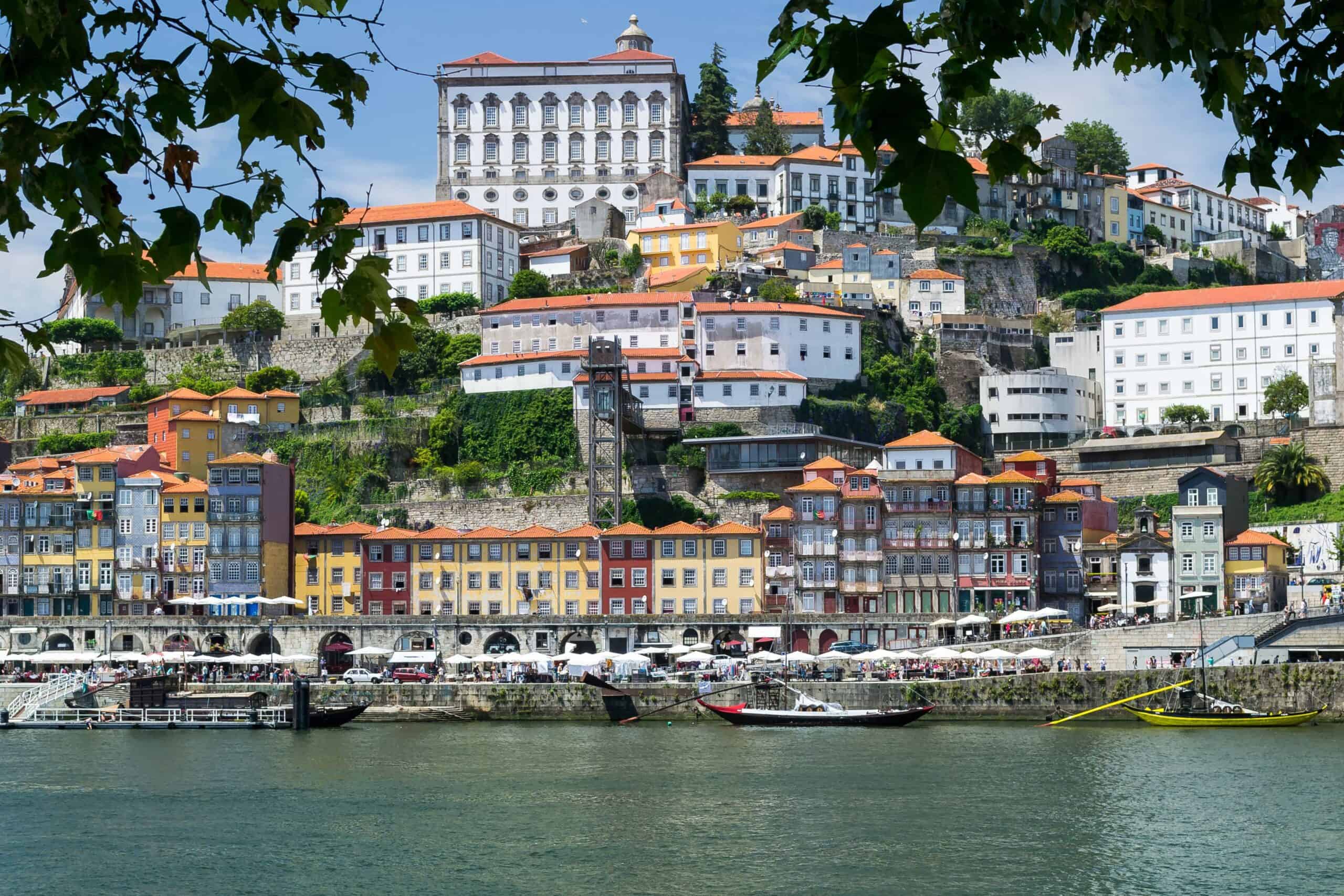
Porto, Portgual (photo: nathsegato, Pixabay)
Porto, Portugal (photo: nathsegato)

However, the traditional backpacking experience of traveling with just the essentials and camping in tents or sleeping in hostels might not be a fun experience for some people.

It is thus no surprise that there are backpackers who cheat when traveling to get a more comfortable experience - by hiring a cool campervan to explore their destinations, such as Portugal.

Campervan backpacking is a great experience, as it allows you to explore your favorite destinations from the comfort of an RV.

Below is a look at some of the top benefits of hiring a campervan in Portugal.

Table of Contents

  • Campervan Travel
    • 1. Comfortable and private accommodations
    • 2. Flexible itinerary and increased mobility
    • 3. Home-cooked meals
    • 4. Power for your devices
    • 5. No time wasted setting and packing up a camp

Campervan Travel

1. Comfortable and private accommodations

Camping can give you a thrilling, living-in-the-wild experience when you are backpacking through Portugal.

However, one of the things you have to contend with is sleeping on the ground, either in a sleeping bag or an air mattress.

And while it might be a fun experience, it can become quite uncomfortable over time.

Sleeping in hostels can also be a thrilling backpacking experience, but having to share your space with up to dozens of other travelers (strangers) can grow old quickly.

On top of that, you are likely to experience some backpacking hostel nightmares, such as dirty hostels, bed bugs, snoring roommates, stolen stuff, and more.

Backpacking in a campervan is thus a great way to avoid all of these uncomfortable situations.

To start with, you get a comfortable bed in your RV, where you can lie down at any time of the day or night.

You also get to enjoy a private and peaceful living space; you don't have to worry about sharing (with strangers), your stuff being stolen, unpleasant roommates, etc.

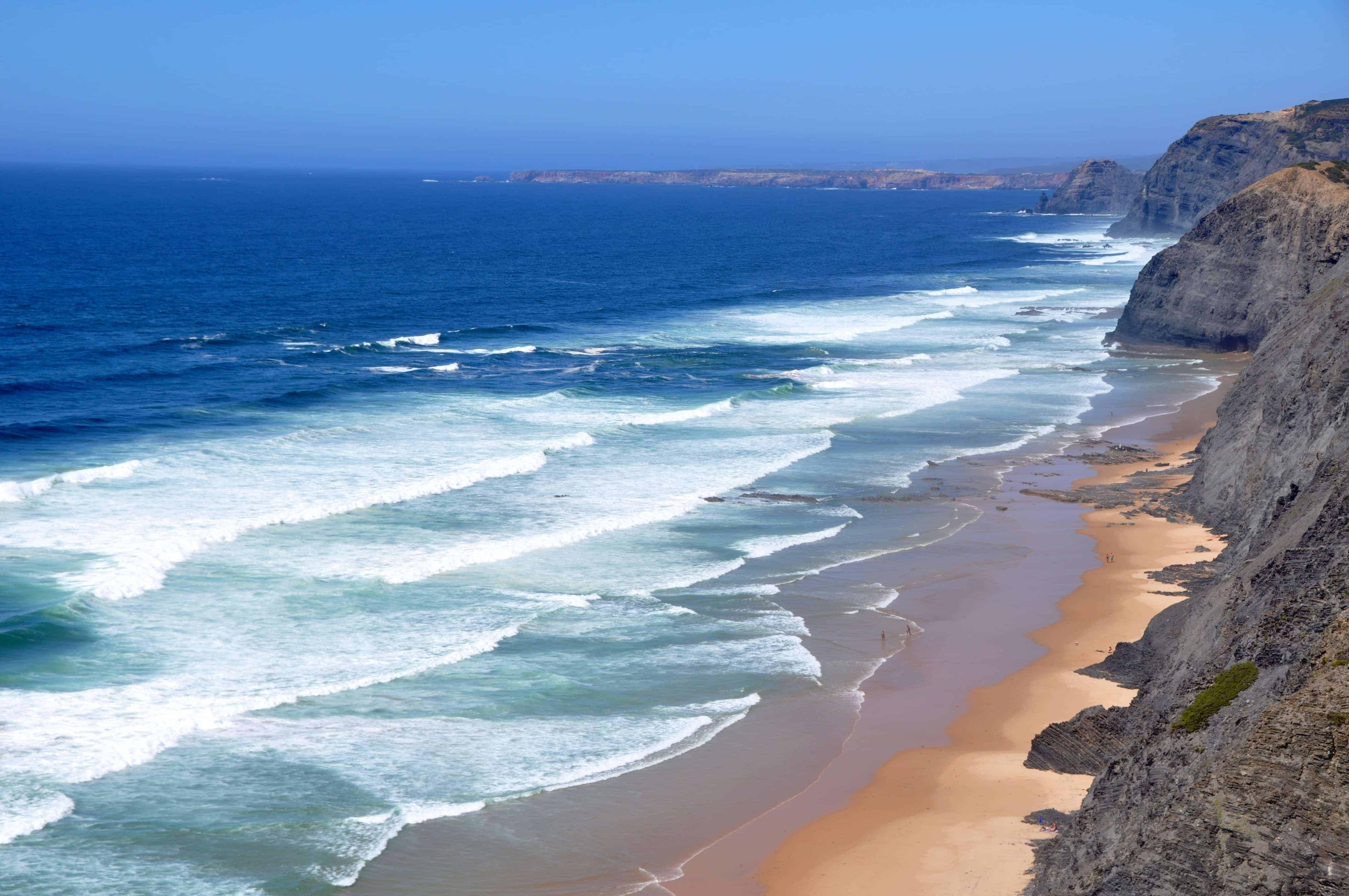
See the West Coast Algarve when you rent a campervan in Portugal (photo: Karl Egger, Pixabay)
West Coast Algarve (photo: Karl Egger)

2. Flexible itinerary and increased mobility

Another benefit of backpacking in a campervan is that it helps to make you more mobile and, at the same time, allows your itinerary to become more flexible.

The campervan offers you an easy way of getting around, where you don't have to rely on hectic public transportation or expensive (and sometimes unavailable) private transport.

With a campervan, you also get to travel to any destination you desire and at your own pace since you do not have to worry about departure and arrival schedules. Therefore, you can include any destination you want in your itinerary.

You can also modify your destinations as you desire - adding new destinations along the way and removing the ones you do not feel like visiting.

Another great thing about hiring a campervan when backpacking is that you can stop wherever you want.

If you come up across a beach on your way, you can stop for a few hours, enjoy the sun, swim, surf, and perhaps even camp.

You can also discover some hidden locations along your way and stop to explore them.

On top of that, you can stop and camp in the wild -- nature parks, close to hiking trails, fishing spots, and so on. You just need to make sure that you are not breaking any local regulations.

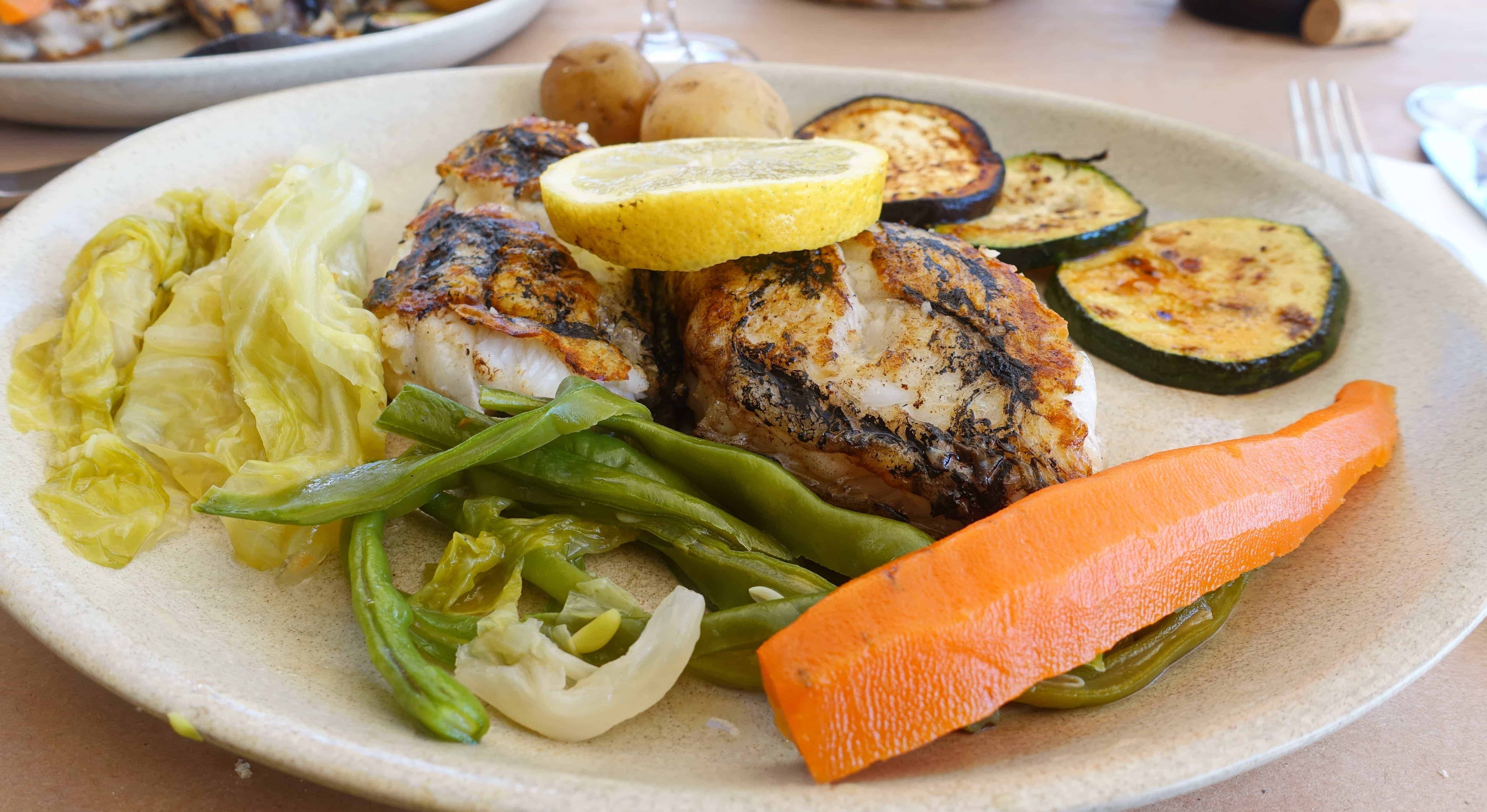
Fish and vegetables (photo: Mogens Petersen, Pixabay)
Fish and vegetables (photo: Mogens Petersen)

3. Home-cooked meals

Camping in tents or staying in a hostel during your backpacking vacation in Portugal can make it hard to prepare your meals.

To start with, some hostels might not have kitchen facilities and appliances.

As for camping, you must carry with you the appliances you need, which will only add weight to your backpack. And unless you hire a car, moving around with the extra stuff can be an inconvenience.

It is thus no surprise that most backpackers usually end up opting for restaurant meals, street food, and takeout, as opposed to cooking their meals.

Luckily, with a campervan, cooking homemade meals when backpacking is an easy task.

Most campervans in Portugal, especially modern ones, come with a fully functioning kitchen. Therefore, you can shop for foodstuffs and groceries and make your home-cooked meals.

This will help you to save money (on the usually expensive restaurant meals and takeout) while allowing you to enjoy healthy and delicious meals.

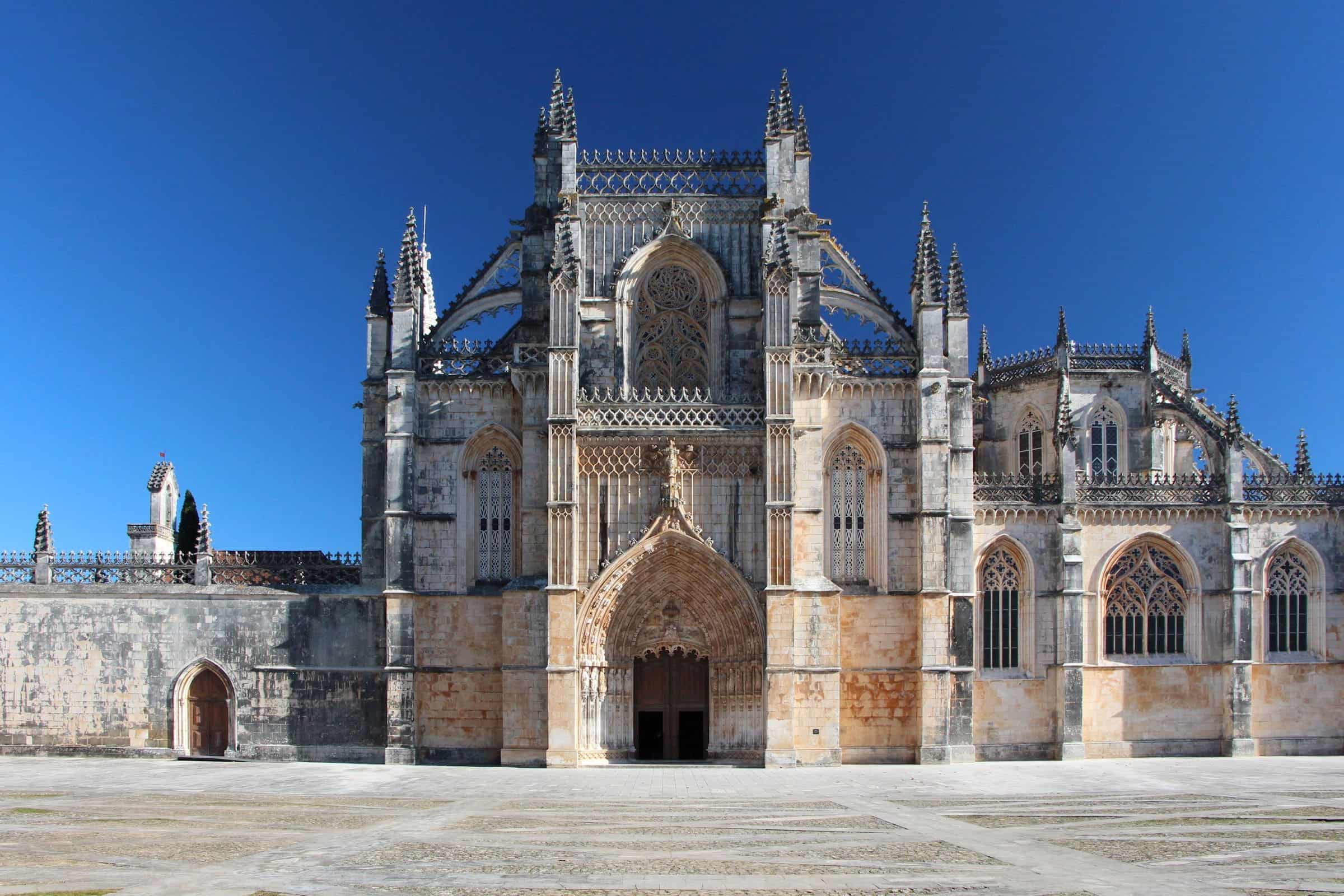
Monastery of Batalha (photo: Andrzej Stawujak, Pixabay)
Monastery of Batalha (photo: Andrzej Stawujak)

4. Power for your devices

If you decide to camp in a tent while backpacking through Portugal, one of the luxuries you might have to give up on is power for your devices.

The best you can do is carry a big power bank or portable solar panels to power your devices, but this will add to your luggage size.

Alternatively, you can seek out places with power along the way to charge your devices.

However, you might not always come across places to charge, especially if you are in a hurry or camping in remote areas. Traveling by campervan in Portugal can help to solve this problem.

Modern motorhomes come with solar power, and some even have generators and mains electricity connection (when comping in areas with electricity).

Therefore, regardless of where you are, you are guaranteed enough power for all of your devices.

As a result, you can bring along devices such as a laptop, tablet, smartphone, and camera.

With a campervan, you don't have to worry about being bored or not being able to capture memorable moments because your devices lose their charge.

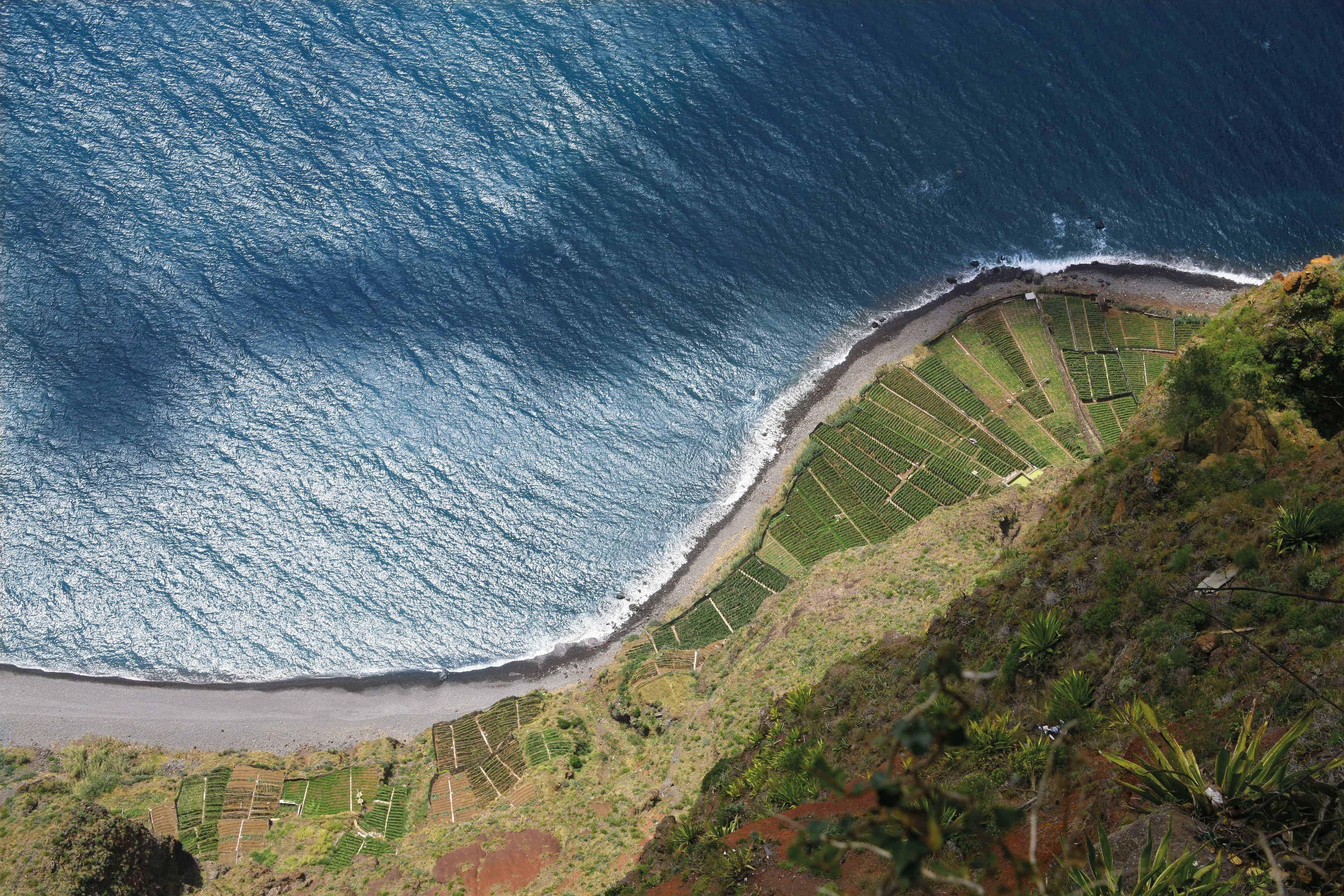
Madeira, Portugal (photo: Bischoff49 from Pixabay)
Madeira, Portugal (photo: Bischoff49)

5. No time wasted setting and packing up a camp

Another downside of opting to camp when backpacking is that you spend a lot of time searching for a campground and setting up a tent.

Also, when moving to the next destination, you have to pack up the camp and then begin the process all over again in the following location.

The time you take to set up and pack up your camp can eat into your vacation time, thus making you miss out on some amazing attractions.

This is why hiring a campervan for your backpacking vacation is such a great idea. With a campervan, you do not have to worry about setting up a camp and packing it up when you are done.

You simply stop where you want to spend the night, relax, and pick up again the following morning. While camping can be a fantastic experience when touring Portugal, it is not as comfortable.

If you are looking to enjoy some much-needed comfort during your backpacking trip, hiring a campervan in Portugal is the way to go.

From a comfortable bed, private living spaces, flexible itinerary, cheap and convenient transportation, and more, a campervan can make your vacation smooth and stress-free, thus ensuring that you enjoy it to the fullest.

_____

This story was brought to you in partnership with Siesta Campers.

5 Amazing Outdoor Places To See in Arizona

Arizona is the perfect place to go on vacation if you love the outdoors. The U.S. state is best known for being the home of the Grand Canyon, one of the world's seven natural wonders. But the Grand Canyon State, the nickname given to Arizona, has more going for it than this impressive attraction. Arizona has some of America's most scenic landscapes and many exhilarating outdoor activities. This article will show you some of the most beautiful places to see in Arizona and the activities you can do there.

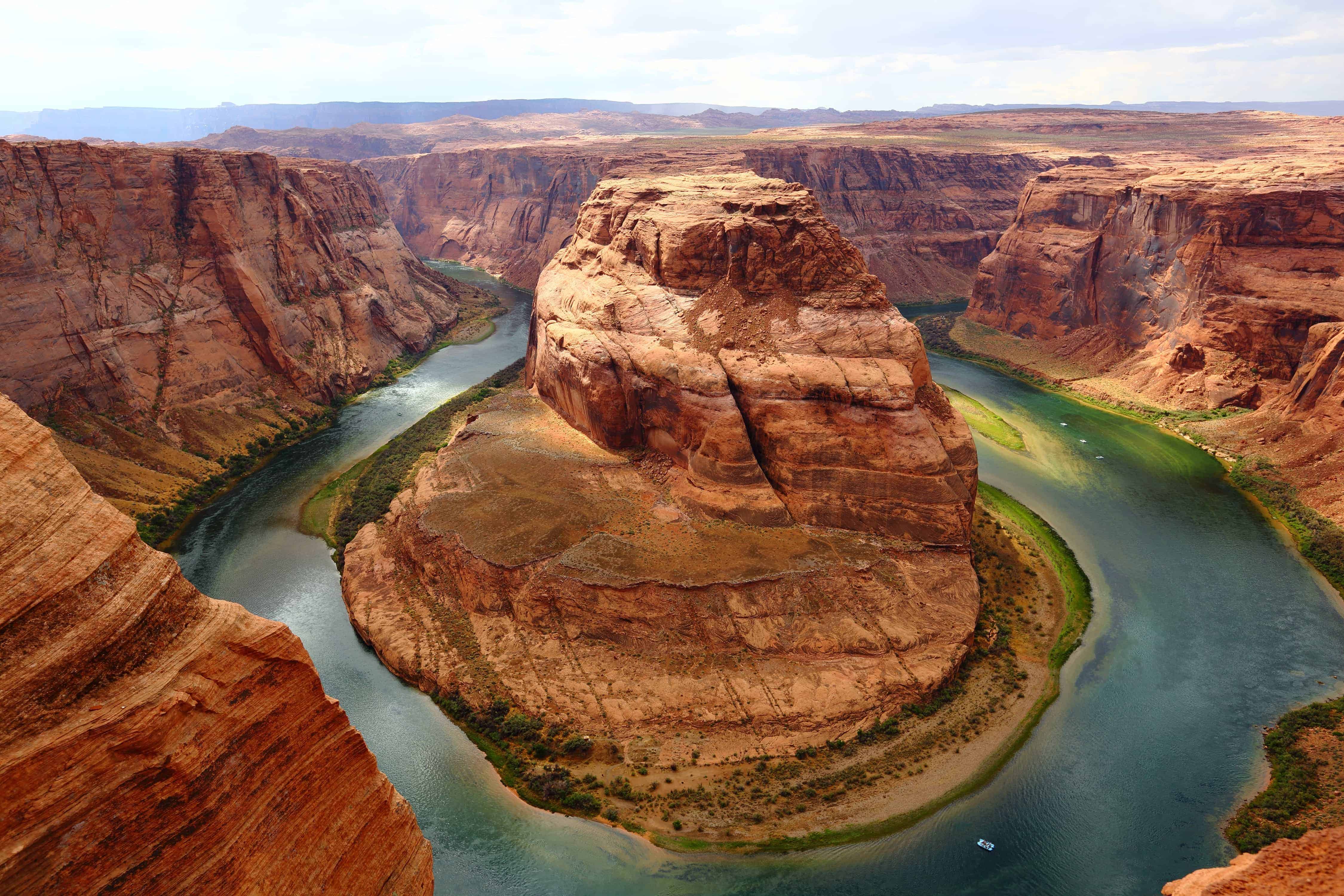
Horseshoe Bend in the Grand Canyon is one of the many amazing places to see in Arizona (photo: ? ?, Pixabay)
Horseshoe Bend - Grand Canyon 

Table of Contents

  • Where To Go in Arizona
    • 1. Grand Canyon National Park
    • 2. Lake Mead National Recreation Area
    • 3. Saguaro National Park
    • 4. Organ Pipe Cactus National Monument
    • 5. Petrified Forest National Park

Where To Go in Arizona

1. Grand Canyon National Park

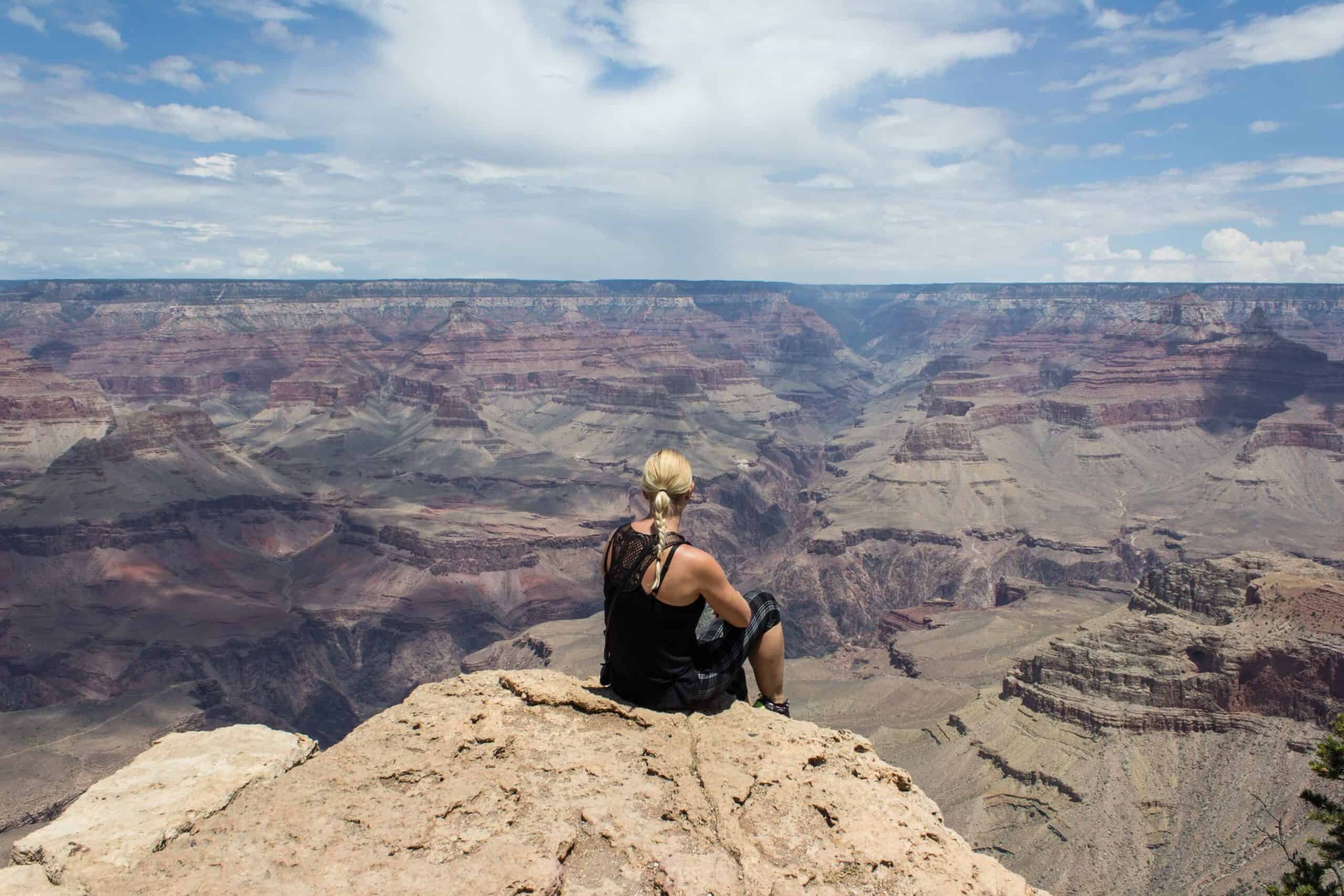
The Grand Canyon is Arizona's most visited tourist destination. Over 6.7 million people visit this out-of-this-world attraction each year. The canyon, which the Colorado River has carved out over millions of years, is now 277 miles (446 kilometers) long, close to 18 miles (29 kilometers) wide, and a mile (1.6 kilometers) deep. You must see it when you take your trip to Arizona.

The Grand Canyon has two sides: the South and North Rim. The South Rim receives more visitors and is open all year. Here, you can take guided canyon tours, drive up to overlooks that offer stunning views, or visit the museum to learn more about the attraction.

The North Rim is where you can access the highest elevations of the Grand Canyon. This side, however, is not open all year; from October to May, tourist access is limited primarily because of snow. Here are my favorite outdoor activities at the Grand Canyon.

A woman looking out over the Grand Canyon, an awe-inspiring place in Arizona (photo: Bettina Nørgaard, Pixabay)
Grand Canyon (photo: Bettina Nørgaard)

Hiking

You can explore various trails, and you don't have a pro hiker to do this. There are hiking routes for all skill levels. Arizona can be hot, especially during the summer, so if you plan to do some hiking, do it early in the morning or later in the afternoon when it's a bit cooler. Winter is often the best time for hiking.

Photography

You want to capture the magical beauty of the Grand Canyon; therefore, don't forget to carry your camera or phone to take plenty of pictures.

Whitewater rafting on the Colorado River

Camping at the park

The Grand Canyon National Park camping sites receive many tourists and locals. To ensure you get a place to camp, I suggest you book a space.

Take a helicopter tour of the canyon.

The aerial views of the Grand Canyon are fantastic; you'll love them.

Ride a mule

If you don't like hiking, you can cover the trails of the Grand Canyon on a mule.

2. Lake Mead National Recreation Area

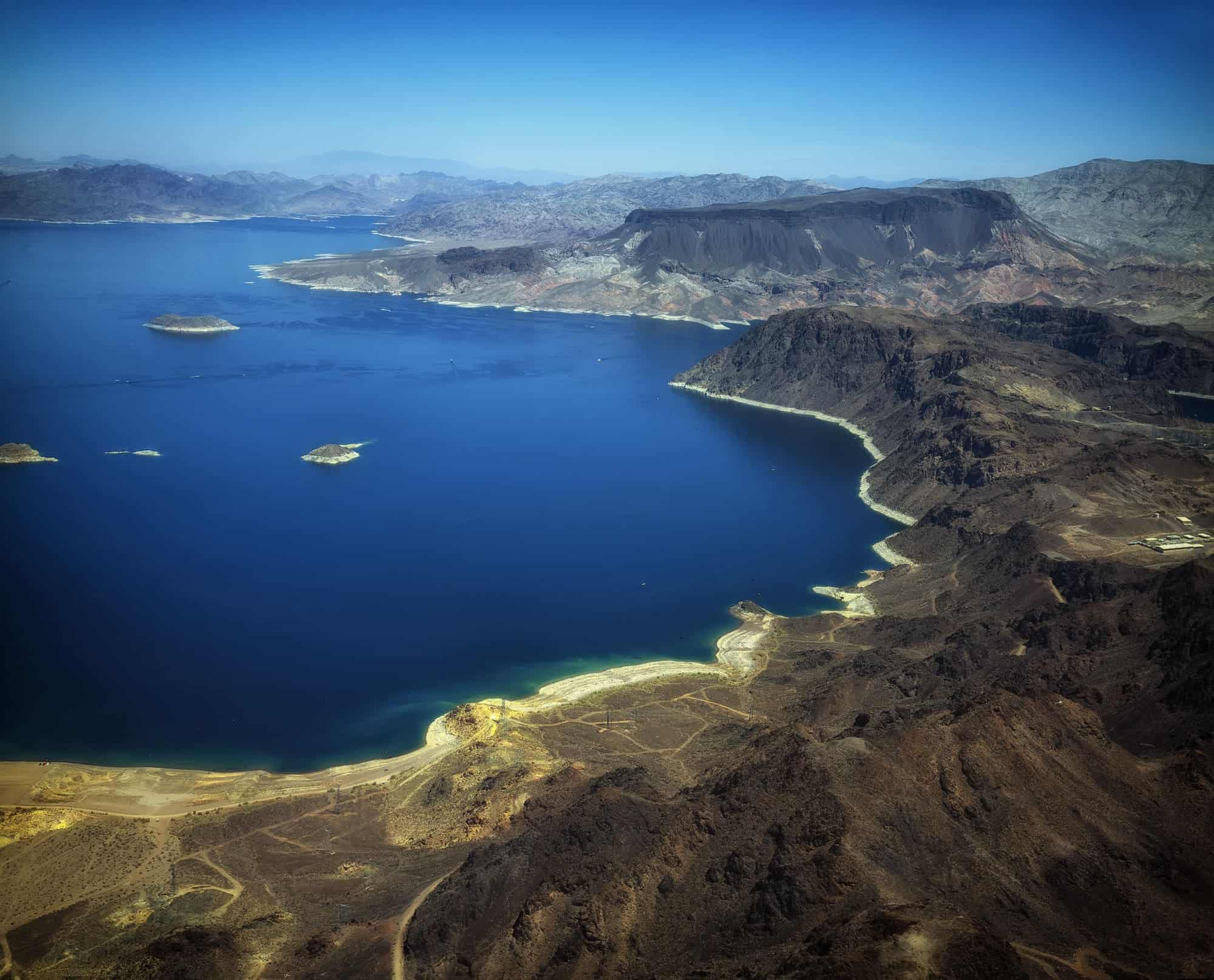
Lake Mead (photo: David Mark, Pixabay)
Lake Mead (photo: David Mark)

This lake covers over 1.5 million acres and has about nine trillion gallons of water. Its proximity to Hoover Dam and the Colorado River makes it the largest reservoir in the United States. You can do a lot at this attraction, such as swimming, sailing, water skiing, and fishing. Activities you can do off water include hiking, cycling, nature photography, and camping.

What I like about Lake Mead National Recreation Area is that if you want to be more adventurous instead of camping on the land, you can rent a houseboat and spend a couple of days living on the water.

3. Saguaro National Park

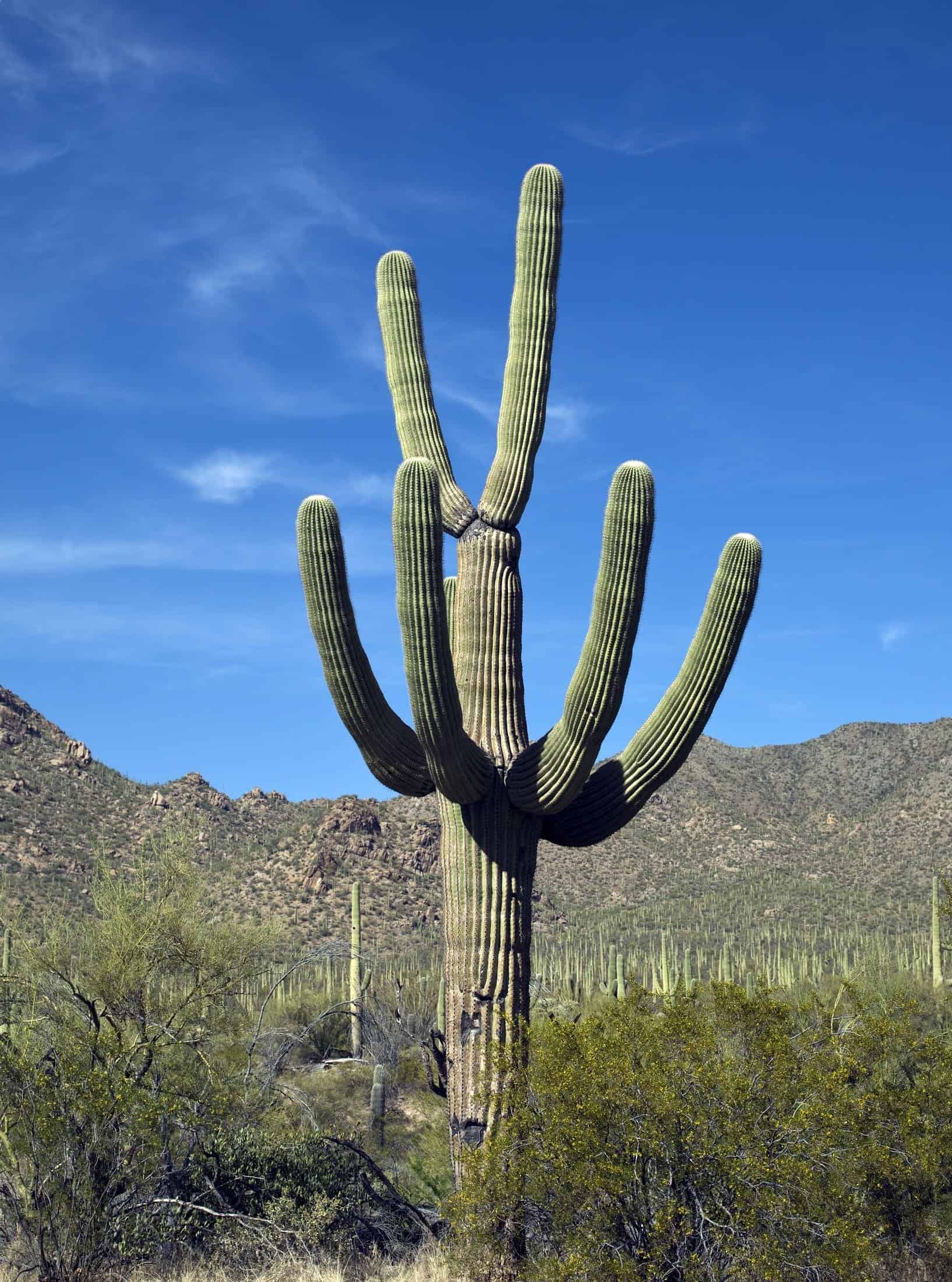
Saguaro cacti like you'll see in Arizona (photo: skeeze, Pixabay)
Saguaro cacti

This park is named after a rare cactus at the 92,000-acre national park. The saguaro cactus is tall, weighs several tons, and can live for over 250 years. The cactus only grows in small portions in Arizona and Mexico. Because of this fact, saguaros are protected by the state of Arizona. If you harm one in any way, you could be jailed or given a hefty fine.

So you can visit the Saguaro National Park to see these iconic cacti. The best time to visit the park is late May when the cacti bloom and produce beautiful flowers. While there, you can hike some of the 150 miles of well-maintained and marked trails. You can also spend a few days camping. The park has a desert climate, so bring lots of water.

4. Organ Pipe Cactus National Monument

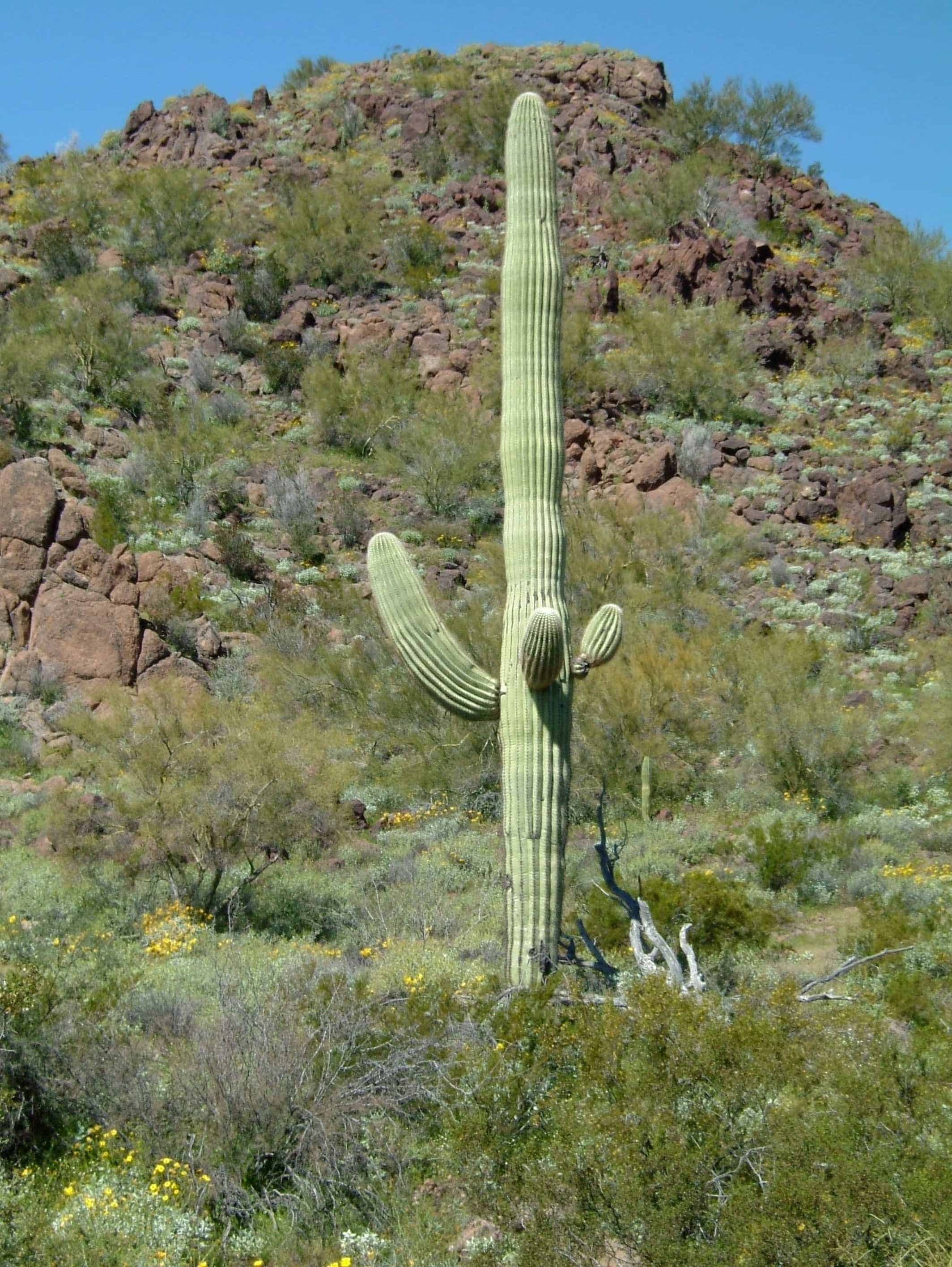
Organ Pipe Cactus (photo: kchild, Pixabay)
Organ Pipe Cactus (photo: kchild)

This park is close to the US-Mexico border, so as a backpacker, you can easily continue your international travels and visit Mexico after spending some time here. If you decide to cross the border, make sure your U.S. visa allows you to get back into the U.S. If it is about to expire, check how to renew EVUS online.

The attraction is named after a type of cactus, the organ pipe cactus, whose stems look like pipe organs. At this national monument, you can learn how plants and animals survive in the desert, take scenic drives, hike in the wilderness, or camp. I am sure all these activities will make any outdoor enthusiast more than happy.

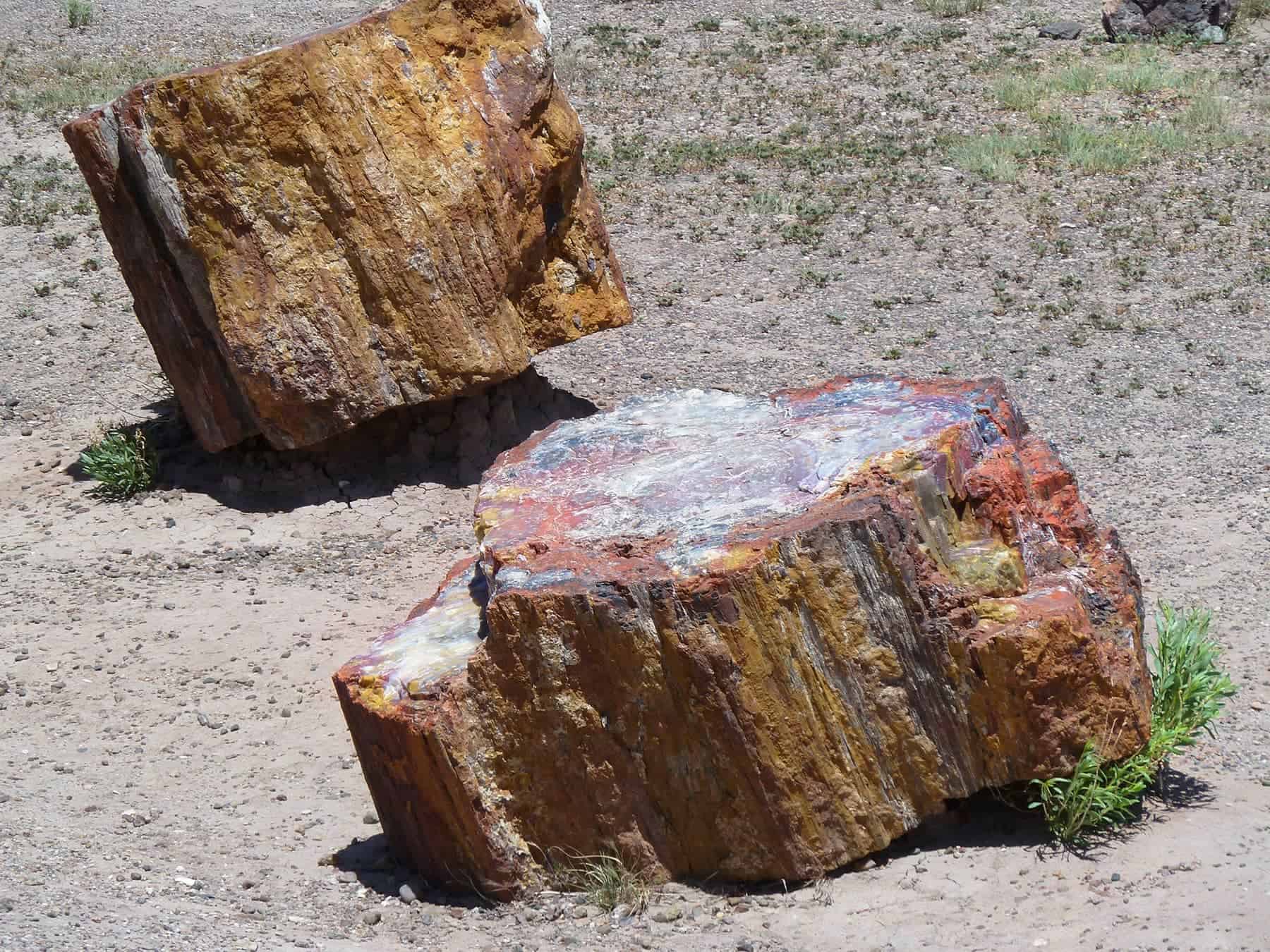
Petrified wood (photo: Brigitte Werner, Pixabay)
Petrified wood (photo: Brigitte Werner)

5. Petrified Forest National Park

What if I told you I had seen wood that turned into stone? You would probably say that is not possible. But that is precisely what you will see at this park: wood that has turned to stone.

This happens through a process called permineralization, where the organic materials of wood change over the years to create the stone. What is formed through this process is called petrified wood, and you can see a lot of it at Petrified Forest National Park.

At the park, you can also see fossils of dinosaurs; these creatures lived here millions of years ago. This is a beautiful place to put on your hiking boots and wander around, taking in the history. It is also a stunning location for photography.

Arizona has so many more places you can visit to enjoy nature. Other areas worth mentioning include:

  • Monument Valley
  • Oak Creek Canyon
  • Desert Botanical Gardens -- featuring over 20,000 plants
  • Canyon de Chelly National Monument
  • Hoover Dam -- built in the 1930s to control the Colorado River
  • Sonoran Desert
  • Wupatki and Sunset Crater National Monuments

Wherever you travel in Arizona, I hope you have a magical time being one with nature.

Barcelona on a Budget: A Guide to Save You Money

Barcelona is a city alive with culture, the streets buzzing with activity from morning till night; it's no wonder figuring out how to see Barcelona on a budget is a popular topic.

Versatile, Barcelona has something for everyone, but as with most European cities, visiting can leave you with a light wallet.

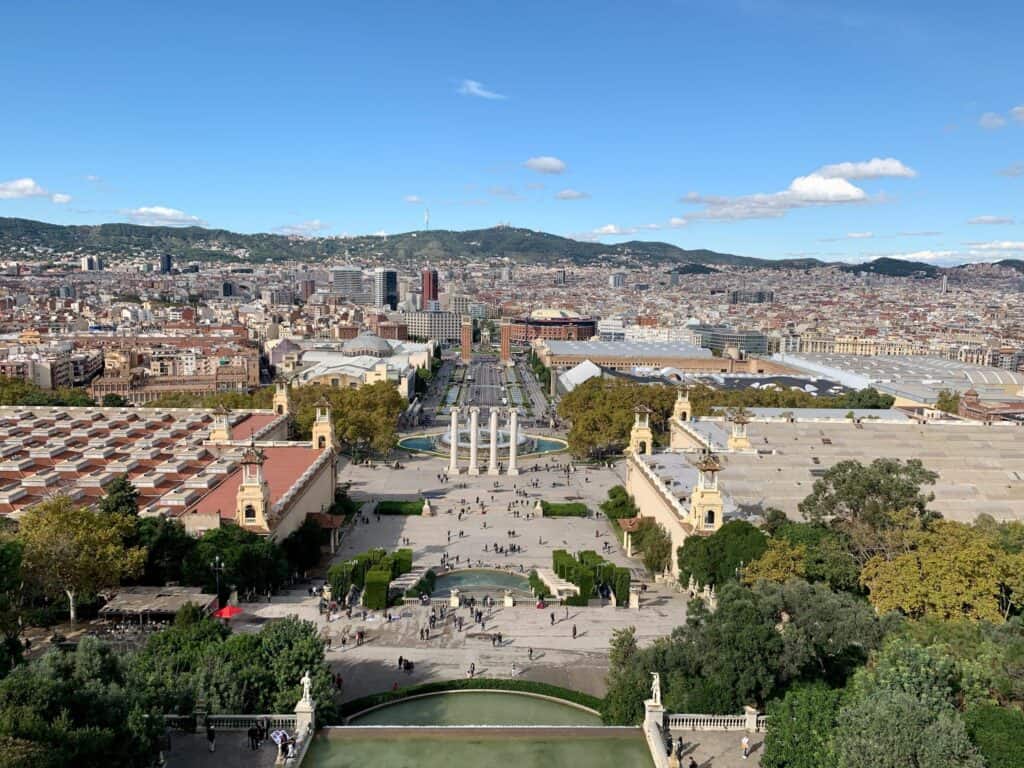
View of Barcelona from the roof of MNAC
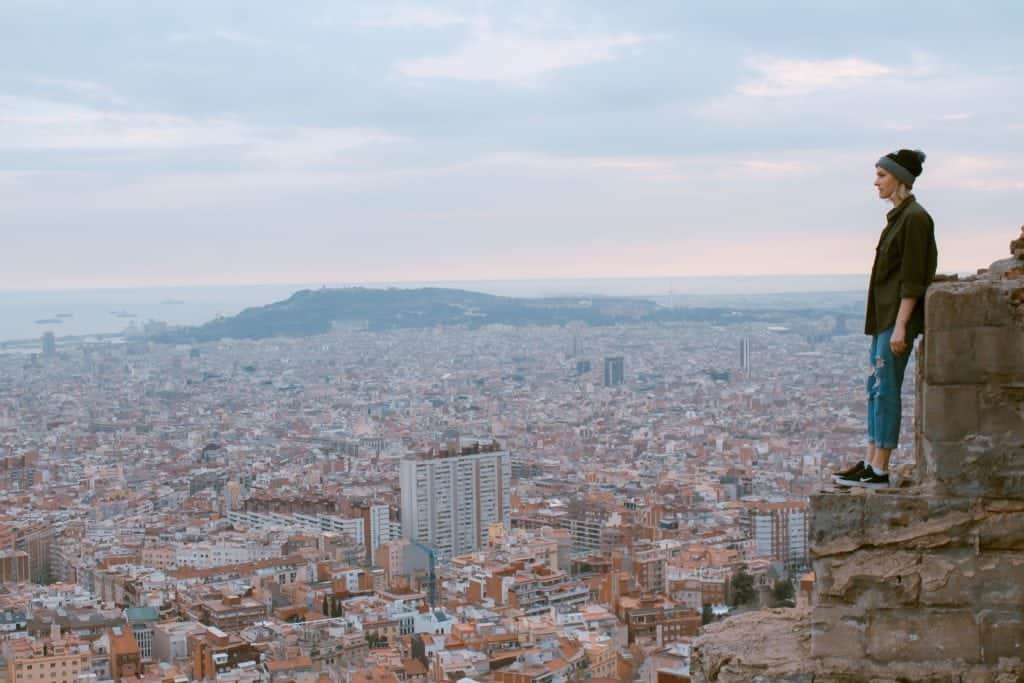
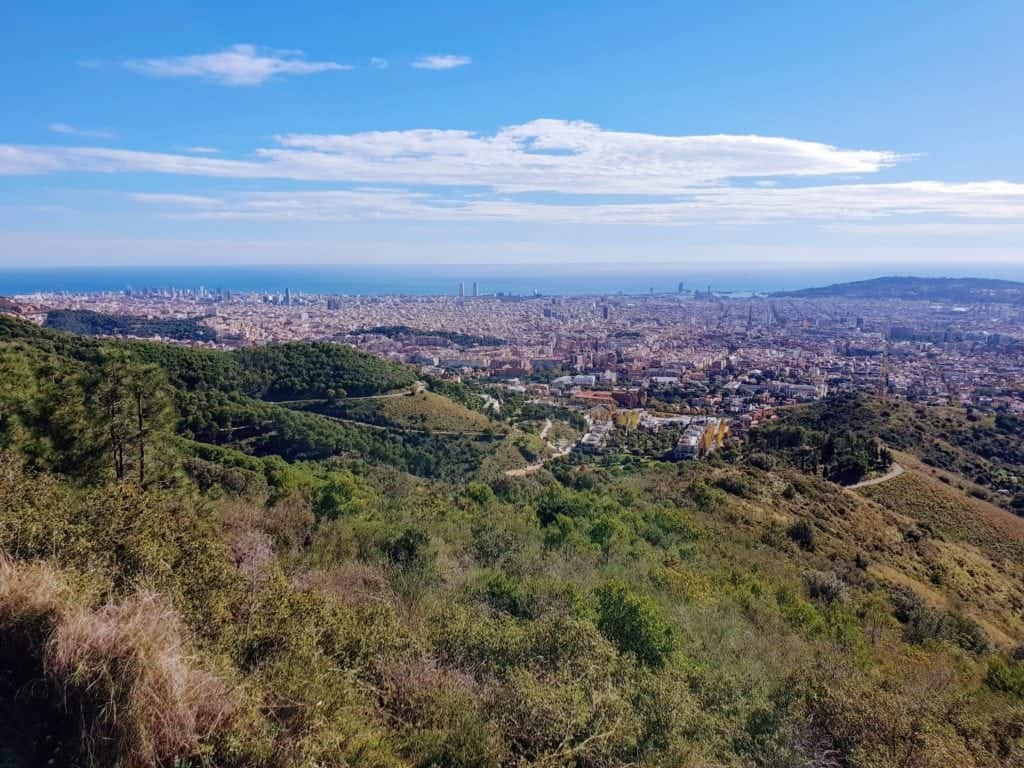
View of Barcelona from Museu Nacional D'Art De Catalunya (photo: Dave Lee)

I spent a year teaching just outside of Barcelona and often stayed in the city on weekends.

As an English teacher in Spain, I was paid more in experience than euros, so I quickly learned how to explore Barcelona on a budget. Here are my top tips!

Table of Contents

  • Save Money on Transport in Barcelona
    • Avoid Taxis - Take the Trains, Metro, and Walk
    • Purchase a T10 Ticket
    • Walk -- It's Free!
  • Avoid Hotels -- Book Hostels and Try Couchsurfing
  • Things to Do in Barcelona
    • Admire the Art from the Streets
    • Free Entry to Museums, Get Discounts if You Can
    • Enjoy an Afternoon in the Park
    • Make the Most of the Beach
    • Avoid the Tourist Traps
  • Know Where to Eat Cheaply
  • Research Free Events in Advance

Save Money on Transport in Barcelona

Avoid Taxis - Take the Trains, Metro, and Walk

Barcelona has an excellent public transport system. When you arrive at Barcelona International Airport, the closest airport to the city center, avoid the taxis and cross the enclosed footbridge to the train station.

The RENFE train runs every 30 minutes, and it's a 25-minute journey to Barcelona Sants.

Musicians often busk onboard, playing their guitars and saxophones from carriage to carriage - it's a brilliant way to start your trip by getting amongst the colorful locals.

It's €4.20 ($4.75) for a single ticket from the airport. Alternatively, you can purchase a T10 ticket - see below.

If necessary, you can lighten your load by taking advantage of Barcelona luggage storage services in train stations and around town.

Purchase a T10 Ticket

For travel around Barcelona, I found the most economical option to be the T10 ticket.

Available to purchase from all metro and train stations, it entitles you to 10 journeys within zone 1 of the city, which includes almost everything you'll want to see and do, including travel to and from the airport.

Providing you're willing to walk shorter distances, this should cover you for a weekend break. At only €10.20 ($11.50), it's a steal!

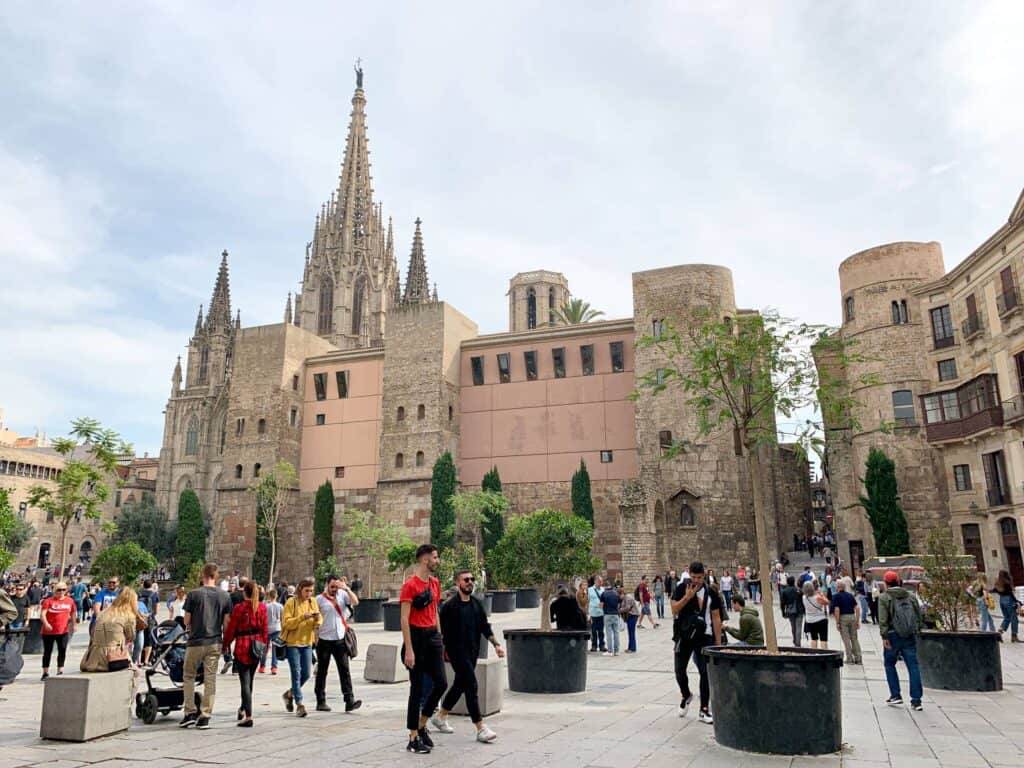
Gothic Quarter
Gothic Quarter (photo: Dave Lee)

Walk -- It's Free!

Not only does walking cost you nothing, but it's also by far the best way to see the city. Barcelona has a hidden treasure around every corner, and there are so many things you'll miss while on the metro.

Las Ramblas is the main wide walkway that snakes through the city. Brimming with market stalls and lined with tall trees that shade you on hot summer days, you can't visit Barcelona without taking a stroll down this iconic street.

Walking in and out of the alleyways to explore cafes and shops and grab a gelato at one of the many vendors is the perfect way to explore Barcelona.

Avoid Hotels -- Book Hostels and Try Couchsurfing

Barcelona has thousands of hotels and hostels, so selecting accommodation on a budget can prove challenging.

Hotels are often costly, particularly in the city center, so they are best avoided if you don't wish to spend lots of money on accommodation.

Search for hostels in advance as Barcelona is a popular city, and you may struggle to find a decent deal at short notice. If you don't fancy sharing, I often find deals on private rooms in hostels.

If you plan to venture out in the evening, pick somewhere near the city center to get home quickly at the night's end.

I often booked hostels in the Gothic Quarter as this is an ideal location for daytime sightseeing and nightlife.

If you've never Couchsurfed before, or even if you have, there are plenty of hosts in Barcelona offering free accommodation in many great locations.

Couchsurfing is also the perfect way to mix with fellow passionate travelers, as many hosts have been in your position and are often full of advice that hostels and tourist offices are unlikely to offer.

A fantastic tip for Couchsurfing is to take your host for dinner on the first night. It is a kind gesture, and they often tell you the best spots to visit for the rest of your stay - always listen to the locals!

See also: How to Find a Cheap Place to Stay

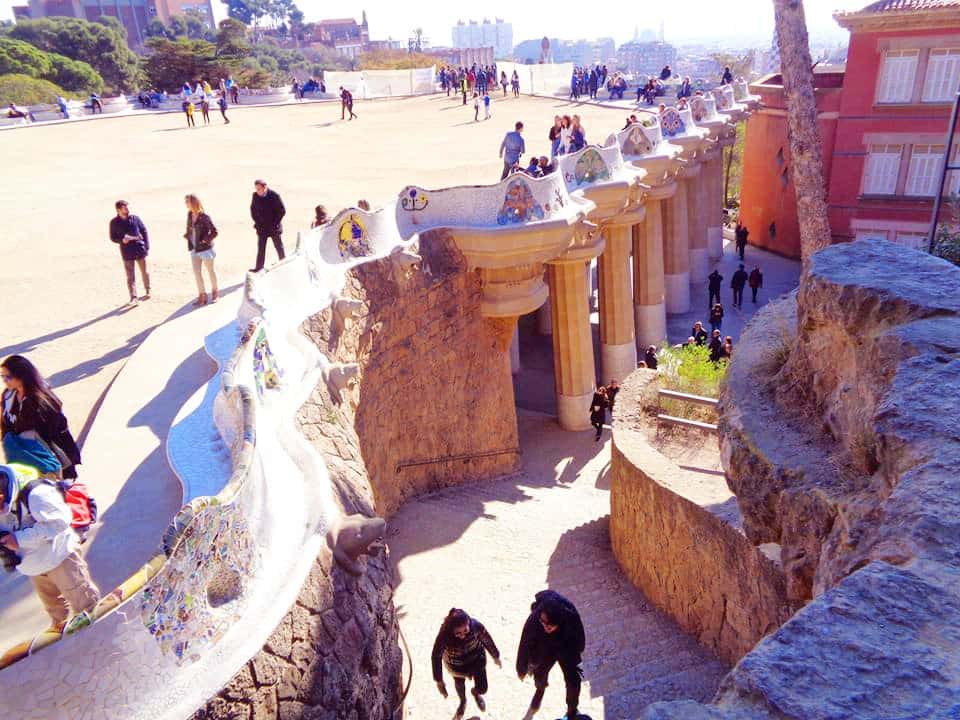
Park Guell
Park Guell

Things to Do in Barcelona

Admire the Art from the Streets

Barcelona is famous for its art scene, home to Picasso and a favorite haunt of Salvador Dali; it is second to none for all art lovers.

Though visiting galleries and museums can offer a fantastic insight into the history of some of its most famous artists, there's nothing like seeing their work in its raw form.

Admire it for free by walking down some of Barcelona's most famous streets.

View Gaudi's weird and wonderful architecture at Casa Batlló on Passeig de Gràcia or venture to Casa Milà, a modernist masterpiece strangely alluring in its peculiar aesthetic.

Park Güell can also be visited free of charge; though the Monumental Zone is ticketed, the park's sections can be explored freely.

Save money by avoiding the Güell bus and instead catch the Metro green line 3 to Lesseps station - although it is a 20-minute walk up lots of steps from here, it is included in your T10 ticket so it won't cost you anything extra.

Las Ramblas is also home to plenty of art, featuring work by Joan Miró, who gifted four public art pieces to the city.

Street artists El Pez and Xupet Negre have also left their mark throughout Barcelona, and the beach promenade and Gothic Quarter are full of street art from names big and small.

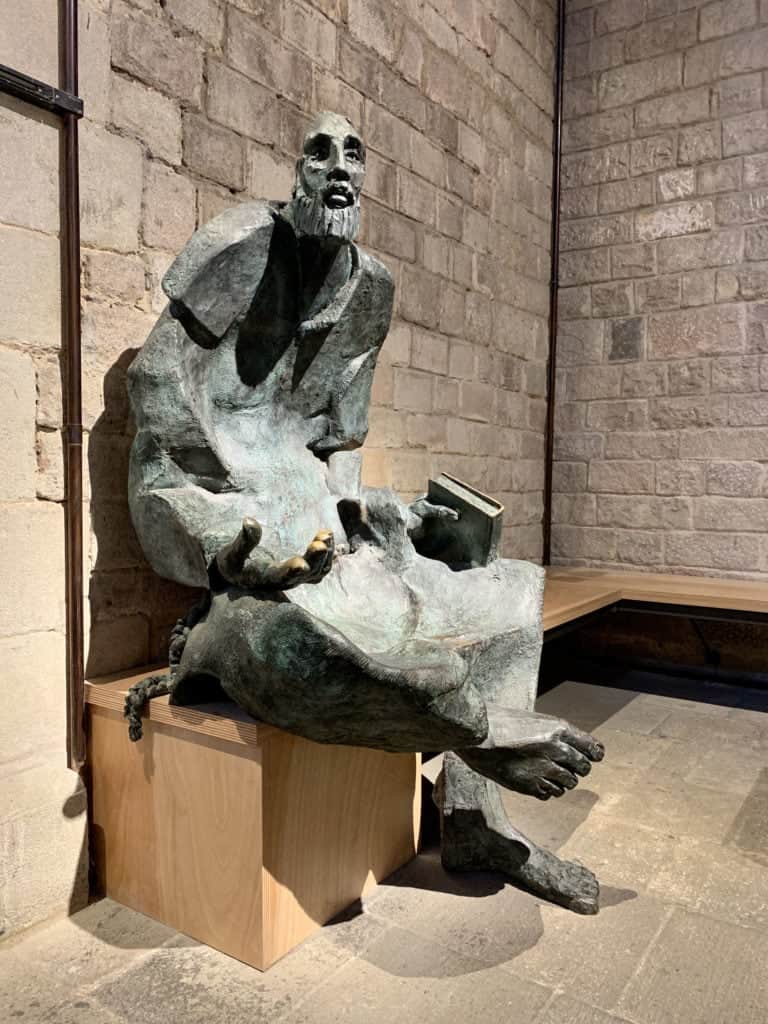
Sculpture in Basilica of Santa Maria del Mar
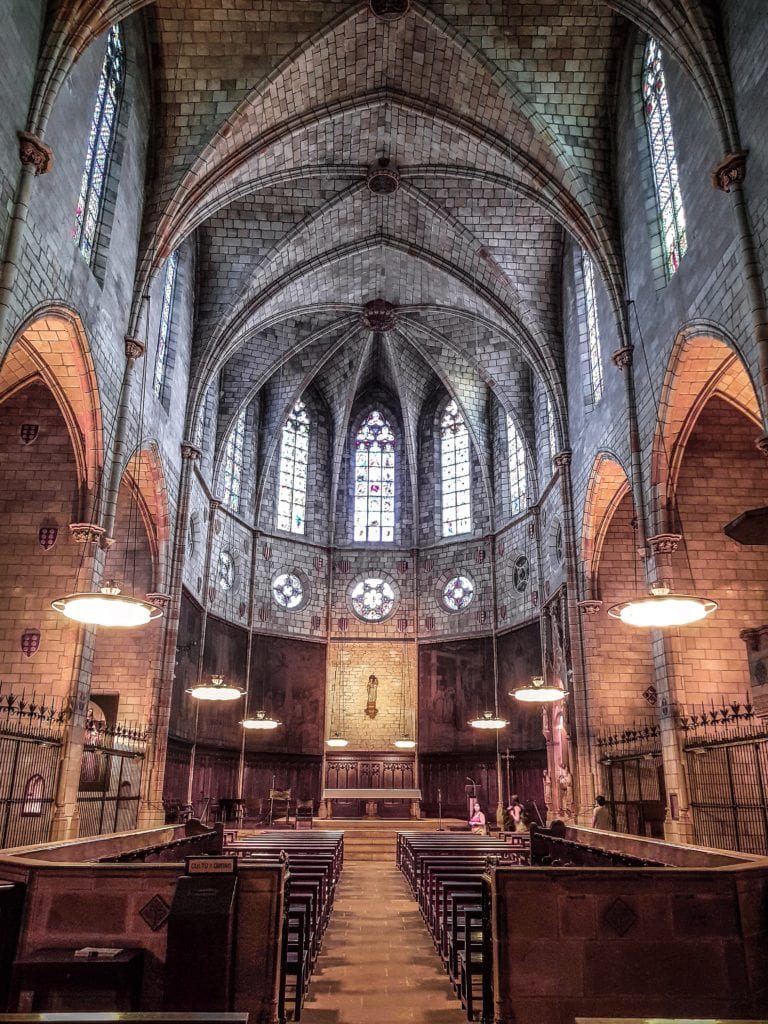
Sculpture in Basilica of Santa Maria del Mar (photo: Dave Lee)

Free Entry to Museums, Get Discounts if You Can

If you plan to visit any of Barcelona's museums and exhibitions, you will always save money by booking online.

Students, be sure to come with your student ID, and you'll most likely get around a fifty percent discount.

For those under 25 or over 60, you'll also be entitled to a discounted price at certain places, so bring proof of age.

If you happen to be visiting on the first Sunday of the month, many venues offer free entry for the main exhibits, so get there early to guarantee access.

You can't leave Barcelona without getting Sagrada Familia tickets. While regular admission is €15 ($17), you can gain free entry by attending one of the international masses if you get there early on a Sunday.

Don't expect a guided tour; however, this is a unique experience if you're respectful. Or admire the building's stunning exterior - which costs nothing!

Budget Tip: Save money in Barcelona with Go City. Buy a 1, 2, 3, or 5-day all-inclusive pass to enjoy tours, museums, and more at a discounted rate. Get your Go City pass here.

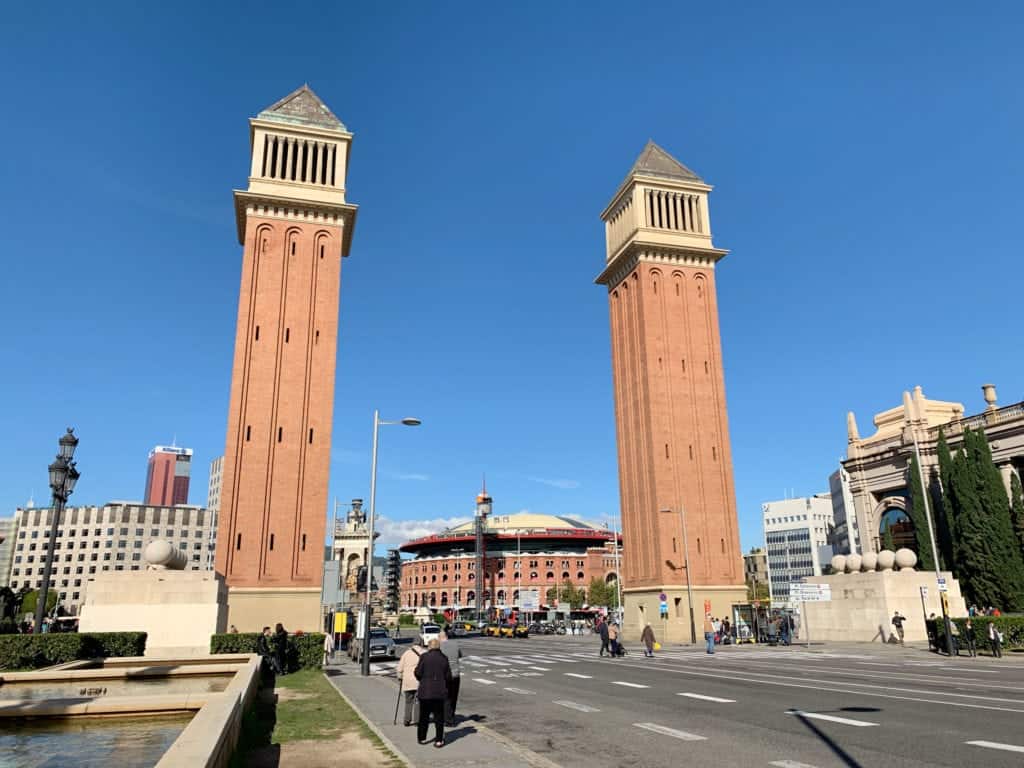
Venetian Towers at Placa d'Espanya
Venetian Towers at Placa d'Espanya (photo: Dave Lee)

Enjoy an Afternoon in the Park

Some of my most memorable afternoons in Barcelona were spent with a takeaway coffee in the city's prettiest parks.

If you are tired from a morning of sightseeing, pack a drink, a book, and something to sit on and sun yourself in the park.

Parc de Cervantes is one of my favorites, with tall trees for shade and a vast collection of picturesque roses.

The mountain-side park Mirador del Migdia is another must during your stay - quiet, it offers some of the city's best views, away from hordes of tourists.

Start at Plaça Espanya, take the stairs to the Museu Nacional D'Art De Catalunya (MNAC Museum), and walk up the hill.

It's a long but easy walk, best started in the early evening when the weather is cooler, and you can finish off by enjoying the sunset with panoramic views.

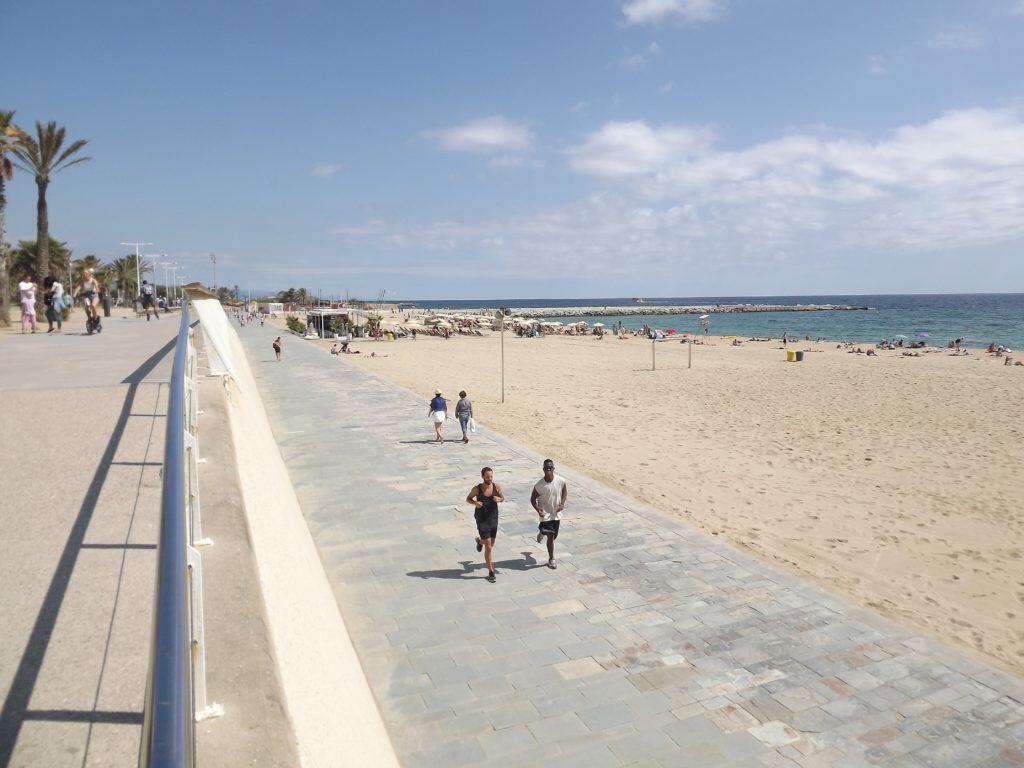
Beach in Barcelona (photo: Artepoli Pierre Rivero, Pixabay)
Beach in Barcelona (photo: Artepoli Pierre Rivero)

Make the Most of the Beach

One of Barcelona's greatest perks is the city's very own beach, just minutes away from the hustle and bustle of the center.

When I wanted to unwind from a day of sightseeing, I often enjoyed a swim, followed by a couple of hours of lazing on the beach.

Bring a towel and avoid getting caught out by the many vendors wandering up and down the shoreline, selling drinks.

Instead, go to the local supermarket and fill up a backpack with whatever tipple you fancy, even if it's just water.

Though many beach bars look enticing, they often charge a premium for their location, so they are best avoided unless you fancy treating yourself.

Avoid the Tourist Traps

While there are lots of places worth visiting during your time in Barcelona, there are also a few to avoid if you wish to value your time and money.

Barcelona's aquarium is heavily advertised, but with an entrance fee of €21 ($23.70) for an adult; even if you have kids, I recommend taking them to any free spectacles the city offers.

This includes the colorful nighttime fountain show at Plaça d'Espanya (most evenings every 30 minutes) or a walk around the labyrinth at Horta Park (free on Wednesdays and Sundays).

Another venue to be sure to avoid if you don't fancy splashing the cash is Plaza Monumental de Barcelona.

While the outside is impressive and worth a look at, it was the last commercially run bullfighting ring to operate in Catalonia before the ban; the inside is simply an overpriced shopping center.

Don't fall prey to buying souvenirs here or any other of the gimmicky tourist shops.

Instead, grab a bargain at Mercat dels Encants - one of Europe's largest flea markets. It has anything and everything you can think of for unbelievably low prices.

Related: Off the Beaten Track in Barcelona

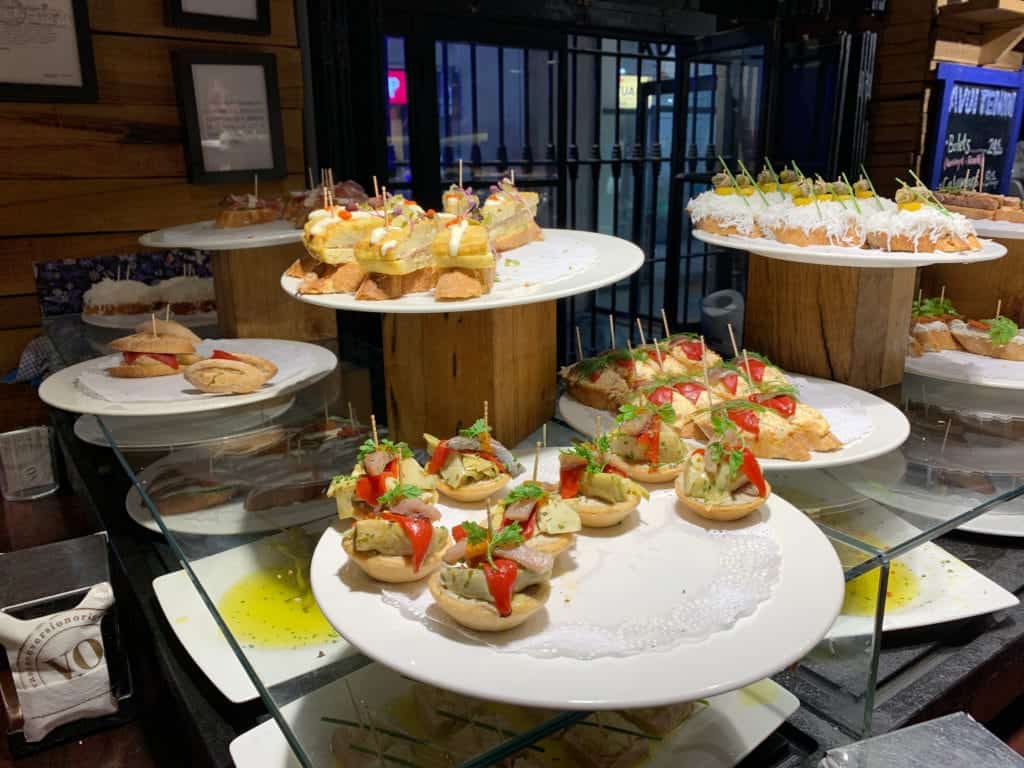
Pintxos
Pintxos (photo: Dave Lee)

Know Where to Eat Cheaply

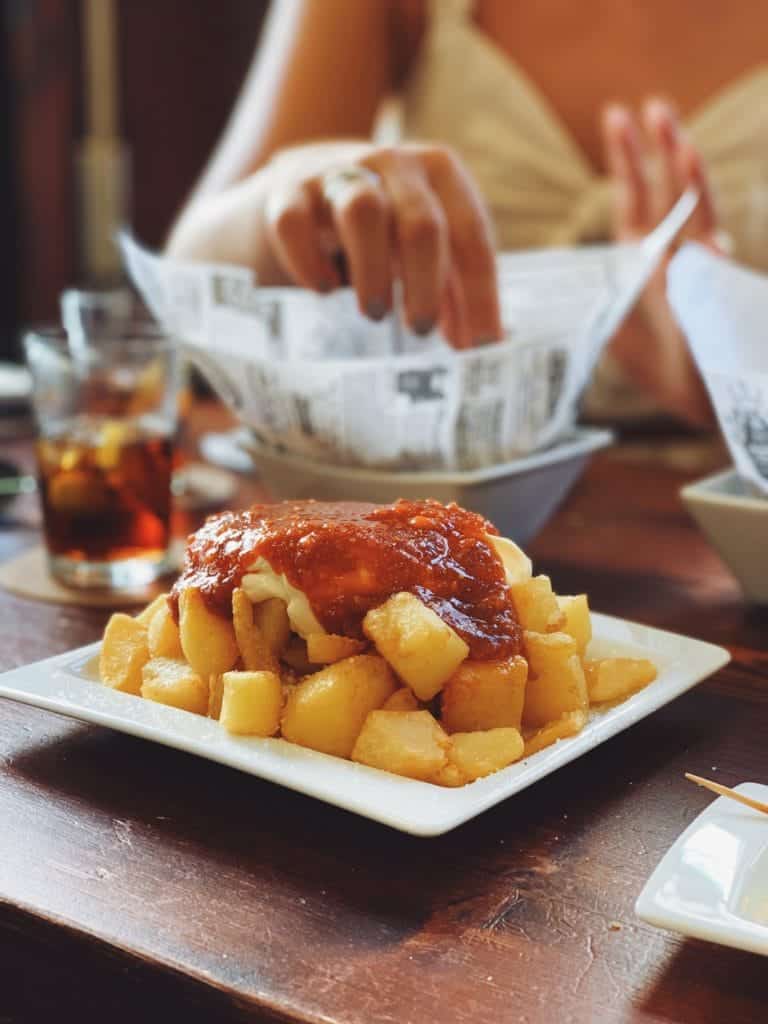
Barcelona is a cosmopolitan city; the choice of food is vast, and your price varies hugely. Pintxos are the ideal way to try Spanish cuisine.

Stop off at almost any bar, and they will offer a menu featuring a variety of pintxos - the name refers to the cocktail stick the food is spiked with; these are then counted after you've eaten, totaling up your bill.

These small snacks can be anything from small Spanish omelets to muscles - they are just delicious, and at as little as €1 ($1.12), they don't break the bank.

Taberna Blai Tonight, on Carrer de Blai, is a tasty and popular choice with great sangria.

Many restaurants approaching the beach also have fantastic deals at lunchtime - they advertise their set menus on boards outside, allowing you to decide if you fancy what's on offer.

You can indulge in a three-course meal for around €15 ($17), including a drink. I was never disappointed with the delicious seafood, so be sure to try it yourself.

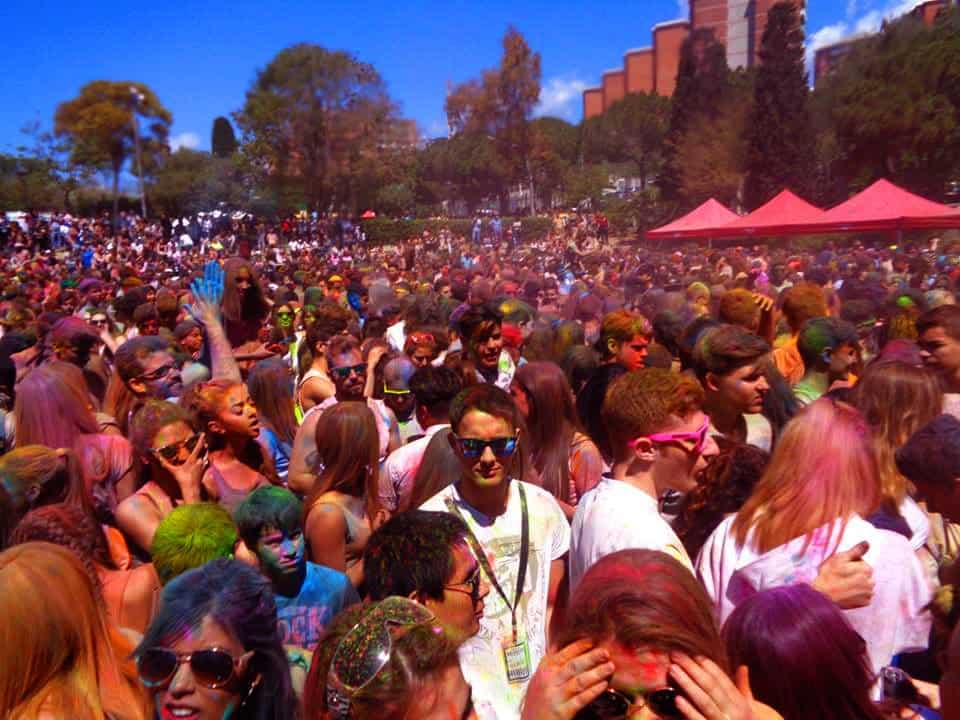
Holi Festival of Colour

Research Free Events in Advance

Barcelona has a calendar full of free and low-cost events, which can be a fun addition to your stay.

You can soak up Barcelona's culture and meet new people from Blues festivals and fairs to slam poetry events and outside music festivals.

Do a quick search online to see which events take your fancy before you leave, then plan one of your days or nights around the event.

One of my favorites was the Holi Festival of Colour - Barcelona's version of India's Hindu festival. Grab some powder paint, get creative, and have a good old dance amongst the crowds.

So be sure to pick Barcelona for your next European city break and use these top tips to do Barcelona on a budget!

Canadian Grand Prix: Attending an F1 Race in Montreal

In June, I flew to Montreal to attend the Formula 1 Canadian Grand Prix, visit my friend Jodi, and get to know the city better. Before moving to Austin, Texas, I wasn't familiar with F1 racing, and the idea of traveling to see a car race had never occurred to me.

Dave pictured with a giant F1 sign at the Canadian Grand Prix.

I'd visited Monaco and seen the famous Fairmount hairpin turn, but only because it's where I got picked up for my Ferrari driving experience.

Austin, however, hosts the annual US Grand Prix every October, so I've been twice now with a friend who is a huge racing fan.

Experiencing a Formula 1 race in person doesn't get any cheaper than watching it in your city for the cost of a general admission ticket ($100) and an Uber ride.

The weather was beautiful for both races, and while I didn't have a favorite driver or team, it was a fun way to spend a Sunday afternoon. What began as a curiosity in my backyard became a growing interest in following Formula 1. 

Naturally, I began thinking about where else to watch a race without breaking the bank. Montreal and Mexico City made the most sense.

I first visited Montreal in the spring of 2016, a month after moving to Austin, and loved it. I'd wanted to go back ever since.

The Canadian GP motivated me to book a flight, and I was also excited to check out more restaurants for my food blog.

Once I decided to see my first Formula 1 race in another country, it was time to do research. Beyond watching races and documentaries, I also started looking for F1 travel tips to understand ticket options, race-day logistics, and which cities make the most sense for first-time fans.

Then I watched "Formula 1: Drive to Survive" on Netflix. This beautifully shot series takes you behind the scenes of F1 race seasons as you get to know the teams and drivers. Learning the backstories, drama, and politics of the sport further increased my interest. 

I also watched "Senna," an incredible documentary about Brazilian driver Ayrton Senna, a three-time F1 champion, who died tragically in a race crash at 34.

Now that you understand where I'm coming from, let's head to Montreal for a taste of Canadian Grand Prix weekend. 

Table of Contents

  • Arriving in Montreal
  • Pre-Race Events
  • Formula 1 Canadian Grand Prix
    • Food
    • Fan Zone
    • Views from General Admission 
    • View from Grandstand 34
    • Watching the Canadian Grand Prix
    • Leaving the Race
  • Plan Your Canadian Grand Prix Weekend
    • Tickets 
    • Where to Stay
    • Where To Eat

Arriving in Montreal

Lewis Hamilton's F1 Mercedes
Lewis Hamilton's F1 car outside the Ritz Carlton

I used points from travel hacking to book a United Airlines flight from Austin to Montreal, arriving on Wednesday.

This gave me three full days to explore the city, try some restaurants, and see my friend before race weekend.

I stayed at the Hotel M Montreal in the Gay Village neighborhood. Several guys in my dorm were also in town for the Formula 1 race.

It was more of a boutique hostel than a hotel, and only a few minutes' walk to the metro. And from there, the racetrack was just one stop away. 

I learned there was overlap between race fans and foodies when I met another American F1 fan while dining at Joe Beef, a favorite of Anthony Bourdain.

The next night, I ran into him again at Au Pied de Cochon, where I met a California woman in town for the race.

Related: Ferrari Museum in Maranello

Pre-Race Events

Montreal F1 fan zone

Events related to the Canadian Grand Prix began Thursday evening, with the track opening to ticketholders on Friday. Tickets are sold by the day, and I only bought a ticket for the final race on Sunday. 

At least one of the guys in my dorm bought a 3-day race ticket entitling him to all the events at the racetrack, including:

  • Driver practice sessions on Friday.
  • Qualifying sessions on Saturday.
  • The race on Sunday.

In addition to watching the drivers, there were many Porsche and Ferrari driving challenges on the track and F1 experiences for fans at the Monster Energy Compound, like skateboard and freestyle moto demos, DJs, and live music.

I spent the day before the race visiting my friend and checking out the scene on Crescent Street in downtown Montreal. 

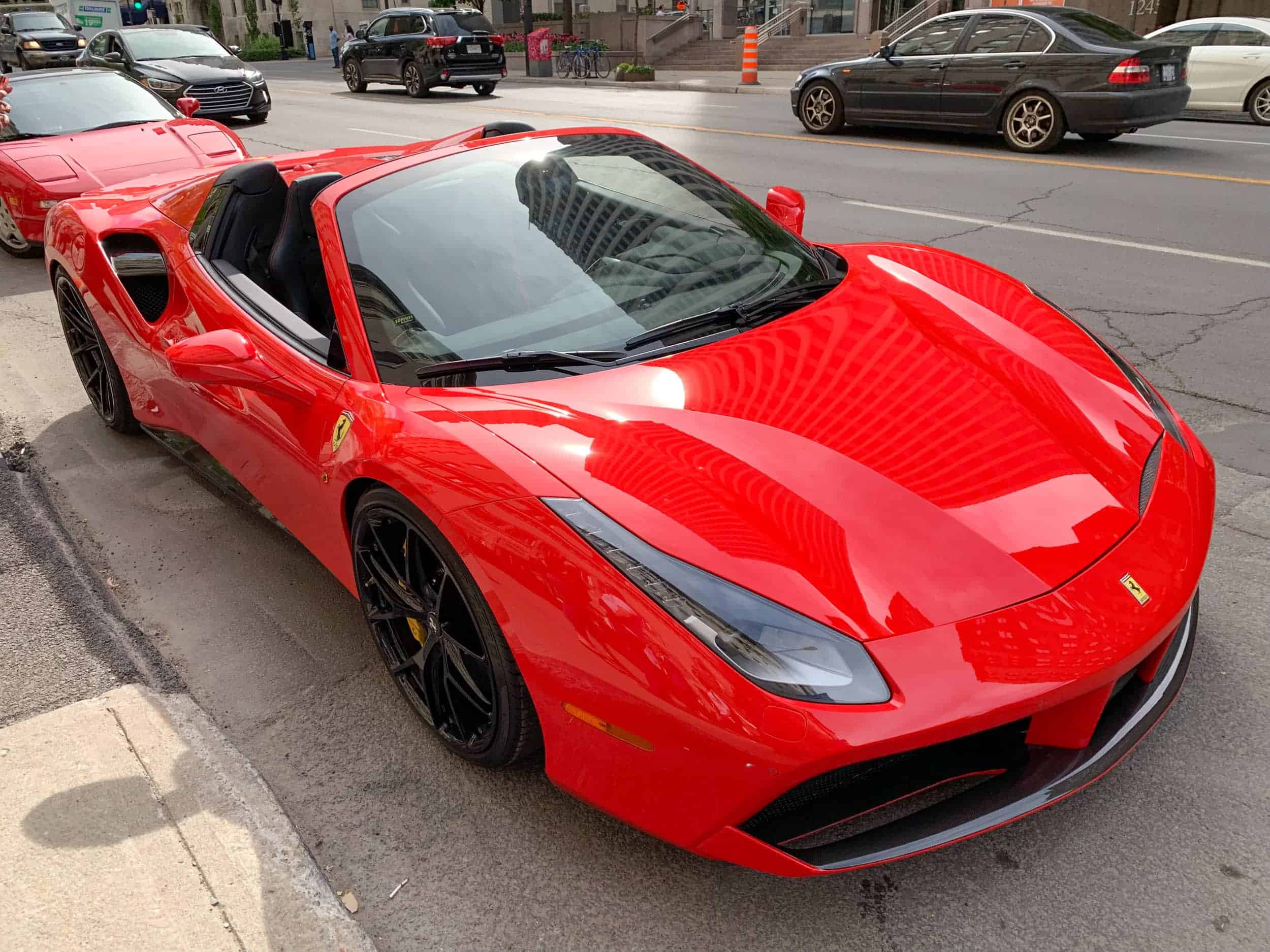
I spotted one of Lewis Hamilton's old F1 race cars on display outside the Ritz Carlton, and a pristine red Ferrari 488 Spider like the one I drove in Maranello.

Ferrari 488 Spider
Ferrari 488 Spider

The Crescent Festival, celebrating the Canadian Grand Prix, was in its 20th year. A DJ was performing, and the streets were full of race fans and curious locals wandering about. 

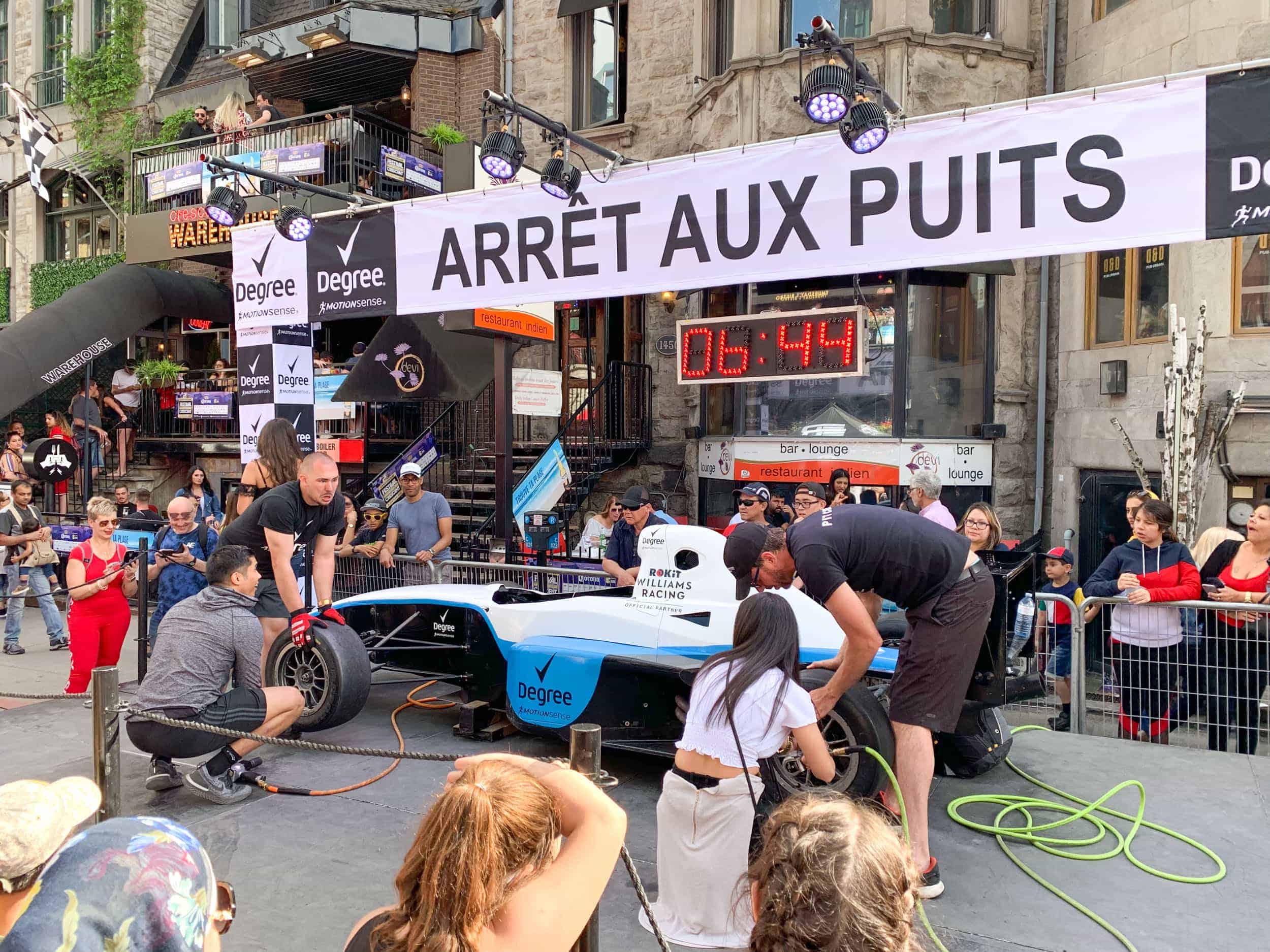
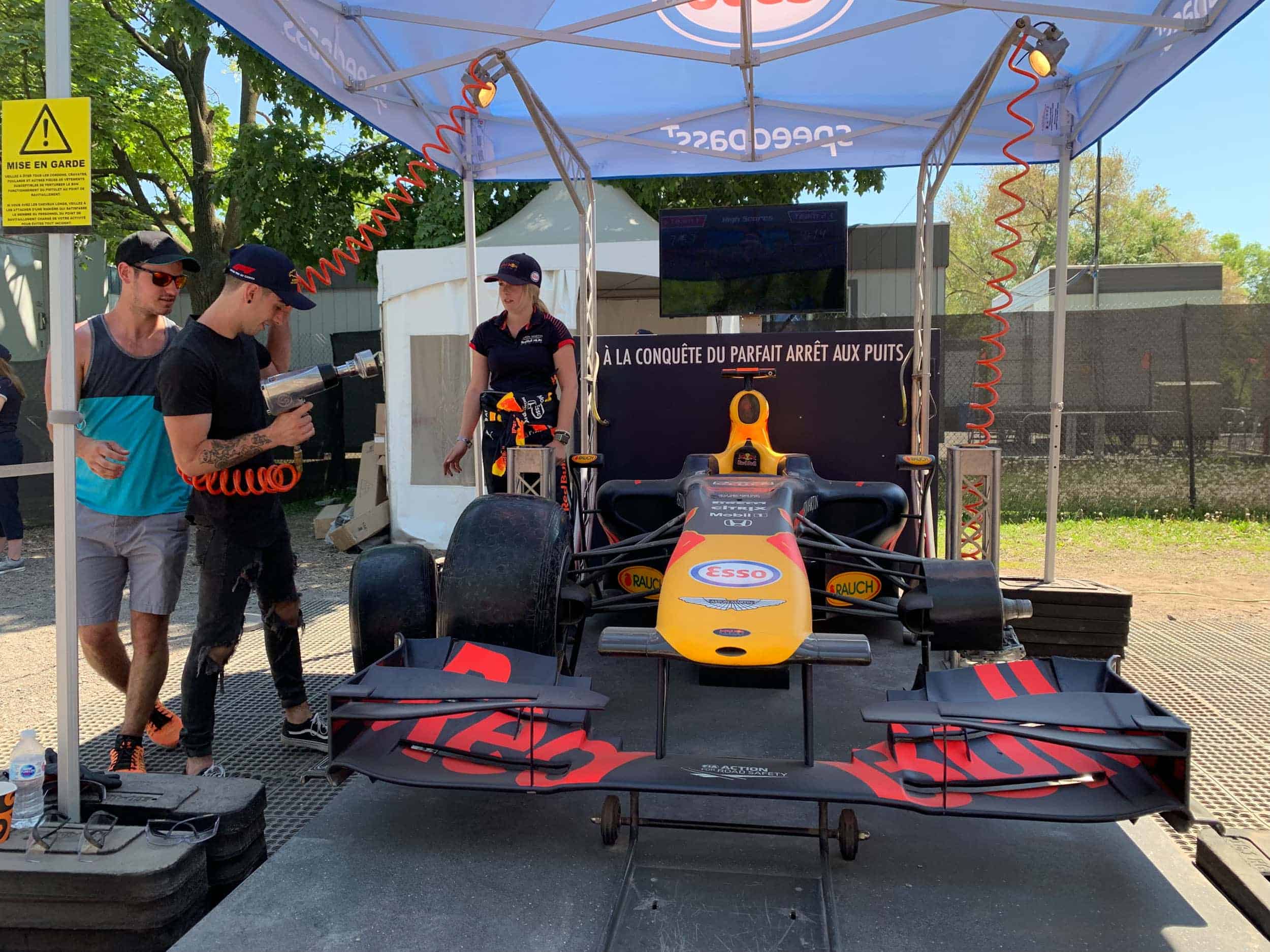
There was a pit-lane challenge where you could try to use the machines to change F1 car tires. And at least two Lamborghinis were on display, one white and one purple with white rims.

F1 pit stop challenge
Lamborghini
Lamborghini

The festival also featured many food stalls, and there was easy access to the neighborhood restaurants. I knew race day would involve large crowds, so I didn't linger long at this event. 

Formula 1 Canadian Grand Prix

Arriving at Circuit Gilles Villeneuve for the Canadian Grand Prix.
Arriving at Circuit Gilles Villeneuve

Sunday morning was the big day, and arriving at the Circuit Gilles Villeneuve from the Hotel M Montreal couldn't have been easier. 

I walked five minutes to the Berri-UQAM metro station and took the train to Jean-Drapeau, one stop away. This metro station is on St. Helen's Island, in the middle of the St. Lawrence River. 

One of the first things you see as you exit the metro is a geodesic dome built for the 1967 World Expo, which is now part of the Biosphere Environmental Museum.

The Circuit Gilles-Villeneuve is on a second island, accessible on foot from the metro station. 

Walking from the Jean-Drapeau metro station to the racetrack, including passing through security and crossing a bridge over the St Lawrence River, only takes 15 minutes. 

I arrived two and a half hours before the race, leaving plenty of time to walk around. 

Food

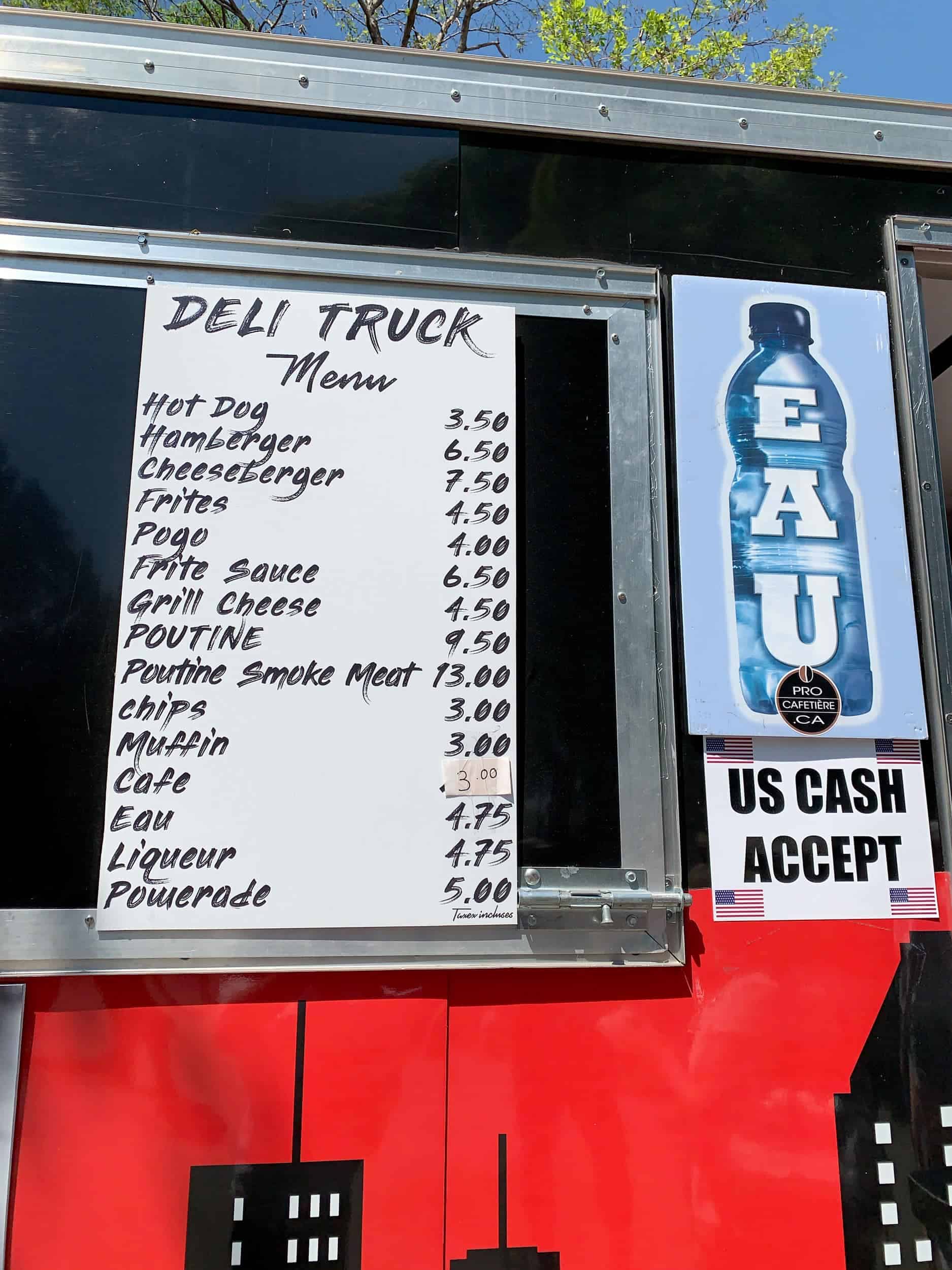
Food at Canadian Grand Prix
The food at the Canadian Grand Prix (in Canadian dollars)

I ate a few hot dogs (3.50 Canadian, $2.70 US) and ice cream for lunch, washing it down with bottled water. Montrealers steam their buns and refer to their hot dogs as "steamies."

It was a hot, sunny day, and my seat in Grandstand 34 inside the hairpin curve offered no protection from the sun. 

I'm glad I got some food in me early, as the lines grew a lot longer as the start of the race drew near.

Credit to the guys I saw walking around in such heat with bowls of poutine (gravy-covered cheese curds and fries).

Fan Zone

Canadian Grand Prix demo car
Fans have a chance to change the F1 car tires.

Once again, the fan zone at the Canadian Grand Prix featured opportunities to try changing tires. This seemed to be a running theme!

I watched a freestyle moto demo at the Monster Energy Compound, but there was no shade, so I eventually retreated to the trees near the entrance to the hairpin turn. 

Views from General Admission 

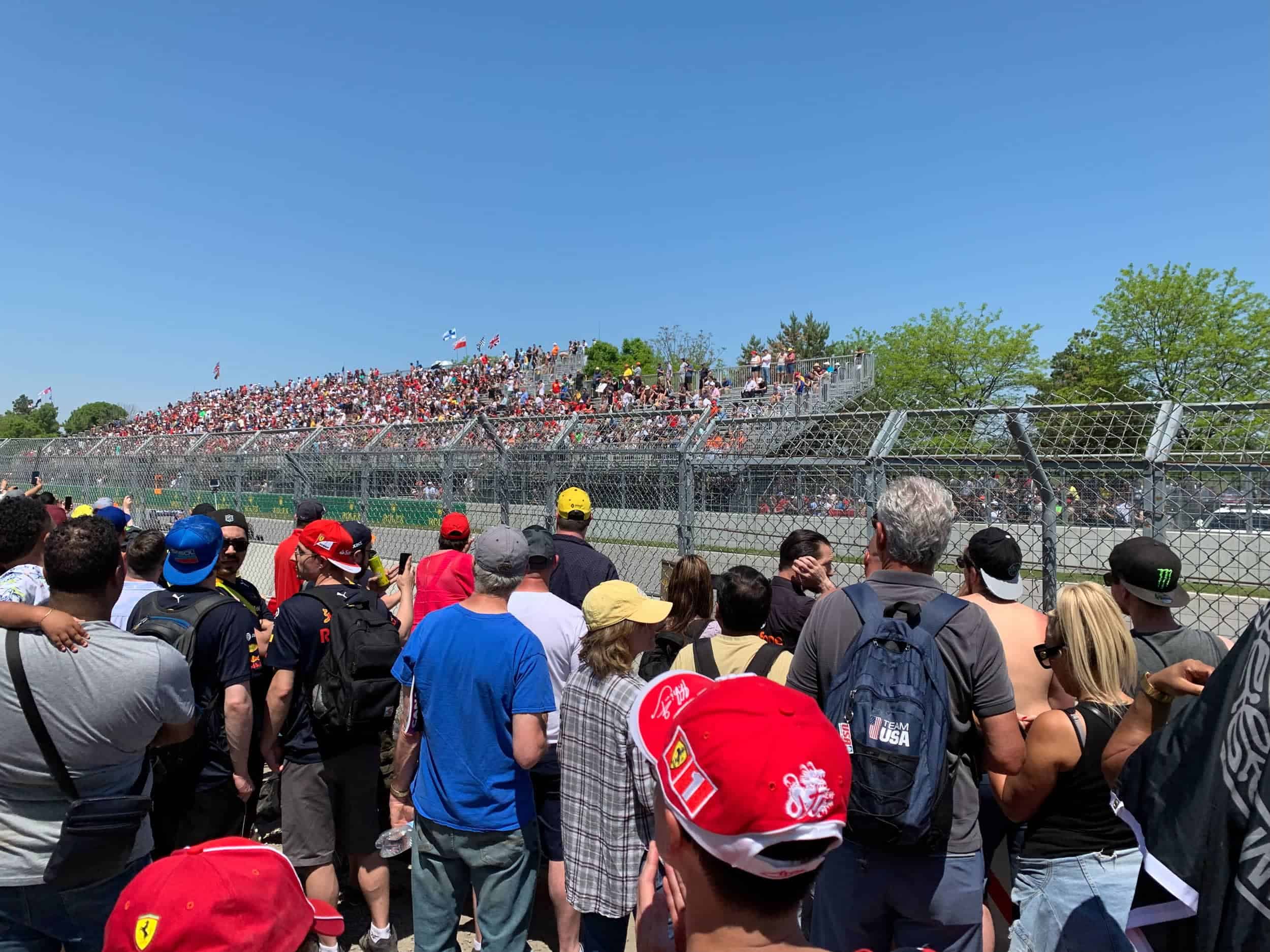
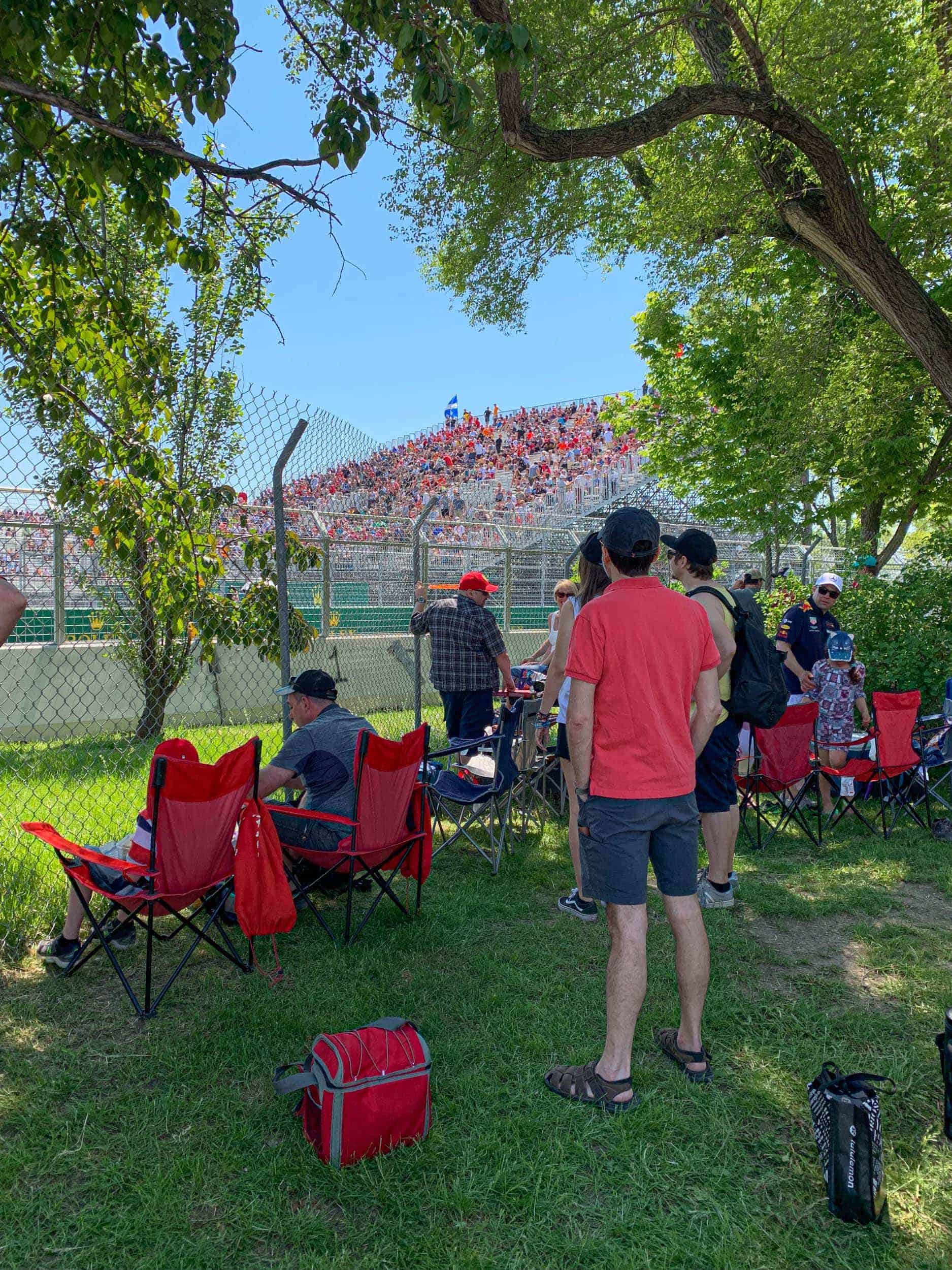
General admission viewing at Montreal racetrack
General admission view near the exit of Turn 10

Arriving early also gave me a sense of the views you can get with general admission tickets. 

The friend with whom I'd watched the US Grand Prix races had been to Montreal the year before recommended I buy a seat as it's hard to see from the ground. 

I quickly found he was right, unless you know the track well enough to find a good view and get there early. Very early. 

On the plus side, it's cheaper (about 100 Canadian dollars) and as close as you'll get to the cars.

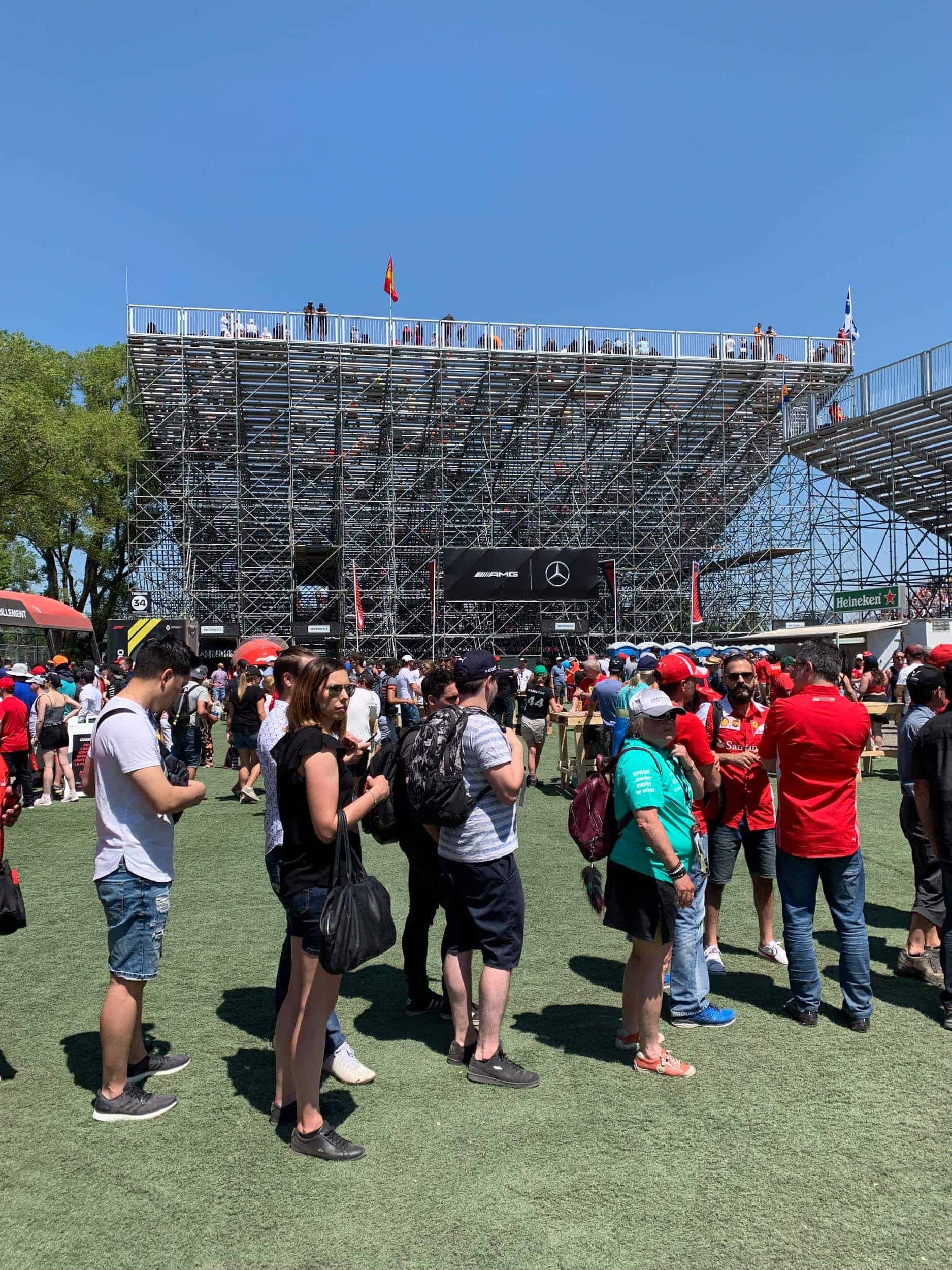
View of Grandstand 34 inside Turn 10 at the Canadian Grand Prix in Montreal.
View of Grandstand 34 inside Turn 10
Grandstand 34
The back of Grandstand 34

I'd researched online about the best grandstands before buying my ticket, but it wasn't until I started writing this story that I discovered The F1 Spectator. 

This F1 blogger has photos and descriptions of all the seating areas around the track in Montreal.

Ultimately, I felt a seat in Grandstand 34 inside Turn 10, the hairpin curve, offered the best value.

As this was a last-minute trip, the official ticket packages had sold out, and I had to accept paying a premium on StubHub ($268, including fees).

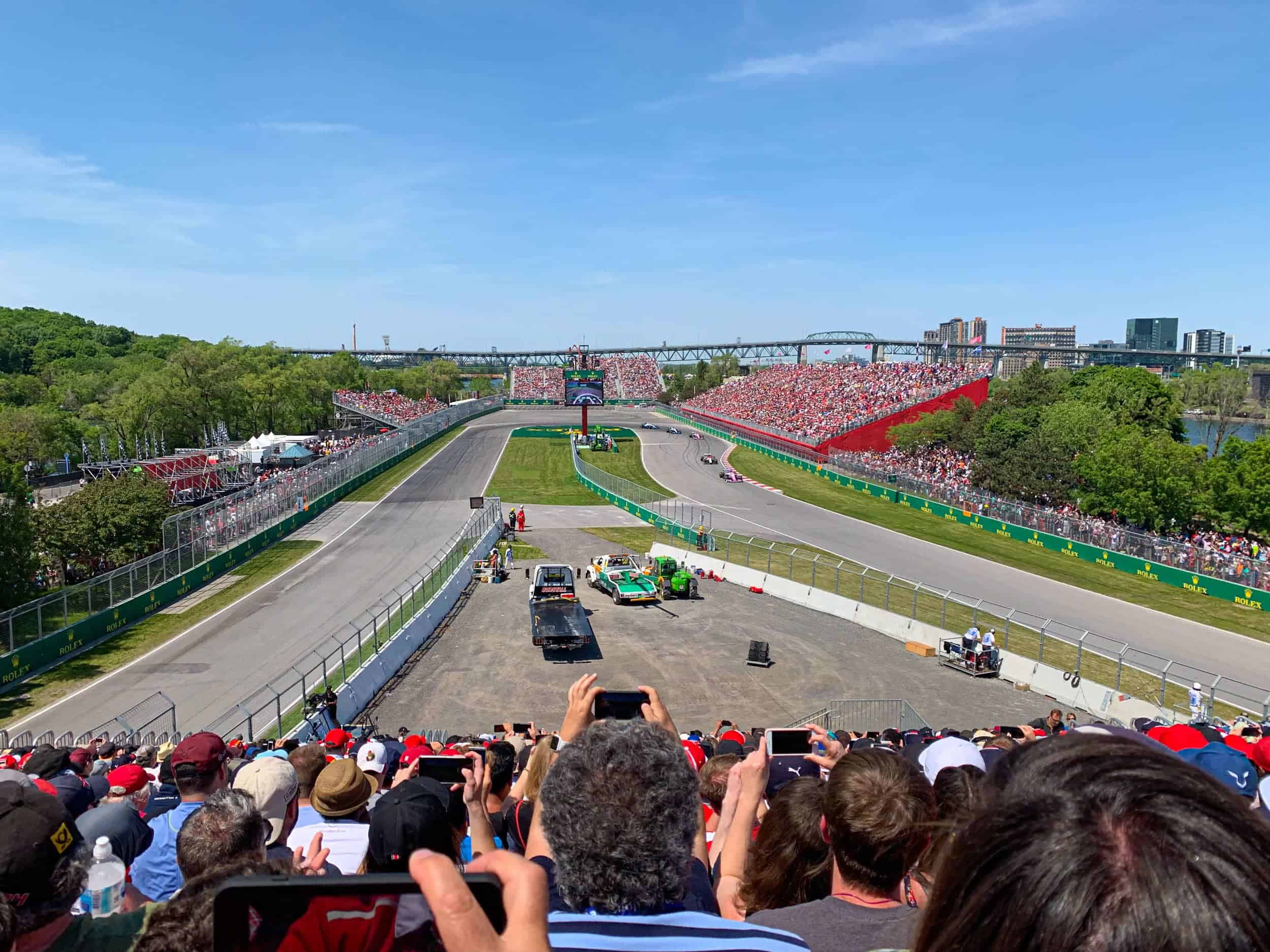
View from Grandstand 34

View from Grandstand 34, inside the hairpin curve at Turn 10.
View from Grandstand 34, inside the hairpin curve at Turn 10

Once I reached my seat, I knew I'd made the right call to spend a little extra. The weather was perfect, if a little hot, and the view was excellent. 

Military jets performed a flyover after the Canadian National Anthem, and the race began. First, the drivers took a formation lap (a low-speed warm-up lap to heat their tires). 

The second time I saw them enter Turn 10, it was as if they were braking from a top speed of 186 mph (300 kmph) to about 37 mph (60 kmph). 

The sounds of these cars are intense! The video clip above doesn't do it justice. I'd first experienced it walking around the track in Austin, so I was prepared with earplugs, but it was a different feeling being seated for the whole race. 

It's worth listening to them without ear protection, but doing so for 70 laps over two hours would've been too much.

Watching the Canadian Grand Prix

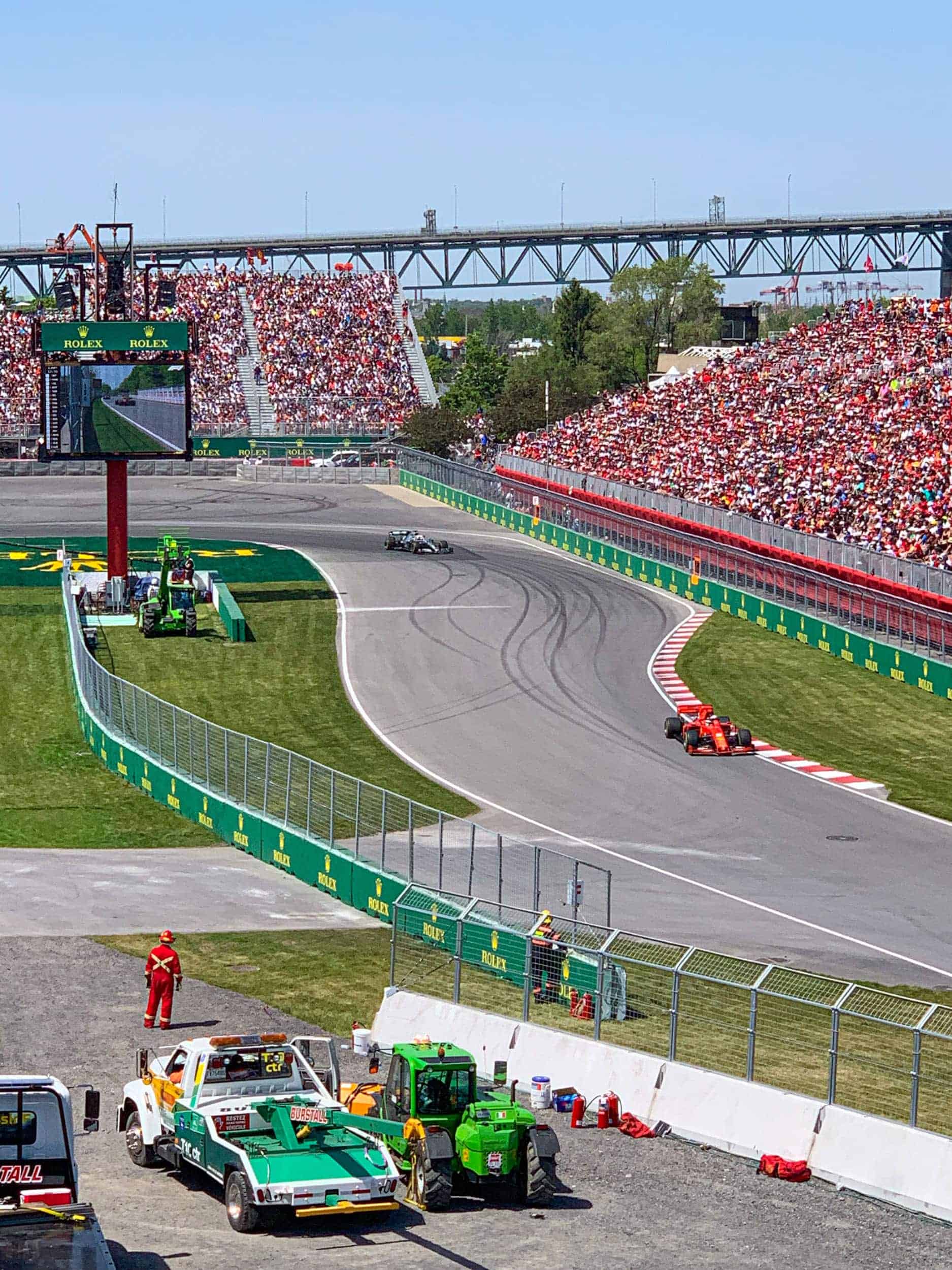
Sebastian Vettel
Sebastian Vettel leads coming out of Turn 10

In red for Ferrari, Sebastian Vettel began the race in the pole position and dominated through 48 laps.

It was his race to lose. Unfortunately, he made a mistake that gave Lewis Hamilton, driving for Mercedes, the lead (and ultimately, the win).

With Lewis Hamilton hot on his heels, Vettel momentarily veered off the track into the grass. 

He brought the car back onto the track. However, officials penalized him for five seconds, stating his recovery was dangerous to other drivers.

Specifically, Hamilton, who at best lost a chance to pass Vettel to take the lead and, at worst, was almost struck by the Ferrari driver.

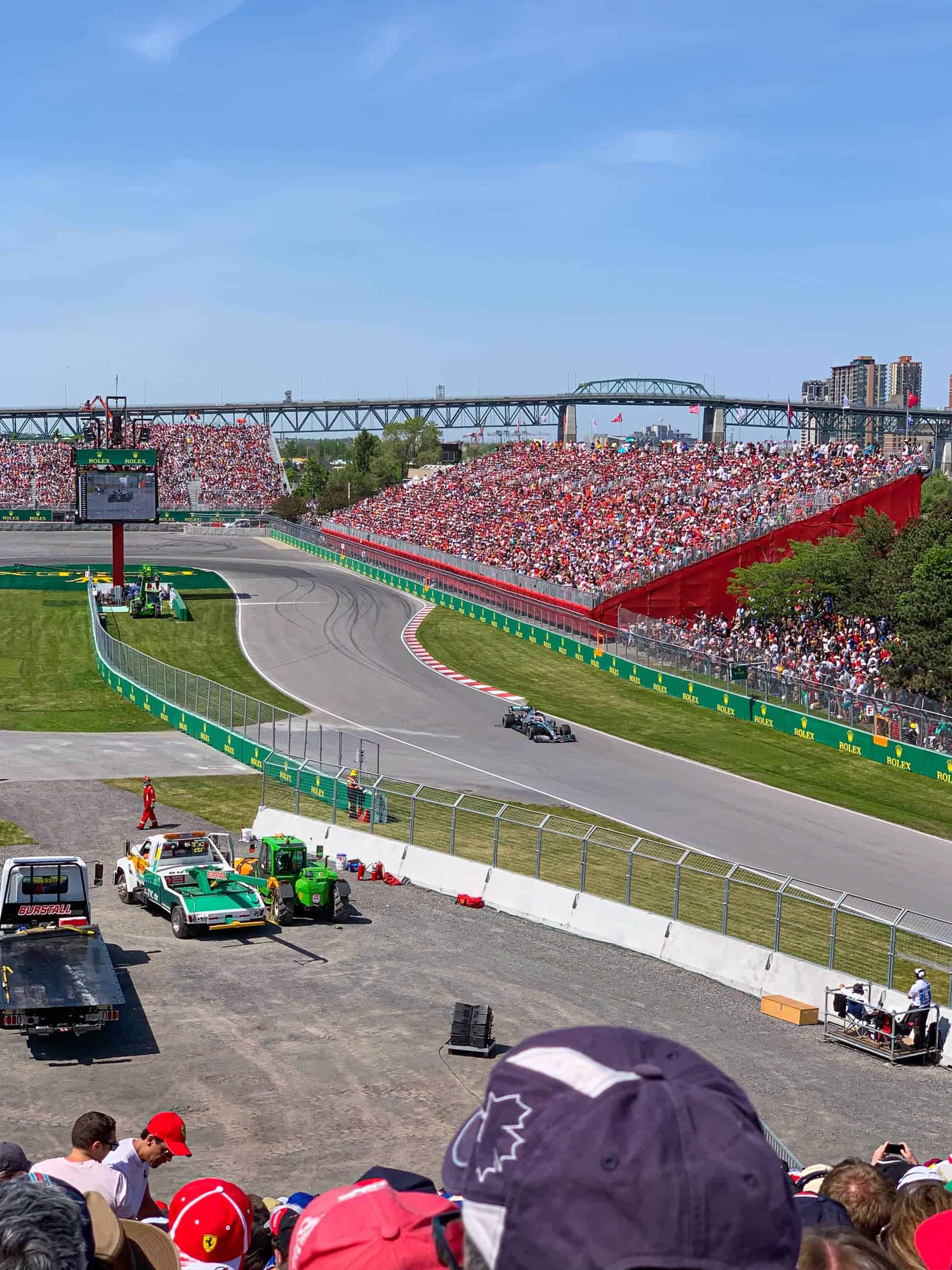
Lewis Hamilton exiting Turn 10 in the lead at the Canadian Grand Prix.
Lewis Hamilton exiting Turn 10 in the lead.

These events happened in a different part of the track, so I couldn't see them live. There's a jumbo TV screen inside Turn 10; however, I was far from it, so it was hard to follow what was happening. 

My T-Mobile connection in Canada wasn't working properly, so I didn't have mobile internet to follow the race. I had to rely on the guy sitting next to me to clue me in. 

The race was over faster than I expected. It was all but clear Hamilton would win in the final laps, so I left early to beat the crowds of Canadian F1 fans to the metro. 

Leaving the Race

I returned to Hotel M Montreal from the racetrack in about 15-20 minutes, where I chilled out in the air-conditioning for a while. 

As other guys returned to the room from the race, they discussed the controversial penalty that handed Hamilton the win.

Sebastian Vettel finished second, and Charles LeClerc, also driving for Ferrari, came in third. Max Verstappen, the future winner of the 2021 World Championship, came in fifth for Red Bull.

I wrapped up my first Canadian Grand Prix weekend with delicious poutine at Frite Alors near the hostel. 

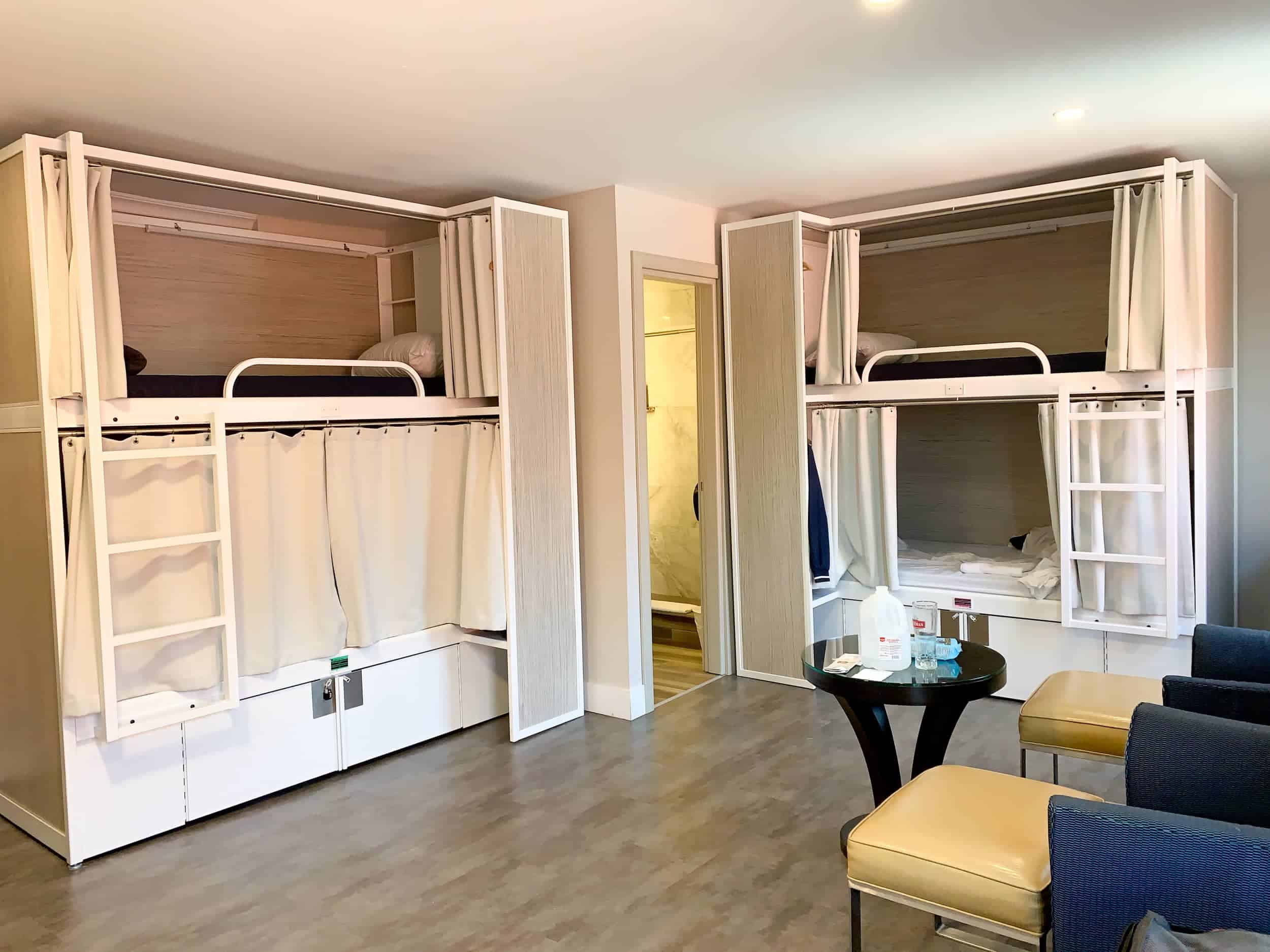
Bunk beds at Hotel M Montreal

Plan Your Canadian Grand Prix Weekend

Tickets 

Buy from Formula 1 Grand Prix du Canada for the best ticket rates. And keep an eye out for pre-sale tickets. 

I found plenty of tickets available one month out from the race; I just waited a few more weeks to buy, and by then it was sold out (and I had to use StubHub). 

Where to Stay

Hotel M Montreal - this boutique hostel is the clear favorite in Montreal, with a 9.5 guest rating on Hostelworld. The sturdy bunk beds include privacy curtains, secure lockers, reading lights, and electric outlets.

The location is excellent, whether you're in town for the Grand Prix or sightseeing. There are several rooftop jacuzzis and a bar in the basement for socializing. Check prices on Hostelworld.

HI Montreal - As an alternative, the HI Montreal Hostel is downtown, closer to some of Montreal's terrific museums and the pre-race fan festival on Crescent Street.

However, the trip to/from the race track via the metro will be longer. The hostel has a solid 9.2 guest rating on Hostelworld.

Where To Eat

Montreal is full of cheap eats and excellent mom-and-pop restaurants. A few of my favorites included Wilensky's Light Lunch (34 Avenue Fairmount O, wilenskys.com) and Beauty's Restaurant (93 Mont-Royal Ave W, beautys.ca).

Check out Feastio for my complete list of the best places to eat in Montreal.

Travel Q&A with Matthew Kepnes, Author of Ten Years a Nomad

Turning one's passion for travel into a career and business is challenging work. Matt Kepnes, the author of the new book Ten Years a Nomad: A Traveler's Journey Home, knows this well. 

Matt with a lemur in Madagascar

I had the opportunity to read an advance copy of Matt's new travel memoir, which traces his early life from childhood and adolescence through to today. 

In it, I saw many parallels with my journey as a man, traveler, and entrepreneur, including his desire to build a business around blogging to keep it going. 

To celebrate the release of his new book, Ten Years a Nomad, I sent Matt a few questions so you can hear from him directly.

***

Go Backpacking: Tell us about yourself!

My name is Matt Kepnes, and I run the website Nomadic Matt, which helps people travel cheaper, better, and longer.

I grew up in the Boston area and went to school to be a high school history teacher. 

I ended up taking a job at a hospital doing administrative work while I tried to find a teaching job and ended up there for three years.

In 2006, after meeting some backpackers in Thailand, I quit my job to travel the world. My plan was to travel for about a year, and then I ended up traveling for a decade! Now, I use my blog as a resource to help others do the same.

In addition to my blog, I started a conference called TravelCon and co-own a hostel in Austin, Texas, called HK Austin.

Matt Kepnes in Africa

Did you travel before you quit your job back in 2006?

Barely. I didn't actually go on my first real trip abroad until I was 23. Travel wasn't a really big part of my upbringing. We did mostly domestic travel to theme parks or to see my parents.

After I graduated from college and got a job, I took a tour of Costa Rica. And I know it will sound cliché, but this trip really did change my life.

It opened my eyes to all the amazing opportunities and experiences that travel offers. That was when I first caught the travel bug.

Then, in 2005, I went to Thailand for a few weeks. It was there, in Chiang Mai, that I met a group of backpackers who opened my eyes to the world of long-term travel.

Like most Americans, up until that point, I just thought of travel as something you did as a vacation.

You go away for a short trip, spend too much money, and then come home and go back to work. But these backpackers showed me that travel could actually be a lifestyle.

Related: Introducing FLYTE, a Non-Profit to Encourage Student Travel

Matt in Southeast Asia

How did you afford your trip?

For the next year, I saved every penny that I could. I worked overtime, sold my things, and stopped going out. I needed every cent for my trip.

By 2006, I was ready. I quit my job, got rid of the rest of my things, and kicked off a round-the-world adventure that has essentially continued to this day.

Along the way, I taught English in Thailand and Taiwan to make some extra money.

Eventually, I started a blog as a way to keep my friends and family up to date with my travels and to hone my writing (I had dreams of being a travel writer at the time).

While I never did end up writing for Lonely Planet, my blog grew and slowly evolved into my full-time job. It's been keeping me busy ever since!

How has travel changed since your first trip?

Technology has really changed how people travel.

Back when I started (which in internet terms was the stone age), there were no smartphones, no Google maps, no fancy cameras or laptops.

If you wanted to contact home, you had to find an internet café or use a payphone.

If you got lost, you had to figure it out on your own. And in hostels, everyone hung out together instead of just sitting on their phones.

To be fair, it was much more challenging and could be much more frustrating. But it was also more rewarding too. You had to figure things out on your own - there was no Google to save you.

So, when you finally solved a problem and arrived where you needed to be, there was a greater sense of accomplishment.

That being said, travel is much more affordable and accessible now than it was, and all this technology has gotten people out the door more, which is a good thing.

Yes, we have the problem of overtourism now, but more people traveling is a good thing.

Nothing destroys prejudice like travel, which is why I'm still out here encouraging people to get out there and see the world!

Matt Kepnes, author of Ten Year's a Nomad: A Traveler's Journey Home
Matt in Iceland

What destinations do you recommend for new solo travelers (or just new travelers in general)?

For new travelers, I always recommend Thailand. It's my favorite country and a perfect destination for both new and veteran budget travelers.

It's cheap and has amazing food, stunning beaches, fun nightlife, great diving, and lots of history and culture. No matter what you like, you'll find it in Thailand.

Southeast Asia as a whole is also a great region for new travelers.

There is a well-worn backpacker trail from Vietnam all the way down to Singapore and over to the Philippines and Indonesia. It's an affordable region, easy to get around, and safe.

Plus, there are tons of other backpackers and budget travelers there, so it's easy to meet people and make friends if you're traveling solo.

You can find accommodation here for under $5 a day and meals for less than $1.

It's a budget traveler's paradise and a great place for new travelers to test the waters.

After a decade of travel, you've likely been to some amazing places. What have been some of the highlights from your travels over the years?

The standard answer here is to list the places I really liked, such as Bangkok, Paris, Amsterdam, London, and Stockholm (I like big cities, what can I say!).

But there is more to travel than just visiting cool destinations.

One thing I've realized over the years is that, more often than not, it's the people who make a trip memorable.

The great thing about traveling solo is that you'll meet tons of people over the course of your travels. Solo travel forces you out of your shell and opens you up to the world.

It lets you connect with like-minded travelers in a way that I don't think you can do back home in your everyday life.

Travelers form fast friendships because we have so many shared experiences. To me, it's those friendships that are the highlights of any trip.

For example, I spent a month relaxing on Ko Lipe in Thailand with a great crew of friends I met while traveling, which to this day is probably my favorite travel memory.

Ten Years a Nomad book

You're about to head out on a book tour. Tell us about your new book!

It's called Ten Years a Nomad, and unlike my book How to Travel the World on $50 a Day, this book is a memoir and not a "how-to" kind of book.

No budget tips. No packing suggestions. Just stories, advice, and reflections on my travels.

It covers my ten years traveling around the world and the lessons I learned from traveling. It also features lots of stories I've never told on the blog before.

In a nutshell, Ten Years a Nomad traces the entire journey of a trip around the world: getting the travel bug, planning an adventure, quitting my job and setting off, the highs and the lows of life on the road, the friends you make, and what happens when you eventually have to come home.

Why did you want to write a memoir instead of another "how-to" book?

I wanted to share my thoughts, experiences, and stories in a way that could do them justice, as a simple blog post can never really capture everything.

I wanted to share the why of travel. What motivates people to travel long-term? How does that change as you get older? What's it like to travel long-term? And how can people learn from this experience?

I wanted something that could reach a wider audience than just another "how-to" book, and this is it! This is my opus on travel.

***

As I mentioned at the top, I had the opportunity to read Matt's new book. Despite knowing him as a friend and peer since 2009, I still learned a lot about his life.

It's not easy to be vulnerable in today's world, let alone when you have millions of people reading your travel tips. 

Yet, he was willing to talk about the challenges he experienced, from being bullied as a kid to building relationships as an adult. 

Ten Year's a Nomad: A Traveler's Journey Home is a coming-of-age story set amidst a fleeting moment in time when digital publishing upended the traditional path to becoming a travel writer.

Available now on Amazon

Tehran: Iran’s Top Tourist Destination

Tehran, the capital of Iran, is a cosmopolitan city with numerous vibrant monuments, museums, eateries, and lush green landscapes. In recent years, there has been a growing interest among tourists in visiting this ancient city due to its numerous attractions.

Tehran, Iran (photo: Mohammad Rezaie, Unsplash)
Tehran, Iran (photo: Mohammad Rezaie)

The availability of cheap Air Arabia flights has also been helpful to a large extent, as Tehran can now be reached from many worldwide destinations. For hotel and flight bookings, you can rely on Cleartrip.

Compared to other Middle Eastern cities, Tehran has a cooler temperature, and the air tends to be dry for much of the year. The highest peak of Iran is also located very close to the city, on its northern fringes in the Alborz ranges. During winter, ski enthusiasts travel there in large numbers.

Additionally, there are many other places tourists can visit in the city. Let's examine some of them, as their appeal helps explain why tourism interest in Tehran is increasing.

Table of Contents

  • Things To See and Do in Tehran
    • 1. The Azadi Tower
    • 2. National Museum of Iran
    • 3. Milad Tower
    • 4. Treasury of the National Jewels
    • 5. Jamshidieh Park
    • 6. Chitgar Lake
    • 7. Saadabad Palace

Things To See and Do in Tehran

1. The Azadi Tower

Azadi Tower (photo: Mahdiar Mahmoodi, Unsplash)
Azadi Tower (photo: Mahdiar Mahmoodi)

The vibrant tower can be reached through the Azadi Square subway station. It was built to commemorate the 2,500th anniversary of the Persian Empire and is constructed in accordance with Islamic and Sassanid architectural styles.

The entire area is well-maintained, featuring lush greenery and ample facilities. The main entrance to the tower is below the vault. In the basement of the structure lies the Azadi Museum, where visitors can view numerous exhibits and artifacts dedicated to the Persian Empire.

2. National Museum of Iran

The large National Museum of Iran is divided into two parts to showcase the country's history in ample detail. The old building houses collections from the pre-Islamic period, featuring carvings, stone figures, and other artifacts spanning from the Neolithic to the Sassanid periods.

The three halls of the building have artifacts from the Neolithic, Chalcolithic, Median, Bronze Age, Seleucid, and Sassanid periods.

The new building is more oriented towards displaying collections that are reminiscent of its 1,400-year history as an Islamic site. It has three floors and features exhibits that include artworks, pottery pieces, adobe calligraphy, textiles, and many other items.

3. Milad Tower

Milad Tower (photo: Siamak Mokhtari, Unsplash)
Milad Tower (photo: Siamak Mokhtari)

The Milad Tower can be reached by taking the Metro Tarasht or the Metro Hemmat from any part of the city. It is a gigantic tower that can be seen from all around the city; it is the fourth-tallest tower in the world.

Standing at 435 meters high, it is also the 12th-tallest freestanding structure in the world. There are two viewing decks and an art gallery that can also be visited here.

The view of the city from its decks is simply stunning. It also features a skydome; visiting the dome with kids is sure to be a fantastic experience.

There are numerous places to eat around the tower where you can savor the diverse flavors of Iranian cuisine.

4. Treasury of the National Jewels

For all the gold and precious jewels fanatics reading, the Treasury of the National Jewels is the place to be to catch a glimpse of some of the most precious jewels in the world. There is a free-standing golden globe that has been carved from 34 kilograms of gold.

Then, there is the "Sea of Light," touted as the world's largest pink diamond. The place has a rich collection of over 51,000 precious stones, and a visit here can be pretty revealing.

There are shields, tiaras, thrones, crowns, loose gems, and numerous aigrettes, along with a large number of diamonds, emeralds, and rubies. The exhibits also feature many items from the 2,500-year reign of the Shahs of Iran, which can be seen closely.

5. Jamshidieh Park

Niavaran Park (photo: Mohammad Hoseini Rad, Unsplash)
Backflip in Niavaran Park (photo: Mohammad Hoseini Rad)

The Park is also known as Niavaran Park, as it is located in the Niavaran district of the city. It is one of the most picturesque parks in the town, situated on the foothills of the Kolakchal Mountains and south of the Niavaran Palace Complex.

It features ample greenery, making it a must-visit destination for escaping the city's heat. The proximity of the mountain provides it with a scenic setting, making the visit all the more enjoyable.

6. Chitgar Lake

Birdwatchers will be highly delighted to visit Chitgar Lake, as it is a natural setting for many types of migratory birds. It is also known as the "Lake of Martyrs of the Persian Gulf" and features a very serene atmosphere all around it.

The entire complex spans a sprawling area of 250 hectares, with the park occupying approximately 130 hectares. There are many resorts in the area, as well as a coastal region.

7. Saadabad Palace

The Pahlavi dynasty of Iran built this magnificent palace in the Shemiran region of the city. It was the residence of the Qajar kings and the royal family during the 19th century. There are many museums within the complex, and visitors can explore each one.

The Klara Abkar Painting Museum, Fine Arts Museum, Mahmoud Farshchian Miniature Museum, Ethnological Research Museum, and Vessels Museum are among the notable museums within the complex, alongside many others.

The Reza Shah working room, the Ceremony Hall, and the Reza Shah dining room can be seen here at the Green Palace.

Visiting the Saadabad Palace is sure to be a memorable experience, with its numerous exhibits that showcase the country's history and rich cultural heritage.

Internationally, Tehran has attracted a significant number of tourists in recent years and continues to make waves with its tourist-friendly offerings.

The city offers ample accommodation, complemented by some lovely cafes and restaurants that cater to all tastes. Hence, visiting Tehran will be a pleasurable experience for any tourist. For hotel and flight bookings, you can rely on Cleartrip.

______

This story was brought to you in partnership with Cleartrip.

11 Travel Essentials to Make Your Next Trip Easier

When it comes to packing, space in our backpacks is at a premium. Therefore, we're always searching for the best travel essentials. 

Most travelers struggle with everyday tasks and the surprises of being out on the road. Just this morning, I had to find my hostel with no charge on my phone. 

I managed to make it to my hostel, but it would have been much quicker if I had my usual gadgets to lead me there.

It's these moments that spurred this piece. Here are the travel essentials I use to make my trips as stress-free as possible. 

The Ryno solar charger is one of Adam's favorite travel essentials

Table of Contents

  • Essential Travel Accessories
    • 1. External charger (solar power)
    • 2. Airtight bags
    • 3. Headphones (especially for digital nomads)
    • 4. Miniature flexible tripod
    • 5. Tile
    • 6. Anti-Skimming Passport Wallet
    • 7. Battery case
    • 8. Packing Cubes
    • 9. Vapur
    • 10. Kindle Paperwhite
    • 11. TK 120 Tactical Flashlight by EcoGear FX
  • Travel Essentials to Make Life Easier

Essential Travel Accessories

1. External charger (solar power)

An external charger is something I have traveled with ever since my first backpacking trip in 2015. Sometimes, I will carry it on me even when not traveling.

Extra battery power is just one of those resources you never know when you'll need. 

It is almost inevitable, though, you will encounter a time while traveling when the extra phone charge could come in handy (like me this morning while trying to find my hostel).

I have had several external chargers in the past. Some work better than others, but I prefer a decent solar-powered external battery over the ones that need to be charged themselves.

In my opinion, the purpose of an external battery source is for emergencies, and having a battery source that can be charged by the sun is the safest bet.

Right now, I am traveling with this Ryno Tuff Solar Charger, and it has held up well through all conditions and never let me down. It has been about six months, and I highly suggest having it.

Buy it on Amazon

Spacesaver

2. Airtight bags

I was always curious about airtight packing bags.

I have known about them for a long time, but it wasn't until recently (Christmas of 2018) that I decided to try them. 

I'm glad I did; they have been a pleasure to use and have saved space as organizers in my backpack, which has traditionally been an unorganized mess.

It feels like I have been traveling with a new nifty backpack ever since I started using the airtight bags, and it does make a difference.

The only thing I wish I had done was to get bigger bags. I use them mainly to transport smaller items such as socks, underwear, and swimwear. 

It is hard to find a combination of the right size of bags on Amazon, but I've been traveling with these Spacesaver Premium Vacuum Travel Bags this year. 

I don't suggest traveling with six of them, and I usually bring along two to three, but six was the smallest quantity Spacesaver offers. 

Buy it on Amazon

COWIN E7 PRO headphones

3. Headphones (especially for digital nomads)

I spend a lot of my days out on the road working. I know it sounds boring, but I've got to pay for my travels somehow! 

A lot of times, I am working in not-so-ideal conditions. Usually, it is loud or busy with many things happening around me. 

To focus, I use my noise-canceling headphones, which I splurged on because I must be able to focus on the road. 

Beyond digital nomads, many people (myself included) can only sleep in hostels or on airplanes, buses, or trains with earphones in.

Good earphones/headphones for your purpose are worth the investment.

Right now, I use the COWIN E7 Pro Noise-Cancelling headphones, which are a cheaper alternative to BOSE products (in my opinion). 

It is a bit of a splurge, but this isn't a bad deal compared to the market value for headphones. 

We also recommend you check out the xFyro Wireless and waterproof earbuds.

The award-winning engineers at xFyro audio created the most advanced pair of best Bluetooth earbuds on the market, bringing next-generation technology to today's active listener.

Bonus Headphone Recommendation

Before I wrap up, I have one more pair of headphones to recommend -- ReduxBuds, one of the best noise-canceling wireless earbuds with an AI Powered Active Noise Cancelling (ANC) feature.

Made by a group of sound engineers and audiophiles, ReduxBuds is the perfect fit if you don't want to worry about charging your earbuds.

These wireless earbuds push the boundaries with a 90-hour charging case! You want to check these out.

UBeesize tripod

4. Miniature flexible tripod

I will admit I no longer travel with a tripod; it's on this list because it used to be one of the handiest travel essentials in my backpack. 

However, I no longer focus my travels on smartphone photography or taking photos.

It has become less of a priority, and the tripod did get to be pretty bulky in packing.

That said, if you are remotely into photography or respect the art more than a dorky selfie, you may want to consider one.

I couldn't tell you how many times it helped me in my years of traveling. 

I liked the UBeesize Tripod, in particular, for its foam-like grip. It seemed to grip more sturdy than others I have used. 

Buy it on Amazon

See also: How to Choose the Best Travel Camera

Tile Mate

5. Tile

Tile is a travel gadget I have recently started using as a precaution. Are you looking for a bit of peace of mind? This is your product.

Tile is a "find my phone" product that uses little tile tracking devices on all your valuables while traveling.

Connect one to your keys, camera, laptop, phone, wallet, passport -- whatever you can. 

Using an app on your phone, you can track down the location of all your belongings. 

If you lose your phone, pressing the button on your Tile Mate will automatically make your phone ring out loud so you can find it if nearby.

Buy it on Amazon

6. Anti-Skimming Passport Wallet

Everyone generally keeps their passport in a safe case, but how secure is yours? 

There are tactics that scammers use out on the streets, which make it as easy as bumping into you to rip off all your passport and credit card information. 

Your passport and credit cards don't need to be in plain sight. Scary, right?

You can protect your information from this type of scam with this waterproof Passport Wallet Holder.

You never know when it might come in handy.

Buy it on Amazon

7. Battery case

Another option to solve your lack of phone battery while traveling is a case that charges your phone itself.

It can, at least, provide a few extra charges to your phone. 

There are a ton of different options available for all models of phones. 

Buy it on Amazon

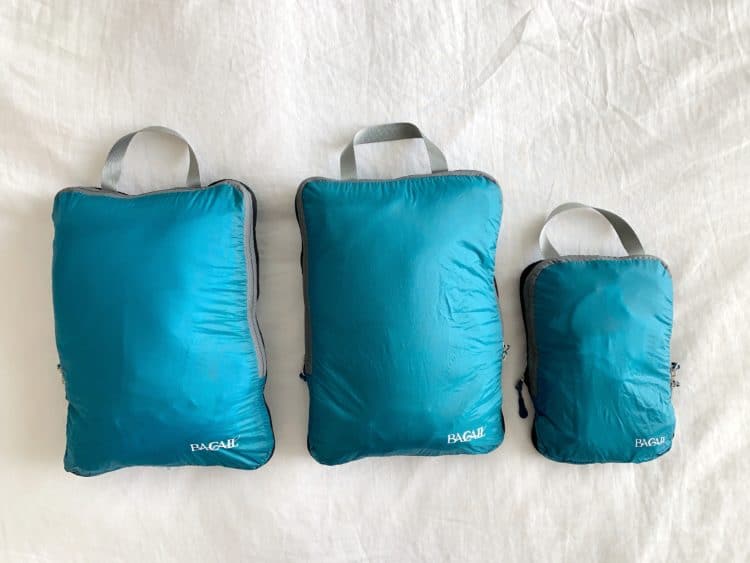
Packing cubes

8. Packing Cubes

Packing cubes are a travel product that can help keep your backpack organized while on the road.

The cubes would also be helpful in a hostel for a few days. 

I haven't personally used this product yet, but have been recommended several times. I will purchase these for my next trip to see how helpful they are.

However, since several fellow travelers have already recommended them, I'm sure there is some effectiveness to them.

Buy them on Amazon

Vapur water bottle

9. Vapur

Vapur is a company I have supported from the get-go.

They specialize in reusable, super convenient, and portable drinking solutions. 

Their innovation is top-notch, and their mission is even more honorable. Not to mention, their product is super helpful for eco-friendly travelers. 

I would 100% recommend this product to every traveler. 

Buy it on Amazon

Kindle Paperwhite

10. Kindle Paperwhite

For all readers, this product will save you space and, in the long run, probably money.

If you have a passion for reading, the Kindle Paperwhite is the best e-reader for you. 

Admittedly, I don't read as much as I need to. Generally, I only desire to start reading as soon as I travel. Please don't ask me why. 

However, the Kindle Paperwhite is perfect for traveling, and if you also read at home, you will only get more value from it. 

It is super reasonably priced, and I love it!

Buy it on Amazon

TK 120 Tactical Flashlight by EcoGear FX

11. TK 120 Tactical Flashlight by EcoGear FX

Having a flashlight with you is always a good idea when traveling. 

This tactical flashlight from EcoGear FX is water-resistant and compact, and lightweight. It is built with high-quality aluminum alloy.

It can be seen from 4,000 yards and has a tactical strobe light. They cost $39.99.

Buy it at EcoGearFX.com

Travel Essentials to Make Life Easier

I could name more handy items I have seen other backpackers with during my travels.

I could also name things I have seen, which, to me, seem completely unnecessary. But, to every man/woman, their own. 

I don't take all of these travel essentials with me on every trip. It certainly matters where you are going and for how long.

New Orleans Cocktail Tour: A History of Mixed Drinks

My New Orleans cocktail tour began at Tiki Tolteca bar.

The Big Easy is historically significant as the birthplace of the cocktail. Taking a New Orleans cocktail tour with Doctor Gumbo is not only fun, but it's also educational. 

If you're looking to add context to your drink consumption or are traveling solo and prefer some company for a bar crawl, this lighthearted tour is for you. 

Mai Tai
Mai Tai

Table of Contents

  • Cocktail Bars
    • 1. Tiki Tolteca
    • 2. SoBou Restaurant
    • 3. Tujague's Restaurant
    • 4. Bourbon "O" Jazz Bar

Cocktail Bars

1. Tiki Tolteca

The tour began at Tiki Tolteca (301 N. Peters St), a Latin American tiki bar that opened in the 1980s and bills itself as the first tiki bar in New Orleans. 

Here, I met the others in our tour group, along with Ben, our larger-than-life tour guide. 

Ben acknowledged that there was no particular reason the first bar of the tour was Tiki Tolteca, other than it wasn't typically busy at 5 pm. 

Mai Tai

He brought us each a mai tai (rum, lime, curacao, and orgeat syrup) in a plastic cup.

Consuming alcohol on the street is legal in New Orleans so long as it's in a plastic cup. As a result, many bars serve drinks in plastic instead of glass. 

Related: 15 Cheap and Fun Things to Do in New Orleans

Sazerac (left) and Brandy Crusta (right) are highlights of a New Orleans cocktail tour.
Sazerac (left) and Brandy Crusta (right)

2. SoBou Restaurant

Once we'd introduced ourselves and finished our mai tais, we walked a block and a half to SoBou Restaurant at the W Hotel New Orleans (310 Chartres St). Here, we had the outdoor courtyard to ourselves.

While waiting for our cocktails, Ben showed us a copy of The Bartender's Guide, a comprehensive collection of recipes published by Jerry Thomas in 1862.

At the time, Jerry Thomas was the most renowned bartender in the United States. His guide became the go-to resource for bartenders everywhere.

It's here that we also learned which ingredients make up a cocktail:

  • Spirits
  • Sugar
  • Water
  • Bitters

Absent any of these ingredients, and you're not technically drinking a cocktail. That was my biggest takeaway from the New Orleans cocktail tour.

Gin and tonic, vodka and cranberry, and the screwdriver are just three of the many mixed drinks I always thought of as cocktails. 

Brandy Crusta
Brandy Crusta

Sazerac

The first cocktail we tried was the Sazerac, which dates back to 1838 when Antoine Peychaud created it in his New Orleans apothecary.

Widely recognized as the world's first cocktail, it was initially made with brandy, sugar, bitters, and absinthe. 

In the early 20th century, when brandy became harder to come by, rye whiskey was substituted.

At SoBou, the Sazerac is made with rye whiskey, brandy, bitters, Steen's cane syrup, and Herbsaint rinse. It's garnished with lemon peel and served clean (without ice). 

I found the Sazerac too strong for my tastes. I'm not a whiskey drinker, so it's not something I'd order in the future.

Our New Orleans cocktail tour group.
Our cocktail tour group

Brandy Crusta

The Brandy Crusta was more to my liking, invented by bartender Joseph Santini at his New Orleans bar, Jewel of the South, in the 1850s. 

The Brandy Crusta is made of cognac, lemon juice, curacao, maraschino liqueur, and bitters.

The rim of the glass is dipped in sugar, and it's garnished with a long slice of lemon peel. 

By this point, our lively group was getting along well. As you can tell from the photo above, there wasn't a lot of us. 

There were two sisters, a couple, myself, and our guide Ben (far right). A few others had signed up but couldn't make it. 

Side note: In late 2019, I happened to be in town for the opening of a new incarnation of Jewel of the South, which immediately became one of the best cocktail bars in New Orleans.

Grasshopper
Grasshopper

3. Tujague's Restaurant

Our third stop of the New Orleans cocktail tour was a 10-minute walk away.

Founded in 1856, Tujague's Restaurant (823 Decatur St) is New Orleans' second oldest restaurant.

Tujague's mid-19th-century cypress bar, imported from Europe, lacks stools. It's standing room only, just as it has always been. 

Grasshopper

It's here that the grasshopper was invented in the early 20th century. 

The cocktail is made by shaking equal parts creme de menthe and creme de cacao, heavy cream, and ice, then straining the chilled liquid into a glass.

The result is thick, heavy, and sweet. I generally enjoy sugary drinks, but the creaminess of this was too much for me. It's like a liquid chocolate mint dessert.

French 75 at Tujague's cocktail bar.
French 75

French 75

We also sampled the French 75 at Tujague's, which became my favorite drink of the night. This cocktail is made with gin, Champagne, lemon juice, and sugar. 

Unlike the previous three cocktails we tried, the French 75 doesn't originate in the Big Easy. The French 75 was created in 1915 at the New York Bar in Paris, France. 

By this point, I was having a hard time keeping up with Ben and his storytelling. 

Related: History of Mardi Gras, Then and Now

Ruffagnac
Ruffagnac

4. Bourbon "O" Jazz Bar

Our fourth and final stop of the night was the Bourbon "O" Jazz Bar at the Bourbon Orleans Hotel (717 Orleans St), a mere five-minute walk from Tujague's. 

The bar is managed by Cheryl Charming, who in 2015 was named Mixologist of the Year by New Orleans Magazine.

It's right on Bourbon St and features live jazz nightly, making it an excellent spot to end the tour. 

The "Ruffagnac"

We were served the "Ruffagnac" in a plastic cup, which I liked according to my Instagram Stories archive.

But I have no recollection of what's in it, and it's no longer on the bar's menu!

Can you blame me, though? If you can reach the end of Doctor Gumbo's cocktail history tour in New Orleans, remembering everything your guide has shared, I commend you. 

Tours run most nights, from 5 to 8 pm. Check the website for availability and to book your tour.

The cost is $70 per person and includes drinks. If you want to go on the tour but prefer not to drink, the price is $35.
Doctor Gumbo also runs a three-hour New Orleans food tour every afternoon.

Where to Stay:  The HI New Orleans hostel opened on Canal Street on July 1, 2019, and offers easy access to the French Quarter (just across the street). Dorm beds with privacy curtains and electric outlets, plenty of private rooms, and an on-site cafe and bar are a few more reasons to stay here. Click here to check availability.

____

My trip to New Orleans was in partnership with Hostelling International USA; this tour was provided compliments of Doctor Gumbo Tours. All opinions are my own.

How To Travel Poland on a Budget

From the ashes of a war-torn Europe, Poland has emerged as one of the most popular destinations on the continent. Traveling to Poland on a backpacker's budget is very doable. You'll enjoy stunning scenery, vibrant cities, a rich culture, history, heritage, and excellent hospitality.

Traveling Poland on a budget can include a visit to Warsaw, the capital city.
Warsaw - the capital city of Poland (photo: andrzej_b, Pixabay)

There's robust tourist infrastructure, good transport connections, and world-class accommodations available, and it is considerably cheaper than almost everywhere further west.

But as with all travel, costs can soon add up, and budget advice is always welcome. With that in mind, we've decided to write this guide on how to travel to Poland on a budget.

It helps that we're actually from Poland, and although our budget blogging days are over in favor of adventure travel, we remember well how to spend one day in Warsaw for $21 and other such pearls of budgeting wisdom.

So, check out the following advice, and you'll hopefully save a significant amount of money on your next visit to Poland.

Table of Contents

  • Accommodation
    • Hostels
    • Couchsurfing
    • Airbnb / Homestays
  • Getting Around Poland
    • Buses
    • Hitchhiking
    • Ridesharing
  • Food and Drink
    • Dining
    • Bars
  • Sightseeing on a Budget
    • The Tourist Card
    • Free Walking Tours
    • Free Museum Days
  • The Takeaway

Accommodation

First, you'll want to source cheap places to stay while you're in Poland, as paying for the right accommodation when traveling is one of the biggest drains on your resources. Fortunately, there are numerous budget-friendly options available.

Hostels

Poland has a reliable network of world-class hostels, all at affordable prices, with Kraków, in particular, offering such an abundance of choices that it'll be tough to make a decision. For a dorm bed in comfortable surroundings, you'll spend somewhere between $5-$15.

Couchsurfing

What's better than cheap accommodation? Free accommodation! Poland boasts a robust Couchsurfing network, offering an excellent way to meet locals, make new friends, and gain insider tips on what to see and do, thereby saving you from depleting your travel funds.

But remember - while it's "free," always treat your host with respect. It's also nice to offer to cook or bring a gift to show your appreciation.

Airbnb / Homestays

Hugely popular in rural areas, farm stays are all the rage in Poland. "Agroturystyka" or "rural accommodation" is an affordable way to escape the cities and explore Poland's stunning countryside. Failing that, Airbnb is a decent option to save some cash, too.

Getting Around Poland

Buses

City buses make it easier to travel Poland on a budget (photo: Jacqueline Macou, Pixabay).
Buses in Warsaw (photo: Jacqueline Macou)

While train service is available, the network isn't nearly as extensive as the bus system and is considerably more expensive. There's stiff competition between the bus companies, too, so it's possible to price the same route and choose the cheapest option. FlixBus (Polski Bus) is the leading operator.

Hitchhiking

This age-old form of getting around is still going strong in Poland and remains a popular, safe, and effective way to travel. Poland is one of the most hitch-friendly countries in Europe, if not the world. If you want to save, don't be afraid to try it. Waiting times are low, drivers are friendly, and you'll get to your destination faster than any other mode of transport.

Ridesharing

If you're not quite comfortable hitching it, try a ridesharing app. Carpooling is booming in Poland, and it's a great way of getting around. Try BlaBlaCar to check when and where people are setting off on their journey and need some company.

See also: Walking Among Ghosts at a Concentration Camp

Food and Drink

Dining

Pierogis
Pierogis

I have two words for you - Milk Bars! Bar mleczne is the go-to place for cheap eats and low waiting times. Expect a cafeteria vibe and tray service, but the food can be surprisingly delicious, considering you'll be paying under $4 for it. You'll be rubbing shoulders with the locals too - and a visit to Poland isn't complete without eating in one.

Alternatively, follow the students! Low-priced dining can often be found in and around university districts. And don't even think about ordering from a "tourist menu."

Bars

It's extremely easy to get caught up in Poland's blossoming clubbing and pubbing scene, particularly in cities like Warsaw, Kraków, and Wroclaw. But if you want to be exploring Wroclaw for less (or any Polish city, for that matter), you should try to watch your drinking.

If you really must indulge, look out for happy hours and discounted drinks. Most bars will offer something of that ilk, especially in a party town like Kraków. You'll no doubt run into large stag and hen (bachelor and bachelorette) groups, too, so be prepared for the inevitable!
Sightseeing on a Budget

The Tourist Card

Royal Castle in Warsaw, Poland  (photo: Jacqueline Macou, Pixabay).
Royal Castle (photo: Jacqueline Macou)

In the larger and more popular Polish cities, you should be able to pick up a tourist card. This is essential if you're spending a few days there, as it will afford you cheap travel and discounted entry to many attractions and museums. Pop into the local tourist information center to inquire about one.
Free Walking Tours

You can't go wrong with a free walking tour led by a knowledgeable local who is passionate about their city. You'll find several options in most major tourist destinations, so go online or ask your accommodation for the best recommendations. Remember, though - while it is "free," it is common courtesy to tip your guide at the end of the tour and show your appreciation.

Free Museum Days

Get a bit of culture in you and pay a visit to a museum on a free open day. Most museums in the big cities will offer this awesome scheme, and you can check online at your current destination to see what's on offer during your stay there.

See also: Nazi Concentration Camps - Walking Among Ghosts

The Takeaway

As one of the most inexpensive countries in Europe, we're confident you can travel around Poland on a budget. The country shouldn't do too much damage to your wallet, but it's always nice to have some insider tips.

We might be a bit biased, but it truly is a beautiful country and well worth spending as much time as possible there to get to know it, especially if you can experience the Polish Christmas traditions! Witamy w Polsce!

15 Fun Things to Do in New Orleans

New Orleans is one of my favorite cities in the United States. Rich in history, culture, food, and music, New Orleans has no shortage of fun things to do.

I first visited NOLA, also known as "The Big Easy," with family in spring 2017. Our time together revolved around eating-lots and lots of eating, and I've wanted to go back and explore on my own ever since. 

Strolling the French Quarter is one of many fun things to do in New Orleans.
Early morning in the French Quarter

Then came the opportunity to return in partnership with Hostelling International USA to preview their new HI New Orleans hostel. Located on Canal Street, just across the French Quarter, the hostel is housed in a historic building with a fully renovated interior. 

Walking into the spacious lobby feels more like a hotel than a hostel. A local artist was commissioned to create a large, colorful painting that greets all visitors checking in. 

HI New Orleans Hostel (photo: HI USA)

On the second floor, a modern open kitchen welcomes guests to cook their meals, reheat leftovers taken from the last restaurant they visited, or participate in one of the hostel's free community cooking events. NOLA is known for food, so it's the ideal space to hang out and meet some of the hostel's international guests.

Another unique space is the street-level cafe, where guests can grab a quick cup of coffee in the morning or kick off happy hour with a local beer in the afternoon. I highly recommend checking out HI New Orleans when planning your trip.

And now, without further ado, I want to share 15 fun things to do in New Orleans (most of which are cheap, free, and easily accessible). 

Table of Contents

  • Walking and People Watching
    • Explore the French Quarter
    • Watch a Parade on Bourbon Street
    • Admire the Mississippi River
    • Walk Magazine Street in the Garden District
    • New Orleans Botanical Gardens
  • Live Music
    • Frenchmen Street 
    • Louis Armstrong Park 
    • Lafayette Square
  • The Arts
    • New Orleans Museum of Art
    • Sydney and Walda Besthoff Sculpture Garden
    • National World War II Museum
    • Live Theater 
  • Eating and Drinking
    • Eat Award-Winning Southern Food
    • Drink at a Prohibition-Era Speakeasy
    • Cool Off with a Snoball

Walking and People Watching

Catching an unexpected parade on Bourbon Street in the French Quarter.
Parade on Bourbon Street

New Orleans is a very walkable city. I use Uber to cover more considerable distances between neighborhoods, but I prefer to be on foot for the most part. It's also a diverse city with interesting characters, making it a fun place for people-watching. 

Explore the French Quarter

The French Quarter lies at the heart of New Orleans, its east edge running along the Mississippi River banks. Famously home to the city's annual Mardi Gras parades and celebrations, this area offers much more than naked body parts and raucous partying.

The French Quarter has historic buildings, restaurants, bars, and shops. Streets are based on a grid system, so it's easy to find your way around and hard to get lost.

Watch a Parade on Bourbon Street

I always associated parades and bead-throwing on Bourbon Street with Mardi Gras; however, it happens all year. It's just part of the culture. When I was there in March, I heard a parade would be celebrating Italian culture, so I made sure to be on Bourbon Street when it happened. 

Catching an unexpected parade on Bourbon Street is another of the many fun things to do in New Orleans. When planning your trip, check the city website's calendar of events to see what's going on.

Admire the Mississippi River

Mississippi River
Mississippi River

Ah, the mighty Mississippi. Few rivers in the US inspire more nostalgia for days gone by. New Orleans is the last big city on the river before it empties into the Gulf of Mexico, which, of course, makes it the historic entrance for boats and people heading north. 

The riverfront has been cleaned up and improved since the 1970s, and now offers visitors plenty of space to walk around and enjoy the views. 

From Jackson Square, walk east across Decatur Street, up the stairs, and past the Washington Artillery Park to reach The Moonwalk Riverfront Park. This green space offers plenty of benches to take a break and watch the water.

Walking south along the riverbank leads to a giant working paddleboat, Woldenburg Park, and the new Holocaust Memorial.

Walk Magazine Street in the Garden District

Magazine Street follows the Mississippi's curve, running six miles from the French Quarter in the east to Audubon Park in the west. The street is lined with commercial buildings, shops, restaurants, and historic homes dating back to the 19th century.

I find the grand old homes captivating. On a future visit, I'd like to take a walking tour here. You can get a sense of them in passing from a car. However, it's worth walking a stretch, so you can enjoy coffee, a bite to eat, or window shopping.

The Magazine Street website features an event calendar detailing future sales, happy hours, and fun things to do in New Orleans.

New Orleans Botanical Gardens

Visiting the Botanical Gardens is one of the more relaxing things to do in New Orleans.
New Orleans Botanical Gardens

Escape the busy city streets by walking through the peaceful New Orleans Botanical Gardens. The Botanical Gardens are located at the south end of City Park, a vast green space about a 10-minute drive from the French Quarter. 

My favorite area was the Historic Train Garden, which features working model trains in an outdoor garden. Open 10 am - 5 pm, daily. Adult admission is $8.

See also: Whitney Plantation: An American Slavery Museum

Live Music

Frenchmen Street musicians
Washboard Chaz performs on Frenchmen Street

New Orleans is widely considered the birthplace of jazz, which developed around the turn of the 20th century. Live music is a hallmark of the city and well worth seeking out. 

Frenchmen Street 

Frenchmen Street, which lies just beyond the French Quarter's northern edge, is lined with music clubs. Walk around and window shop until you find one you like, then head inside. Some venues charge a cover, although you may be able to avoid it if you arrive early.

On my first trip to New Orleans, my brother and I went out to Frenchmen Street both nights after dinner. My favorite venue was The Spotted Cat, where we saw Washboard Chaz, a singer who plays a washboard worn around his neck. Though originally from New York, he's lived in NOLA since 2000 and has become associated with the city.

See also: Best Jazz Clubs in New Orleans

Louis Armstrong Park 

Louis Armstrong Park

One of the greatest jazz musicians, Louis Armstrong, was born in New Orleans. To the northwest of the French District, just across North Rampart Street, is the 31-acre Louis Armstrong Park. The park is home to the Mahalia Jackson Theater for the Performing Arts and hosts live concerts, films, and other events.

Adjacent to the park is Congo Square, an open space that by 1803 had become a popular place for enslaved Africans to congregate, drum, dance, sing, and trade on Sunday afternoons.

According to the sign, these early forms of artistic expression eventually "developed into Mardi Gras Indian traditions, the Second Line, and eventually New Orleans jazz and rhythm and blues."

Lafayette Square

Lafayette Square
Beautiful Lafayette Square

Lafayette Square sits in the heart of the Central Business District, just south of the French Quarter. The park has hosted jazz concerts for the last 150 years and continues with Wednesday at the Square, a free concert series from March to May. In the fall, Lafayette Square hosts a blues festival. 

The Arts

In addition to the music scene, the arts are alive and well in the Big Easy. 

New Orleans Museum of Art

New Orleans Museum of Art

Like the Botanical Gardens, the New Orleans Museum of Art (NOMA) is located at the southern end of City Park. Opened in 1911 with just nine pieces of art, it now boasts a permanent collection of over 40,000. 

Highlights from my visit included two temporary exhibits: one by Louisiana-born Tina Girouard, featuring sequined prayer flags she created with artists in Haiti, and another by Keith Sonnier, showcasing his work with colorful neon lights. 

Museum hours

  • Tue-Fri: 10 am to 6 pm
  • Sat: 10 am to 5 pm
  • Sun: 11 am to 5 pm

Admission is $15 for adults, $10 for older citizens and active military, $8 for university students, and $6 for children (age 7-12).

Sydney and Walda Besthoff Sculpture Garden

A highlight of my second visit to New Orleans was a relaxing walk through the Sydney and Walda Besthoff Sculpture Garden.

Walking the Sydney and Walda Besthoff Sculpture Garden is one of my favorite things to do in New Orleans.
Horse sculpture

Located adjacent to the New Orleans Museum of Art and free to visit seven days a week, the garden features art by 20th and 21st-century artists.

Soon after my visit, a six-acre, $15 million expansion was completed, effectively doubling the Sculpture Garden's size and creating space for an additional 26 works of art to be displayed. Re-visiting the sculpture garden is high on my list of fun things to do the next time I'm in town.

National World War II Museum

World War II Museum
Inside the World War II Museum

On my first visit to New Orleans, I visited the National World War II Museum with my brother (a Marine veteran who served in Iraq).

According to their website:

The National WWII Museum tells the story of the American experience in the war that changed the world-why it was fought, how it was won, and what it means today-so that all generations will understand the price of freedom and be inspired by what they learn.

Beyond the history it tells, I was enamored with the number of military planes hanging from the ceiling. They also had a small WWII-era tank and a few other vehicles on an outdoor patio. 

Having never served in the military, I find military museums a way to honor and remember those who made the ultimate sacrifice fighting for my country. 

Museum hours

  • Daily, 9 am to 5 pm

Admission is $28 for adults, $24 for older citizens, $18 for active military and students, and free for WWII veterans.

Live Theater 

Hamilton playing at the Saenger Theater.
Saenger Theater

As if street parades, live music, and world-class museums aren't enough, New Orleans also offers fans of the dramatic arts numerous venues to catch a show.

When I visited the new HI New Orleans hostel on Canal Street, I noticed Saenger Theater was hosting Hamilton, one of my all-time favorite musicals. The historic theater opened in 1927 and recently underwent a $53 million restoration to bring it up to modern standards.

Curious, I entered the ticket box and asked about pricing and availability. For the next night, a seat was available only about 20 rows back from the stage. Granted, seeing Hamilton was neither free nor cheap in New Orleans, but I splurged and did it anyway because YOLO (you only live once)!

Touring Broadway shows aside, there are plenty of smaller productions that are available at more backpacker-friendly prices.

Eating and Drinking

Award-winning fried chicken at Willie Mae's Scotch House.
Fried chicken

One of the reasons I became an instant fan of New Orleans is the food scene. It's off the hook! A mix of historic restaurants serving southern food and trendy upstarts gives food fans plenty of options.

And did you know the cocktail was born in New Orleans? I didn't until I took a cocktail history tour in the French Quarter. 

Eat Award-Winning Southern Food

Willie Mae's Scotch House (2401 St. Ann Street) opened in 1957 and was voted the best fried chicken in the United States by The Food Network. This restaurant, named after James Beard award-winning Chef Willie Mae, is a NOLA institution.

I went for an early lunch at 10:30 am on a Monday, and it filled up within minutes of my arrival. I ordered a three-piece fried chicken plate, red beans and rice (a NOLA tradition on Monday mornings), and some fries. True to its reputation, the fried chicken was excellent. Be sure and check it out. 

See also: New Orleans Food Tour

Drink at a Prohibition-Era Speakeasy

Live jazz at a speakeasy

There may be no better city to drink a cocktail than New Orleans. After all, it's where the concept of the cocktail was invented. Take the experience further by going to one of the best speakeasies in the city, the 21st Amendment at La Louisiane (725 Iberville St). 

According to their website: 

"Franklin D. Roosevelt officially ratified the 21st Amendment on December 5, 1933 (referred to as Repeal Day) and repealed the 18th amendment that created Prohibition. The, 21st Amendment at La Louisiane celebrates the resurgence of the cocktail in a building with a rich and colorful French Quarter history dating back to 1881."

I stopped into this small, historic bar for a cocktail and was happy to see a live jazz band performing. 

Cool Off with a Snoball

Cooling off with a Snoball is fun thing to do in New Orleans on a hot day.
Thai Trio snoball: ginger, coconut, and lime

Warm weather comes early to New Orleans, with summer months that can be incredibly humid. A favorite local dessert is the snoball made of shaved ice topped with delicious syrups. 

And there's perhaps no better place to try your first snoball in New Orleans than Hansen's Sno-Bliz (4801 Tchoupitoulas St) in the Garden District. This family-run business was conceived during the Great Depression and has served many New Orleans locals ever since. 

As you can tell from this list, New Orleans has no shortage of fun things to do. Whether you're traveling solo, as a couple, or with family or friends, there's something for everyone in the Big Easy.

____

My trip to New Orleans and this story are brought to you in partnership with Hostelling International USA. 

Top 5 Marble Structures in Europe

Leaning Tower of Pisa
Leaning Tower of Pisa (photo: Dave Lee)

The use of marble to create artistic structures has been in place for centuries.

Both the Romans and the Greeks selected marble for their structures due to its allure and elegance.

The process of mining marble, however, was quite lengthy, especially in the day before machinery.

Hammers and wedges were used to chisel around and loosen the stone.

The marble was then pulled from the earth, assisted by archaic, yet remarkably effective pulleys, winches, levers, and wooden beams.

Throughout the centuries, sculptors have experimented with a variety of materials such as bronze, wood, and clay.

But marble has captivated artist and art-enthusiasts alike, and since then, marble has taken a pretty prominent place in sculptures throughout the world.

Table of Contents

  • Marble claims its fame across the world
    • 1. Discobolus
    • 2. Pietà by Michelangelo
    • 3. Moses by Michelangelo
    • 4. David by Michelangelo 
    • 5. Aphrodite of Milos

Marble claims its fame across the world

Marble has carved a place for itself in history. Some of the most famous and influential buildings in the world were either made from or included a large quantity, of marble.

One of the most widely used building materials in the entire world, buildings made of marble leave a lasting mark on visitors.

Marble is popular because of its durability in a wide variety of weather conditions.

Structures that are now many centuries old and made from marble are still standing to this day, and look as pristine as the day they were crafted.

This makes the soft stone ideal for various aspects of home construction, and especially indoor features as well.

When you don’t need to worry about the sun, wind, rain, or snow having any direct impact, you know that the feature is going to last you a long time, all while still looking as good as the day you had it installed.

These famous buildings were made from marble:

  • The Taj Mahal in Agra, India. Construction took place from 1632 to 1648.
  • Odeon of Herodes Atticus Theatre in Athina, Greece. The building was first completed in 161 AD and was renovated in 1950.
  • The Washington Monument in Washington DC. Construction started in 1848, and the monument was officially opened in 1888.
  • The Supreme Court Building in Washington, DC. Construction was completed in 1935.
  • The Pantheon in Rome, Italy. It is believed that the building was completed in 126 AD.
  • The Leaning Tower of Pisa in Pisa, Italy. Construction on the tower started back in 1173.

Artists look to marble for alluring and enduring sculptures

For the same reasons that many architects and designers of years ago turned to marble, artists have turned to marble.

The soft stone is easy to work with, and it is built to last. Ancient sculptors of Greece and Rome used marble in free-standing sculptures and relief carvings.

The malleability of marble enabled carving so precise that it could imitate the detailed form of a human, in stone. And artisans favored the human body as a subject for their art.

For all these reasons, Europe is now known as being the home of some of the world’s most precious marble sculptures.

Discobolus
Discobolus (photo: djedj, Pixabay)

1. Discobolus

This Greek sculpture was constructed at the beginning of the classical period and depicted a young Greek athlete throwing a discus.

It is believed that this piece was created around 462-450 BC. The original piece was thought to be made of bronze and was lost over time.

Numerous copies, however, have been created using full-scale marble, which was more affordable than bronze.

2. Pietà by Michelangelo

This sculpture was made during the Renaissance period is kept in St. Peter’s Basilica in Vatican City.

The sculpture was commissioned by Jean de Bilheres, a French cardinal.

This famous piece of art was made out of Carrara marble for the cardinal’s monument at his funeral.

However, in the 18th century, it was relocated to St. Peter’s, and it is the only sculpture by Michelangelo that was signed by the artist.

The piece shows Jesus lying on the lap of Mary, his mother, after his crucifixion.

3. Moses by Michelangelo

This sculpture of Moses with horns in his head was created from 1512 to 1515 by Italian artist Michelangelo Buonarroti, and Pope Julius II commissioned it in 1505.

4. David by Michelangelo 

The statue of David was created during the Renaissance period between 1501 and 1504.

The sculpture stands at 17 feet in height and depicts a nude male, intended to represent the biblical David, who was a favored subject in the Italian art world.

The statue became a symbol of protection in the city-state Republic of Florence, Italy.

David’s eyes were directed towards Rome and are believed to have symbolized a glare of warning.

5. Aphrodite of Milos

This statue is one of the most prominent works of art from ancient Greece.

The sculpture was constructed around 130-100 BC, and it is assumed it was made by Alexandros of Antioch.

Others believe that the sculptor was Praxiteles. The statue represents the Greek goddess of beauty and love known as Aphrodite.

Others believe that she depicts the Greek goddess of the sea, the Amphitrite.

This sculpture measures 6 feet and 8 inches tall. Over the years, part of the arm and the original plinth have gone missing.

This piece is currently displayed at the Louvre in Paris, France, and is one of the main pieces of art (along with the Mona Lisa) that drives tourists to visit the museum every day.

Modern artists continue to use marble due to its elegance and long-lasting beauty.

The softness of the stone is attractive to artists who want to create an iconic piece with a malleable material.

Marble is easy to carve, and artists can easily create smooth curves and shapes that would be nearly impossible in harder stones like granite.

The marble used most often for carving the human form is not opaque. Instead, it is translucent, so that when it is well lit, it seems to glow.

This allows artists to create artwork that looks like it is alive instead of just hard and shiny.

With the notoriety and fame that marble artwork has seen over the centuries, it is assumed that sculptors will continue to turn to this elegant stone for centuries and centuries to come.

____

This story was brought to you in partnership with Marble.com. 

5 Reasons To Go Abroad Before You're Ready

Copacabana beach
Copacabana beach (photo: Dave Lee)

Before I went on my first trip abroad, I spent many months (a couple of years, really) pondering where I should go and what I should do.

There were so many places I could go: Thailand, Colombia, Brazil, Mexico, Italy, France, and on and on.

And, there were so many things I could do: teach English, volunteer, backpack, do a language exchange, live in a home-stay with a family. The options seemed endless.

As a result, I spent a lot of time reading travel advice on the internet, postponing my trip abroad for just the right opportunity, and making sure I weighed out the pros and cons of each choice.

As I look back, I'd say most of that time researching wasn't necessary.

I wish I had just pulled the trigger and gone abroad without overthinking it. As long as I had my backup plans in place and access to money, I would have been fine.

A lot of people today are in the same boat I was in. They wonder if they are ready to go abroad and to make the jump into the unknown of a foreign place.

I would encourage those people (whoever you are) just to take a deep breath and go.

And, to that end, here are five reasons you should go abroad before you are ready to.

Elderly backpackers
Elderly backpackers (photo: pasja1000, Pixabay)

Table of Contents

  • 1. The older you get, the less agile you are
  • 2. It is good to expand your mind as early as possible
  • 3. Going abroad fuels creativity
  • 4. Learning a language takes time, and the earlier you get to it, the better
  • 5. You learn self-reliance
  • Conclusion

1. The older you get, the less agile you are

Going abroad (especially for months) involves a certain amount of unknowns, particularly if you are traveling to less-developed countries.

You never know when you might have to hike up a flight of stairs with your luggage, for example.

You never know if you will have to walk a long distance to get from point A to point B. You never quite know if it will be hard or easy to find your specific destination.

All of these activities involve agility and ability. Unfortunately, these things tend to decline with age. It will be relatively harder to do them if you are a lot older.

I remember one time in South America I had to lift my large, completely-full suitcase over a subway entrance, then carry it down three flights of stairs, then up another three flights of stairs, then up another three flights of stairs at my hostel.

Even I, as a young man, was huffing and puffing at this. I remember saying to myself: there is no way I could do this if I were 60 years old!

When you are younger, you have the agility and adaptability to face the physical challenges of travel, especially budget travel.

This is why it is best to go abroad when you are young as opposed to postponing it until you're much older, or of retirement age. Ya ain't getting any younger!

See also: What is a Hostel? The Complete Guide

Isla 70 by Raul Martinez hangs in Havana
Isla 70 by Raul Martinez hangs in Havana (photo: Dave Lee)

2. It is good to expand your mind as early as possible

"Travel is fatal to prejudice," wrote Mark Twain.

One happy benefit of spending time in foreign lands is that your mind opens to new ways of seeing the world, and you open yourself to new experiences.

These experiences can often be formative and can broaden your perspective on the world and your place in it.

Thus, while it is great to have these experiences at any point in time, they have a greater ability to impact your life if you have them earlier in life.

Think about it: if you have rich, formative experiences in your 20s or 30s, you will experience the benefit of that experience for the remaining decades of your life.

You will see the world with a new set of eyes from that point forward.

As the saying goes, "a mind expanded cannot be made smaller again."

If you wait until retirement age to travel, by contrast, you may feel you are late in getting these new insights and perspectives.

Also, later on in life, you might find yourself with a stronger tendency towards the routine and the comfort of the familiar.

Your perspective might not be so easily broadened, and your preferences may be narrower.

Going abroad earlier in life--even before you are ready to-- has potentially huge, mind-expanding benefits for the rest of your life.

Dave Lee drafting blog posts in a beach bungalow on Koh Samui, Thailand

3. Going abroad fuels creativity

Traveling abroad is a great way to get a fresh perspective on your own life, not just on the world.

If you are facing an upcoming decision, or a nagging feeling like you want to change the course of your life, travel is a great way to whip up the creative juices.

In my opinion, we as humans underestimate the effect that a specific environment has on our thoughts.

Many people believe their creativity levels would be the same regardless of where they find themselves, and that their ordinary routine should be sufficient to generate whatever creativity they need in their lives.

I've found the opposite to be true: changing your environment seems almost necessary to obtain the creativity you need.

If you change your environment, you give your brain a chance to "reset" and see things from different angles.

You realize the positives and negatives of certain choices, and perhaps you see new possibilities that you hadn't considered.

Time in a foreign land is a great way to see with new eyes, and changing your environment is a great way to refresh and re-invigorate your creative juices.

Live salsa music in Cuba
Live salsa music in Cuba (photo: Dave Lee)

4. Learning a language takes time, and the earlier you get to it, the better

Before I started traveling in Latin America, I spent a lot of time trying to learn Spanish on my own.

I would study nearly an hour a day and think that I was making significant progress.

The truth is, I wasn't making nearly as much progress as I thought I was, and I was using the excuse of "needing to learn more Spanish" as a way of delaying going abroad.

Learning a foreign language as an adult is not an impossible task, and it can be done at any age.

But, you'll acquire a language faster by fully immersing yourself in the foreign culture whose language you want to learn.

All of the aspects of learning the new language would be intensified as you use it in daily life.

And your learning curve will be much steeper if you find yourself in situations where you need to use the language.

Plus, once you have acquired a foreign language, it stays with you much like riding a bike. Thus, the earlier you learn, the better.

So, if it is ever a life goal of yours to learn a foreign language to fluency, don't wait-- go to your target country and learn there. It works out to be a much more efficient way to learn.

See also: Learn Spanish Fast - Six Strategies for Success in Latin America

Sharing wine in Tbilisi, Georgia
Sharing wine in Tbilisi, Georgia (photo: Dave Lee)

5. You learn self-reliance

One of the biggest reasons to go abroad before you are ready is that you will learn how to overcome things you didn't plan for.

No matter how well you plan before your first trip abroad, there will be things you failed to prepare for, and things that you over-planned for.

In these situations, you will learn how to create solutions for a wide range of problems-- from doing laundry in a sink to not getting scammed by money changers, to finding a secure place to keep your passport.

You will learn that there is always some course of action that will make your life easier, and it might take a little ingenuity or help from someone to get it done.

This is an incredibly important skill to have in your life, and the earlier you learn it, the better.

As you navigate through the rest of your life, you will be able to draw upon those situations in a foreign land where, even though things may not have been comfortable, you were able to find a way through.

You met the challenges and overcame them without losing your head.

Conclusion

All told, there are substantial reasons not to postpone your trip abroad. You don't gain a lot by delaying, and you stand to gain much by just going.

So, let's suppose that after you've read this article, I've convinced you.

You realize that there are HUGE benefits to going abroad before you are ready to...

So what's next?

The next step is simple: get a departure date and buy the ticket.

You ain't getting any younger!

Best Time to Visit Miami, Florida: Weather by Month

When is the best time to visit Miami, Florida? Whether your trip to Miami includes a stay at one of the area's exclusive hotels, like the W Hotel, or staying in one of the many luxurious vacation rentals in Miami Beach, when you visit impacts what you'll pay and what you can experience.

The best time to travel to Miami Beach will depend on your interests. (photo: Antonio Cuellar)
Miami Beach in the United States (photo: Antonio Cuellar)

If you go in the high season, you'll get great weather in the summer, but you'll miss out on lower prices and smaller crowds (but still pleasant weather) in the winter months. Of course, Florida is the Sunshine State. South Florida and Miami are noted for a moderate average temperature year-round, but significant events and seasonal adjustments will play a part. Let's take a closer look.

Table of Contents

  • What To Expect in Miami
    • January
    • February
    • March
    • April
    • May
    • June
    • July
    • August
    • September
    • October
    • November
    • December
  • Conclusion

What To Expect in Miami

January

In January, Miami enjoys mild temperatures that are a far cry from the sweltering heat of summer. The average high hovers around a comfortable 74 F (23 C), while the average low dips to about 60 F (16 C). It's weather that's perfect for a light jacket in the evening and beachwear during the day. In addition to being the coldest month, January is one of Miami's drier months, with an average rainfall of about 1.7 inches.

If you're interested in visiting Miami at one of the most cost-effective times of the year and work or children in school aren't a burden, January is a good time. Great deals are often available. While January in Miami can be cool, and the beach may not always be an option if a cold wave reaches South Florida, it's the off-season.

In the off-season, you can visit Miami's clubs, museums, zoos, and other attractions with fewer crowds and possibly better prices, including luxury accommodations. Significant events occur at this time of year (especially in late January), such as the Miami Marathon and the famous Art Deco Weekend.

Learn the best time to travel to Miami, Florida (photo: tammon)
South Beach, Miami (photo: tammon)

February

February continues the mild, pleasant weather trend, making Miami a winter escape haven. Temperature-wise, you're looking at an average high of around 76 F (24 C) and an average low of about 62 F (17 C). It's that sweet spot where you can still rock a swimsuit by day and maybe throw on a light sweater for those evening strolls along Ocean Drive.

February is still in Miami's dry season, but it's a bit wetter than January. The average rainfall for the month is approximately 2.3 inches. While you might see a few more clouds in the sky, rain showers are generally short-lived and often happen overnight or early in the morning.

So, your beach plans are pretty safe, and an umbrella is more of a "just in case" item than a necessity. The South Beach Wine & Food Festival (SOBEWFF) is in late February.

March

The weather is nearly perfect in Miami and South Florida during spring. From March to May, the Magic City starts to heat up in more ways than one, offering a blend of warm temperatures and a lineup of outdoor events that'll make you want to extend your stay.

The dry season is still in place, and temperatures are warm but generally moderate. This period has a low chance of rain, so it's a great time to get out and enjoy live music or a food festival.

March kicks off the spring season with average high temperatures around 78 F (26 C) and lows around 64 F (18 C). Rainfall is still relatively low, averaging about 2.3 inches for the month. March is known for world-famous events like the Ultra Music Festival and Miami Music Week.

April

April sees a slight uptick in temperatures, with highs averaging around 81 F (27 C) and lows at 68 F (20 C). Rainfall also starts to increase a bit, with an average of 3.1 inches. April is the shoulder season. It's often the best time of year to visit, with warm weather and outdoor events but without the days of rain that you can get in the wettest months.

While large crowds of college students on Spring Break impact the community, its adverse effects are minimal, like elsewhere in Florida. The Miami Heat (basketball team) is winding down their season, while the Miami Marlins (baseball team) are getting started with theirs.

May

May is when you'll start to feel the Miami heat. The average high temperature climbs to about 85 F (29 C), and lows are around 72 F (22 C). As for rainfall, May marks the beginning of Miami's wet season, with an average of 5.3 inches.

While showers might occur more frequently during the rainy season, they often occur in the late afternoon and clear up quickly, leaving plenty of sunshine for daytime adventures.

Travel Tip: Save money in Miami with Go City. Buy a 1, 2, 3, or 5-day all-inclusive pass to enjoy tours, museums, and the Everglades at a discounted rate. Get your Go City pass here.

Beach on Key Biscayne (photo: Damon Warren)
Key Biscayne (photo: Damon Warren)

June

Miami's wet season begins in June. The average high temperature is around 88 F (31 C), while the low average is about 76 F (24 C). Rainfall is significant, with an average of 7.4 inches for the month.

It's also the start of Atlantic hurricane season in Florida. As temperatures heat up, so does the tourist season and the number of events scheduled throughout the community.

South Beach is popping every night of the week, and the beautiful beaches are packed, making it perhaps the best time to travel to Miami. The summer peak season is also the time when this city shines. Weekend festivals, art shows, and community events abound-you'll enjoy your time during this period, no matter your interests.

July

July is the hottest month of the year in Miami, so prepare to embrace the heat. The average high temperature is a toasty 89 F (32 C), and the low is around 77 F (25 C). Rainfall averages about 5.8 inches

August

August keeps the heat coming, with average high temperatures of 89 F (32 C) and lows around 77 F (25 C). Rainfall is a bit higher than in July, averaging around 6.8 inches for the month. The afternoons often feature brief showers or thunderstorms, which are seldom cause to cancel plans, although you may need to adjust.

September

Fall is another great time for deals, with terrific off-season pricing and exceptional availability of luxury accommodations. As the humidity in Miami's weather lessens, locals appreciate more moderate temperatures.

The average high temperature is around 87 F (31 C), and the low is about 76 F (24 C). Rainfall is still significant, averaging about 8.1 inches, making it one of the wetter months. It's still hurricane season, but it's coming to an end. The beach weather is outstanding, and the crowds have begun to thin out.

The Miami Dolphins (football team) and the Miami Hurricanes (college football team) start their seasons. Again, if your situation allows, this is a prime time to schedule a visit to the city.

October

October marks the beginning of the transition to cooler weather. The average high temperature drops to about 84 F (29 C), and the low hovers around 72 F (22 C). Rainfall decreases to an average of 6.3 inches, and you'll start to feel the high humidity lifting.

Related: Sustainability in Panama City

Vintage car in South Beach, Miami (photo: Deyson Ortiz)
Vintage car (photo: Deyson Ortiz)

November

There are good values to be found toward the end of the year, but visitors and rates increase as the holidays approach. The average high temperature is around 78 F (26 C), and the low dips to about 66 F (19 C). Rainfall drops significantly to an average of 3.3 inches, making it an excellent time for outdoor activities and al fresco dining.

December

December is one of the most pleasant months to visit Miami. The average high temperature is a comfortable 75 F (24 C), and the low is around 61 F (16 C). Rainfall is at its lowest, averaging just 2 inches for the month.

One of Miami's major cultural events, Art Basel Miami Beach, takes place in early December, and the Christmas season is hectic. Plan for the accommodations you desire during this time, and you shouldn't be disappointed. If you're arriving from a colder climate, the combination of shorts, sandals, holiday decorations, and palm trees can be both disorienting and enjoyable.

Conclusion

Alright, folks, let's wrap this up! When it comes to the best time to visit Miami, the answer depends on what you're looking for. The summer months are your jam if you're all about that sun and surf. Just be prepared for higher prices and bigger crowds. On the flip side, the winter months are a solid bet if you're looking for milder temperatures and fewer people.

Miami is a city that thrives all year round, each season offering its unique vibe and set of activities. From the high-energy events of March's Ultra Music Festival to the cultural richness of December's Art Basel, there's always something happening in the Magic City.

So, when's the best time to visit Miami? Whenever you decide to go, know that Miami is always ready to show you a good time. Just pack according to the season, keep an eye on event calendars, and, most importantly, bring your sense of adventure. With its year-round moderate temperatures and vibrant lifestyle, Miami is always a good idea.

______

This story was published in partnership with Luxury Rentals Miami Beach.

15 Reasons to Visit Everest Region of Nepal

Mount Everest
Mount Everest (photo: lutz6078, Pixabay)

The following story is published in partnership with Nepal Guide Treks and Expedition.

Nepal offers the best trekking destinations anywhere in the world.

It has a great combination of natural landscapes and cultural mysteries.

It attracts all forms of traveler, including the explorer, the nature admirer, and even the luxury traveler. Unity in diversities is her specialty.

There are multiple reasons to visit this beautiful country. However, the Everest region is the first and foremost.

Visiting the Everest region of Nepal is inspiring because it revitalizes your adventurous spirit.

Pristine natural beauty, a rich cultural history, and tantalizing views of many of the world’s most admired mountains are some of the main draws.

Visiting the Everest region is like visiting a museum of mountains.

The Everest region is not just home to the tallest mountains in the world, but it's also a paradise full of natural beauty and breath-taking wonders, warm hospitality, rugged landscape, and unexpected magical corners with unforeseen fantasies.

A tour of the Everest region is the ideal way to experience this part of Nepal safely.

The beautiful mountains not only dominate the skyline but also attract the hearts of everyone across the globe. The region has plenty of admirable peaks to challenge you.

See also: How to Get Ready for a High Altitude Mountain Climb

Helicopter at Everest Base Camp
Everest (l), Nuptse (r) (photo: Daniel Oberhaus, 2016)

Everest - the tallest mountain in the world, Cho Oyu, Pumori, Makalu, Lhotse, Nuptse, and many other mountains are appealing peak-climbing destinations.

However, Mera and Island Peak climbing via Amphu Labtsa La Pass make a great combination.

The most sought after Mera peak Climbing Expedition starts from Lukla; the gateway of the entire Khumbu Region.

On your journey towards the summit of Mera Peak (6,173m), you can explore beautiful Hinku Valley.

After a successful climb of Mera Peak, you can climb over Amphu Labtsa La Pass that stands at the elevation of 5,845 meters above sea level towards Island Peak (6,421m).

Although it is just a pass to trek over, it is highly technical and subtly thrilling. After conquering the pass, you will scale another beautiful peak: Island Peak.

Once the climbing adventure is over, you will return to join Everest Base Camp trekking trail at Pangboche, amuse yourself at the foot of Mount Everest, and return to Lukla via Tengboche and Namche.

This trip is truly designed to satisfy adventure hunger.

To complete this venture, you do not need to be an expert mountaineer.

You need to have good physical fitness with a strong sense of mental willpower to push forward.

Perhaps Everest holds imaginable enchantment and expectations beyond, and this may be the very reason why travelers from around the world are obsessed with the beauty of mighty Everest.

And here are the top 15 reasons why you should plan a journey to the Everest region of Nepal.

Namche Bazaar
Namche Bazaar (photo: pascalifremmont, Pixabay)

Table of Contents

  • What to See in the Everest Region of Nepal
    • 1. Culturally Diverse Hubs: Lukla and Namche Bazaar
    • 2. Sagarmatha National Park: A UNESCO World Heritage Site
    • 3. World's Highest Mountains, including Mount Everest
    • 4. Sherpa Culture
    • 5. Imposing Views of Remarkable Mountains
    • 6. Historical and Cultural Monasteries
    • 7. Most Famous Viewpoints
    • 8. Well-Managed and Safe Trekking Route
    • 9. Well-Known Glaciers and Ice Falls
    • 10. Highest and Most Attractive Mountain Passes
    • 11. Surprisingly Affordable Packages
    • 12. Art and Architecture
    • 13. Big-Hearted People
    • 14. Dramatically Improved Safety and Infrastructure
    • 15. Great Combined Treks

What to See in the Everest Region of Nepal

1. Culturally Diverse Hubs: Lukla and Namche Bazaar

The Everest region of Nepal holds many beautiful, culturally rich, and scenic villages and towns.

Lukla and Namche Bazaar are highlights of the Khumbu region. 

Lukla is a small and beautiful town. It is also the gateway to the entire Khumbu Region.

Namche Bazaar, on the other hand, is the main trading center and a hub for the Khumbu Region with many government offices, police check post, banks, etc.

Other remarkable villages include Thame, Khumjung, Pangboche, Pheriche, Phakding, and Kunde.

The traditional villages of Khunde and Khumjung have beautiful vistas on all sides.

2. Sagarmatha National Park: A UNESCO World Heritage Site

Sagarmatha National Park is a protected area of the Himalayas in Nepal.

It is famous for being home to many of the world's tallest mountains, including Mount Everest.

This park encompasses glaciers, valleys, and trails. It is also a UNESCO natural heritage site.

It is rich in biodiversity, and home to more than 118 species of birds.

Rare species like the Himalayan Monal, blood pheasant, snow leopard, musk deer, and red panda are protected.

Sagarmatha National Park is popular not only for the breathtaking beauty but also due to the cultural traditions that prevail there.

Mount Ama Dablam
Mount Ama Dablam

3. World's Highest Mountains, including Mount Everest

The Everest Region encompasses some of the highest mountains in the world.

Among the 14 highest mountains on the earth which are above 8,000 meters, four are in the Everest region of Nepal.

Everest, Lhotse, Makalu, and Cho Oyu are those four mountains. Nuptse, Ama Dablam, Kyajo Ri, and hundreds of other mountains are dwelling in the region.

4. Sherpa Culture

Another most important reason to visit the Everest Region is to get insight into the fantastic Sherpa culture.

Everest region is the main settlement of the Sherpa’s. About 6,000 Sherpa reside in some 20 surrounding villages.

They have their language, costume, religious practices, traditional houses, and social rules.

These distinct aspects of the Sherpa attract culture vultures from all countries. It is the best place to learn about Sherpa and their civilization.

5. Imposing Views of Remarkable Mountains

Visiting the Everest region offers you superb mountain views of the majestic mountains.

The views of Everest, Nuptse, Ama Dablam, Tawache, Thamserku, etc. are mind-blowing. 

Tengboche Monastery in the Everest region of Nepal
Tengboche Monastery (photo: Stefanos Nikologianis)

6. Historical and Cultural Monasteries

Your visit to the Everest region will expose you to many Buddhist monasteries and gompas.

Tengboche Monastery is one of them. It is the largest as well as oldest gompa in the Khumbu region of Nepal.

It is a worth visiting place because it offers a panoramic view of majestic mountains of the Everest Region.

Besides that, there are many other traditional gompas in Khumjung, Namche Bazaar, Pangboche, etc. They offer an excellent taste of Buddhist and Sherpa community.

The villages full of prayer flags, small gompas, mani wall will make it more attractive.

7. Most Famous Viewpoints

The Everest region has many incredible viewpoints. One such view is Kalapatthar, the most famous of them all. It provides the most stunning views of Mount Everest and other peaks.

Similarly, Namche Bazaar, Tengboche, Gokyo Ri, Renjo La Pass, Pikey Peak, are some of the best viewpoints. From these places, you can easily observe Mount Everest and many other mountains.

8. Well-Managed and Safe Trekking Route

The Everest Base Camp Trek is one of the most famous trekking destinations in Nepal.

In spite of being an adventurous and strenuous undertaking, the trail passes through many high Himalayan villages with a sufficient number of tea houses for lodging.

You don’t have to miss anything, even the internet. Some of the best hotels are waiting for you.

Any trained guide who leads you towards Everest will take your safety into top consideration.

Trekking in the Everest region is well managed, and the routes are safe and secure.

Everest Base Camp trek
Everest Base Camp trek (photo: Ben & Gab)

9. Well-Known Glaciers and Ice Falls

The Khumbu Glacier and Khumbu Icefall are the most famous among others.

Khumbu Glacier is the world's highest as well as the largest glacier. It has a notable icefall, the Khumbu IceFall.

Similarly, Ngozumpa Glacier is a large persistent body of ice below Cho Oyu. It is also a significant crossover towards Cho La Pass or the Gokyo Lake.

10. Highest and Most Attractive Mountain Passes

The three high passes of the Everest Region include Cho La Pass, Renjo La Pass, and Kongma La Pass.

These three passes are the most attractive places as well as worth doing hiking in the Everest Region.

All three passes offer breathtaking views of massive mountains such as Everest, Cho Oyu, Makalu, Pumori, Ama Dablam, Nuptse, Lhotse, etc.

11. Surprisingly Affordable Packages

In spite of being one of the world’s best trekking destinations, the Everest region offers amazingly affordable trekking packages.

It has become economical as there are thousands of hopeful climbers every year.

12. Art and Architecture

Another good reason to choose an Everest trek is the vibrant art and architecture you'll encounter.

You will see unique art and architecture in Tibetan influenced villages, monasteries, gompas, mani walls, etc. The artwork at the Tengboche monastery itself is brilliant.

Porter carrying a heavy load
Porter carrying a heavy load (photo: Petr Meissner)

13. Big-Hearted People

Throughout your journey, you will encounter the simple, innocent, and friendly Sherpa.

They will amaze you with the best hospitality, which you won't find anywhere else in the world.

Not only are they geniuses in the Himalaya, but they are also usually happy and easygoing people, too.

They are proud of their mountain heritage. They are the elite and early explorers of the Himalayas.

They befriend everybody as they are calm, honest, and patient.

14. Dramatically Improved Safety and Infrastructure

The trails toward every nook and cranny in the region have been improved. You won’t have any technical problems on the way here or back.

Now, Everest is not a 100 percent safe mountain. It will always be a remote and rugged part of the world. However, experts say that the Everest region is safer after repairs from the earthquake have been made.

15. Great Combined Treks

(Mera and Island Peak, Everest Three High Passes, Everest Base Camp, Cho La Pass, and Gokyo Lake Trek)

Another essential reason to visit the Everest Region of Nepal is you can have great combined trekking packages.

The most popular and featured trekking packages include Mera and Island Peak Climbing, Everest Base Camp Trek, Everest Three High Passes Trek, Cho La Pass, and Gokyo Lake Trek.

Combined trekking packages are your best choice because they allow you to efficiently cover more of the Everest region in a single attempt.

____

This story is published in partnership with Nepal Guide Treks and Expedition.

How to Prevent Overtourism

Overtourism is a new concept for many people; therefore, learning how to prevent overtourism is too. Tourists come from all corners of the world, yet, not every place has tourists.

In 2018, international tourist arrivals (the number of people traveling) reached 1.4 billion.

Longboats in Maya Bay, Thailand before it was closed due to overtourism
Boats in Maya Bay, Thailand (photo: marinaoffice0850, Pixabay)

The World Tourism Organization predicted we wouldn't reach that number for a few more years.

Compare this number to 1995, when there were only 525 million tourists worldwide, and you can see where we're headed.

More affordable flights and travel combined with increases in personal wealth have made it possible for more and more people to travel for fun. It's a trend that's both wonderful and potentially harmful and threatening, too.

The term "overtourism," believed to have developed in 2015, is used to explain crowded tourist destinations and their negative impact on the surrounding communities and cultures.

Overtourism is an idea that encompasses all the negative impacts of tourism.

It explains the conflict between foreign visitors and locals, which has reached a boiling point in some places.

Overtourism can also explain the impact of the industry on struggling natural environments. This is seen, for example, in Thailand, or, more specifically, Maya Beach.

Very few people knew about Maya Beach on Koh Phi Phi in southern Thailand until the Hollywood blockbuster "The Beach" starring Leonardo Decaprio made Maya Bay the most popular destination in all of Southeast Asia.

Since it was released in 2000, tourism on Maya Beach has exploded.

It is reported that, at one point, more than 5,000 visitors were frolicking on the beach each day, delivered by more than 200 boats. In turn, the beach suffered a significant environmental loss.

Over 80 percent of the coral around Maya Bay has already been damaged, and government officials in Thailand hope closing the beach to visitors indefinitely will bring it back to life.

As travelers, it is our job to leave a community exactly how it was when we arrived.

Zero-impact travel is what we should all strive for unique places to remain available to future travelers.

Thailand is far from the only place affected. The Inca ruins of Machu Picchu in Peru and the sinking city of Venice in Italy are two more threatened sites.

Below, we have highlighted different ways you can become more conscious of overtourism. We challenge you to do your part to help the bigger cause.

Sign in Turkey
Sign in Turkey (photo: Dave Lee)

Table of Contents

  • How You Can Help
    • 1. Pay attention to local signs
    • 2. Travel in the off-season
    • 3. Reconsider hostels/hotels
    • 4. Be socially responsible
    • 5. Look past the first page of Google
    • 6. Spend your money locally
    • 7. Be aware of cultural sensitivities
    • 8. Do your research

How You Can Help

1. Pay attention to local signs

It is simple. If the sign says, "stay off the grass," don't step on the grass.

If the sign says, "do not feed the wild animals," don't do it.

If the sign says "no photography inside the cathedral," don't try to sneak a quick photo when no one is looking.

These signs are made for a reason, and usually, it is to protect yourself, the environment, and the culture.

Ponte Vecchio
Even in October, the famous Ponte Vecchio is crowded (photo: Dave Lee)

2. Travel in the off-season

Traveling in the fall or winter months will not only mean fewer queues to deal with, but you will also be going at a time when prices are lower.

Dave, for example, re-visited Italy last fall. He said the prominent landmarks like the Florence Duomo and Ponte Vecchio bridge were still busy but not nearly as crowded as they would've been in summer.

Another reason to travel in the should or off-season is that locals will be more willing to strike up a conversation as they haven't been wrestling with hordes of tourists all season.

In some destinations, such as Switzerland, a sheet of snow over the landscape brings out the real magic and makes photographs even better. Who wants to spend a vacation in lines, anyway?

This is where you may need to do a little research, as the months that constitute off-season travel vary depending on where you want to go.

Related: Travel Switzerland on a Budget

3. Reconsider hostels/hotels

Did you know over 40 percent of vacation apartments in Barcelona are operated illegally?

That is because greedy landlords have realized tourists are willing to pay much more than residents.

Searching for the cheapest accommodation possible, tourists have begun to stop looking in the direction of hotels, which isn't necessarily a good thing.

Sure, spending locally is always good (see #6). However, it makes housing a nightmare for locals, driving rent prices through the roof and creating more friction between tourists and locals.

Barcelona is not the lone exception to this issue. Combat this growing problem by reconsidering going back to the hostels or hotels.

Trash on Ko Pha Ngan
Trash on Ko Pha Ngan, Thailand, after Full Moon Party (photo: Joe Stump, 2008)

4. Be socially responsible

Leaving a place as it was when you arrived is your responsibility, but have you ever considered doing more than the minimum?

What about leaving the beach with less plastic than you brought?

Instead of blaming others, go the extra mile, and help compensate for others' neglect.

If every traveler picked up just one piece of litter a day, it would go a long way.

Whenever I go on a hike, I always bring a trash bag for loose trash on the trail, and, in most places, I can fill it up before my walk is finished.

5. Look past the first page of Google

The truth about travel blogging is that it exists on the internet, and some people lie online.

Have you ever considered why every small town or village you have read about is "quaint," "paradisiacal," or "unexplored?"

How every tropical destination is excellent for snorkeling, and its beaches are "pristine" and "secluded?"

These are easy, safe, and unmeasurable ways to write about places we have never been.

I am a part of the problem in travel blogging as I've used these unjustifiable descriptions to convince readers they must go to the most visited destinations in a city.

Admittedly, I have written articles that clients ask me to write about attractions I have never visited.

They have asked me to write about the top ten attractions on TripAdvisor, for example. In turn, this leads to the promotion of the same few attractions in the city.

[Editor's note: Go Backpacking only publishes stories based on an author's first-hand experience in a destination.]

The world is big. Be open to exploring it independently on a whim and based on the recommendations of blogs.

6. Spend your money locally

Backpackers have historically been good about this, if for no other reason than it's often cheaper to eat locally than at international chains.

Instead of eating at McDonald's, try the local street food across the way. Sure, easy!

However, tour companies have gotten sneakier at disguising themselves as homegrown companies when, in fact, they have roots worldwide.

One of my favorite things is the free city walking tours offered in most major cities worldwide.

Though a few popular companies, like Sandeman, operate in most cities, they are unique in that all proceeds go to the local guides themselves.

Not only that, but they can save you a pretty penny for your wallet, too.

Most local guides know secrets you can't find on the internet and will take you to places you wouldn't have known about had it not been for taking the walking tour.

The Blue Mosque, Istanbul
The Blue Mosque, Istanbul (photo: Dave Lee)

7. Be aware of cultural sensitivities

Do your research about the culture before you leave for your destination. This seems like a dying process among all travelers.

With affordable travel and increased tourism worldwide, it feels like you can travel to a destination and never cross paths with a country's culture. How tragic.

Immersing yourself in culture and participating in traditions and lifestyles from across the world is what makes travel such a valuable experience. Let's get back to our roots.

Among cultural sensitivities to be aware of, religion is of utmost importance.

To air on the safe side, the less skin you show, the less like a tourist you will appear, and the less likely you are to offend anyone.

Be conservative in public, cautious about voice level and language, and try to blend in as much as possible. After all, that is a common goal for travelers, isn't it, still?

8. Do your research

Before Leo made Maya Beach a phenomenon, Koh Phi Phi was just one of the 1,400 Thai islands.

Think about it -- despite what people may tell you, there are still gems out there that the internet hasn't discovered: islands that haven't lost their culture, beaches that don't have vendors walking the shoreline, and streets without tour buses.

However, if you keep following the "Top 10 Destinations in ____" lists, you will not find those places.

If you read it on the internet, so did thousands of others. Try doing some research and exploration on your own.

[Editor's note: Yes, we've also published our share of "Top X" lists on Go Backpacking. While we don't believe there's anything inherently wrong with a list format, we'll keep the problem of overtourism in mind as we draft the content of such articles in the future.]

Let's tackle overtourism together before it's too late

No matter which country -- in which community -- we are traveling, we have a responsibility (which everyone is now aware of) to be conscious travelers.

That means taking control of our actions, thinking before we act, and making decisions to better the place we are visiting.

If everyone does their part to be a more responsible traveler, we can fix this issue ourselves -- without closing beaches indefinitely or irritating locals to the point of conflict.

Let's get a grip so we can prevent overtourism before it gets further out of hand.

Visit Nepal 2020: A New Campaign to Boost Tourism

Climbing Island Peak

The following story is published in partnership with Nepal Guide Treks and Expedition.

The Visit Nepal 2020 edition of the Nepalese Tourism Year has been declared after the successive tourism years: Visit Nepal Year 1998 and Nepal Tourism Year 2011.

The Visit Nepal Campaign 2020 has been designed to welcome two million foreign tourists within the year.

The movement also targets better economic growth and making Nepal known as a beautiful and safe country to travel.

The Ministry of Culture, Tourism and Civil Aviation had announced this campaign in 2015 to be held in the year 2018, but later it was postponed until 2020 because of delayed construction of infrastructure and renovation of the heritage sites.

Visit Nepal Campaigns have been organized frequently to help promote Nepal globally and attract more tourists.

It is a matter of pride that Nepal is fifth among the top ten countries to visit in the world and the number one valued destination on the planet.

It is a mystical nation with an incredible blend of geography, culture, people, and more.

The devastating earthquake of 2015 reduced the inflow of the tourists by nearly half in comparison to the previous year.

Therefore, this campaign is a must to boost the slumping tourism industry and give a golden message to the world, "Nepal is Safe."

There are multiple reasons to visit Nepal. Nepal boasts pristine natural beauty, a sky-high mountain range, endless culture and traditions to explore, and villages across the country.

Trekking, climbing, rafting, paragliding, mountain biking, touring, and bird watching can amuse anyone.

Here, I am highlighting the major attractions of Visit Nepal 2020.

Everest Base Camp
Everest Base Camp

Table of Contents

  • Activity Highlights for Visit Nepal 2020 Campaign
    • Trekking and Mountain Climbing
    • National Heritage Sites Enlisted in UNESCO
    • Incredible Biodiversity
    • Diverse Geography
    • Highest Altitude Lakes
    • Historical and Cultural Sites
    • The Land of Rivers
  • Visit Nepal Year 2020: Preparations and Strategies
  • What to Expect in Visit Nepal 2020?
    • Rebirth of Medieval Landmarks
    • Better Infrastructure
    • Exciting New Destinations
    • Customized and Tailored Packages
    • Is Nepal Safe?

Activity Highlights for Visit Nepal 2020 Campaign

Trekking and Mountain Climbing

Nepal is a mountainous country. It is also the home of eight out of the fourteen 8,000-meter tall mountains in the world.

It has introduced 35 safe hiking routes. Everest Base Camp Trek, Annapurna Base Camp Trek, Annapurna Circuit Trek, Ghorepani Poonhill Trek are all time famous trekking destinations.

Visit Nepal Year 2020 also tends to promote lesser known hiking trails too.

The Nepal Government is also shining a light on the Manaslu Circuit Trek, Ganesh Himal Trek, and Langtang Gosaikunda Trek to make these destinations a dream destination for the future.

Mountaineering is an adventure you can enjoy in Nepal. There are over 1,300 peaks above 6,000m, and 238 of them are already opened for climbing.

After the first successful climb of Mt. Everest, the tallest mountain in the world, in 1953 by Tenzing Norgay Sherpa and Sir Edmund Hillary, Nepal has become home to mountaineers.

Everest, Lhotse, Makalu, Cho Oyu, Annapurna, Dhaulagiri, Manaslu, Api, Saipal, Ama Dablam, Mera Peak are some of the major peaks.

High pass trekking is also possible if you are not sure about undertaking a bigger mountain expedition.

Durbar Square
Durbar Square (photo: Wolfgang Reindl)

National Heritage Sites Enlisted in UNESCO

Nepal is a culturally diverse country. It is rich in culture and traditions.

Every society has its distinct art, religion, and customs. You can find such harmony nowhere in the world. Unity in diversity is well maintained.

The brilliant medieval art and architecture in our heritage sites showcase the culture and our civilizations.

Nepal boasts ten national heritages being enlisted in the World Heritage Sites of UNESCO.

Sagarmatha National Park and Chitwan National Park are the natural heritages and rest of others are the cultural heritage.

Kathmandu Valley: the city of temples, alone offers seven cultural heritages named as:

  • Pashupatinath
  • Boudhanath
  • Swyambhunath Stupa
  • Kathmandu Durbar Square
  • Patan Durbar Square
  • Bhaktapur Durbar Square
  • Changunarayan Temple

Lumbini: the birthplace of Lord Buddha is also a featured destination of this tourism year.

Our heritages are the peerless landmarks of the entire universe.

Incredible Biodiversity

Nepal’s unique geography, with its remarkable changes in elevation and associated variety of eco-climatic conditions, has given rise to unique, rich biodiversity.

Nepal is an attraction for many travelers, thanks to its wide range of plants and animals.

A total of 118 ecosystems have been identified in Nepal. It’s a golden platform for researchers and wildlife explorers to study about them.

Eight hundred twenty-five species of birds, 284 species of flowering plants, 160 animal species, and 14 species of Herpetofauna are reportedly endemic to Nepal.

Besides that, 1,624 species of medicinal and aromatic herbs grow in Nepal.

Moreover, Nepal also preserves several endangered species such as the Bengal Tiger, one Horned Rhinoceros, Bengal Fox, Red Panda, Snow Leopard, Musk Deer Blue Sheep, etc.

Mount Ama Dablam
Mount Ama Dablam

Diverse Geography

In spite of being a small country, Nepal has a wide variety of landscapes.

The huge mountains of the north, the lush valleys, and hills of the middle and vast plains in the south have made this country too diverse.

This country has been gifted by Mother Nature. We can experience almost all types of climates though it lies in a sub-tropical climate region.

Beautiful valleys, river basins, natural fountains and hot springs, gorges, lakes, glaciers, pasture lands, and natural parks have enriched this country.

We have many natural superlatives such as the tallest mountain, the highest lake, the deepest gorge, the highest national park, etc.

Highest Altitude Lakes

Nepal is also the home of some of the most amazing and picturesque lakes in the world. Most of them are the glacial-fed high altitude lakes.

These lakes are worth visiting places in your Nepal Trip. Gokyo Lake, Tilicho Lake, Phoksundo, Gosaikunda, Rara, Paanch Pokhari, Tsho Rolpa, Phewa, Begnas, and Rupa lakes are all mesmerizing.

Man working in Kathmandu, Nepal
Man working in Kathmandu (photo: wei zhu)

Historical and Cultural Sites

Nepal is a small yet warm-hearted country. It has a glorious history.

The exclusive art and architecture of our country, temples, monasteries, stupas, palaces, forts are just exotic.

Not only Kathmandu, but all parts of Nepal also have their own distinct featured historical and religious landmarks.

Muktinath, Lo-manthang, Swargadwari, Tilaurakot, Sinja Valley, Tansen, Resunga, Panauti, Gorkha Durbar, Manakamana, Janaki Temple, Rani Mahal, Seven Storey Palace, Halesi Temple, Pathivara, Baraha Kshetra are some of the representative ones.

The Land of Rivers

Nepal is the second most prosperous country in the world in water resources.

Most of the rivers originate from the Himalayas. Nepal has over 6,000 rivers and rivulets.

Koshi, Gandaki, and Karnali are the major river systems in Nepal. We have so many water-related activities such as rafting, kayaking, and canoeing.

If you want to challenge yourself with water adventure, you shouldn’t miss visiting Nepal in 2020.

Buddha statues in Nepal
Buddha statues in Nepal (photo: Rajesh Maharjan)

Visit Nepal Year 2020: Preparations and Strategies

The Nepal government has been planning a wide range of tourism promotion and related developmental activities across the country and beyond.

The government of Nepal has decided to promote 100 new tourism destinations within the year 2019, with at least ten new destinations in each province.

For better connectivity and accessibility, the government has initiated the development of new airports across the country, with at least one major airport in each province.

The government has identified 21 national pride projects on a priority basis.

Eight new international chain hotels are expected to be launched in 2019 for enhancing accommodation in Kathmandu, Pokhara, Chitwan, and other urban areas that includes Hilton, Marriot, and A-loft.

Tourism Publicity programs based on Neighbours First Strategy have been planned across the neighboring countries.

The Tourism Board Nepal has created more than 25 special tourism packages for tourists on the lines of Visit Nepal 2020 Campaign.

There are also six special activities on offer, including mountain flights, jungle safaris, river rafting, and bungy jumping, etc. as part of tourism promotion.

The Nepali Expedition Team climbed Argentina's Mt. Aconcagua (6,962m) to promote the Visit Nepal 2020 Campaign globally.

And the Nepal Tourism Board organized special roadshows in the UK in January 2019.

See also: Rafting Nepal's Kali Gandaki River

Streets of Nepal
Streets of Nepal (photo: travelphotographer, Pixabay)

What to Expect in Visit Nepal 2020?

Rebirth of Medieval Landmarks

Nepal experienced terrible devastation in the year 2015. A massive earthquake hit Kathmandu and surrounding districts and swept away much of the incredible, centuries’ old national heritages.

In the absence of these landmarks, the industry witnessed low tourism. The reconstruction of those heritage sites has been very slow.

But taking Visit Nepal Year 2020 into consideration, they are being restored more rapidly now. You will be able to see them restored to their old form next year.

Better Infrastructure

Learning the lessons from the previous tourism years, Nepal has been focusing on the construction of roads in the rural areas and expansion of roads in the cities.

The construction of Gautam Buddha International Airport in Bhairahawa is in its final stage.

Similarly, upgrading of Tribhuvan International Airport has been already completed.

And Pokhara Regional International Airport is under construction.

The broad reach of the internet and flourishing hotels throughout the country will make your Nepal visit a different one this time.

Exciting New Destinations

In spite of having an overwhelming number of destinations and activities, the Tourism Board has been working day and night to explore new destinations and activities.

Kathmandu, Pokhara, Everest Base Camp, and Annapurna Base Camp are some of the most visited destinations.

The Khaptad and Dolpo regions have yet to be discovered. Exclusive packages featuring these destinations will be available.

The government has introduced 100 new destinations over the country for sustainable tourism development highlighting tourism in 2020.

Customized and Tailored Packages

With the beginning of the tourism year, hundreds of travel agencies will try to attract you with exclusive packages to the new destinations. This will be economical for you as well.

Is Nepal Safe?

The aftermath of the devastating earthquake of 2015 is almost over. However, many tourists still fear and feel unsafe traveling to Nepal.

The earthquake damaged the old and weak buildings made of clay.

Twelve districts of central Nepal (Kathmandu, Lalitpur, Bhaktapur, Gorkha, Sindhupalchowk, Nuwakot, Dolakha, etc.) were affected by the seismic events.

In addition to this, there was minor destruction in most of the affected districts. At the same time, other regions are intact and untouched.

Nevertheless, the impact of this calamity over the Nepalese Tourism industry is not over. This decline in visits has been significant.

However, the year 2017 showed positive symptoms with a remarkable flow of international tourists into Nepal.

To mitigate the fall in the tourism sector and to rise from the ashes following the devastating incident and to remove the fear from the eyes of the travelers, the Nepal Government has come up with Visit Nepal Year 2020.

Moreover, this campaign tends to give the message to the world that Nepal is a safe place to travel.

For the same, the tourism board has already checked all the trekking trails/ hiking routes and reported that there are 35 safe hiking routes.

Apart from that, the national parks are also cleared, and the damaged heritages and landmarks are being repaired at a rapid pace.

The buildings and temples over affected districts are examined thoroughly and approved by the engineer.

At present, there is nothing to worry about in Nepal. The armed insurgency of Maoist has been over almost a decade ago.

People are well educated about tourism and its importance. The hospitality industry has flourished quite considerably in comparison to the past few years.

The telecommunication and transportation facilities extend to every nook and corner.

People are friendly and hospitable. You don’t have to worry about cross-cultural understandings.

In sum, you can confidently choose Nepal for your upcoming vacation.

____

This story is published in partnership with Nepal Guide Treks and Expedition.

Minimalist Packing Tips for When You're Hauling It All

Traveling

'Let your memory be your travel bag' - Alexander Solzhenitsyn, winner of the Nobel Prize for Literature

As a Soviet-era essayist wrongly imprisoned for the political content of his writing, Solzhenitsyn has a valuable opinion on travel: it's not about the items you take with you or collect along your way.  

Put another way, the more you clutter your journey, the less you gain from it. As an avid traveler, I use minimalist packing tips to pare down the load I bear.

I won't say I've never kicked myself after forgetting something specific, but I've never returned from a trip wishing I had brought more luggage.

To avoid any confusion, I need to point out that this is not a backpacking article. That is a totally different discussion.

But, if you're interested in some packing tips to pare down your belongings when journeying by planes, trains, and automobiles, read on.  

Let's dig into our packs and sort the must-haves from the better-left-behinds.

Table of Contents

  • Ounces Matter: What to Leave Behind
    • Items You Didn't Use LAST TIME
    • Large Electronics
    • Books
    • Excess Footwear
    • Jewelry & Bulky Toiletries
  • Packing Tips: What to Bring Along
    • 1 ID and 1 Credit Card
    • Layers
    • Items You Can't Buy
  • How to Pack & Protect
    • Go Strapped
    • Protective Cases & 'Find My Phone' Apps
  • Closing: Pack Like Solzhenitsyn

Ounces Matter: What to Leave Behind

I'm a minimalist. For me, if I have to think twice about bringing it along, it gets left behind.  

Each person will ultimately decide what makes the cut, but some recurring offenders end up dead weight.

Let's start with some commonly packed items that should be reconsidered.  

Items You Didn't Use LAST TIME

I know this isn't a definitive component, but it's an excellent exercise to undertake each time you pack.

Some items get grandfathered into the packing list because of the mentality that you 'always bring that.'  

While that's not necessarily a bad thing, it shouldn't be a rule. Styles and habits change, technology upgrades, and situations fluctuate.

Also, beware of travel-oriented gifts you received or items you purchased individually for traveling. The is similar to the economic concept of a sunk cost.  

Just because you have the thing and will never use it unless it's during a trip, doesn't mean you should bring it.  

For instance, if Uncle Cedric gave you an excellent new camera but you always end up taking pictures with your phone, consider leaving that Motorola behind next time.

Large Electronics

When it comes to considerations of weight and practicality, tech can be a double-edged sword.  

While small electronics like a phone or a tablet are almost modern necessities, larger ones are better left at home.

Unless you need it (e.g., for work), don't bring a laptop. Even light ones add 4-5 pounds to your pack, plus the significant expense increases your risk.

If you need a keyboard, consider a Bluetooth one that you can sync to your phone or tablet.

Another place that electronics can weigh you down (physically, emotionally, spiritually) is in the accessory department.  

While a phone charger might be a must-have, a cordless mouse or a selfie stick probably isn't.

Also, don't bother packing redundancies. If you ever find yourself without a charger, ask a hotel front desk.

They will have a whole drawer that guests have deserted in rooms upon check-out.  

Books

I know. This one kills me. I'm an English literature major and a freelance writer. I adore books. But, paper is heavy and bulky.

A single 400-page paperback can add up to five pounds to your pack.

Explore some other options like e-readers (e.g., Kindles) and audiobooks (e.g., Audible).

Also, if you're going to be traveling through airports and train stations, consider picking up a book on the way and then selling it or gifting it to a local book bank or even a friend you make along the way.  

I know that isn't very economical. This is an article about minimalist packing tips, not traveling on a shoestring.

Excess Footwear

Weight-wise, you can get away with a little indulgence in the extra T-shirt department. Not so, for footwear.

Shoes are heavy, bulky, expensive, and easy to mess up. For these reasons, buy well-made shoes that multitask.

If you're worried about coordinating (and you don't need to be), dress from the bottom up.  

Consider your itinerary, select the mandatory footwear, and then fill in the rest of the ensemble.

Ideal travel shoes can be worn all day, endure a modest amount of moisture, and still look a little attractive. Consider wearing the best shoes for your foot type.

If you need a pair of travel shoes, for example, try to pick one that is versatile and that you can use in different situations. Loom Travel Shoes are super comfy, waterproof, and breathable, which is ideal for traveling.

My M.O. is to wear running shoes; pack brown, casual slip-ons that I could wear with chinos and a pair of sandals.

Jewelry & Bulky Toiletries

I don't have too much to pare down in this department, but some travelers can drop some serious weight and bulk by consolidating the vanity items.  

Consider two separate questions: What can I leave behind? And what can I take less of?

For instance, you may be able to completely omit the hairdryer and carefully measure out just enough shampoo and conditioner into travel bottles.

Besides weight, there are other important reasons to leave this sort of stuff safely at home: loss prevention and risk management.  

Jewelry may have a high dollar value, hold sentimental worth, or even be irreplaceable.

Wearing or displaying expensive things also makes you a more appealing target, which may put other belongings at risk - or even your safety.  

Train station

Packing Tips: What to Bring Along

Now that you've ditched the newbie-gear, let's make sure you haven't omitted any necessities.  

While each person is the ultimate arbiter of the must-have list, here are a few things I bring with me to every destination.

1 ID and 1 Credit Card

The average American has more than a dozen payment cards and IDs at any given time: driver's license, passport, debit card, credit card, credit card, Starbucks gift card… you see where I'm going.

There are two huge problems with traveling without first cleaning out your purse or wallet.  

First, forms or payment and IDs are notoriously hard to replace while traveling.

Second, if lost or stolen, they put you at a higher risk of identity fraud, which can be even more dangerous if you're abroad.

Do some research and carefully select the ID that you need.

The US State Department recommends bringing only one credit card on international trips.  

Leave what you can at home, and take the credit card that maximizes travel miles.

Layers

The secret is to a travel wardrobe is layering: allowing you to accomplish versatility with minimal weight and bulk.

Avoid bringing multiple versions of the same type of clothing.   

To quickly see the difference layering make, consider these two examples, each with four pieces:

Example A) 2 T-shirts and 2 Sweaters

Provides you a maximum of three unique options: T-shirt only, sweater only, and T-shirt + sweater.

Example B) 1 T-shirt, 1 Polo, 1 Fleece, and 1 Light Jacket

It affords you a minimum of eight options that vary styles, provides comfort and cover a broad range of temperature conditions

Items You Can't Buy

No matter how financially well-endowed and savvy you are, there are certain things you will be hurting for if you forget them.

Prescriptions

From medication to corrective lenses, these items are mandatory for health, comfort, and sometimes life.  

They're expensive and potentially difficult to obtain when you're away from home.

Put items like prescription medication on a physical checklist and plan some redundancies in case you're in a bind.

This might include a prescription refill tucked into your purse or a pair of contact lenses hidden in a separate zippered pouch.

Personal & Emergency Information

The most important things you take with you may take up no weight at all.  

Consider keeping all of these pieces of information written down in one physical place (e.g., a small notebook in an interior pocket) and one electronic place (e.g., the notes section of your phone):

  • Personal emergency contacts
  • Emergency and essential contacts local to your destination(s)
  • Passport and driver's license number
  • Medical Insurance card with Member ID and Group Number
  • Travel insurance policy info

Having access to this information doesn't expose you to many risks but could make a massive difference if you run into an emergency while traveling.

Passport

How to Pack & Protect

Now that you've weeded the must-haves from the better-off-not, let's take a moment to consider how to pack and protect your valuables.

Go Strapped

What I'm talking about here is ditching the suitcase for a backpack. 

Far from the hobo-sacks of the Woody Guthrie days, modern backpacks are efficient, versatile, and secure. With a pack, you keep the bag off the ground and close to your body.

If you're going to use a backpack as your only piece of luggage, I suggest what is usually referred to as a 'Day-and-a-Half-Pack.'  

This category of pack is larger than a bookbag/daypack but smaller than a full-scale framed backpack.

These packs offer many or all of the same bells and whistles as a frame pack, including external water-bottle holders, a hip belt, and a sternum strap.

Of course, your physique, agenda, or personal preference may make this luggage ill-advised.  

In that case, the combination of a rolling pullman and a smaller backpack/satchel is probably the most effective.

Protective Cases & 'Find My Phone' Apps

For reasons ranging from finance to convenience to safety, it's crucial to secure and protect your electronics when you travel.   

Invest in protective cases from suppliers like Otterbox and Lifeproof. Avoid common mistakes like leaving your phone in the seatback of your airplane seat.

Allow the permissions (e.g., Google Sync) that will enable you to find your phone or other devices if they are lost or stolen.  

You may even want to physically tether small electronic devices to your luggage when they're not in your hand.

Airport

Closing: Pack Like Solzhenitsyn

Ok. I don't know the man's travel habits. But his quote from the first of the article rings true with me.  

The less you clutter travel with belongings, the more you open yourself to the experience.  

So, use these minimalist packing tips to pack like every ounce matters and then have yourself an adventure.

Once you get back, I'd love to hear about it. See you out there.

Eurail Passes: How to Choose the Best Train Pass

Train station - Lucca, Tuscany

Traveling Europe by train with a Eurail pass is one of the most popular ways to get around during your backpacking trip.

I took the Eurail (Interrail) train around Europe during my first backpacking trip in 2015.

I traveled for an entire month using Europe's sophisticated international train system.

I paid one combined price for an Interrail pass and saw eight countries and dozens of European cities.

The only reason I was able to purchase an Interrail pass (which is cheaper than a Eurail Pass) at the time was that I was a legal resident of a European country.

If you're not a resident or citizen of Europe, you must purchase the Eurail pass.

During the experience, I learned a lot about how to approach European travel with Eurail passes.

Here is what you need to know before you jump in and buy a Eurail pass.

Eurail Global Pass
Eurail Global Pass

Table of Contents

  • What is a Eurail Pass?
    • How does it work?
    • Why travel with a Eurail Pass?
    • Things you need to know before purchasing
    • Is a Eurail Pass right for you?
    • Would I do Eurail again?
    • How to buy a Eurail pass

What is a Eurail Pass?

A Eurail pass is a single train ticket allowing you to hop on and off trains across most of Europe at your leisure. It is your ticket to flexibility.

Don't worry about missing your train as, with a train pass, you are free to hop on the next one that comes along.

A Eurail pass allows you to take a ride on most routes throughout the continent.

Although a few train companies require reservations beforehand, most will allow you to show up to the train station and board without a reservation.

It is the freedom to go anywhere at any time.

How does it work?

There are several types of Eurail passes, each valid for varying lengths depending on the duration of your trip.

Each also offers a different number of rides included.

Types of Passes

First, you must decide what kind of Europe backpacking trip you will be taking.

The Global Pass option allows the pass holder to travel freely between 31 European countries.

The One Country Pass only allows you to travel within one country.

Each of these passes has additional options to cater further to your trip.

Validity of Passes

Eurail does an excellent job of providing the customer with a wide selection of pass validity lengths so every traveler can find the pass which fits their itinerary.

Pro Tip: For the greatest selection of European rail passes, shop at raileurope.com. Be sure and check their Deals page for a chance to save $$$. 

High Speed train in Milan, Italy
A high-speed train in Milan

Why travel with a Eurail Pass?

A Eurail pass makes everything a little more comfortable while backpacking in Europe.

You don't have to worry about checking in or printing tickets.

You don't have to worry about itineraries as it allows you to choose as you go. You don't even have to know where you are going while you are on the train.

You can get on, ride through the night, and get off the train at sunrise wherever you end up. It's all up to you!

Besides that, it is nice paying for the pass in advance and not stressing over transportation costs as you go.

Things you need to know before purchasing

There are only a few simple questions you need to have answers to before purchasing your ticket.

They aren't restrictive questions. They only give you an idea of what kind of pass you will require.

Know before you go:

  • How long will you be traveling in Europe?
  • Will you visit multiple countries?
  • Will you be traveling in the same region or across the continent?
  • Will you be traveling to many off-the-beaten-path destinations?

Answering those four questions will help you tremendously in deciding which pass, if any, is right for you.

See also: Eurail Cost Comparison - How Much Money Can You Save

High-speed train in Barcelona
A high-speed train in Barcelona

Is a Eurail Pass right for you?

First, it is essential to note that those under 27-years-old or over 60 will receive discounts on their Eurail Pass, which greatly benefits those who fit that description.

To determine if the pass is right for you, you need to weigh the pros and cons.

What I feel are cons about the Eurail pass may be pros to others.

For example, its routes. I found the routes cater to those seeking to visit the big, well-known cities such as Paris, Amsterdam, Berlin, Prague, and Rome.

I struggled to align my schedule and routes while visiting friends in small towns across Europe.

However, that could be an advantage to those traveling from capital city to capital city as there are many trains and departure times for that type of itinerary.

It is true. A Eurail pass isn't the right choice for every trip, and, although the pass sounds convenient, there are some trips you would be better off traveling by bus or plane.

Would I do Eurail again?

This is a tricky question. If I were new to traveling still, I would. This is not to say the Eurail pass is only for first-timers.

It is to say a Eurail pass doesn't fit the type of travel I do anymore.

I know many travelers (even Europeans) who love to travel on the train. Hell, I love to travel via train.

The only thing that holds me back from purchasing another Eurail pass is the time restraints on you.

However, if you have a definite start and end date, this could be the perfect way to organize your trip.

See also: Planning Your First Backpacking Trip

Milan Central Train Station
Milan Centrale Train Station

How to buy a Eurail pass

Purchasing a Eurail pass is as easy as a click of a button.

You can purchase your pass up to 11 months in advance. Just make sure you leave enough time to receive it via traditional mail.

Note: If you are unsure which days you will be arriving/ departing Europe, that is OK. One of the greatest conveniences of the pass is it allows you to activate the pass at the train station upon arrival.

Do not activate it when you get it in the mail. As soon as you activate it, your time on your pass begins ticking.

Maximize your given time by activating the pass at the first train station you arrive at.

A journey on the ever-popular Eurail train in Europe is a once-in-a-lifetime experience (well, it can be twice or thrice, if you fancy).

  • Let's go over the essential things one more time
  • Know what type of trip (how many countries) you are going on
  • Know how many days you have to travel
  • Google distances between destinations to make sure a train is the right mode of transportation to choose
  • Order your rail pass far enough in advance to allow time for delivery by mail to your home address

Ready to check out what rail passes are available? Head over to Rail Europe and start your search.

If you have any questions regarding travel by train in Europe or purchasing the right Eurail passes for you, share them in the comments section below. 

___

Photo credit: All photos by Dave Lee

Cluj-Napoca: The Best Base to Explore Transylvania

Cluj-Napoca, Transylvania

When visiting Romania, Cluj-Napoca is one city you shouldn’t miss.

In contrast to Bucharest, the second biggest city in Romania has a charming air and laid-back lifestyle with an interesting mix of people from different backgrounds from all over the country.

And thanks to a large number of students who come to study at one of Romania’s most prestigious universities, the Babes-Bolyai University, Cluj has a youthful energy and a fantastic going out scene which makes it the unofficial capital of Transylvania.

What makes Cluj-Napoca even better for tourists is the fact that the city is backpacker-friendly, affordable, and well connected, which makes it a perfect place to set up base and explore the region.

The average room price for a double room, per night, is $35-50.

Hostel prices go way lower, so if you’re thrifty and want to save a buck, look for accommodation on Airbnb or Booking.com!

Saint Michael Church

Table of Contents

  • A City of Contrasts
    • 1. Take a look at the ancient City of Napoca
    • 2. Get lost on Eroilor Blvd.
    • 4. Visit the Alexandru Borza Botanical Garden
    • 5. Take a trip to Sighisoara and Oradea
    • 6. Take the bus to Sibiu
    • 7. Go hiking in the Apuseni Mountains

A City of Contrasts

Cluj-Napoca or Cluj, as locals like to call it, features a complex blend of old and new, modern and traditional.

This contract can be seen in the city’s architecture, historical and cultural landmarks.

And like in many other cities in Transylvania, most attractions are concentrated in the historical center known as the Old Town area.

Here you will find Avram Iancu Square, Museum Square, Saint Michael Church, the house of Matthias Corvinus and many others.

And scattered between these landmarks are many bars, pubs, restaurants and coffee shops where the city comes to life and locals sometimes queue to get a table!

1. Take a look at the ancient City of Napoca

The best way to visit the city is on foot so you can admire the sights and take the local atmosphere.

Start your historical journey with the Roman ruins beautifully displayed behind reinforced glass right in the center of the city in Union Square.

Although discovered only a few years ago, the remains date back from the V –VI century A.D.

From this moment on the city became a strategic point and a cultural hub in the region.

Eroilor Blvd
Eroilor Blvd

2. Get lost on Eroilor Blvd.

The bustling Eroilor Blvd. is one of the most famous streets in Cluj with many terraces and shops lined next to each other.

But besides enjoying food and drinks, tourists should admire the beautiful townhouses which belonged to the city’s upper class.

The Opera House and the National Theatre are two important buildings you will encounter on your stroll on Eroilor Blvd., and they feature a beautiful mix of Renaissance and Baroque architecture.

There are many places to go out: Joben is hip and stylish, Form Café is urban and industrial.

Samsara food house combines vegetarian and vegan food with a clean design with natural elements.

Noah and Euphoria are the go-to clubs.

Cluj also has a booming – and delicious – specialty coffee scene and Roots, Meron, Narcoffee are the best places for that.

Depending on where you go out, food and beverage prices start from $1.35 for a beer or coffee, $2.50 for a glass of wine and $15-25 for a dinner for two at a mid-range restaurant.

3. Stop by the Saint Michael Church

Saint Michael Church in Union Square is undoubtedly the city’s most famous landmark.

The church is built in Gothic style 600 years ago and is safely guarded by the immense Mathias Corvinus Monument.

If you pass by the church on Saturday evenings starting from 5 pm you can hear the organ recitals.

Entrance is free so if you need a breather from your adventures in Cluj, go in, have a seat, and enjoy the show!

Local tip: over the Summer there are many public, open-air events and fairs going on in Cluj with free performances or shows.

Alexandru Borza Botanical Garden

4. Visit the Alexandru Borza Botanical Garden

The botanical garden is part of the Babes-Bolyai University and is used for teaching purposes – so this means you’ll find here many species of exotic, rare and beautiful plants showcasing the diversity of our nature.

You can get there by bus, and the entrance is a little over $2.

Make sure to stop by the Japanese gardens and the greenhouses.

The Japanese garden is wonderfully decorated in traditional Asian style, while the greenhouses host impressive plants, gathered from different corners of the world: enormous water lilies, banana trees, and other exotic plants and trees.

Sighisoara and Oradea

5. Take a trip to Sighisoara and Oradea

Once you’re done exploring Cluj, hop on a train to visit the medieval Sighisoara Citadel or the charming city of Oradea.

Tickets cost between $7-$10 each way, and this will be a great way to blend in with the locals and see Romania’s countryside.

With a history that goes as far back as Roman times, Sighisoara still is one of the best-preserved medieval citadels in Europe, part of UNESCO heritage.

Landmarks you shouldn’t miss:

  • The Blacksmiths' Tower (Turnul Fierarilor)
  • Butchers' Tower (Turnul Macelarilor)
  • Cobblers' Tower (Turnul Cizmarilor)
  • Furriers' Tower (Turnul Cojocarilor)
  • Ropemakers' Tower (Turnul Franghierilor)
  • Tailors' Tower (Turnul Croitorilor)
  • Tanners' Tower (Turnul Tabacarilor)
  • Tinsmiths' Tower (Turnul Cositorilor)

But don’t just rush from one to another – take your time to admire the colorful houses and medieval architecture – and then imagine how people lived 500 years ago!

Oradea is another jewel-of-a-city you could visit: the city features many beautiful Art Nouveau landmarks and townhouses that will impress even people not familiar or interested in design or architecture.

There’s a lovely promenade along Criul Repede river where you can relax at a terrace. Other places to put on your visiting itinerary: the Moon Church, Oradea Citadel, and Casa Darvas.

Sibiu
Sibiu

6. Take the bus to Sibiu

A bus to Sibiu, one of Transylvania’s most famous cities, is another excellent option.

With a rich history, friendly locals, and a great fine-dining scene, Sibiu is a lively city! Go for a stroll in the Old Town area and make sure to stop in the Large and Small Square to get the pulse of local life.

Don’t be afraid to venture on side streets – you’ll find cozy and bohemian cafes alongside artisan shops.

Prices here are like those in Cluj-Napoca so you won’t go bankrupt while visiting.

Sibiu also offers plenty of accommodation options and hostels, so maybe you’d like to spend a couple of days here and go on tours in Transylvania to visit the famous Transfagarasan Highway, Corvin Castle or even Bran Castle!

Apuseni Mountains
Apuseni Mountains

7. Go hiking in the Apuseni Mountains

All these cities are lovely but if you’d like to see the great Romanian outdoors consider a hiking day trip from Cluj-Napoca to Apuseni Natural Park.

Full of unspoiled natural wonders, Apuseni Mts. will impress you with their picturesque sceneries and rural life.

See the Scarita Belioara Reserve an impressive rocky ridge to get the best views over the Western Carpathians Mountains.

And don’t be afraid to say hi to the locals: it’s customary for visitors to salute and they will be more than happy to sell you local produce from their garden!

10 Reasons to Rent an Airbnb While Traveling

Since 2008, the trend towards renting an Airbnb has taken the accommodation industry by storm. Below, we have outlined our reasons why booking an Airbnb can be just as good, if not better, than staying in a hostel or hotel. Here's our case for why you should rent an Airbnb while traveling.

Rent an Airbnb like this one for a stylish stay in Mexico City
Stylish Airbnb in Mexico City (photo: Dave Lee)

Table of Contents

  • Why Use Airbnb
    • 1. Cost
    • 2. Privacy
    • 3. Flexibility
    • 4. Unique Spaces
    • 5. Safety
    • 6. Ease of Booking an Airbnb
    • 7. Meet Locals (if Renting a Room)
    • 8. Amenities 
    • 9. An Airbnb Address Can Help You Obtain a Visa
    • 10. Support Local People Instead of Big Business
  • Why Rent an Airbnb?

Why Use Airbnb

1. Cost

Not only can a room on Airbnb be cheaper than a hostel dorm in some regions of the world, but Airbnb also gives hosts the option to list their accommodation with long-term discounts (weekly, monthly, etc.).

I once stayed at a villa in Bali, Indonesia, for a month at a 40 percent discount off the going rate. Not only are discounts provided for long-term stays, but you can also try to negotiate rates.

Try messaging the host to communicate your budget limitations. You may be surprised at the special offers some hosts send back.

Negotiation on Airbnb works particularly well for more extended stays and during the winter months (or off-season travel). I negotiated my way to half-price for a stay in Cape Town, South Africa, while traveling during the low season there.

2. Privacy

Increased privacy is one reason to rent an Airbnb while traveling
One-bedroom Airbnb in Mexico City

Unlike hostel dorms, most Airbnb stays are private-either a spare room for rent in the owner's home or an entire apartment, house, etc. Either way, you will be provided your own space unless otherwise stated.

However, if you filter your options to include "shared room," you may be able to save a few bucks and still have the room to yourself if no one else has reserved it (which is quite common on Airbnb).

Another nice feature to filter for is a "private entrance." Though unnecessary, a private entrance always makes you feel like you have the whole place to yourself, even if it is a shared accommodation.

3. Flexibility

As mentioned above, Airbnb lets you filter for preferences and affords you plenty of options. Whether you want a private room, shared room, house, apartment, townhouse, villa, bungalow, chalet - the choice is yours.

You can also filter for preferences such as:

  • Number of bedrooms/bathrooms.
  • Staying with locals or other travelers.
  • Self-check-in (especially helpful for those arriving late at night).
  • Shared or private amenities (kitchen, living room, gym, laundry facilities, etc.).

A new feature on Airbnb, "tour this home," is especially nice as it provides a room-by-room tour with dozens of photos from different angles. You can inspect every inch of your potential accommodation to minimize the odds of any surprises on arrival.

4. Unique Spaces

Dining room at an Airbnb in Oaxaca, Mexico
The dining room at an Airbnb in Oaxaca, Mexico

Airbnb allows hosts to turn their space into a work of art. Many hosts take pride in designing their space and making it as attractive as possible.

Another new feature, "Airbnb Plus," allows you to choose from a selection of verified high-quality and designer spaces. This favors those hosts who have gone the extra mile to improve your experience. These are premium listings, so the cost is typically higher than average.

5. Safety

Airbnb is a safe platform for reserving accommodation. Customer reviews provide insight into what to expect. It's best to book with owners who have already received positive reviews (I.e., avoid new listings).

There have been a few instances where the host has refunded me for various reasons, including when Airbnb took the financial hit to ensure my satisfaction.

I'm never afraid to book on Airbnb because I know they will do anything to guarantee their customers' satisfaction.

I was recently given $100 of Airbnb credit and awarded a refund only because a host didn't respond to my messages before I arrived in Montenegro.

6. Ease of Booking an Airbnb

Airbnb in Bogota
Airbnb in Bogota, Colombia

Airbnb offers one of the most accessible platforms for completing a booking request. The design is user-friendly, and the fine print has no hidden fees or essential notifications.

Like on other platforms, once your profile is built, you can save a credit card on file, and from there, it takes no more than a few clicks to make a reservation. Go Backpacking's Editor in Chief, Dave, prefers the usability of Airbnb over other large-scale booking sites.

7. Meet Locals (if Renting a Room)

One key benefit of booking through Airbnb is knowing that the accommodation is most likely owned by a local. That means you will be in direct contact with someone who can make helpful and credible recommendations (especially about the neighborhood where you'll be staying).

Some hosts organize their recommendations from a single sheet of paper to binders with photos.

8. Amenities 

Rooftop pool at an Airbnb in Santa Marta, Colombia (photo: Dave Lee)
Rooftop pool at an Airbnb in Santa Marta, Colombia

Airbnb is a world-class booking engine. It has become competitive among hosts, so they must provide for their customers more than their competitors. Some listings will provide you with amenities similar to those you would experience while staying at a hotel.

Complimentary breakfast, tour services, airport pick-ups and drop-offs, and complimentary coffee/tea are just some of the basic amenities you will experience in most Airbnb stays. They get more creative from there.

9. An Airbnb Address Can Help You Obtain a Visa

In many countries, an Airbnb address is enough to serve as your residential address on a visa application. If you're a US citizen going to Cuba, paying for an Airbnb counts toward qualifying for the visa to support the Cuban people.

Private room in Vianles, Cuba
Using Airbnb in Cuba supports the local people

10. Support Local People Instead of Big Business

Airbnb charges a service fee, which varies depending on the region and the reservation's cost. However, most money goes straight into the local owner's pocket.

Many hosts bring in money on Airbnb directly to support their entrepreneurial dreams (especially in low-income corners of the world like Southeast Asia). It is wonderful to see locals turning their space into a business, and it is even better knowing you can support them.

Airbnb

Why Rent an Airbnb?

By now, the benefits of renting an Airbnb when you travel are clear.

In summary, Airbnb can offer:

  • Cost-effective accommodation
  • Privacy, flexibility, amenities, unique stays, peace of mind, ease of access, and more
  • The ability to meet locals
  • Visa application support

The next time you think about booking an Airbnb, remember all of these benefits, and don't forget to try to negotiate a cheaper rate.

Learn Spanish Fast: Six Strategies for Success in Latin America

Salsa music - Trinidad, Cuba (photo: Dave Lee)
Salsa music - Trinidad, Cuba

So, you are planning to go to Latin America. And you're wondering how much Spanish you need to know, how long it will take to learn it, and whether will it be worth it.

I will tell you up front that if you make long-term fluency your goal, it will be worth it.

Learning a foreign language to fluency is a great achievement and will broaden your perspectives.

There is an old saying, "He who learns a new language acquires a new soul."

It is remarkable how a different side of you can open up when you learn a new language.

Learning a language to fluency, by the way, is not a quick thing--despite what some programs advertise!

I once heard a radio advertisement saying "You can be speaking Spanish in 10 minutes!"

What that meant was that a specific question like what time is it (que hora es?) was taught to the learner, and if the learner could say it, he was, therefore "speaking Spanish." 

There are better and worse ways to learn Spanish, but understand that you have to put in some time to get it down.

Without further ado, if you are planning to travel to Latin America sometime soon, here are six ways to learn Spanish fast.

Cafe in Mexico City
Cafe in Mexico City

Table of Contents

  • How to Learn Spanish Fast
    • 1. Learn The Phonetics and Pronunciation of Letters FIRST
    • 2. Avoid Picture-Clicking Programs
    • 3. Hook Spanish On To One Of Your Interests
    • 4. Use the Slow-Speed Feature Of YouTube
    • 5. Utilize Your Transit and In-Between Time
    • 6. Keep Your Target Country In Mind
    • Conclusion

How to Learn Spanish Fast

1. Learn The Phonetics and Pronunciation of Letters FIRST

Spanish is a phonetic language, whose alphabet is mostly the same as English. This means that many of the sounds you know from English carry over to Spanish.

Some of the sounds do not carry over to Spanish, however, but pronunciation in Spanish turns out to be very easy for one simple reason: each letter has a distinct sound, and that sound very rarely changes. 

So if you see the letter "i," it will always have the sound as in the English word "ski." 

This is why native Spanish speakers will sometimes read the word "wifi" as "weefee." It is because the pronunciation of the letter 'i' stays the same regardless of the word.

English is different, by the way. Consider how different English renders the sound of "i" when in the word "ski" versus in the word "bit" versus in the word "kite."

English is not a phonetic language.

In Spanish, by contrast, the pronunciation of the letters stays the same (with very few exceptions).

Thus, it is essential to learn the phonetics (sounds) of Spanish so that when people speak to you, you can know what words they are talking about.

If you learn this correctly, you should be able to spell Spanish words very quickly.

Another example of this is the rolled "r." 

In Spanish, you only hear the rolled "r" when the "r" starts the word, as in "rojo" or if there are two consecutive r's in the word, as in "carro."

Here is an excellent tutorial on learning to roll your "r:"

Take the video above and go through it for the next three days, and you should have it down (maybe even sooner). 

The good news is that once you have the pronunciation of the letters down, you will always have them down!

Like riding a bike, it is a permanent skill that will stay with you.

See Also: How to Approach Language Learning as a Traveler

2. Avoid Picture-Clicking Programs

Many well-known language programs such as Rosetta Stone offer an endless path of clicking on pictures with the proper vocabulary word.

So, a picture of a little girl is shown and the word "niña." You then have to click on the right image the next time the word "niña" is shown or vice versa.

This is one big time-sink.

The action of clicking pictures is not anything you would do in ordinary life.

It is not what you will be doing when you travel to Latin America.

When you travel, you will need to be speaking, reading, and listening to the language, and occasionally writing.

You must learn to make the sounds (see #1) of the language, and learn to recognize them.

Clicking pictures is an incredibly SLOW way to learn a language because it is a phenomenon of selection and not one of production. 

When you are confined to selective clicking, you are engaging in limited ways of learning.

Your biggest mental muscles, those of creative production, are left dormant while you go on clicking and clicking. 

The main reason why these programs exist is that they are scalable to millions of consumers, and not because they encourage you to become fluent in the language.

This is because you are not engaging yourself in the difficult process of expressing your thoughts and of putting together what you want to say. 

Just think about it: which is easier to do, click on a picture of a man or woman, or have a relationship with him or her?

But which is the activity that you probably want to do?

Clicking pictures is selection, not production, and it can eat up your time. Avoid it.

Salsa dancing lesson
Salsa dancing lesson - Medellin, Colombia

3. Hook Spanish On To One Of Your Interests

An easy way to get more interested in the process of learning any language is to hook it on to something you already do or are already interested in.

Say you enjoy MMA fighting. There are many websites you can find about MMA in Spanish, and there are broadcasts covering MMA fights in Spanish.

You could watch them (Youtube is a source) with the subtitles on, all the while imitating the pronunciation that you hear.

Or say you enjoy soap operas. If you do, you just hit the jackpot with Latin America! Soap operas are all the rage there. The Spanish word for them is telenovelas.

You can find entertaining soap operas from the countries you are interested in.

They are already likely on a cable channel (if you have cable TV) or streaming services such as Netflix or Amazon Prime Video.

But again, if you do an internet search for "top soap operas in Argentina" or "telenovelas Argentina," you could find episodes and clips to watch.

Again, watch the episodes with subtitles so you can match the words that are spoken with the pronunciation.

See if you can imitate words.

Not that I am a telenovela aficionado, but I remember watching the Mexican series La Rosa de Guadalupe when I would go to the gym.

(I later learned Mexican and Colombian Spanish are some of the clearer accents to learn from.)

The theatrics always made me smile, and eventually, I could jokingly summarize most episodes with "Mamá, quien es mi padre!?" ("Mom, who is my father?")

If you are into cars, buy car magazines in Spanish. If you enjoyed the Harry Potter movies, watch them dubbed in Spanish. If you enjoy golf, tune-in to the Spanish broadcasts of the PGA tour. You get the idea.

Once you hook Spanish on to an interest of yours, learning becomes much more relaxed.

Related: To learn more about building new habits off of existing ones, read Atomic Habits by James Clear.

"Two Fridas" on display in Mexico City

4. Use the Slow-Speed Feature Of YouTube

As mentioned above, YouTube is a significant resource for finding materials to learn Spanish, including TV shows and other video clips.

One thing that is inescapable about Spanish, however, is that the native speakers seem to speak so darn fast.

If they were to speak twice as slowly, perhaps we could all understand them better. However, there's just no getting around this.

Except with the YouTube slow-playback feature.

You probably already knew this, but if you click on the gear icon on any YouTube video, you can select playback speed.

Most of the choices are faster (1.25x, 1.5x, 1.75x, 2x, etc.), but you could also select slower (.5x, .75x).

This is a great feature to try and catch each word a native speaker is saying.

One way to use this feature effectively is to find a short clip of one to two minutes that you want to hone in on. Then, play the clip over and over on a slow speed until you can write down and repeat back every word that is said.

Then return it to normal speed and see if you can follow everything.

This will make your Spanish very good, very fast.

See Also: Tips for Choosing a Language School Abroad

Street art - Lima, Peru

5. Utilize Your Transit and In-Between Time

Whatever your current life set-up is, there are usually some hours in your day that you could tack on some Spanish learning.

Whether it is a commute to work, a trip in a subway car, or a time in an airport, you could plug in your headphones and learn.

I've found that the Pimsleur Spanish program is an excellent introductory level course that is listen-and-response based.

It teaches you a lot of basic survival phrases and proper pronunciation and can be learned wherever you have access to audio.

Each lesson is about 30 minutes long. It is rather expensive to purchase, but rumor has it you can find it online for free. 

You'd be surprised at how much time you can invest in learning Spanish if you use this "in-between" time.

The idea is not to make learning Spanish one big chore that you have to add on to your day, but rather something you can fit into the otherwise burned time.

Many people use cardio machines for exercise. You can do the entire Pimsleur program while on a treadmill, for example.

Plaza Bolivar in Bogota, Colombia
Plaza Bolivar - Bogota, Colombia

6. Keep Your Target Country In Mind

If you already know where you are planning to go, then you can appropriately direct your efforts to learn Spanish.

Do an internet search (I prefer DuckDuckGo search engine) for country-specific phrases.

Search "Argentinian survival phrases," for example. This will give you a good introduction as to how to ask for directions, talk about your day, order food, and other everyday activities.

At the very least, you want to make sure you learn phrases like "I would like...," "I have to...," "I need...," "Please," "Thank you," "Excuse me," etc.

I suggest writing these down in a notebook, or writing them on the notes app on your phone, and looking at them every day.

Then, do another internet search for the top food and drinks in the country.

Learn how to order a steak, and how you would like it cooked. Learn what drink to order, and how to ask what they have on tap. It will prepare you for the real thing once you arrive.

See if you can visit a restaurant nearby that has food typical of the country you intend to go (an Argentinian steakhouse, a Mexican taco place, etc.), and perhaps some staff will be from that country.

You can strike up a conversation about your plans and tell them how you are interested in visiting.

They will be happy that you are visiting their country, and you can practice your Spanish in a real-world situation.

Make it a point to practice Spanish with real people, and have real conversations, as soon as you can.

Cultivate relationships with native speakers and socialize with them in Spanish as much as possible.

If you're not quite to that level, you may want to consult italki for one-on-one Skype lessons.

Conclusion

If you follow these six recommendations, you will be way ahead of the game.

You will learn Spanish faster than you thought possible, and it will be more enjoyable that you would have thought.

Your trip to Latin America will also be a lot more rewarding!

____

Photo Credit: All photos by Dave Lee

5 Best Festivals in United Arab Emirates

Mosque in Abu Dhabi (photo: Nikul Patel, Pixabay)
Mosque in Abu Dhabi

Exotic, adventurous, unexpected. These are just some of the ways you could describe a vacation to the United Arab Emirates (UAE).

This is one vacation destination that almost everybody has on their bucket list.

The amazing contrast of hot desert dunes, lush vegetation wadis, warm paradisiac waters, futuristic buildings, cutting edge technology, and abundance, guarantees you will have an unforgettable and unique trip.

However, every day, available year-round attractions of UAE cities and nature aren't the only experiences to consider when you plan a trip there.

The Emirates are known to host some fabulous festivals worth your attention as well. They celebrate various cultural, religious, shopping, and sports events.

So, you may want to plan your stay so that you can take part in some of these festivals.

We have selected five of the most thrilling festivals that you can participate in on a trip to the United Arab Emirates.

Also, it's best in these busy times to advance book your hotels in one of the many trending options with the best facilities in the Emirates.

Table of Contents

  • 1. Eid
  • 2. Dubai International Jazz Festival
  • 3. Dubai Shopping Festival
  • 4. Dubai Marathon
  • 5. Dubai Summer Surprise

1. Eid

Amazing parties and feasts take place in all cities to celebrate the end of Ramadan, the Islamic holy month of fasting.

This is one of the most important religious festivals in the Emirates, although Eid is celebrated everywhere in the world by the Muslims. However, the grandeur in the United Arab Emirates is unparalleled.

You can experience the most from Eid in cities like Dubai and Abu Dhabi, where many festivities and events are organized for this occasion.

2. Dubai International Jazz Festival

The city of Dubai hosts this dazzling jazz event. The greatest musicians and jazz stars attend it, as well as top performers in pop music.

Thousands of music lovers attend the electrifying live performances.

Initially, the festival began as a two-day event. Today, it spans for a week and features numerous stages.

Dubai Mall (photo: Ali Hassan, Pixabay)
Dubai Mall

3. Dubai Shopping Festival

There would be no Dubai without a connection to shopping activities.

So such a festival makes sense here more than anywhere else.

Every shopping outlet in the city of Dubai offers enormous discounts on all products. The city is flooded with shoppers from all over the world.

But, this isn't just a shopping frenzy. The festival includes concerts, fireworks, and all forms of entertainment.

4. Dubai Marathon

The Dubai Marathon is another world-famous event that gathers sports lovers from all over the world.

It's an exciting festival with three different races to participate in 3 km, 10 km, and 50 km.

The entry fee is quite low, so the participants come in large numbers. The great thing about this marathon is that it is also a  charitable event. 

Dubai Marina (photo: katylpeek, Pixabay)
Dubai Marina

5. Dubai Summer Surprise

This event takes place in Dubai annually during the summer months of June, July, and August.

The idea is to combine the shopping experience with entertainment because shopping is one of the major attractions for taking a vacation to the UAE.

The festival mascot is a worm called “Modhesh.” It appears everywhere, in shopping malls, hotels, and theme parks.

Beyond the gifts and attractive discounts, you'll also enjoy a complete sensory experience thanks to the entertainment that's made available.

___

This story was brought to you in partnership with Cleartrip.

What Is a Hostel? The Complete Guide

Queen Hostel in Milan (photo: David Lee)
Mural at Queen Hostel in Milan, Italy

Hostels are the backbone of backpacking as a means for young people to see the world.

However, as youth hostels have historically been more popular in Europe, many American, Asian, and African travelers are not familiar with this form of accommodation.

Hollywood horror films and less-than-appealing stories passed on from our parents haven’t helped, either.

So, what is a hostel, exactly? Let’s answer that question so you can take them into account when planning your next trip.

Table of Contents

  • What is a Hostel?
  • Why do Backpackers Stay at Hostels?
  • What Can I Expect at Hostels?
  • Pro's and Con's of Staying at Hostels
  • Types of Rooms
  • Staying Safe in a Hostel (How to Protect Your Valuables)
  • Booking Tours and Activities
  • More Ways Hostels Can Save You Money
  • What to Look for in a Good Hostel
  • Let's Review

What is a Hostel?

A hostel is a form of accommodation that offers dormitory-style rooms that sleep two or more people, often in bunk beds to maximize space. The lack of privacy allows for lower prices than hotels and tends to draw younger travelers.

Why do Backpackers Stay at Hostels?

Hostels have always been popular among the backpacking community. This is not a new trend.

However, what is new is the atmosphere and amenities which a hostel can provide.

As a whole, hostels around the world have rebranded themselves into staying at them as an appealing bonus of traveling the globe.

With affordable nightly rates, amenities which compete with hotels, excellent central locations, and friendly atmospheres which are great for meeting up with other travelers, it’s no wonder the backpacking community has remained loyal to hostels.

What is a hostel? Hostels differ from hotels in that they use shared dorm-style rooms.
Bunk beds at Fernweh Inn & Hostel in Ft Collins, Colorado

What Can I Expect at Hostels?

A significant benefit to staying at hostels is the variety and options they provide budget travelers.

There’s no standard way to define hostels because they differ greatly by region/country and time of year you’re traveling.

For example, in western Europe during the summer season, a hostel dorm reservation may cost as much as $30 per night.

Compare that to eastern Europe where a similar reservation may only cost $5-7 per night.

Pro's and Con's of Staying at Hostels

The Good

  • Instant social opportunities, even for the shyest of travelers
  • Central locations near many of the place's most popular attractions
  • Hostels are everywhere - even exotic destinations associated with luxury travel

The Bad

  • Lack of privacy - I've had to listen to couples (or drunken one-night-stands) have sex on a few occasions, and it is not pleasant. Come on, people!
  • Lack of personal and physical space in dorms - this sometimes includes space for storage
  • Not the best sleeping conditions - can be noisy, bright, etc. People may be coming in and out of a dorm room at all hours based on when they arrive or depart a city.

Antique bathtub at Fernweh Inn & Hostel

Types of Rooms

Shared Dorms

Dorm-style rooms consist of multiple beds in a shared sleeping space.

There could be anywhere between four to 20-or-more beds in a single room.

Some dorm rooms are spacious, and some are very cramped.

Dorms may be mixed gender or gender-specific:

  • Mixed gender
  • Male only
  • Female only

If you're new to staying in hostels, you may find it more comfortable to stay in a gender-specific dorm room. 

You can still mix and mingle in common areas like the kitchen, TV room, bar, or pool. 

Privates

Sometimes, hostels will charge a rate for every bed in a private room even if you are the only one on the booking request.

Double check before finalizing your reservation so you don’t overpay.

What’s an Ensuite?

An ensuite room includes a bathroom, so you don’t have to share with other travelers from different rooms.

Being able to use bathroom facilities (sink, toilet, shower) with fewer people and without having to leave the bedroom with your belongings allows for more privacy.

Ensuites are typically smaller than regular hostel dorms, usually ranging anywhere from four to six beds.

Private hostel room w/balcony - Casa Angel in Oaxaca, Mexico

Staying Safe in a Hostel (How to Protect Your Valuables)

Despite what you may hear, hostels are perfectly safe!

Though, it is still smart to proceed with the same precautions you would take in any other instances while traveling.

Here are some excellent tips to remember in hostels to keep your things safe:

  • Don't be flashy - try to keep your valuables/money out of view of others
  • Keep your belongings organized - some backpackers lack in this department, don't be them
  • Choose hostels that offer guests lockers - preferably ones large enough to hold your entire backpack or piece of luggage
  • Use a luggage lock - if there are no lockers, lock the zippers on your luggage together or lock your bag to a secure fixture so no one can easily stick their hands in it
  • Pay for a private room

Thieves are often acting quickly, so small steps can deter them as they search for easy things to steal.

In 2009, while staying at a hostel in Medellin, Colombia, Dave failed to lock up his belongings aside from his travel laptop.

A Colombian woman checked into the hostel pretending to be a traveler, then ransacked travelers’ belongings in several rooms, stealing whatever she could get her hands on before being kicked out.

Dave lost several items, including a sentimental souvenir and the hard-to-replace AC cord for his laptop.

Booking Tours and Activities

Take advantage of all the benefits of staying in hostels like discounted offers from local businesses and tour companies.

Almost all hostels provide information on nearby attractions just as any hotel would.

Not only that, but they may also host their tours and provide a rental service for things such as bicycles, scooters, and much more.

I once rented ice skates from a hostel in Stockholm, Sweden!

Check out the front lobby for this information as it could help you plan a full itinerary with discounts prices.

Casa Angel hostel, Oaxaca Mexico

More Ways Hostels Can Save You Money

Free breakfast

Yes, some hostels provide free breakfast just like hotels.

Hostelworld will let you filter for only those accommodations which offer breakfast. However, not all free breakfasts are created equal. The quality and quantity can vary greatly.

At the basic end of the spectrum is bread and butter with some instant coffee, or boxed juice, perhaps.

Fancier breakfasts can include freshly-made eggs, pancakes, assorted meats, and cheeses, or whatever the locals tend to eat.

If this is important to you, and the hostel doesn’t indicate what’s included, check the user reviews on Hostelworld to see what travelers have to say.

Free water

When you are in Europe and water is $3.50 per single-use plastic bottle, the free water dispenser at your hostel will become a friend.

In developing countries, where it’s often not safe to drink tap water, you’ll be doing the environmentally-friendly thing by using any filtered water that’s provided.

Cook your meals

Make sure your hostel provides a full kitchen (especially in countries which are expensive to travel), so you can prepare your meals.

No one says you have to eat at local restaurants every meal of your trip. Go to the market, save some money!

Discounts

As mentioned above, check the lobby of your hostel for discounts on attractions (in some instances, FREE walking tours) and rentals.

Traveler’s Tips

Undoubtedly, you will converse with backpackers at your hostel who are taking on the same itinerary as you.

You will hear tips about how to save money and even split costs with them in some instances.

Adam says: One time, in a hostel in Poland, I was told about a hostel in the next city on my circuit (Zakopane) which offers ski lessons included in the hostel fee.

Hearing about this saved me over $80, which would have been spent on beginner’s lessons had I stayed anywhere else.

Share a Private Room

If you're traveling with a friend, family member or partner and routinely staying in dorm rooms, consider sharing a private from time to time.

You can split the cost and give yourself some space for a few nights.

Fire pit at Fernweh Inn & Hostel

What to Look for in a Good Hostel

There are many things which makes a hostel a pleasant experience.

Fortunately, Hostelworld makes it easy for you to find which hostels do the best job at accommodating.

Use their many filtering options to narrow down a selection of hostels which suits you. Here is what I filter for most often:

“Atmosphere” Rating

This is a score which other customers have given the hostel in terms of the social atmosphere in the accommodation.

I love ensuring there will be a welcoming socializing area before making my booking.

Distance and Price

These are clear and standard filters for other travelers. You don’t want to stay too far away from the city, though, often the distance to the city and price are in direct correlation with each other.

Cleanliness and Security

Hostelworld also provides ratings in regards to the cleanliness and security of each hostel. Read what other travelers have to say before you book.

There are other things you can look for in the description and photos of each listing on Hostelworld which will make your hostel stay more pleasant:

  • Outlet by the bed
  • Reading lamp
  • Storage locker
  • Shower towel provided (if you're not traveling with one)
  • 24-hour reception
  • Laundry facilities
  • Book exchange/library

Read the directions provided on Hostelworld to make sure the hostel is easy to find. Check their cancellation policy, too, in case you need to change your plans

Let's Review

By now, you should have a better understanding of what is a hostel. Let’s go over a few of the critical things to remember:

  • The old stereotypes are no longer valid; hostel quality has improved worldwide
  • Hostels offer various styles and amenities to accommodate your needs
  • Exercise reasonable travel precautions to keep your belongings safe inside hostels
  • There are numerous ways hostels save you money besides the cheap nightly rates
  • Using Hostelworld and its features is the best way to improve your odds of having a good hostel experience

Hostels have changed the dynamic of many backpacking trips worldwide.

Some of my favorite stories while traveling have come either inside hostels or with the people I have met inside hostels.

Now that you know what a hostel is don’t be timid to make your first reservation!

As always, feel free to leave a comment below if you have any questions or concerns about staying in hostels.

7 Safety Tips for Traveling with Dogs

While every dog owner dreams of endless road trips with Fido, the reality doesn't always match the movies. It's not as simple as putting your dog in the car and driving off into the sunset, and you don't have the security of a backyard fence installation to keep them safe.

However, you can take a few essential steps to ensure your dog's safety while traveling. We've compiled our top safety tips for traveling with dogs to help you enjoy a stress-free vacation.

A dog, Max, rides with his head outside the window of a car.

Table of Contents

  • Dog Travel Tips
    • 1. Understand Your Dog's Temperament
    • 2. Start with Training
    • 3. Crate Training a Dog for Travel
    • 4. Start with Short Journeys
    • 5. Use a Harness in the Car
    • 6. Training Basic Commands
    • 7. Keep on Leash in New Places
  • Summary

Dog Travel Tips

1. Understand Your Dog's Temperament

The most important thing is for any owner to be realistic about their dog's temperament. How confident are you that your pet can cope with travel and, more importantly, will behave? If the answer to those questions is no, it doesn't mean you are housebound; it just means you have a little more work to do.

2. Start with Training

Not surprisingly, training your dog to travel should be at the top of your list. They should be comfortable on all your trips, including those longer ones.

You decide how your dog travels, whether you put them in a crate in the back of the car or attach a harness. Either way, your dog needs to be safely restrained at all times. Introduce this slowly. If they are already crate-trained at home, it's slightly easier to transfer this to a car.

3. Crate Training a Dog for Travel

Jeff Playing in the Apartment
Throw treats inside the crate intermittently.

Set up the crate at home and allow your dog to explore it. Let them sniff and go in if they choose. Dogs are more likely to repeat a behavior when something good happens, so we need to teach our dogs that good things happen in the crate.

Once they are comfortable in and around the crate at home, transfer it to your car and repeat the process. Once it's in the car, let them explore, sniff, and throw treats inside. If you need a more extended distraction, you can give them a chew toy.

4. Start with Short Journeys

Rescue Collie
A dog waiting to go in the car.

Once they are confident in the crate in the car, start with slow journeys (five to ten minutes at most). When you return home, praise and reward them. Your dog will learn to associate the destination as the "good thing!" Slowly increase the journey length: 15-20 minutes, 30 minutes, etc.

If your dog shows any signs of distress, stop the car when it is safe, let them out, and go for a short walk to calm them down. Return to the car when you are sure your dog is ready.

A similar approach applies if you are attaching your dog to a harness. You need them to get used to the harness and associate it with good things. So again, attach the harness at home and praise and reward your dog while wearing it. Once they have accepted the harness, move to the car.

5. Use a Harness in the Car

Attach your dog to the harness in the car, praise and reward them. Leave them attached for a minute or so, then release. Slowly build up the time spent in the harness in the car: one minute, two minutes, three minutes, and so forth.

Once you are sure they are confident in the harness, start with short journeys as above. Slowly increase the journey length. Again, if your dog shows any signs of distress, stop the car when it is safe, remove them from the vehicle, and take them for a short walk. Return to the journey when your dog is calm.

You should only take your pet on journeys when you are confident they can travel comfortably. As a driver, your eyes should be firmly on the road, and your attention should be there as well.

You don't need to worry that your dog is getting stressed or trying to gnaw their way out of the crate or harness! To find a good harness for your dog, check online product reviews.

6. Training Basic Commands

Before you set off on any trip, it would also be wise to train the basic commands: sit, stop, and leave.

  • "Sit" will keep your dog out of trouble in restaurants.
  • "Stop" could help save his life around busy roads or parking lots.
  • "Leave" could be that saving grace that keeps you from spending the night in the ER.

See also: Husky Trekking with Spruce Island Husky

Dog Food
Feeding a dog a treat

Before you train any command, they need to respond to their name and have good recall. To teach your dog their name, increase your pitch every time you say it. Your dog should pay attention to the change in tone and look at you. Praise them and give a treat (repeat regularly).

Recall

Here is where you need high-value or particularly stinky treats. Now that your dog knows their name, increase the pitch of your voice and shout your dog's name + "Come!"

With some high-value treats in hand, they should come straight to you, be praised, and be rewarded.

If they aren't food-oriented, use a ball or toy they love. Use the same principle. You need to be more exciting than anything else!

Keep commands simple. One or two words are more likely to give you the result you are looking for.

Sit

Sit with your dog in front of you and hold a treat by their nose. Move the treat backward so they have to tilt their head to follow it. Their bottom should instinctively fall to the ground.

As soon as they sit, label the behavior and give them the treat. Repeat several times, labeling the behavior as it's done.

Stop

Stop with your dog off leash in a secure area, and call them to you. As they run towards you, throw treats behind them. They will stop to eat them. As they stop, label the behavior. Repeat.

Moving forward, they should stop and look for treats as soon as you say the word!

Leave

This one often confuses people, but stick with us; it works. Hold a treat in a closed hand. Hold it by your dog's nose. They will likely try to get at it, but don't let them.

Give the treat as soon as your pet moves their nose or head away. Repeat. Your pet is learning that ignoring the treat eventually gets it anyway. Label the behavior as you repeat, "Leave!"

If you struggle to train any of these commands, keep your dog on a leash whenever traveling.

7. Keep on Leash in New Places

There will be plenty of new scents and things to explore in any new place. It's not worth the risk unless you are confident in your dog's ability to listen to you and perform these commands. Otherwise, your dog could become a nuisance to others or, worse, get into danger.

Summary

When planning a trip, consider your route and plot out toilet stops. Your dog will need to go potty and have a drink of water. Remember your poo bags, too. Look for truck stops with open spaces so you can take them for a walk to stretch those legs!

Keep your dog under control at all times and be mindful of what's around you as you are letting them out of the car; are they likely to see something and run after it?

There may be a little more to think about before you take your dog on that road trip, but keeping them safe will make your vacation a lot less stressful. Putting the work in before you head out will be worth it for all of you.

8 Essential Things to Do in Medellín, Colombia

Medellín is one of the few cities I've fallen in love with at first sight. There's no shortage of amazing things to do in Medellín, Colombia, from salsa dancing and paragliding to discovering the local food culture.

Once dubbed "The Most Dangerous City in the World" by Time magazine due to the drug-fueled violence of Pablo Escobar, in the last 20 years, Medellín has transformed.

Dave shares his tips for the best things to do in Medellín, Colombia.
Dave in Medellin, Colombia

In addition to significant improvements in public safety, there's been an enormous surge in urban development projects, including Colombia's first metro system, cable cars serving more impoverished neighborhoods on the mountainsides, as well as new parks and libraries.

Now, Medellín is becoming one of the "it" cities globally, with tons of tourists visiting and foreigners settling and retiring there.

Beautiful mountains, warm weather, friendly locals, and a vibrant culture are just a few of the reasons I spent three and a half years living in Medellín.

There are plenty of things to do to keep any visitor busy. Plus, travel in Colombia remains an excellent bargain compared to other countries in South America.

While it's not as cheap as Ecuador or Bolivia, your money will go a lot further than it does in Brazil, Argentina, Chile, or Uruguay.

Table of Contents

  • Medellín Attractions
    • Explore the Parks and Plazas
    • Adventure Sports
    • Pablo Escobar Tours
    • Take Salsa Lessons
    • Sample the World's Best Coffee
    • Discover Colombian Food
    • Nightlife: How To Party Like a Local
    • Discover Nearby Pueblos

Medellín Attractions

Explore the Parks and Plazas

Sculture in Botero Plaza, Medellín
Botero Plaza

The natural beauty and unique climate of Medellín are something to behold. Set at 4,905 feet (1,495 meters) above sea level in a valley surrounded by tall green mountains, it enjoys constant spring-like temperatures year-round, thanks to its proximity to the equator.

The pleasant weather lends itself well to enjoying the dozens of parks and plazas in and around the city. Each space offers its unique design and personality, all of them being excellent places to grab a seat and watch the locals go about their daily lives. My favorite places in Medellin include the following.

Plaza Botero

Located in the heart of downtown Medellin, Plaza Botero is home to 23 of Fernando Botero's larger-than-life sculptures. The plaza can be reached via the Parque Berrio metro station.

Make sure to step inside the Museo de Antioquia, which faces the plaza. The entrance is free, and you can see paintings by Botero as well as other Latin artists.

Parque Berrio

Across the street from Plaza Botero, Parque Berrio is a small park filled with juice vendors and local street performers playing traditional Colombian music.

Jardín Botánico

Easily accessible from the Universidad metro station, the city's botanical gardens host numerous events, concerts, and festivals throughout the year. Go here when you want a break from the city noise.

Parque Explora

Across the street from Jardín Botánico, the Parque Explora complex features Latin America's largest freshwater aquarium and an outdoor park with interactive games demonstrating the laws of physics.

Pueblito Paisa

Pueblito Paisa is a mock pueblo built atop Cerro Nutibarra, a small hill in the valley's center. The hill offers terrific, near-360-degree views of the city. It's about a 20-minute walk up from the Industriales metro station, or you can take a taxi.

El Castillo Museo y Jardines

Inspired by the castles of the French Loire Valley, El Castillo was constructed in 1930. Admission to the property, including the gardens, and a guided tour of the castle's interior cost 12,000 pesos ($4). The easiest way to get there is by taxi.

Parque Arvi

Escaping east over the mountains to one of the region's largest nature reserves is as easy as jumping on the metro system. A regular ticket will take you as far as Santo Domingo.

Once you exit the metro, buy another ticket for the separate metro cable that runs from Santo Domingo to Parque Arvi. The cost is around 5,000 pesos ($1.50).

Planning a trip to Medellín? Check out my Medellín Travel Guide. 

Adventure Sports

Paragliding is one of many fun things to do in Medellín, CO.
Paragliders

Medellín offers visitors several ways to get their adrenaline going.

Paragliding

Paragliding is one of the most popular tourist activities, especially among backpackers, thanks to dependable thermals and low prices.

You'll be hard-pressed to beat 130,000 pesos ($40) for a 15- to 20-minute tandem flight anywhere else in South America.

The action takes place in the mountains north of the city, about an hour's bus ride from the Caribe bus terminal. Flights are weather-dependent but otherwise available every day of the week from several companies.

Mountain biking and ATVs

Given the rugged topography, it should come as no surprise that there's ample opportunity to go riding in and around the city.

Whether you prefer mountain biking or ATVs, there are an increasing number of tour companies, like Adventure Trails, catering to both foreign tourists and Colombians.

Soccer matches

South America has a reputation for unruly fans, making soccer matches between Medellín's two local teams, Atlético Nacional and Independiente Medellín, a real spectacle.

Supporters of each team occupy bleachers at opposite ends of the stadium. They shout, sing, and unfurl giant banners throughout the full 90 minutes.

Ticket prices are well under 40,000 pesos (usually between $5-12), and even if you're not a huge soccer fan, the experience can send shivers down your spine.

See also: Top 10 Things To Do in Colombia

Pablo Escobar Tours

Pablo Escobar's family grave.
Pablo Escobar grave

The legacy of Pablo Escobar is still a cause for division amongst residents of Medellín, with some people seeing the man in a positive light. In contrast, others do their best to relegate the violence of the '80s and early '90s to the history books.

Curiosity from foreign tourists, many of whom know nothing more of Medellín before they arrive than its association with Escobar's Medellín Cartel, has led to a boom in Pablo Escobar tours.

A typical half-day tour will include visits to sites of historical significance, such as the building adjacent to his last safe house where he was ultimately killed, and to his family's grave in the city of Itagüí, south of Medellín.

Through Viator, tours are available for as little as 60,000 pesos ($20-30) per person.

All three sites can also be visited independently using a combination of the metro and taxis.

See also: Best Hostels in Medellin

Take Salsa Lessons

One of best things to do in Medellín is signing up for salsa dancing lessons.
Salsa dancing lesson

Cali may be Colombia's salsa capital. But there are many dance studios in Medellín where you can learn salsa dancing and other Latin styles, including the bachata and tango.

Santo Baile specializes in Cali-style salsa and is run by Mayra Cutiva, a Cali native who has been dancing and teaching salsa for 20 years.

Under the tutelage of their teachers, you can go from wallflower to So You Think You Can Dance in a few weeks.

The cost of one-hour private lessons has risen in recent years, but it's still a bargain by Western standards.

Expect to pay at least 75,000 pesos ($25-30) per hour, with discounts for purchasing four or eight hours at a time. If you want to spend less, sign up for group classes.

Studios typically host regular dance parties for students and their friends and partners, providing another venue beyond the city's bars and clubs for showing off their new moves.

Related: Learn Tango in Buenos Aires

Sample the World's Best Coffee

Colombian coffee
Colombian coffee

Colombia is one of the world's top coffee producers. Therefore, every visitor has to sit down and enjoy a cup. Ironically, Colombians haven't had a big coffee culture for a country so highly respected for its beans.

Sure, you'll see it available everywhere, from vendors selling little cups on the street to small shops and restaurants, but for the most part, they aren't selling the country's higher-quality, export-grade coffee.

There are a few places you can go to ensure a quality cup. First and foremost, the Juan Valdez Cafes are Colombia's version of Starbucks. They offer delicious coffee, pastries, and free Wi-Fi.

In 2014, Starbucks opened its first cafe in Bogotá, followed by multiple locations in Medellín, Cartagena, and other cities. 

If you prefer family-run coffee shops, head to Pergamino in Parque Lleras. Since opening in 2012, it has received rave reviews from travelers and expats and has attracted a loyal Colombian clientele.

Discover Colombian Food

Ajiaco soup
Ajiaco soup

I like to poke fun at Colombian food for its lack of spices, but the truth is, I've discovered quite a few meals I enjoy here.

More importantly, I've tried to find the best restaurants in Medellín, where you, too, can sample authentic Colombian dishes. Beyond the food, these places all have excellent atmosphere and service as well.

Brasarepa

Located in Envigado, a city just south of Medellín, Brasarepa serves up typical Colombian dishes in an unpretentious setting.

The restaurant was featured in Anthony Bourdain's 2008 Colombia episode of No Reservations. Lunch here will run you about $5.

Hato Viejo

Hato Viejo began with a downtown location over 30 years ago and continues to go strong today.

Try the bandeja paisa, a signature dish from the region, including spicy ground meat, pork cracklings, fried egg, fried plantains, refried beans, rice, avocado, and a small side salad. Entrees average $12.

Ajiacos y Mondongos

Ajiaco is a potato-based soup with shredded white meat chicken, corn, capers, avocado, and cream. It's originally from Bogotá but is available throughout Colombia.

At Ajiacos y Mondongos, expect to pay around 20,000 pesos ($7). For the adventurous, try the mondongo (tripe soup).

Marmoleo

For a unique dining experience and some of the best steaks (imported from the US) in the city, check out Marmoleo. Entrees run from $15 to $30, making it the costliest restaurant on the list.

They also hold special events, including horse parades and fashion shows. As they say in Colombia, ¡buen provecho!

See also: Intro to Traditional Colombian Food

Nightlife: How To Party Like a Local

The Dulce Jesus Mio dance club.
Dulce Jesus Mio nightclub

Medellín balances the feel of a small mountain pueblo with the vibrancy of a major Latin American city.

Colombian nightlife options are limited early in the week, but the activity in bars and dance clubs slowly begins to pick up the pace on Thursday nights, thanks to a few popular ladies' nights. Friday is big, and by Saturday, everything is hopping.

The local firewater is called aguardiente, or guaro for short. It's clear, anise-flavored liquor is traditionally consumed as a shot, but don't be surprised if you see locals drinking straight from the bottle, too. It's often chased with water or soda.

Another locally produced liquor is Ron Medellín Añejo. This rum is widely available and taken straight, on the rocks, or with ginger ale or Sprite.

Colombians prefer their aguardiente and rum straight, saying it doesn't produce as big a hangover the next day if you skip the soda.

There are tons of places to go out at night. Still, the epicenter of nightlife in Medellín is Parque Lleras, a dense collection of restaurants, bars, and dance clubs situated around a little tree-filled park in the upscale Poblado neighborhood.

Within a few minutes walk from most of the city's hostels, many hotels, and apartment rentals, it couldn't be easier to find a restaurant or bar to your liking.

Beyond Parque Lleras, there are plenty of other places to kick up your heels. Here are just a few of my favorites to get you started.

El Eslabon Prendido

Located downtown, El Eslabon is a salsa bar known for its live music on Tuesday nights. The cover charge is only a few thousand pesos (one or two dollars).

Dulce Jesús Mio

Dulce Jesús Mio is a typical fonda club, which means it's a caricature of the regular bars found in rural pueblos.

During the weekends, the cover charge is around 15,000 pesos ($5). If you're a guy, they may not let you in unless you have a woman with you.

Son Havana

Son Havana is one of the best salsa bars in the city. Go on Thursdays and Saturdays for live music. Entry is between 5,000 and 10,000 pesos ($1.50-3).

Discover Nearby Pueblos

Visiting Guatape is a popular thing to do in Medellín, Colombia.
Guatape, Colombia

Traveling to Medellín isn't complete without a visit to at least one pueblo. These small towns offer middle- to upper-income Colombians the chance to escape the city's noise and craziness every weekend.

Many locals own or rent fincas (country homes) in pueblos and the surrounding countryside.

Guatape is a colorful pueblo located about two hours by bus from Medellín. It can easily be visited as a long day trip, either independently (it's safe) or as part of an organized tour. A one-way bus ticket costs about 12,000 pesos ($4).

Guatape is on the edge of a lake, and you can take tours of the surrounding area by speedboat or party boat. You'll see more with the former, including the remains of one of Pablo Escobar's old homes.

A 15-minute rickshaw ride from Guatape is El Peñol, a granite monolith with over 700 concrete stairs etched in its side.

For a few thousand pesos (a few dollars), visitors can climb to the top for breathtaking 360-degree views of the region. Rock climbing is also an option if you prefer a challenge.

Santa Fe de Antioquia became the first capital of the department of Antioquia back in 1584. Santa Fe can be reached by bus in an hour, and because of its lower elevation, it's noticeably warmer.

And as if this list isn't long enough to keep you busy, there are a dozen or so festivals in Medellín each year, celebrating everything from Christmas lights and flowers to salsa, tango, jazz, and poetry.

Backpackers and budget travelers who take advantage of local transport, eat like locals, and don't go overboard with their partying can experience the city for as little as $40 a day.

Add a few nicer restaurants, salsa lessons, or a tour or two, and budgets should be increased to $55-60 a day.

Medellín lacks prominent landmarks as you'll find in Rio de Janeiro or Buenos Aires, but spend a little time here, and you may find the spring weather, mountain views, friendly locals, and relaxed pace of life hard to leave.

Combined with the low cost of travel and living, it's no wonder that more and more foreigners are deciding not only to travel to Medellín but also to live and retire here.

How To Find a Cheap Place To Stay

As backpackers, our mantra is to sacrifice while traveling. This means searching for a cheap place to stay in all destinations we travel to. In some parts of the world, this is easier than in others. Below, you will find our guide to finding affordable accommodation while traveling.

Couchsurfing is an excellent way to find a cheap place to stay in Tokyo, Japan
Couchsurfing in Tokyo (photo: Dave Lee)

Table of Contents

  • Factors to Help You Find a Cheap Place to Stay
    • Location
    • Time of Year
    • Privacy
  • Types of Accommodation
    • Traditional Options
    • Non-Traditional Options

Factors to Help You Find a Cheap Place to Stay

First, you must know some factors will make any accommodation you choose cheaper. Once you know these and are willing to sacrifice any of them to save some bucks, you will already be expanding your budget in other areas of your travels.

Location

No matter where you are traveling, the location of your accommodation is always an affordability factor.

Of course, if you want a hotel in Times Square in New York City, it will be more expensive than a hotel on the city's outskirts, like across the bridge in Jersey City.

If you choose to save money this way, ensure it's worth the time you'll sacrifice on local transportation to reach the city center, wherever you are.

If you save only a few bucks on accommodation by staying a few miles out of the city, but then have to pay a few dollars for transportation to get into the city, you might want to reconsider.

Time of Year

Around the world, the busiest spring and summer travel seasons range from May to August. During this time, prices are higher, lines are longer, and beaches are more crowded because the weather tends to be warmer. It's the season people traditionally plan their vacations around.

Alternatively, you could travel in the months preceding or following the high season and save big. These are called "shoulder" seasons because they fill the gap between the high and low seasons.

For example, Dave visited Japan for ten days in February, which is the winter season. He had a positive experience Couchsurfing in Tokyo and was thrilled to discover that the hostel dorm in Kyoto, where he stayed, was 50 percent off during the low season.

In total, he spent less than $200 on accommodation to visit one of the most expensive countries in the world.

Privacy

For some, accommodation with privacy is a big deal. Others willingly invite socializing. No matter where you stay, you will always have the option for more privacy.

For example, you can stay in a private room or a dorm with anywhere from a few to 25 other people in hostels. However, privacy comes at a premium in hostels, so you can expect to pay a higher nightly rate for dorm rooms with fewer beds.

A 12-bed dorm will be cheaper than a 4-bed dorm. However, dorm room design and occupancy can vary. I have often stayed in an empty dorm room during the off-season, having a room to myself.

Types of Accommodation

Traditional Options

Generally speaking, traditional accommodation options refer to the options on a travel booking search engine such as Booking.com.

Hostels

Native Hostel - Austin, TX (photo: Dave Lee)

Many people who have never stayed in a hostel may have the wrong idea of what amenities a modern hostel has to offer. Often, a hostel has more to offer the average traveler than a budget hotel.

With the availability of a full kitchen, shared spaces, capsule sleeping arrangements, bars (with happy hours), tour services, swimming pools, large communal bathrooms (and private), complimentary breakfast, and more.

There is so much that hostels can offer which regular hotels cannot. If you are hesitant to try hostels because of outdated cliches and horror stories from your parents, I suggest giving them another shot.

Hostel stays are at the core of many backpackers, and you might end up, like me, appreciating hostels as your favorite part about traveling!

Pro tip: The best platform for booking hostels is Hostelworld, where you can read customer reviews and compare prices and options easily.

Bungalows

Dave Lee drafting blog posts in a beach bungalow on Koh Samui, Thailand
Dave Lee drafting blog posts in a beach bungalow in Koh Samui, Thailand

Especially popular in tropical climates, bungalows are an affordable option for the minimalist traveler. Though there are expensive luxury bungalows, options for backpackers usually provide a bed with a fan (sometimes A/C) and a basic bathroom.

The grounds of these bungalows are usually the most significant benefit, as the minimalist aspect allows them to be in pretty neat locations like rainforests, mountains, and rice paddy fields.

Homestays

Breakfast at a family-owned Airbnb in Trinidad, Cuba
Breakfast at a family-owned Airbnb in Trinidad, Cuba (photo: Dave Lee)

Homestays are very common in Asia. This option offers access to a private bedroom and bathroom, and usually a shared kitchen and common area.

The unique part of this is that you get the comfort of your own space, plus a space to share with other travelers.

In addition, a local family usually lives on these properties, so you will also get a bit of a cultural experience.

Now that Airbnb has arrived in Cuba, renting rooms through the platform allows you to stay in a Cuban family home. Often, the family will offer to provide one or more meals for a cost.

Guesthouses

This is a popular option in some parts of Africa, usually offering an entire apartment-style space with a kitchen, a bedroom or two, and a living space. These are great options when traveling with others.

Hotels

Hotel room in Barcelona
Budget hotel room in Barcelona (photo: Dave Lee)

Everyone is familiar with hotel stays. This is often cost-prohibitive for solo backpackers, but if you are traveling with a friend or two, you might be able to find an option that fits your budget.

In Southeast Asia, you would be shocked at how cheap a single or double room could be in an average hotel. Alternatively, if you collect travel points, hotel stays are great for adding to your point savings.

Camping

You may not find as many camping opportunities on a booking portal such as Booking.com, but they exist. If you are an outdoorsy person in a climate that suits you, this is an excellent option to save money while traveling.

Reserve America is an excellent booking platform for those looking to camp exclusively in America. The only drawback is that you usually have to bring a tent or rent one, which would bring accommodation costs up to a similar price as one of the other options listed above.

Non-Traditional Options

If you like to think outside the box and experience new things while traveling, here are some options you won't find on the regular accommodation booking sites.

Airbnb

Rooftop pool at an Airbnb in Santa Marta, Colombia (photo: Dave Lee)

One of the latest ways to find accommodation is through the easy-to-use portal Airbnb offers. Traditional Airbnb stays usually provide private accommodation -- with your choice of a whole house or private room.

Sometimes, you get access to private amenities, and, in other instances, you must share with travelers or the local family that owns the accommodation. The benefit of Airbnb is the flexibility in choosing the type of place you want.

Couchsurfing

This is a real backpacker's portal. Couchsurfing links local hosts with travelers to create an open-minded community. Stay with a local for free and share in conversation and traditions.

Couchsurfing has evolved into more than just a means to find a free place to stay. It's also become a social network where you can meet locals and other travelers in the area for drinks, sightseeing, or events.

Whether you use it as a platform for finding accommodation or meeting friends as you travel, the Couchsurfing app is worth a download.

Workaway / Farm Stay (WWOOF)

Workaway, Worldpackers, and World Wide Opportunities on Organic Farms (WWOOF) are membership-based, so you must pay a small annual fee. However, it could still save you a significant amount of money on accommodation.

Generally, these options are free stays in exchange for a few hours of labor each day. Sometimes, they even provide free meals with the stay. It's also an excellent opportunity to meet locals.

House Sitting

Sites like Mind My House and Trusted Housesitters enable longer-term travelers to stay in a particular place for weeks or months, performing basic household chores and caring for pets while the homeowners are away.

These sites, like Workaway and WWOOFING, are membership-based, so unless you plan to be semi-rooted during your travels, I wouldn't jump into building your profile.

Monasteries

Bhutanese Monastery in Bodhgaya, India
Bhutanese Monastery in Bodhgaya, India (photo: Dave Lee)

Sometimes, it's possible to stay in religious buildings, such as monasteries or adjacent hostels managed by a church.

For example, Dave rented a private room at a Bhutanese monastery in Bodhgaya. Every morning, the monks would chant in the main building, and guests staying at the monastery could sit in on these rituals.

More recently, while Dave was hiking the Via Francigena, an ancient pilgrimage route that runs through Tuscany, he met a modern-day pilgrim staying at the hostel run by a church along the way.

The man was nearing the end of his thru-walk of the entire route from Canterbury, England, to Rome, Italy. And no doubt, he stayed at many church-run hostels along the way.

Staying with Acquaintances

I can't tell you how often I've stayed with friends in their home cities after meeting them for only a few days in a hostel elsewhere. Remember the friendships you have made in the world because you never know when you will be in their city.

This works both ways. If you are willing to stay with an acquaintance, you should also be prepared to host them.

For example, Dave met a woman on his Qatar Airways flight to Cape Town, South Africa, and she invited him to stay with her and her partner once he'd completed his already scheduled Couchsurfing stay.

My Favorite Accommodation Resources

Through all of the options that have been presented throughout this article, here are the ones you must check out the next time you are booking accommodation for your trip:

  • Booking
  • Hostelworld
  • Airbnb
  • Couchsurfing
  • Workaway
  • Worldpackers

Use these sites the next time you are looking for a cheap place to stay, and you are guaranteed to save some bucks on your travel budget.

Visiting Colombia: 3 Important Things to Know Before You Go

Medellin, Colombia
Medellin (photo: Dave Lee)

Ah, visiting Colombia. A place of beautiful mountains. A place of happy people. A place of adventures. A place where you could lose yourself. (...This could be a good thing or a bad thing.)

Colombia is a country that has risen on the radar of many travelers because the situation in the country is much different than it was 20 years ago.

The armed conflict between the FARC fighters and the Colombian government has "officially" drawn to a close.

Infamous drug lord Pablo Escobar is long gone. And numerous areas of the country have become hot spots of tourism.

It doesn't mean that everything is peachy, though, especially as the troubles of neighboring Venezuela have caused instability on the border and a massive influx of migrants fleeing into Colombia.

Colombia itself still has an edge to it in terms of safety, as Dave himself could attest, and so it is crucial to get a solid grasp on a few things before you go.

Understand The Reality Of Petty Theft

Unfortunately, the heightened potential for petty theft is just a reality in most areas of Colombia.

It's not something that should prevent you from visiting the country, but it is just part of the picture that any traveler needs to take into account.

One of the ways to deal with this is to minimize what you have on you at any given time.

This means that you don't carry around all your money, credit cards, passport, camera, nice watch, and phone all at once.

If you go out for the day exploring, just take what you need, like your phone and only enough Colombian pesos to last the day. That way, if you are ever robbed, the perpetrators won't wipe you out of everything.

The other side to this, of course, is making sure to have your things secured at the place you are staying. Make sure you bring several locks to put stuff in lockers or lock your backpack if there are no lockers available.

If you are staying in a hotel, don't forget to lock up your things there as well. I've sometimes used the Pacsafe traveling safe to store my credit cards and passport out of sight and under the bed, for example.

I'd say the most commonly stolen item in Colombia is phones.

On the street, thieves can swoop in and swipe the phones out of people's hands before they know what happened. It's likely the most identifiable value target these days as well because everyone loves being on their phones.

So how do you prepare for this?

Well, it's rather simple. Have backups (see below) of the data on your phone so that it is not the end of the world if it is stolen, and try not to take out your phone in areas where there a lot of people.

Wait to step into a coffee shop or cafe or mall before you whip out your phone.

It's also a good idea to not take out your phone when someone could come up behind you. Try to be leaning up against a wall, for example. Always be aware of your surroundings.

I have heard of numerous cases of people being robbed as they walked through a park at night. This is because thieves can hide out of sight and ambush their victims. Try to keep your distance from shady characters whenever possible.

It may be hard to get used to these practices, but if you incorporate them into your travel, you minimize the chances of anything terrible happening.

Also, in the event you do get ambushed, give up your phone, even though it may be hard to do at the moment. Stories abound of victims in Colombia getting hurt or killed if they resist an attempted robbery.

Your life is more important than your phone, and if you have backups and travel insurance, it will all be restored anyway. Which brings us to our second point.

Costeno Beach, Santa Marta
Costeno Beach, Santa Marta (photo: Dave Lee)

Have Backups Ready

In the software world, there is a constant refrain about making backups.

In traveling safely (and wisely), I think there should be the same refrain. It's a good idea to have a backup of not only your data and belongings but also a backup plan in case something happens.

One backup that is a good idea is to make electronic copies of the ATM cards and credit cards that you are taking with you and store them in your email.

That way, even if you lose the cards or they are stolen, you know what numbers were on the cards, and can quickly call to report them lost or stolen.

You could also freeze the accounts without delay so that unauthorized transactions have a lower chance of happening.

Then, once you have your digital copies, make sure you travel with more than one ATM card. Thus if you lose one, you still have the other to rely on, and you won't have to wait anxiously while the bank mails you one.

See the idea? Backups.

It's also a good idea to make several color copies of your passport, and keep them in various parts of your backpack or travel gear.

I make it a point not to go out with my passport (as I don't want it stolen), but I always carry a copy of my passport as it is a general Colombian rule to be able to show your ID if asked.

In situations where I've been asked for my ID (except official visits to the migrations office), I've never had a problem showing a copy of my passport instead of the real thing.

Make sure you backup all of your digital life as well.

It's a good idea to have one or more external hard drives like these on which you back up your computer and phone. That way, again, if anything happens, you still have your data.

Finally, it is an excellent idea to have travel insurance. If your phone is stolen, the right travel insurance can help cover your loss. It is a solid plan to have it just in case something happens.

The benefit of having backups for everything, including a backup plan in case something goes wrong, is that it enables your mind to be freer, and to focus more on enjoying the fantastic country of Colombia.

You might have some hiccups during your trip, but with backups in place, you won't be so drastically affected.

Santa Fe de Antioquia
Santa Fe de Antioquia (photo: Dave Lee)

Prepare Yourself for a No-English Experience

While the Colombian government is promoting English-learning programs across the country, Colombia still lacks English in most parts.

If you are traveling to Colombia, especially if you will go off the beaten track to smaller pueblos, you need to plan to do so without any English.

This means that taxi drivers won't speak much English (although I've found some Uber drivers do).

The hotel front desk probably won't speak good English.

Hostel workers probably will speak a little English.

Bus drivers, bus ticket operators, and random people along your routes probably won't speak English.

There are many ways to prepare for this, but the best way would be to learn Spanish before you go. 

You could practice using the Pimsleur series or the app DuoLingo. You could take Spanish classes or get online language tutoring from italki.

Learning Spanish could be an excellent life-long goal, after all. Developing fluency in a foreign language is a handy skill.

Also, Spanish is one of the top-five most utilized languages in the world.

So if you were going to pick a language to learn that would enable you to communicate with a lot of people, Spanish is a great choice.

Short of fluency, it's essential to be able to say the survival phrases such as:

  • Where is the restroom (donde esta el baño?)
  • Where is the bus station (donde esta el terminal de autobús?)
  • How much does it cost (cuanto cuesta?)
  • More beer please (mas cerveza por favor!)

Even if you don't have time to learn Spanish, you still have to prepare for a no-English experience.

So, make sure you have downloaded the Google Translator app and have downloaded the offline dictionary for Spanish.

That way, you won't even need an internet connection on your phone to translate words or phrases.

It is one of the most useful apps and makes communication in foreign languages a hundred times easier than it used to be.

I would personally recommend it if you are going to a foreign country without knowing the language.

Of course, above I wrote that you shouldn't take out your phone, so you will have to be wise about where and when you use the app!

Conclusion

Colombia is a beautiful place to visit, but it can have its challenges.

If you take the steps I've listed above, it will enable you to better enjoy your trip more by relieving your mind of genuine concerns.

Then you can let go, and lose yourself in a fantastic country.

The 8 Most Instagrammable Places in Istanbul

Istiklal Avenue - Istanbul (photo: Samuele Schirò from Pixabay)
Istiklal Avenue (photo: Samuele Schirò)

Whether you live in the city or plan to visit on holiday, Istanbul's unique DNA ensures that it is the perfect destination for photography enthusiasts wishing to brighten up their social media.

The diversity offered by the transcontinental city that connects Europe and Asia merges natural beauty, historic architecture, and modern culture to produce stunning photo opportunities.

Thanks to the hundreds of photo-worthy backdrops and frames, Istanbul allows Instagrammers a chance to focus on capturing one style or showcase the diversity of human life with stunning results. 

Table of Contents

  • 1. Istiklal Avenue, Beyoglu
  • 2. Phanar Greek Orthodox College, Fener
  • 3. Galata Tower, Beyoglu
  • 4. Yildiz Park, Besiktas
  • 5. Turk Telekom Stadium, Sanyer
  • 6. Fenerbahce Park, Kadikoy
  • 7. Ortakoy Mosque, Ortakoy Square
  • 8. Sirkeci, Fatih District
  • The Final Word

1. Istiklal Avenue, Beyoglu

As arguably the most famous street in the city, Istiklal Avenue is visited by over three million people every weekend.

Naturally, this produces a vibrant atmosphere that serves up new and unique photo opportunities every single day.

Capturing your moment in history with a selfie will give you the ultimate Instagram photo.

Meanwhile, Turkey's busiest street will provide plenty of shots or short video opportunities for your story.

Whether it's quick and easy photos from inside stores and restaurants or an artistic shot of the architecture is up to you.

Greek Orthodox School

2. Phanar Greek Orthodox College, Fener

The Fener district of Istanbul is blessed with several architectural wonders. The Phanar Greek Orthodox College is one of the best.

In truth, you don't even need to step inside to get some truly stunning photos, especially if you catch it in the light.

Red brickwork gives the 19th century a distinct look. As well as the religious context, this part of the city is home to many historical buildings from the Ottoman dynasty.

A range of photos depicting those culturally significant places will brighten up any Instagram feed while you'll have some great experiences too.

Galat Tower (photo: ?inasi Müldür from Pixabay)
Galat Tower (photo: Sinasi Müldür)

3. Galata Tower, Beyoglu

Galata Tower now serves as a museum, making it the perfect place to take a step back in time and take photos of multiple stunning items, all of which carry a historical significance that your guide will explain.

For the close-up images of art and cultural pieces that you couldn't see anywhere else on the planet, this attraction in Beyoglu is a must-see venue.

If that wasn't enough, you could also climb the tower to take some genuinely incredible panoramic shots of the city.

The skylines are more than worthy of your Instagram, especially when you're in the frame too. This is #livingthehighlife in style.

4. Yildiz Park, Besiktas

Located on Cirigan Avenue, the 46-hectare field is a wonderful place to bask in the Turkish climate and get away from the busy city.

Moreover, the natural delights of ponds, colorful trees, and wildlife will leave you with some incredible snaps for social media or your personal enjoyment.

Artistic shots looking up at the trees, close-ups of squirrels, and landscape shots that have you in the frame can all serve as great additions to your Insta feed.

When added to the enjoyment you'll gain from visiting this part of the city too, which gives you easy access to Besiktas and Ortakoy, you'd be a fool to miss out.

5. Turk Telekom Stadium, Sanyer

Home to Galatasaray, the 52,000-seater stadium is a piece of architectural beauty.

Touring the stadium will give you the perfect opportunity to capture the beauty of the building while tapping into the history of the city's biggest club.

Istanbul is a football-loving city. Shooting the passion and atmosphere of this energy is sure to produce some truly Instagrammable snaps.

Moreover, with the right sports-related hashtags, this is sure to generate plenty of new followers. Even if you don't enjoy soccer yourself, the photo opportunities are phenomenal.

6. Fenerbahce Park, Kadikoy

Kadikoy is a trendy district for tourists, and photographers will enjoy plenty of shooting opportunities when visiting the island.

Even the journey from the mainland is excellent for picking up some great shots. Nonetheless, the beauty of Fenerbahce Park is where Kadikoy truly flirts for the camera lens.

The vibrant colors of the plant life make this a popular destination for weddings. But you can take advantage by creating truly artistic photos through the use of natural beauty alone.

Even without editing, the photos are sure to dazzle your followers.

Ortakoy Mosque (photo: Jo Re from Pixabay)
Ortakoy Mosque (photo: Jo Re)

7. Ortakoy Mosque, Ortakoy Square

The neighborhood of Ortakoy is blessed with several photography hotspots but is best known for Ortakoy Square.

Ortakoy Mosque is undoubtedly one of the most beautiful pieces of architecture in the city. And the opportunities for beautiful shots begin before you've even entered.

Shots of the building reflected in the water are a must for any social media star.

Once inside, the dome is probably the main shot to get, but the décor and historical context throughout is stunning.

Panels depicting the calligraphy of Abdulmecid I are an excellent backdrop for photos too.

Ortakoy is also housing Ciragan Palace. This 19th Century Ottoman Palace is now a part of a grand hotel complex.

The neighborhood offers many other picturesque buildings as hotels. If you are thinking about where to stay in Istanbul, this area is one of the best options.

Sirkeci (photo: sefa atilla from Pixabay)
Sirkeci (photo: sefa atilla)

8. Sirkeci, Fatih District

The Sirkeci quarter of the city's Fatih district is a busy business area, which gives you the perfect backdrop for capturing the real-life hustle and bustle.

However, it's also a place that attracts tourists due to the quality of the stores and food stools.

Meanwhile, you can often find street performers are excellent subjects for action shots. This modern art also provides a fantastic juxtaposition against historic buildings.

Those with good editing skills will find that this is the perfect time to embrace them.

Even if you don't, there's no doubt that your Instagram feed will look richer for the addition of these shots.

The Final Word

Istanbul is a beautiful place to visit and will provide some golden memories.

Capture the moments forever by taking a quality DSLR or a high-quality smartphone camera.

Still, shots and short videos will soon give your Instagram feed energy like never before.

This Turkish city can capture different cultures, religions, periods of history, and natural backdrops.

When supported by the traditional holiday shots of great food and nightlife, Istanbul is a winner for photographers and vacationers alike.

You may also consider hiring a private tour guide in Istanbul who can take you to the best spots. Insta likes and comments will soon come flooding your feed.

_____

This story is brought to you in partnership with Istanbul Local Guide. 

4th of July Travel Ideas: Celebrate Independence Day in a New City

July 4th Fireworks, Brooklyn Bridge, 2014
July 4th Fireworks, Brooklyn Bridge (photo: Dan Nguyen)

Editor's Note: Thank you, Travelocity, for sponsoring this 4th of July travel story. While this was a sponsored opportunity from Travelocity, all content and opinions expressed here are my own.

Nearly 50 million Americans travel 50 miles or more from home every year for the July 4th holiday. And this year, I'll be one of them.

I'm heading to a travel blogging conference in Boston in the last week of June. It'll be my first time in Boston, and I couldn't be more excited to explore one of the nation's oldest cities. 

I'm not one to get on a plane and visit just one place, so I thought, why not add a stop to celebrate the 4th of July in Nashville, another city I'm curious about, on my way home? 

The timing is that I'll be turning what's always been more of a holiday spent at home with friends into an adventure in Tennessee, which got me thinking about the 4th of July travel ideas. 

Table of Contents

  • New York City
  • Washington, DC
  • Boston
  • Austin, TX
  • Nashville, TN

New York City

I'm originally from a suburb of New York City, so my earliest 4th of July travel experiences were spent at the beach.

Some of the best beaches in New York City are easily accessible via public transport, including:

  • Rockaway Beach in Queens
  • Brighton Beach in Brooklyn
  • Coney Island in Brooklyn

And, there's always the lure of bourgeoisie partying a few hours away in The Hamptons on Long Island. 

The annual fireworks display, which is moving back to the Brooklyn Bridge this year, is one of the biggest in the country. 

>>> Go to Travelocity and enter code SAVEBIG17 to save 17% on select hotels during their One Big Day Sale. 

Seeing the fireworks over the National Mall in Washington, DC is one of many popular 4th of July travel ideas
Fireworks over the National Mall

Washington, DC

The National Mall in Washington, DC, is another beautiful space for the July 4th fireworks.

In 18 years of living in northern Virginia, I'll admit that I never made a day of picnicking on the National Mall to watch them. It's packed and often hot and humid.

However, I did watch one year from the US Marine Corps War Memorial on the Virginia side of the Potomac River.

Of course, there's more to our nation's capital than epic fireworks displays. Washington, DC has historical monuments, beautiful parks, and incredible museums (the Smithsonian museums line the Mall). 

Boston

Boston ranks as one of the top 4th of July travel destinations year after year.

Boston's Harborfest is a multi-day festival celebrating Independence Day, and the city's Boston Pops Fireworks Spectacular is one of the biggest shows in the country. 

I can't believe it's taken me 42 years to visit Boston, but it's finally time for me to soak up some US history in Beantown (and visit all the scenes from Goodwill Hunting while I'm at it). 

Ladybird Lake in Austin, Texas

Austin, TX

Austin probably isn't the first city that comes to mind when considering places to visit during the July 4th holiday; however, I believe it has much to offer since moving here. 

First, the airport is only a 20-minute ride from the city center. It's easy to get around downtown Austin on foot, and there are electric scooters galore.

There are many bars, from the cheap college hangouts on "Dirty 6th" Street to relaxing rooftops and excellent speakeasies. 

Americans love to barbecue on July 4th, and Austin has some of the best BBQs in Texas.

Franklin's is the most famous, though you have to be prepared to wait in line for hours to get a taste of it.

Thankfully, there are plenty of other options, including La Barbecue and Terry Black's. 

After you've filled up on brisket at lunch, take a refreshing dip in Barton Springs, and then catch the fireworks display over Ladybird Lake in the evening.

Nashville, TN

Nashville prides itself on having one of the country's biggest July 4th celebrations. I can't attest to that yet, but I have great hope for Music City. 

Why the curiosity to visit Nashville? I think it came from living in Austin, another city where live music is central to the nightlife scene. 

My early research also includes plenty of fun-looking Nashville bars and restaurants. 

And while downtown Nashville will indeed be crowded for the fireworks in the evening, I think it's safe to say it won't be the crush of humanity one can encounter in bigger cities like New York and Washington. 

Are you thinking of traveling on the 4th of July?

>>> Save $100 on select flights + hotel packages when you spend $1,000 or more. Go to Travelocity and enter code BUNDLEBIG100 to save. 

The Pro's and Con's of Buying a RTW Ticket

If you're planning a trip around the world, a 'round-the-world ticket (RTW ticket) can help save you time and money. Keep reading, and we'll show you how and some of the downsides of buying flights as you go.

Airplane wing
En route to Mexico City (photo: Dave Lee)

Table of Contents

  • What Is a Round-the-World Ticket?
  • How To Book a RTW Ticket
    • Booking Yourself
    • Using a Travel Agent
    • Making Up Your Own RTW Ticket
  • RTW Tickets Summary

What Is a Round-the-World Ticket?

A 'round-the-world ticket is a single airline ticket that includes flights to different cities, countries, and continents. Some travelers prefer to book RTW tickets rather than deal with the hassle of booking flights as they go. It's a more organized strategy for a long trip, providing a set itinerary and less uncertainty.

An around-the-world ticket can save you money and grant your family the peace of mind of generally knowing where you will be and when. However, a RTW ticket isn't for everyone.

For travelers who live by the old saying, "Schedules are for trains, and plans are for architects," a RTW ticket may feel restrictive. Having a set itinerary from the start isn't necessarily everyone's style, and there's no guarantee that a RTW ticket will save you money.

It requires a lot more attention to detail in the planning stages of your journey and could keep you constantly on the move, even on rainy days when you lack energy.

However, even if you feel like you're not the type of traveler to book a round-the-world ticket, it's worth continuing to read to find out how a RTW ticket could benefit you.

How To Book a RTW Ticket

There are two ways to book your round-the-world ticket: either you do all the research, pricing, and buying yourself, or you work with a travel agent who will help you with all the heavy lifting. We will break it down both ways, so you know which is better for you.

Booking Yourself

If you decide to book a RTW trip yourself, sign up for any and every frequent flyer program that crosses your path - that is, if you haven't already.

A big trip around the world can result in many loyalty points and possibly save you money on future trips. Star Alliance and Oneworld are two of the largest frequent-flyer programs in the travel industry. These are excellent programs to start with.

Each program combines points from dozens of airlines worldwide, so you'll probably book at least one flight that can contribute to one of these programs.

Using a Travel Agent

You can also use a travel agent. It is well-debated whether or not travel agents save you money. On the one hand, their job is to find the best deals on flights for you. On the other hand, the money they save on good flight deals could be lost due to the commission rates they receive.

Dave, the Editor in Chief at Go Backpacking, used AirTreks, a company specializing in RTW tickets, when he wanted help booking the first four flights for his trip around the world. 

AirTreks are experts at what they do. He was happy with their service and would gladly work with them again. Their services, tailored to backpackers and long-term travelers, are worth using to ease the burden of planning.

Making Up Your Own RTW Ticket

The main advantage of scheduling your own around-the-world trip is the total freedom to go where you want, when you want, and on a travel budget that works for you.

It also assures you that you've exhausted all options and know you're booking the most affordable flights possible. For more, check out our guide on how to book a cheap flight. 

It may also mean you can use travel points or miles you've accumulated over time by signing up for and using travel rewards credit cards.

Travel agents won't be able to apply those points to your round-the-world ticket, so you're missing an opportunity to save thousands!

Booking each leg of your trip allows you to familiarize yourself with budget airlines around the world that traditional travel agents may not use.

Many times, the commission rates of budget airlines aren't worth a travel agent's time, and, therefore, they will skip right over a budget flight that could save you money.

Scheduling and booking the trip will allow you to schedule the right length of layovers, pick your seats on board, and probably leave you better researched for each particular city on your itinerary.

However, with all the advantages of booking yourself come the time-consuming disadvantages (which may drive you up a wall).

The details can become overwhelming and confusing, so travel agents use specific computer systems to keep it straight. And, in the end, you may not even save enough to warrant all the hassle.

RTW Tickets Summary

Whether or not you should book RTW tickets depends on what type of traveler you are.

Below, we've highlighted what we believe are the main focus points of what you just read:

  • Your trip will be more organized with a RTW ticket.
  • RTW tickets could be restrictive if you are a spontaneous traveler.
  • You can book a RTW ticket yourself or through an agent.
  • Working with a company like AirTreks can save you time and money when buying a RTW ticket,

Every choice you make while traveling has pros and cons, and your decision to book a round-the-world ticket is just the beginning. If you're unsure whether an RTW ticket is right for you, let us know your concerns in the comments below-maybe we can help!

Travel Tips: How To Get Over Jet Lag

Woman sleeping (photo sourced from Pixabay)
How most of us feel after a long flight

Traveling is an excellent opportunity to explore the world and gain new experiences, but it can come with some unintended side effects, like jet lag.

Jet lag is what happens when your sleep cycle and internal rhythm are disrupted, usually due to switching time zones after flying.

This disruption makes you much more exhausted and can throw your entire schedule off.

The symptoms of jet lag are usually easy to spot, mainly:

  • Fatigue
  • General feeling of unwellness
  • Lack of focus
  • Stomach problems

These can serve to dampen and hinder anyone’s vacation, which is all the more reason to recognize the symptoms when they occur so you can take steps to relieve them.

With a little bit of knowledge, you can not only beat jet lag but also prevent it from happening entirely.

This article will give you tips on how to do exactly that so you can have a better, more lively stay, wherever you go.

Table of Contents

  • Scheduling a Proper Bedtime
  • Getting Enough Exercise
  • Eat Healthy Foods and Ditch the Sugar
  • Getting Enough Sleep Before the Trip and on the Plane
  • Conclusion

Scheduling a Proper Bedtime

This one might seem like a no brainer, but a lot of people skip out on this step.

You’ll want to try and set your bedtime up to match the local time, so as to sleep at regular times while on vacation.

It may be tempting to go to sleep once you land, but you shouldn’t do this, as it could further ruin your schedule.

Be sure to sleep in a quiet and cool room so you're less likely to wake up during the night. It might make it harder to go back to sleep if this happens.

Getting comfortable rest at night is one way of fighting back jet lag, because setting up a temporary sleep schedule while away from home can give you some sense of order.

If this doesn’t help, you can also try taking short naps to help give you quick bursts of energy.

This isn’t an end all be all, as naps aren’t always the best solution for a long-term problem, but it might give you much-needed energy at that moment.

It can also help keep your internal clock -- or circadian rhythm -- in check, too.

Jogging is one way to beat jet lag (photo sourced from Pixabay)
Jogging across the Brooklyn Bridge

Getting Enough Exercise

Exercising might be the last thing on your mind when all you want to do is sleep, but studies have shown that it’s quite effective at combating the destructive effects of jet lag.

Start simple if you don’t usually exercise, doing only what feels most comfortable. This could mean a brisk walk or jog to get active.

Exercising isn’t just good for jet lag, but for your health as a whole. It can also give you much-needed energy whenever you need it.

Exercising also helps you to sleep at night and feel better about yourself

Eat Healthy Foods and Ditch the Sugar

One thing that could potentially make your jet lag worse is consuming a lot of unhealthy foods while afflicted.

You’ll want to make sure to get plenty of water and to eat nutritious foods while suffering from jet lag. This should give you more energy and make you feel less exhausted.

You’ll want to avoid both sugar and caffeine. It can be very tempting going for that latte or candy bar in hopes of getting a good jolt of energy, but these more often than not just tend to make you crash, rather than give you any real sense of energy.

You can substitute sugary treats for fruit, and coffee for water, making your diet all the healthier and energizing.

What time you eat is also crucial. Eating a lot before bed might give you an upset stomach or make sleep a little harder for you.

You’ll want to eat well before bedtime to give your body enough time to digest its foods, instead of it doing most of the work during sleep.

Getting Enough Sleep Before the Trip and on the Plane

Although you can’t prevent jet lag in most cases, you can help mitigate some of its nastier effects by sleeping ahead of time, either at home or on the plane.

You don’t want to start your trip off sleep deprived, as it could make things that much harder for you.

Conclusion

Jet lag isn’t fun, but you can beat it. Getting your sleep cycle interrupted can have pretty harmful effects on your body and mood. Your vacation might also suffer.

Make sure to keep an eye on when you’re going to bed, your diet, how much exercise you’re getting, and so on.

All of these factors contribute to jet lag and have a tangible impact on them as such.

Hopefully, this article has provided you with some advice on how to overcome it and enjoy yourself and all future vacations without worrying about jet lag.

____

This story was brought to you in partnership with The Sleep Advisor. 

Scuba Diving on the Road: Turn Your Hobby Into a Side Income

Diving in the Red Sea, Egypt

Some people consider the world below the sea one of the last great frontiers on Earth. And why wouldn’t they? Scientists have said 95 percent of the ocean has yet to be explored.

That’s the statistic which set me off on a journey to explore what lives under the sea. I was determined to feel what it was like to explore a place so many haven’t.

And what is down there will not disappoint. However, not everyone is allowed to explore the depths of the ocean. You must learn to take the proper precautions. It can be dangerous down there, after all.

You also must learn a new language spoken with hand and arm signals.

And, finally, you must be able to afford it. Luckily, I will explain how everyone can afford to scuba dive and even turn the hobby into a side income.

Table of Contents

  • Utilizing Your Background Skills to Get Started
  • Getting Certified as a Professional Diver
    • Open Water Diver
    • Advanced Open Water Diver
    • Rescue Diver
    • Divemaster
    • Instructor
  • How You Can Use Scuba Diving as a Side Income

Utilizing Your Background Skills to Get Started

Two years ago, at the beginning of 2017, I had been scuba diving zero times in my life. I had yet to take my first breath underwater. I didn’t even know the first thing about scuba diving.

I was looking for a job which could extend my visa and keep me in Europe, and I was desperate. Walking around Malta with resumes, I stumbled upon a dive shop along the Sliema promenade.

Quickly, I examined their storefront. They had a few PADI advertisements hanging from the window which looked like they were designed in 1998.

That made me curious about their marketing strategy. Without hesitation, I checked their Facebook page. As I suspected, it was less than stellar.

With that in mind, I entered the shop and asked for a job with their marketing team. Many dive shops need help in this department.

I had a background in marketing and a resume to prove it.

Though, I didn’t want a wage. I knew the chance of them offering me a job on the spot if I was requesting money was unlikely. So, instead, I asked for something which they could offer - diving lessons.

Me (far right) and friends diving in Malta

I would do marketing for the shop, and in return, they would train me to become a certified diver – and they went for it! I got my visa to stay in Europe.

Unfortunately, scuba diving is not the most affordable hobby, especially for a backpacker.

If you hold yourself to a strict budget while traveling, you may want to start thinking about what skills you could utilize to earn yourself free dives. Marketing is not the only useful skill in dive shops.

Being bi-lingual is an asset; photographers and videographers are needed; even people with excellent organizational skills who are willing to do the dirty work can find a job in dive shops.

You never know if your skills qualify until you ask.

Clown fish hanging out in the anemone

Getting Certified as a Professional Diver

There are all kinds of levels of certification in the PADI scuba diving world. Below are the most common levels and the advantages each certification holds.

Open Water Diver

Dive down to 60-feet of depth without a professional as long as you are with another diver of any certification level.

This benefits you because diving becomes a lot less expensive when you don’t have to bring along a professional.

Advanced Open Water Diver

With the Advanced Open Water certification, you can now dive to 100-feet of depth, opening up a world of potential.

Rescue Diver

This is a required level of certification in safety. You will become a much safer diver in the unlikely event of an emergency. However, as far as advantages go, that’s about it.

Most people consider it a bit of a bump in the road on your way to becoming a professional.

Divemaster

This is the point at which you earn the label of "professional."

Once you reach this level of certification, you can begin working in the industry. With this level of training, you can lead groups on your own and assist instructors with their underwater courses.

Many people earn their Divemaster and are satisfied. It allows them to work at any dive shop and get paid to hang out underwater. However, others want to make even more money.

Instructor

At this point, you can grant other divers different levels of certification as you see fit. You are responsible for teaching the fundamentals (and beyond) of diving.

Instructors typically make a considerable amount more than Divemasters which is the most significant benefit of taking the IDC (Instructor Development Course).

Once you are an instructor, you are highly touted and needed almost anywhere.

Southeast Asia is one of the best places to dive in the world

How You Can Use Scuba Diving as a Side Income

If you are the type of traveler who leaves your schedule open to opportunities, perhaps pop your head into a few dive shops and ask about opportunities for your level of certification.

Many times a Divemaster will stick around a shop for only a week or two. That is okay! During the summer season, especially, dive shops are traditionally short-staffed of qualified Divemasters.

It’s a great way to make some extra spending money while you travel without getting tied down somewhere.

The best part is there is diving happening all over the world. Even in destinations which aren’t often talked about for their diving scene – like Malta – you can find great gigs that keep you on the road longer.

Some of the most popular places to dive (with the most promise to find a job as a certified diver) are the Caribbean Sea, Mediterranean Sea, South East Asia, Australia, the Red Sea, and the South Pacific.

There are more opportunities than what meets the eye in the line of scuba diving. Once you reach professional certification, it is a very laid back and rewarding industry.

The problem is, many people don’t pursue diving as a career or as a means to bring in an income because reaching proper certification levels is so expensive.

However, after reading, hopefully, you are persuaded that you don’t need to be knowledgeable in the field to enter it. And you don’t need to be rich to become certified.

There are alternatives to these common misconceptions. You just have to find yours.

_____

This is a guest post written by Adam Cheshier on behalf of his client, Surface Interval.

Why You Should Use a VPN in the United Arab Emirates

Dubai at night (photo: Elena Jones, Pixabay)
Dubai at night (photo: Elena Jones)

Whether you’re traveling for business or leisure, the United Arab Emirates is an impressive place to visit.

Home to an array of stunning tourist attractions such as Abu Dhabi’s Sheikh Zayed Grand Mosque and Dubai’s Burj Khalifa, it is safe to say that the nation has grown rapidly over the past thirty years.

In turn, this has made it one of the most visited places in the world.

However, there are certain things that you need to know about the UAE before you head over there, and we will cover some of the essentials in the following article.

One of the biggest things you need to know is that the UAE is stringent when it comes to internet usage.

With a plethora of websites and services censored by the government, you’ll need to take the steps necessary to bypass such restrictions.

You can make censorship and geo-restrictions a thing of the past by using a VPN. But, this then begs the question – what is the best VPN for the United Arab Emirates? Well, if you’d like to find out the answer to that very question, you’ll need to continue reading as we delve deeper into the things you head to know when traveling to the UAE.

United Arab Emirates Travel Tips

You’ll probably already be aware of just how hot the UAE is – even in winter. So, it’s best to prepare yourself for hot weather and stock up on appropriate clothing and sunscreen.

If you’d like to visit when it’s a little cooler, then shoulder seasons such as May and September are popular months to visit.

In terms of currency, you’ll find that the dirham (DH) is used within the United Arab Emirates.

While credit and debit cards are also widely accepted, it’s always worth having a little cash on you should you ever need it.

It’s also worth mentioning that you’ll need to keep it conservative while visiting the UAE.

This is because the entire nation follows Islamic traditions, and so you should always do your absolute best to remain on the right side of the law.

This includes such things as keeping it cool on public displays of affection, not being under the influence of alcohol in public, and dressing appropriately when you are out and about.

Furthermore, we briefly touched upon the United Arab Emirates’ strict stance when it comes to internet censorship.

Because of the restrictions which are in place, you’ll need to take the necessary steps beforehand to get around them.

You can find out more about this in the next section.

Why You Should Use a VPN in UAE

When it comes to internet use, it is safe to say that the UAE takes a very strict approach.

The government censors many online websites and services, and so you might find it difficult to access your favorites when visiting the country.

In addition to this, you’ll find that if you’d like to access services such as Netflix and Amazon Prime Video while abroad, you’d have difficulty in doing so because of geo-restrictions that are in place.

These are essentially laws that prevent you from accessing content based on your geographical location.

For example, if you’re from the US and would like to access your country’s version of Netflix, you wouldn’t have the option to while in the UAE.

If you’d like to access your favorite websites and services just as you would at home, you’ll need to make use of a popular tool known as a VPN (Virtual Private Network).

By using a VPN, not only will you be able to bypass any geo-restrictions in the UAE, but you can also enjoy enhanced security thanks to protocols that encrypt your web traffic, hide your IP address, and much more.

Just make sure that you use a VPN appropriately while you are in the UAE. Otherwise, this could potentially get you into a whole lot of trouble with the authorities.

Conclusion

Well, that concludes our guide to traveling in the United Arab Emirates.

By this point, you’ll now be aware of some of the essential information you need to take on board before your visit to the nation.

But, you must also remember that if you’re looking to bypass the strict geo-restrictions which are in place, you’ll need to invest in a VPN that has been proven to work within the nation.

You’ll be happy to know that there are a whole host of VPNs out there that are not only tried and tested with the UAE, but they also come in at an affordable cost too.

For example, you can pick up a subscription to Switzerland-based VyprVPN from as little as $3.75 a month. PureVPN is another great option too, which starts at $2.95 a month.

Therefore, if you are on a budget, there’s no need for you to worry – you should still be able to access all of your favorite services without a hitch just as you would at home!

_____

This story was brought to you in partnership with VPNPRO.

Chasing Lines: My World Record Pursuit Cycling Unsupported Across Europe

James McLaren

Editor's Note: This is a guest post by James McLaren, author of the new book Chasing Lines: My World Record Pursuit Cycling Unsupported Across Europe 6292km, 9 Countries, Two Wheels, One Man.

The alarm goes off in my hotel room in Ufa. Better get used to that.

I've had my day of getting ready so here we go, all the planning and training is done, it's real, it's right here in front of me.

Clothes on, eat snacks and get breakfast. Bike and kit all ready, it's time to wheel it out into the elevator of my nice hotel room.

I come out the elevator into the reception, head to toe in Lycra, with the bike by my side, to a bemused security guard and receptionist. I check out and wheel out the hotel to find grey skies.

Rolling down the road, I put my leg over the saddle and head down the very steep hill to the station where, annoyingly I know I'll have to head right back up in just a minute.

But it's not raining and the wind doesn't seem too bad. Any cyclist will know that wind can be the bane of your existence, and over the next month I will become a human weather vane!

I get down to the train station aiming to start around 8 am, not too early, but at a set time. I stop with my bike outside the station, take photos and videos, and turn on my GPS tracker device all for the Guinness World Record evidence.

There aren't many people around, but I still get a few funny looks. I guess they wouldn't be thinking, I know, he must be cycling to Portugal.

I give the GPS a few minutes to make sure it's sending its signal, and then with a very intense in-over-my-head feeling, I anxiously put the first pedal down and begin.

Straight away, it feels better, like I knew it would. Crossing town, I immediately go the wrong way down an estate of some very official-looking city hall-type buildings.

I get the feeling that I'm heading the wrong way when the street cleaners stop working and watch me go past.

I can just tell that they're thinking: he's lost. I smile at them as I pedal back past and onto the right road.

Down a long hill and onto a busy road, then over a big river to leave Ufa, I'm finally going out into Russia….

My first attempt at anything so big I am feeling the weight of in over my head. I decided to take on this adventure of a lifetime being 29 and approaching that point of my life where if I didn’t go now I never would.

After all the small trips saving up leave when I could I dropped out of the career chasing for the moment and went for something that seemed more than I could chew.

With my helmet mirror taped on, my alloy bike covered with old bike bottles and knee wrapped in physio tape I was heading out of a city Called Ufa, Russia alone aiming to cycle 6,292km to Cabo da Roca in Portugal.

I aimed to break the Guinness World Record for fastest cycle across Europe, not the most sensible thing to do, but it turned out to be a roller-coaster of a ride from start to finish.

In Chasing Lines, I write not just about this single trip, but stories from past experiences that gave me the tools to attempt something so big whether it be crossing the Andes mountains alone to getting through a 9-5 job or adapting to the changes of life.

I aim to show you truly don’t need to be a professional at something to give it a go. You don’t have to have all the right tools, and there is no perfect moment to wait to attempt a goal.

No sign will tell you this is what you should do, or when to do it, you just have to try and keep moving.

You can find Chasing Lines on Lulu.com, Amazon, and iBookstore in paperback and ebook format.

Chasing Lines book jacket

8 Cultural Adventures in Tokyo You Have To Experience

Tokyo is a city filled with beauty, eccentricity, and culture. Whether you are looking for pretty places to sightsee and take photos, delicious restaurants to try, or events to attend, there is a little something for everyone.

Here are eight adventures in Tokyo to keep in mind for your trip to Japan.

Table of Contents

  • Tokyo Adventures
    • 1. Explore Harajuku - the Heart of Fashion
    • 2. Take Part in Cultural Cooking Classes
    • 3. Visit the Busy Shibuya Crossing
    • 4. Check Out Ryokan - A Historical Rest Stop
    • 5. Take a Tour or Walk Around the Imperial Palace
    • 6. Enjoy Natural Japanese Entertainment at the Kabuki Theater
    • 7. See The Sights From The Tokyo Tower
    • 8. Suck Up Some Luck at the Gotokuji Temple

Tokyo Adventures

1. Explore Harajuku - the Heart of Fashion

Explore Japanese fashion in Harajuku, a fun adventure in Tokyo
Japanese fashion

Harajuku is the heart of fashion in Tokyo. It is the perfect place to go shopping and to see what styles are popular. There are many trendy boutiques and shopping malls filled with clothing and accessories.

The best news is that the shopping centers are affordable, so you won't break the bank becoming a fashionista. Beyond the shopping, there are terrific cafes and restaurants to experience as well.

If you're into fashion and pop culture, you can take a guided tour of the area to learn more. If you're traveling with teenagers, chances are they'll enjoy this adventure.

2. Take Part in Cultural Cooking Classes

Sushi
Sushi

If you have traveled to Tokyo to eat yummy food and learn about the culture, then consider taking a cooking class.

Even though it is nice to go to a restaurant and have a meal prepared for you, you could learn how to cook and bring some of that culture back home.

There are many different types of classes you can take. You can take a class on making sushi, Ramen, Udon noodles, and even Japanese dumplings. If you are tired of eating out, this can be a fun way to create and enjoy an exciting meal.

3. Visit the Busy Shibuya Crossing

Walking through Shibuya Crossing is a pedestrian adventure in Tokyo
Shibuya Crossing

This will undoubtedly be an adventure. Shibuya Crossing is one of the most unique places for pedestrians to visit.

It is thought to be the busiest intersection in the world, a place where people cross the street from all directions at once. It sounds like it would be chaos, but it is very organized chaos.

Visit the Starbucks near the intersection to capture a neat picture of the intersection. At peak times, there can be up to 3,000 people crossing at once. Want even more of a thrill? Go there at night!

4. Check Out Ryokan - A Historical Rest Stop

Ryokan
A typical Ryokan

If you are wondering where to stay in Tokyo, consider checking out a Ryokan.

Not only will you have a great stay at a historic hotel, but you will also get treated to traditional Japanese hospitality, which might be better than a regular hotel stay. It might be cheaper than staying in a more modern hotel.

You can learn a lot about the culture while experiencing a warm and welcoming atmosphere. One of the best Ryokans to stay in is the Sawanoya, which has been voted #1 in the Top 5 on TripAdvisor.

Even if you decide to say somewhere else, going there to learn about Japanese culture and history can be a unique adventure!

5. Take a Tour or Walk Around the Imperial Palace

Imperial Palace
Imperial Palace

The Imperial Palace is a well-known tourist attraction you can't miss while visiting Tokyo. This is where the Royal family lives, but it also has a rich history as it was once the point of defense at Edo Castle.

While many of its buildings were destroyed throughout the years, it is a beautiful place to visit. You have the option to walk around the grounds and take a tour, however before visiting, make sure both are open and available.

6. Enjoy Natural Japanese Entertainment at the Kabuki Theater

Kabuki Theater
Kabuki Theater

If you love theater or are just looking for a fun cultural adventure in Tokyo, check out a Kabuki theater.

Kabuki is a traditional form of Japanese entertainment that tells stories by using dramatic expressions of the body.

It is usually accompanied by music, which adds to the storytelling. Many of the plays tend to be histories, dramas, tragedies, and conflicts. 

7. See The Sights From The Tokyo Tower

Tokyo Tower
Tokyo Tower

What you may not know about the Tokyo Tower is that it was constructed in 1958 after WWII and is a symbol of the country's rebirth.

It is 33 meters taller than the Eiffel Tower, and from it, you can see the city from heights of 150 meters and 250 meters.

The view is quite good on a clear day. During the night time, it is lit up, which is a whole different experience. The Tokyo Tower is usually open from 9 am to 11 pm; the view will take your breath away.

8. Suck Up Some Luck at the Gotokuji Temple

Lucky cats
Lucky cats

If you are looking for some good luck, you can visit the Gotokuji Temple to see all the lucky cats. These cat figurines hold one paw up and are thought to bring luck to those who visit. If you love cats, this is also an exciting adventure to take.

The temple is dedicated to the Maneki-neko cats that are part of a legend. You can learn about the legend by visiting the temple. It is a calm and peaceful place that will leave you feeling serene. Better yet, it is free, unless you would like to buy a lucky cat for yourself!

Traveling to Tokyo is a once in a lifetime opportunity, but if you are lucky enough to go there more than once, there are plenty of things to see and do. It is filled with rich history and culture, and the Japanese are very proud of their heritage.

Be sure to check out some of the etiquette guidelines to ensure you are respectful when out in public and visiting historical buildings and landmarks. Most of all, take lots of pictures and enjoy your cultural adventures in Tokyo.

____

This story was brought to you in partnership with Asiatravelbug.com. 

How to Find Cheap Flights (and Save Money)

We've all been there. Hours of research have led us to the final step in purchasing our plane ticket, but we can't seem to click "Confirm Purchase" because we're scared there is a cheaper option. This post will outline how to find cheap flights to anywhere in the world using simple techniques anyone can use.

Boarding a Viva Air Colombia flight
Boarding a Viva flight (photo: Dave Lee)

That way, next time you are on the confirmation page, you won't be afraid to pull the trigger on the trip of your dreams because you are positive you've found the best deal.

Table of Contents

  • Be Flexible
    • Timing Matters - Don't Wait Until the Last Minute
  • Use Budget Airlines 
    • United States
    • Latin America
    • Europe
    • Asia, India, and Australia
    • Africa
  • Use Multiple Airlines to Reach Your Destination
  • Sign Up for Cheap Airfare Newsletters
    • Going
    • Airfarewatchdog
    • Secret Flying and Fly4Free
  • Take Advantage of Frequent Flyer Programs
    • Join airline loyalty programs.
    • Sign up for travel rewards credit cards.
    • Track everything with a free app like AwardWallet.
    • Watch for error fares (and buy them quickly).
  • Consider Getting Help with RTW Tickets
    • AirTreks
  • Finding Cheap Flights: Quick Hits

Be Flexible

Being flexible is the one thing that will make finding a better deal easier. The benefit of being flexible with departure/return dates means choosing the most affordable day of the week/month to fly. Airfare can often jump tens of dollars within the week and hundreds within the month.

Once, when flying to the Faroe Islands, I was flexible on departure and return dates, which landed me a round-trip deal with Atlantic Airways to the remote islands at a lower price than the usual one-way fare.

The same goes for being flexible on destination. Although it isn't always an option, you can sometimes save a small fortune if you are flexible about the airports you fly into and don't oppose taking a bus or train to neighboring cities.

Sometimes, taking a long layover can be a blessing in disguise. This was the case for Go Backpacking Editor-in-Chief Dave on his flight with Air Tahiti Nui from the U.S. to New Zealand. The airline allowed for a five-day stopover on the islands of French Polynesia, which Dave used to chill out in the South Pacific.

Timing Matters - Don't Wait Until the Last Minute

There are two trains of thought when booking travel: either book early or wait until your backpack is packed for a last-minute deal. Most people will try to book early. Using our advice, you won't have to worry too much about a better deal being offered later.

Generally, we recommend booking airfare one to two months in advance because there is no guarantee a last-minute deal will surface. However, using a few of our tips below, you may be able to find affordable airfare on your last-ditch effort, too.

Tip: Airport parking is one of the least exciting aspects of booking a trip, but it can often be cheaper than expensive taxi rides.

Use Budget Airlines 

Budget airlines can be a traveler's best friend. Don't let warnings of high carry-on and hidden fees deter you from reserving a seat with an airline that offers a cheaper flight. Read the fine print, click through to confirmation, and ensure you aren't paying more than advertised. It's as simple as that.

Note: Generally, if you travel with more than one piece of carry-on luggage, you'll be subject to high fees from these no-frills airlines, which are tailored to the minimalist traveler.

Still, you may find paying the checked-bag fee cheaper than using a regular airline without such a charge. Dave finds it helpful to fly repeatedly with the same budget airlines to better familiarize himself with their policies (it also helps build loyalty rewards).

Here are some of the most popular budget airlines by region:

United States

  • Allegiant
  • Frontier
  • jetBlue
  • Southwest
  • Spirit
  • Sun Country

Latin America

  • Aerolineas Argentinas
  • ASTA (Brazil, for flights to the Amazon)
  • Azul Airlines (Offers 10 and 21-day air passes for travel in Brazil for $399 and $499, respectively.)
  • Fly Bondi (Argentina)
  • JetSMART (Chile)
  • Volaris (Mexico)

Europe

  • Aer Lingus
  • easyJet
  • Eurowings
  • Iberia Express
  • Norwegian (our preferred airline for trans-Atlantic flights)
  • Ryanair
  • TUI
  • TUI Fly (website in Swedish)
  • Vueling
  • Wizz Air

Asia, India, and Australia

  • AirAsia (Malaysia)
  • Hong Kong Express
  • Jeju Air (Korea)
  • Jetstar (Australia)
  • Nok Air (Thailand)
  • Peach (Japan)
  • Scoot (Singapore)
  • SpiceJet (India)
  • Spring Airlines (China)
  • Vietnam Airlines

Africa

  • fastjet
  • flydubai
  • Jambojet (Kenya)
  • Mango (South Africa)
  • Safair (South Africa)
Norwegian and Ryanair at Barcelona airport
Norwegian and Ryanair at Barcelona airport (photo: Dave Lee)

Use Multiple Airlines to Reach Your Destination

Using multiple airlines to get to where you're going is a common technique among travelers. Often, flying with the same airline all the way through will result in higher prices because the times and dates of their flights don't line up.

This is where specific airfare search engines come in handy because they match you with the cheapest and most convenient routes using any and every airline.

Below, we've listed some of our favorites:

  • Skyscanner - Our #1 recommendation as it tends to offer the best fares and most search filters
  • Kayak - Another trusted search engine that compares prices on hundreds of travel sites
  • Momondo - Can show cheaper tickets than Skyscanner, but they're continually fluctuating
  • Google Flights - Although the fares aren't always the best, Google Flights presents the big picture better than any other search engine. I usually start my searches on Google Flights to formulate a base fare.

For example, Dave flew from Austin to London-Gatwick with Norwegian, and then from London to Milan with a regional budget airline.

In July 2018, I flew back to the U.S. from Southeast Asia using Singapore Airlines. However, once I reached U.S. soil, flying with American Airlines was much cheaper.

Also, when searching for a flight from Kuala Lumpur to Kansas City, the price was drastically higher than a flight from Kuala Lumpur to Chicago. From Chicago, American Airlines offered a flight to Kansas City that much better matched my budget, and this technique saved me over $200.

***

Have you experienced a flight delay? Check this article on "How to Claim Flight Delay Compensation" from SkyRefund.

Southwest flight - Havana, Cuba
Southwest flight from Austin, TX, lands in Havana, Cuba (photo: Dave Lee)

Sign Up for Cheap Airfare Newsletters

In 2019, airfare worldwide was projected to increase by 2.6 percent. That's a substantial increase when booking round-trip international flights. Luckily, some tools and blogs can help you find deals to spare your travel budget. Here are a few newsletters that might help.

Going

Although it's a paid service, Going (formerly Scott's Cheap Flights) states that members who use its service save an average of $550 per international flight. It could be worth the investment.

Airfarewatchdog

Airfarewatchdog alerts you to cheap flight deals tailored to your location. You can act on your dream trip when the email hits your inbox.

Secret Flying and Fly4Free

Secret Flying and Fly4Free are known as error fare trackers. Follow their social media pages and sign up for their email alerts to get unreasonably low deals priced mistakenly before the airlines realize their error (more about this below).

***

Would you prefer to fly premium? Check sites like Cheapbizclass.com, which focuses on finding deals for business and first-class seats.

Copa Airlines at Tampa Bay airport
Dave flew Tampa, FL to Bogota, Colombia for free using points (photo: Dave Lee)

Take Advantage of Frequent Flyer Programs

Join airline loyalty programs.

Virtually every airline has a loyalty program. Some have even combined their programs, so if you're earning for one, you're earning for both or several. The sooner you can save points/miles for your next flight, the better.

These programs are generally free and only require a quick sign-up process. Never book a flight without first joining an airline's frequent flyer program!

Sign up for travel rewards credit cards.

If you play your cards right, you can use travel rewards to book every flight like I have for four years! Sign-up bonuses on new cards are the most efficient way to earn points, as Dave outlined in a recap of his first year applying for travel reward credit cards.

Track everything with a free app like AwardWallet.

Award Wallet will track all your frequent flyer programs, keep track of hotel points, and even help you book reward travel. Make sure to use points before they expire. Otherwise, your effort will have been wasted.

Watch for error fares (and buy them quickly).

As I mentioned above, being quick to book deals known as "error fares" is one of the most effective ways to find cheap flights. Error fares are extremely low prices on tickets, which are typically more expensive.

This usually happens when the airline mistakenly lists a flight at the wrong price. The good news is that you can save a lot of money. The bad news is that you must be a particular type of traveler to take advantage of these deals.

This budget tactic requires three things:

  • Patience
  • Flexibility on dates, destinations, layovers, etc.
  • Spontaneity

If you've got the freedom to be flexible and don't care where you are going, error fares can be your best friend.

Consider Getting Help with RTW Tickets

Travel agents are still in business because they are good at what they do. With all the newest technology in travel research and airfare search engines, if travel agents couldn't save you money, they wouldn't have a job.

And yet, here they are -- with plenty of clients. It may be worthwhile to start your round-the-world trip research by consulting with a travel agent. We encourage you to do your research and not take a travel agent's advice as the final solution.

AirTreks

AirTreks is an excellent alternative to traditional travel agents for an around-the-world trip. Their tool, TripPlanner, makes complex airfare ticketing a breeze, and their phones are always on. Give them a call or visit their website to get started today!

Finding Cheap Flights: Quick Hits

We hope these tips will help you find the best deals on airfare that are affordable for you.

To review, we've listed our top tips for how to find cheap flights below:

  • Stay flexible (with dates and destinations).
  • Familiarize yourself with budget airlines in the region you're traveling to.
  • Use multiple airlines to reach your destination.
  • Sign up for airfare newsletters.
  • Start earning frequent flier points.

Using these tips, you should be able to save a substantial amount on your airline ticket, making traveling much more affordable. Good luck!

The 4 Best Remote Treks in Nepal

Do you want to experience extremely remote treks in Nepal? Certain places in Nepal have a very primitive lifestyle, and exploring them requires trekking.

Two of these remote treks are restricted. You need a special permit, which local trekking companies can issue. However, that being said, I don't recommend you go on any of these treks without a guide.

Here is the list of four extreme remote treks in Nepal. These are for serious adventure seekers.

Table of Contents

  • Remote Treks
    • 1. Kanchenjunga Trek
    • 2. Manaslu Circuit Trek
    • 3. Dhaulagiri Circuit Trek
    • 4. Jumla Rara Lake Trek

Remote Treks

1. Kanchenjunga Trek

Kanchenjunga (photo: Nilanjan Ghosh via Pixabay).
Kanchenjunga (photo: Nilanjan Ghosh)

Detached from the chaos of the modern world lies the Kanchenjunga region - home to the third-highest peak in the world, Mount Kanchenjunga (8,586 meters). "Kanchenjunga" means five treasures of snow, a reference to the five summits that signify the peak.  

The Kanchenjunga Circuit Trek offers extraordinary views of more than twenty peaks, including Kanchenjunga (8,586m), Kanchenjunga West (8,505m), Janu (7,710m), Jongsong (7,483m), Kabru (7,353m), and more.

In addition, this trek shows you five major glacial systems in Nepal: Talun, Zumu, Kanchenjunga, Rathong, and Yalung.

The Kanchenjunga Trek is demanding as it takes you to elevations higher than 4,500 meters, past high passes, narrow trails, steep hills, and rocky paths. But the views of the peaks and landscapes will leave you speechless, making the exhaustion of getting there seem less of a concern.

On this trek, you will walk through dense forests which are home to more than 2,000 species of plants and animals such as musk deer, Red Panda, the highly-endangered snow leopard, Himalayan black bear, red-billed blue magpies, shy, and many more.

2. Manaslu Circuit Trek

View of Manaslu on one of the most remote treks in Nepal (photo: Charles Ng).
View of Manaslu (photo: Charles Ng)

The Manaslu Circuit Trek takes you to the isolated lands of the Himalayas, where you can walk on rugged trails and enjoy the bliss.

This trek offers exotic Himalayan wildlife, towering peaks, and simple villages with preserved culture. Hence, the Manaslu Trek is one of the best treks in Nepal if you want to avoid people.

The trekking trails will take you past suspension bridges, rocky paths, steep hills, and rugged terrains to see the authentic Himalayas that have enticed people from around the world.

Being a restricted region, a guide is compulsory for this trek. A local company can only operate this trek by issuing your permits. Various local companies offer different packages. Magical Nepal offers a Manaslu Trek package at a very affordable rate and has good client reviews.

The highest point on this trek is Larke La Pass, at 5,100 meters, from which you can see panoramic views of the Manaslu range. Despite the challenging trails, you will enjoy this trek because of its fantastic views and peace.

The Manaslu Circuit Trek combines the best of the Annapurna and Manaslu regions, which makes it thrilling and worthwhile. In addition to the Himalayan adventure, the trek also offers a glimpse of Tibetan-influenced Buddhism, its norms, culture, and architectural monuments.

Dhaulagiri I (photo: Charles Ng).
Dhaulagiri I (photo: Charles Ng)

3. Dhaulagiri Circuit Trek

Dhaulagiri is the seventh-tallest mountain in the world, standing at 8,167 meters (26,795 ft). The Dhaulagiri Circuit Trek is about seeing this peak up close and simultaneously exploring forests, farmlands, terraced hills, high passes, alpine pastures, and snow valleys.

The trial promises extraordinary views of:

  • Dhaulagiri I (8,167m / 26,795ft )
  • Dhaulagiri II (7,751m / 25,430ft)
  • Dhaulagiri III (7,715m / 25,312 ft)
  • Dhaulagiri V(7,618m / 24,993ft)
  • Tuckuche Peak (6,920m / 22,703ft)

It also shows you authentic Himalayan trails untouched by modernization, where you can explore the wildlife and have adventures.

Though the Dhaulagiri region is not a restricted area of Nepal, it is better not to go on this trek alone. The trek is demanding, and you must cross two high mountain passes.

One is the French Pass at 5,360 meters, and the other is the Dhampus Pass at 5,258 meters. This trek also takes you close to Dhampus Peak and even gives the mountaineer in you a chance to climb it.

4. Jumla Rara Lake Trek

Rara Lake, Nepal (photo: Sudarshan Khatiwada via Pixabay).
Rara Lake (photo: Sudarshan Khatiwada)

In the far-west region of Nepal, in Karnali, lies Rara Lake - the largest lake in Nepal. Known also as the Mahendra Taal, Rara Lake is a must-visit for its natural heritage.

The Jumla Rara Lake Trek is a short trek primarily about exploring the Rara National Park. This lake is inside the Rara National Park, which is home to 51 species of mammals, including musk deer, leopard, red panda, and Himalayan black bear, 214 species of birds, including danfe-the national bird of Nepal-1,074 species of flora, and many more.

Another highlight of this trek is the Jumla village. You will enjoy exploring this village, traversing its apple farms, and learning about its culture and norms.

The Rara Lake Trek also allows you to explore Rara Lake and its surrounding pine, juniper, and spruce forests and view the snow-capped peaks surrounding the majestic lake.

Have you decided which trek to go for this year among these four best treks in Nepal? Choose among any of these Himalayan trails, its exotic wildlife, and mind-blowing experiences to create lifetime memories. The adventure of a lifetime is waiting for you!

___

This story was provided by and brought to you in partnership with Magical Nepal.

7 Lessons from Traveling and Working in 7 Countries

Editor's Note: This guest post is by Nick Milne, author of the new book Life Expands: A Travel Comedy Romance. 

From surfing in shark-infested South African waters to meeting the King of the North on a Sri Lankan beach, my eighteen-month trip writing a book across seven countries was full of sunsets and surprises. I learned many lessons from backpacking in India, Sri Lanka, Spain, Portugal, Colombia, Costa Rica, and South Africa.

Santa Teresa, Costa Rica
Not a bad view in Santa Teresa, Costa Rica

In this post, I'll share my top seven tips from my travels to help you leave behind your rectangular desk and monochrome office. Set sail for a hot pink sunset over a balmy sea, breathing in the salty air and sipping a fresh coconut.

Table of Contents

  • Lessons Learned
    • 1. Choose Cheap and Cheerful Countries (at the right time)
    • 2. Accommodation - It's a Dating Game
    • 3. Plug-In and Plug-Out
    • 4. Go Local and Go Slow
    • 5. There Will Be Ups and Downs
    • 6. Challenge Yourself
    • 7. Look After People and the Planet

Lessons Learned

1. Choose Cheap and Cheerful Countries (at the right time)

You could close your eyes, spin a globe, and slam down a finger, and you might get lucky choosing a destination. But you probably won't.

You'll probably end up in a deserted beach town watching Friends episodes, staring out at the stormy Atlantic Ocean, and realizing, "Ah, Lisbon in early March, not great for surfing and sunshine."

Please don't do what I did and choose a location for an extended stay based on a whim. Setting off on a long adventure requires preparation and research. Know your travel budget, destinations (and visa situations), and their shoulder seasons.

If you can arrive before or after the high season, you'll benefit from decent weather and lower prices. In each of the cities of Medellin (Colombia), Hiriketiya Bay (Sri Lanka), and Cape Town (South Africa), I spent less than $1,000 a month for my room (Airbnb), food, drinks (including alcohol), and the odd sightseeing trip.

I spent double that in Costa Rica and Spain and probably had half the fun. To be safe, take debit or credit cards from two different banks and research digital banks, like Starling in the UK, as some offer free international withdrawals. Choose cheap and cheerful countries at the right time of the year, and you will be off to a great start.

2. Accommodation - It's a Dating Game

A working lunch looking over Table Mountain in Cape Town, South Africa

Choosing accommodation is like dating. Don't commit too early before you know what you're getting into. You won't know what it's like until you get there, and you might find that the advertised photos were taken with a good filter and flattering angle quite some time ago.

The "charming sound of nearby wildlife" might be a roving pack of wild dogs, so book for a few nights to get a feel for the people and place. If you like it, since you're already there, striking a longer-term deal with locals will be easier. Or you move on. It wasn't the one.

I learned this the hard way. I booked an Airbnb for a week in Ella (Sri Lanka), where my place was literally on the wrong side of the tracks and required a 30-minute walk past howling street dogs to enter the town.

When I moved to Hiriketiya, I stayed at an Airbnb on the edge of a beautiful bay for two nights. Although pleasant, it was too busy for me. Friends recommended a co-working space that was opening up, and I struck gold.

I was the first guest at the dreamy Verse Collective, a co-working space and hostel on the coast. I stayed for three months writing my book, surfing, sipping G&Ts, and watching the sunset with new friends.

Verse was recently voted one of the top ten hippest hotels in the world by the Sunday Times in the UK. Despite the recent shocking events in Sri Lanka, I plan to return to write my next book there.

3. Plug-In and Plug-Out

Colombian fruits
And what Colombian fruits do we have here?

Many of us dream of escaping the 9-5 grind and don't want to take our work to a remote, sultry paradise. However, there has never been a better time to work remotely.

From the Selina chain with locations across Latin America to smaller independent spaces like Verse in Sri Lanka, you'll find hidden co-working spots to work and play worldwide.

Working or not, I'd recommend taking time off from your phone. My phone broke in Sri Lanka, and being disconnected for four months was as refreshing as the salty seas.

You'll probably want to take photos and check in with loved ones occasionally, but take time to enjoy the sunsets, put the phone away, and embrace the bubblegum skies and people around you.

4. Go Local and Go Slow

Eating local food will introduce you to every local culture, open your taste buds, and save you a few bucks. I wasn't a fan of Kerala in India - too busy and noisy for my sensitive Scottish ears.

However, sampling delicious coconut curry for breakfast and chatting with locals was a highlight. I was almost making up for my sunrise beach run, hurdling fishermen's feces.

What was that spikey Colombian fruit? I didn't know, so I went on a food tour with La Mesa in Colombia. I enjoyed learning about food provenance and Colombian cuisine.

Food tours are increasingly popular - seek them out. Learning basic phrases in the local language will help you travel and be invaluable if you travel slowly.

Costa Rica appears to have only expensive shuttles that transport travelers across the country; however, you can take local transport if you ask around and do some research.

An ex-girlfriend used to call me Militant Milne as I loved an itinerary (a consequence of being a Latin American luxury travel consultant).

I shed my militant tendencies for a trip from Arenal (volcano) to Montezuma (beach), so I didn't stress about timings. Subsequently, I saved $50, nearly accidentally left the country, and made a new friend.

A volcano and me before meeting Abelina
A volcano and I before meeting Abelina

Taking a local bus weaving through the stunning Costa Rican countryside, I missed a connection but found a bakery with delicious pastries. Upon arrival at the port town, I followed the crowd. There was a huge line waiting at the dock for a massive boat.

Confirming this was the queue, I stood out in the sweltering heat for an hour before attempting to buy a ticket for the short jaunt across the sea. However, the boat was a cruise ship sailing to Guatemala.

Usually, I'd be annoyed at my failure to know there were two ports (and the idiocy of not recognizing a cruise ship); however, if I'd organized everything, I wouldn't have met Abelina.

On my bus to the beach, my Costa Rican neighbor started a conversation about how much the bus cost. After learning I'd been overcharged, we chatted, and she told me she was one of 15 children. I joked that it was a soccer team, and she agreed (plus a referee, manager, physio, and one sub).

She told me about recent landslides, her family, and life in rural Costa Rica, and we merrily chatted away in pigeon Spanish. She reminded me of my grandma. She pulled me to the front and ordered the bus driver to give me my change, as overcharging gave a bad impression of Ticos (Costa Ricans).

After hugging me, she crossed my palms with colones (the Costa Rican currency unit) and walked away, saying it had been a pleasure chatting. Militant Milne wouldn't have met Abelina. Go local and go slow.

5. There Will Be Ups and Downs

Be Shark Smart in South Africa

One moment you'll be alone, hungover in a coffin-like dorm, cursing your life choices, the next you'll be slow-dancing on the beach with a svelte Swedish yoga teacher.

Don't get too down when things seem bleak or get too excited when you're with the yoga teacher. Traveling involves risks, and you'll invariably have a dodgy stomach at some point, but you'll marvel at the stunning scenery and adrenaline-filled activities.

One day, flailing in whitewash in Cape Town and struggling to surf - not helped by the fact I'd put my wetsuit on the wrong way - I was down, making excuses to myself to avoid the shark-infested water.

However, I built up the courage to go out again the next day, and after putting on the wetsuit correctly, I enjoyed the best day surfing I've ever had. I even saw a wild beast frolicking twenty meters away.

6. Challenge Yourself

Better than me surfing in Hiriketiya

Have you always wanted to learn a language? Write a book? Or surf salty seas? Do it.

A favorite quote of mine is:

"Life expands or contracts in proportion to one's courage" -- Anais Nin

Real life is better than watching fictional characters lead fictional lives on TV or in the movies, so have the courage to do things that scare you. I had trust issues with being in the open water, but I faced my fears and learned how to surf in Sri Lanka.

Getting up at 6 a.m., I'd venture out into blue waters and surf warm waves. I loved my yoga routine, surfing, and having breakfast by the sea before writing.

On New Year's Eve 2017, the only other guy on the secluded beach walking towards me looked familiar; however, I couldn't place him. Hearing a British accent, I knew him. Was he a friend from school?

With him smiling awkwardly at me, my brain clicked. It was Jon Snow from Game of Thrones. The King of the North stalked me throughout the day, nearly spoiling my start to 2018 by skinny dipping and distracting the Swedish yoga teacher I was trying not to get overexcited with.

7. Look After People and the Planet

This is a massive longboard rather than me being a pint-sized person
This is a massive longboard, rather than me being a pint-sized person

Don't neglect either. Be kind to those traveling with you, and keep in contact with those at home. Don't get stuck with people whom you don't like, and search for those who brighten your days. I've met my favorite people traveling - you'll find yours.

Familiarize yourself with local customs, top up your water bottle before going on long trips, and consider what you consume and throw away. Travel with environmentally conscious organizations like Kagumu Adventures in Colombia.

Choose which information to digest wisely. Read good books and visit positive news sites. Finally, if someone tries to sell you something you don't want, pull out your water bottle, fight fire with water, and try selling them your water. It'll either confuse them or make them laugh.

___

Nick Milne is the author of a new book, Life Expands: A Travel Comedy Romance. 

How to Save Money For Your Next Trip

Traveling is expensive, or at least, that's what everyone says. Backpackers, though, know the myth doesn't have to be true.

Many people of limited means and small savings have found a way to take a trip around the world.

Consider the Turkish Mediterranean as you save money for your next trip
The beautiful waters of Oludeniz, Turkey (photo: Dave Lee)

There are many easy ways to save money for your next trip; you only have to be disciplined and remember the big picture.

The tips below apply whether you're saving for a two-week vacation, a two-month journey, or an around-the-world adventure.

To give you real-world examples of the advice in action, I'll share how I saved for my eight-month trip to Europe.

Table of Contents

  • Establish Your Ultimate Financial Goal
    • Break your larger goal into smaller goals
    • Track Your Spending
  • Pay Off Your Debt
  • Increase Your Savings
    • Put a percentage of money aside from every paycheck 
    • Use apps to automate saving
    • Open a high-interest savings or money market account
    • Cook at home more, eat out, and call delivery less
    • Cut down on alcohol, nicotine, or drug use
  • Reduce Your Expenses
    • Lower or maintain your cost of living
    • Give Up Being a Car Owner
    • Skip cable and use a streaming service
  • Increase Your Income
    • Earn free flights by signing up for a travel rewards credit card
  • Save Money for Your Next Trip

Establish Your Ultimate Financial Goal

The first step is determining the total amount you're trying to save. This number is the culmination of your research to develop a travel budget.

Don't worry if it's a significant number. The longer your trip, the bigger it will get. However, we'll show you how to approach it effortlessly.

When I first got serious about my European trip, it was nearly ten months in advance.

I decided on a rough itinerary, set myself a departure and return date, and did extensive research to develop a travel budget. I determined I'd need to put aside almost $5,000 for the trip - just 5,000 USD.

That may sound expensive, but when you consider most people will spend more than $5,000 in eight months at home, spending eight months in Europe on the trip of a lifetime seems extraordinary.

Now, I didn't need to save $5,000 in that time. I was fortunate enough to have some savings to back me up, but I wanted to save nearly 60 percent ($3,000) of the total budget in the ten months before the trip. This is certainly possible using the steps below.

Break your larger goal into smaller goals

To make your long-term savings goal feel manageable, it can help to break the goal down into smaller medium and short-term goals.

The key to this is attaching deadlines to each goal, whether weekly, bi-weekly, or monthly.

This helps keep you accountable and on track. Even if you don't reach your specific goal on schedule, you will at least be making progress toward it.

Once you get started, if you see yourself missing multiple goals in a row, you can adjust for the future. Set yourself up for success by making the goals attainable.

It will be much more effective to celebrate your small wins along the way than to beat yourself up for falling short constantly.  

Instead of saving $3,000 over ten months, I set my goal for $300/month. That way, I knew I was staying on track toward reaching the overall goal.

I saved money in many different ways, which didn't just mean putting aside my hard-earned money and becoming an anti-social cheapskate. Let's get into the discipline of saving for your trip.

Track Your Spending

Track your spending for several months. Your spending habits will be exposed, and the numbers may surprise you.

Sign up for a money-managing service such as Mint (for U.S. and Canada only), which will act as your financial advisor.

It will track your transactions, automatically create budgets based on your spending habits, and send notifications if you veer from your financial goals. The app is free, so give it a try!

If you'd rather do it independently, you can always track your spending on an Excel or Google spreadsheet, which will function similarly but require dedication and consistency.

That's how I did it when I was saving for my trip in 2014! Nowadays, though, I let the power of a smartphone app take care of it.

QuickBooks Cloud Hosting on a Hosted Citrix Xendesktop can serve as an effective tool for managing your finance & budgeting needs due to its advanced functionalities and ease of access.

Cliffside pools in Santorini, Greece (photo: Dave Lee)

Pay Off Your Debt

If you have debt, make sure you plan to pay it off or, at a minimum, maintain the required payments by their due dates. Generally, we'd suggest paying off as much of your debt as possible before saving for travel.

However, in today's age, student loans can make debt feel everlasting. If you don't start saving for travel today, you may never do so. Trust us; you're not the only one who has ever traveled with debt.

When I graduated in 2015 (the year I began my trip), I was $10,000 in debt to university loans. I thought this was insurmountable, and, in many ways, it made things more challenging.

However, I kept carving away at my payments while saving for travel and eventually paid it off. The secret: learn where you can cut expenses in other aspects of your life. If traveling is essential to you, you'll find a way.

Below is a list of ways to cut expenses and save where it truly matters.

Mykonos, Greece
Mykonos, Greece (photo: Dave Lee)

Increase Your Savings

Here's where things get interesting. Here are some tips for making the magic happen.

Put a percentage of money aside from every paycheck 

Decide on the number after accounting for your regular monthly expenses. Here's the strategy I used in 2014.

At my job, I made a modest (for U.S. income) $1,600/month after taxes. I had rent to pay: $400/month. Plus utilities, $100/month. I put $200 into savings every month and $300 toward cutting down my loans.

I budgeted $100 toward a social life each month, which meant I certainly couldn't go out to the bar every weekend night, but I wasn't a homebody, either. I spent roughly $50 on monthly transportation (including gas for my car) and $200 on food/groceries.

Pro Tip: To fully optimize your paycheck, you may need to adjust your withholdings. This isn't too hard. Simply consult a withholding calculator and, if necessary, have a quick chat with the HR department.

Fortunately, my family still covered expenses such as car and health insurance, mobile phone bills, and most food expenses when I was home for the summer. I was lucky, but I could have managed with a different budget had they not been so generous.

That left $250/month to be deposited directly into my travel account, which we will discuss more in-depth later.

Use apps to automate saving

Saving loose change is where I could save most of the additional $50/month to reach my goal of $300/month. Believe it or not, this technique is effective for getting you to your goal.

Start a coin jar. I'm not kidding! And instead of using money out of your coin jar toward gas station snacks, save it. I saved over $200 in ten months doing this.

Apps like Acorns and Digit quickly turn small amounts of money into big numbers. Download them for free!

Open a high-interest savings or money market account

Though saving off interest isn't nearly as effective as before the financial crisis of 2008, it doesn't hurt to put your money where you can earn the most from it.

Where some accounts used to return nearly 6 percent, we're now around 2-2.5 percent. It's not a huge return, but it falls under the policy of turning pennies into riches.

If you're starting a separate travel account, consider researching where you can earn the most return.

It's risky for short-term savings; however, you could also play the stock market.

I wasn't very informed about the market in 2014 when I was saving for my first trip, so I didn't. However, I now have a mutual fund that is continually gaining around 4.5 percent annually.

Eventually, I'll use the money I've earned from interest to fund an entire trip, and you can too.

Cook at home more, eat out, and call delivery less

Beyond saving you money, controlling what you cook can lead to healthier eating. Plus, you're investing time in growing your cooking skills. This is where I saved the most on my budget.

Whereas I generally ate out a lot more and spent nearly $400/month on food, I limited myself to only $200/month during those ten months (and I have since paid more considerable attention to my spending habits in that regard).

Not to mention, during those ten months, I also lost ten pounds. Whether or not that loss from cooking my food or not, I felt healthier and got much better at cooking.

Cut down on alcohol, nicotine, or drug use

Would you prefer to be drinking a Budweiser in your apartment or a Sapporo in Japan? Your liver, lungs, and other vital organs will thank you for the break.

Tbilisi, Georgia
Tbilisi, Georgia (photo: Dave Lee)

Reduce Your Expenses

To reach your ultimate savings goal, you'll want to carefully examine your spending habits and see where you can make some cuts.

This is where apps such as Mint will tell you a lot about your spending habits and come in handy.

Lower or maintain your cost of living

Start with your most substantial monthly expenses and evaluate how to reduce them.

For example:

  • Live with a roommate instead of renting alone
  • Move to a cheaper neighborhood
  • Buy a pre-owned car instead of a new one (or do as Dave does and don't own a car at all)

It may be more effective and preferable to make a few significant changes vs. trying to nickel and dime your discretionary spending on daily expenses like food and entertainment.

Give Up Being a Car Owner

Consider selling your car and getting around with public transport, rideshares like Uber, or by bicycle or foot.

Buying a bike rack for the front of your bicycle can make it easier to run errands. 

Later on, when I went abroad for the second time, I decided it'd be a more permanent leave, so I decided to sell my first car.

It didn't net me so much as it was 18-years-old at the time. However, that $2,200 went a long way on my journey to perpetual traveling.

Skip cable and use a streaming service

If you're a diehard sports fan and can't do without watching your team play, buy a specific league pass that will let you watch your team via streaming.

If you're a Game of Thrones fan or a fan of any other cable TV show not on these streaming services (i.e., Netflix, Amazon Prime Video, Hulu), there are many alternatives, such as watching with friends.

Given the increasingly ridiculous cable rates, how much is the particular TV series worth? How many channels do you watch, anyway?

Transylvania, Romania (photo: Dave Lee)

Increase Your Income

Sometimes, the best way to save money is to make more money. This topic alone is beyond the scope of what we can write here. 

Here are some quick ideas:

  • Ask for a raise at work or raise your rates if you work independently
  • Take a second job or create a side hustle of your own
  • Rent out a spare room on Airbnb
  • Drive for Uber or Lyft
  • Donate plasma
  • Travel for a good cause and ask friends to pledge money

Earn free flights by signing up for a travel rewards credit card

I didn't get started on the travel points game until after my first trip abroad, and it may be the biggest regret of my years of traveling.

Whenever I'm asked how I can afford to travel, this is single-handedly the best advice I can offer.

Save Money for Your Next Trip

Whether cutting expenses, saving nickels and dimes where you didn't know they existed, tracking your spending habits, or hustling more to make more, saving for your next big trip is easier than you think.

The sooner you can start saving for your next trip, the better. For my first trip, I started saving ten months in advance.

Now, I'm continually applying the lessons I learned that first time saving for travel to my regular-day life, and it hardly feels like I'm sacrificing anything to save for trips.

The best time to start applying these techniques to your own life and start saving for travel was yesterday. The next best time is today, so good luck and make your dream trip a reality!

Kheerganga Trek: Hiking the Himalaya of Northern India

Mountain views on the Kheerganga trek in northern India
Mountains in Kheerganga, India

In India, the Himalayas are a dream destination. Apart from the breathtakingly beautiful mountain ranges and landscapes, India also offers visitors access to its unique culture. 

I was intrigued and wanted to backpack in the Himalayas.

After further research, I arrived at two potential trekking destinations - one was the Triund Trek at McLeod Ganj, and the other was the Kheerganga Trek at Kasol.

Choosing between the two was difficult, as I wanted to go for both.

McLeod Ganj was all things pretty and picturesque, but Kheerganga had a natural hot spring atop it; that inclined me to go for the latter.

So, it was Kheerganga.

Sunset on the way to Kasol

Table of Contents

  • Kheerganga Trek in Northern India
    • Traveling from Delhi to Kasol
    • The Trek Begins
    • Camping at Kheerganga
    • The Trek Up - Into the Wild
    • Why the Ban on Commercial Establishments?
    • The Hot Spring
    • Gladly Lost
    • The Beauty of Tosh Village
    • End of the Trek
    • How Much Did It Cost

Kheerganga Trek in Northern India

Traveling from Delhi to Kasol

There are two ways to reach Kasol. You can either book your tickets to Delhi, and then take a car from Delhi to Kasol through Chandigarh and Punjab, or book a flight to Chandigarh directly and then make your way to Kasol.

Chandigarh is closer to Kasol, but flights are less frequent, so I preferred to go via Delhi, and then rent a car and drive from there to Kasol.

I reached Delhi airport around 8 am, and I started soon after. I had the opportunity to watch one of the most beautiful sunsets in awhile that evening.

It took me around 12 hours to drive from Delhi to Kasol, and I reached my hotel at around 7 pm.

As per the plan, I had dinner and then a good night's sleep since I had to start trekking the next morning.

I woke up the next day and came to the balcony. It was a welcoming sight already.

I could hear the water crackling as it hit the stones in the river and the mountains were all I could see around me.

I looked further down, and the river was running just beneath the roads. I was already in awe.

View from the bridge in the Barshaini - the base to Kheerganga trekking

The Trek Begins

The village of Barshaini is the base for trekking up Kheeerganga. I parked my car there, crossed the bridge, and then was asked to take a left, right after.

There are wooden trekking poles available for purchase at the beginning of the trek. I bought one and found it to be quite useful throughout the trek.

It takes about four to five hours to trek to Kheerganga, on an average.

You could either plan a one-day trek - start early morning and get back home by dawn, or a two-day trek - reach Kheerganga, camp there, and return the next day.

See also: Walking Nepal's Great Himalaya Trail

Pine trees welcoming the trekkers

Camping at Kheerganga

I'm a big fan of camping in the wild, so I had plans to stay there that night.

But, the hotel owner had alerted me that there was a ban issued by the state government on cafes, camping spots, and other commercial establishments.

He asked me to double-check if I would have a place to stay for the night.

I called up a few contacts through Google, and they said it was not wiped out yet.

However, I was not entirely convinced since a few other people had also told me that it was a risk at the time.

I still decided to go for it. And did I regret it? Read on! 

The mountain route - up to Kheerganga

The Trek Up - Into the Wild

It was not very sunny, and that made the trekking easy, though it was an issue only at the beginning.

There was a meadow that I passed through, and after that, there was a canopy of trees that shielded the sun.

Most of the trees were pine and deodar, and all the way up, there was a river alongside, keeping us company.

The trek route is not an easy one for beginners; it involves trekking through the mountains. The mountain is the path, most times.

I find these moments in life to be the best - the wild ones where you are on the verge of life and death. One step astray, and you could be rolling on to join the rivers.

You get through all of that - alive and safe, but a part of you has experienced something that's going to stay with you forever.

There was a majestic waterfall that I came across, on the way. The water was freezing, but the hot drinks and snacks from the nearby cafe made me feel better.

There were not many cafes on the way up, and the ones that did exist were being wrapped up.

I took generous stops in between to soak in all the beauty of the place and rest some.

So I took a good six hours to reach the top of the mountain. It was just as the sun set that I reached the pinnacle.

It had become dark, and I couldn't see what it looked like. I had some food and then went on to check for the camps.

And thank the heavens, the camps were there.

Waterfalls along the mountain route - up to Kheerganga

Why the Ban on Commercial Establishments?

I heaved a sigh of relief but learned shortly after that it was the last night for commercial camping at Kheerganga.

Camping is still possible, but you'd have to carry your tents, sleeping bags, and food yourself.

The luxury of a welcoming camp setup after a long day's trek would not be possible.

The ban is to preserve the beauty of the mountains, especially from plastic pollution.

Though it's a good move, the fact that the accessibility of the place gets reduced because of the irresponsibility of humans makes me sad.

The joy of sandwiches and hot chocolates and tent setups will be missed for sure.

I headed towards my camp and then enjoyed a campfire nearby.

I woke up early in the morning because I did not want to miss the sunrise. But after I got out, I saw majestic mountains surrounding me.

Unfortunately, there is no chance of seeing the sunrise there. The mountains are so tall that you can see the sun only after around 8 am.

Camping tents setup at Kheerganga

The Hot Spring

It was frigid, and that reminded me of the hot spring, which was the reason I had chosen Kheerganga.

It is a three-minute hike up the mountain nearby. There are separate baths for men and women.

The water was piping hot, and it could not have been more soothing given the temperature at that time of day.

Though I wanted to stay forever, the sun was out in a while, and I had to leave.

There is also a Shiva shrine near the hot spring.

I packed my stuff, had some breakfast, and started heading down.

All along my way down, I saw mules that were being marched up to bring back all the settlements and stuff.

Rays of Sunrise reflecting on the mountains at Kheerganga

Gladly Lost

Halfway down, I lost my way as I had taken a different route. I knew it was still a route because people were heading up and down it.

I was glad that I lost my way!

There was another waterfall on this route, and then I saw a village that overwhelmed me. It was called Tosh.

When I was trekking up, I could only focus on the next step ahead, as the path was dangerous, and we were walking amidst the forest that shielded us from the outside.

Tosh village
Tosh village stay options - The Village Route

The Beauty of Tosh Village

But this time, I could enjoy the beauty of the place in its entirety.

The mountains, the pinewood trees, the rivers, the restaurants, everything was so spectacular.

There were green apple orchards that were being cultivated by the locals there.

There were also stay options in the Tosh village, and I couldn't help but wish that I had found it earlier.

See also: Tips for Hiking When You're Overweight

The enchanting river at the end of the trek - The Village Route

End of the Trek

As I saw roads, I realized that the trek was ending. Through the villages, it was a long route but a safe one.

Just before the roads, there was a river that was flowing in all its vibrancy and force.

As I was watching it, a part of me did not want to go back to the hotel. I wish the trek had not ended so soon.

Then I got to know that there were two routes up. One was the mountain route through which I trekked up, quick but a little hard. The second, the village route, was long, safe, and easy.

I am glad that I got to experience both of these, albeit by chance.

It was a fantastic experience. The trek to Kheerganga is something I'll never forget.

I'll definitely come back again for the Triund Trek and Dharamshala at McLeod Ganj because I didn't have the time to visit.

How Much Did It Cost

  • A rental car from Delhi to Kasol: $100-150
  • Stay at Kasol: $20 per day
  • You carry your tents and food to the camping spots atop Kheerganga

If you are looking for sleeping bags to camp, check out some of these ultralight sleeping bags that we have used until now.

They'll make your trek easier by cutting your pack weight.

How To Create a Travel Budget: A Step by Step Guide

Creating a travel budget may not sound like the most exciting step in planning your next trip. However, it can be a beneficial process.

A travel budget serves several needs. In advance of a trip, it can help you figure out how much money you'll need to save. 

Learning how to create a travel budget can help you plan your next trip
Southwest planes (photo: Dave Lee)

Once you're traveling, especially for more than a week or two, it can help you avoid spending more money than you initially planned.

Even if you don't stick to it strictly, you're better off having a sense of how much money you can spend versus not paying attention at all. 

Backpackers are continually trying to find cheaper alternatives or travel hacks to make their trips more cost-efficient and, therefore, last longer.

There are two things to think about when building your travel budget. First, sometimes spontaneity pays off. Other times, research will save you tons.

Second, if you are willing to sacrifice certain aspects of your lifestyle while backpacking, you are almost guaranteed to find cost-friendly alternatives at every stage of the budgeting process.

Backpackers are spontaneous but calculated. We're willing to sacrifice and therefore open ourselves up to situations out of our comfort zone. That's what makes this travel life fun.

Here is a look at the strategy Dave, Go Backpacking's founder, and I use to build a budget before each of our trips.

We've included step-by-step advice on creating a travel budget, using a pretend two-week trip to Western Europe as an example.

Before we continue, it's worth noting that not all budgets are the same, and specific aspects of building a travel budget will vary greatly depending on who you are, where you are going, and how long you will be out on the road. 

Table of Contents

  • What To Include in Your Travel Budget
    • Airfare
    • Accommodation
    • Local Transportation
    • Food and Drink
    • Social Life
    • Sightseeing
    • Passport, Visa Fees, Immunizations, and Travel Insurance
    • Make Space to Splurge 
    • Unexpected Expenses
  • Documenting Your Travel Budget
    • Staying Within Your Travel Budget

What To Include in Your Travel Budget

Airfare

Building a travel budget starts with calculating the cost of your flight. There are several steps we take when starting our flight search.

First, you must know all of the tools and search engines available to you. To our advantage, there are dozens of booking agencies online nowadays.

We tend to use booking engines rather than booking directly through the airline or using personal travel agents.

These sites do the heavy lifting for you at a fraction of the cost, without unreasonable agent commission fees.

They include:

  • Booking.com
  • Expedia
  • Orbitz
  • Kiwi
  • Kayak
  • Skyscanner

Momondo is my personal favorite because I think it tends to offer the cheapest fares.

Some discount airlines do not allow their fares to be shown on these platforms, so keep that in mind. They are an excellent place to start, but checking individual discount airline sites can also save you money. 

Numerous myths on the internet claim to offer various tactics to help these search engines find cheaper flights.

Myths such as clearing all of your browser cookies before you log on to reserve your seat, booking flights on Tuesdays because (supposedly) fares are lower, or even booking your flight from a different device than the one you've been searching on.

Whether or not these myths are true is debatable. You certainly won't save big every time, and we've found that most of these myths play little or no role in saving money.

Instead, to save big on flights, we recommend our ultimate travel hack: travel rewards credit cards.

Flying to Europe from the USA can be affordable for the budget backpacker. We tend to travel during the off-season to get cheaper fares.

Still, even in the summer, Norwegian Air is one of the most affordable airlines to book a trans-Atlantic flight with. Start your search there.

Accommodation

Rooftop pool at an Airbnb in Santa Marta, Colombia (photo: Dave Lee)

Where you stay will depend on your budget. As backpackers, we will generally find the most accommodating low-budget option. Traditionally, that is in hostels.

Hostelworld

For research and accommodation reservations, we spend almost all of our time on Hostelworld.

It is an easy-to-use platform that gives you customer reviews and ratings on anything from cleanliness to the atmosphere of the space (which, for hostels, is one of our favorite ratings to look out for).

Airbnb

There are other options we look into, as well, though. Depending on your destination, Airbnb can sometimes be your best bet.

Some hostels list their prices differently on Airbnb than on Hostelworld. Other times, in more remote places, a homestay or guesthouse may be your only option.

Airbnb is not always the most cost-efficient option, but it's certainly better than settling for an expensive hotel.

Couchsurfing

Once you've got some backpacking experience under your belt (or not), you may be inclined to give Couchsurfing a try. For those on a strict budget, Couchsurfing is your best option, as it's free! 

More Popular Options

Other great platforms for budget (or free) accommodation include:

  • Agoda (especially in Asia)
  • Workaway
  • Worldpackers
  • WWOOF (World Wide Opportunities on Organic Farms)
  • Housesitter
  • Many of the flight search engines listed above

For a trip through Western Europe, Hostelworld is almost always your best and easiest bet.

Make other areas of your budget cheaper by choosing a hostel that offers complimentary breakfast, free WiFi, kitchen access, and is conveniently located near the city center.

I usually find a hostel that mentions easy access to public transportation. The last thing you want to do is pay a steep taxi price to/from an affordable hostel.

Local Transportation

Sightseeing bus in Barcelona
Sightseeing bus in Barcelona (photo: Dave Lee)

Calculating transportation costs while at your destination is often forgotten.

Whether you're backpacking Europe and traveling from country to country using the renowned train system, taking thirty-hour bus rides in Southeast Asia, or just using public transportation or taxis to get where you are going in the city, those are costs you must have in mind.

It's impossible to budget exactly how much you need for local transportation because plans can change quickly. Give yourself leniency here, perhaps by using a range instead of a single amount. 

When you're working through estimates or adjusting numbers on the fly, simple browser-based tools can help speed things up - you can try it here if you want a quick way to handle calculations while planning your trip.

There are several tools I like to use, too. For European travel, I can't recommend Omio (formerly GoEuro) enough.

This app offers every option for travel between European cities, complete with many filters to narrow down your options to your preferences.

Transportation budgets in developing countries are often difficult to account for in advance. There isn't a single central tool like in Europe, nor is there much information online.

In our opinion, it is not worth the hassle of researching every bus or train you may or may not take when there is no central resource. This is the time to use the range budgeting technique.

A simple Google search ("X-location to X-destination by bus/train") will generally lead you to a TripAdvisor or Lonely Planet message board where a transportation fare conversation has already been started -- no matter where you are trying to get.

Just be wary of outdated information. Regardless, it should give you an idea of fare costs so that you can make an educated guess.

Food and Drink

Coconut and violet sorbet
Coconut and violet sorbet in Girona, Spain (photo: Dave Lee)

How much to budget for food and drinks depends largely on your personal preferences. 

A traditional food enthusiast who loves their morning coffee and dessert with dinner will need to budget more than a backpacker who doesn't drink coffee and can survive on cooking their hostel dinners night after night.

Many backpackers tend to self-cater, budgeting mainly for hostel dinners (make sure each hostel you reserve has a kitchen).

But, they'll also leave enough in the budget for a traditional meal or two when meeting new friends who want to eat out.

Alcohol can also play a significant role in how much you spend on drinks. If having a few beers (or buckets in Thailand) each night is an essential part of the travel experience, take that into account. 
It's better to be realistic when creating your budget than to pretend you don't enjoy certain things. 
Assess what kind of eater and drinker you are, what kind of sacrifices you are willing to make, and how much you need to budget for your trip.
To find relatively current costs at restaurants and other aspects of traveling in any particular city (especially Western cities), use the cost of living calculator that Numbeo provides.

Social Life

Drinks at Paradiso in Barcelona
Drinks at Paradiso bar in Barcelona (photo: Dave Lee)

Are you a party animal? An introvert who prefers to do some reading at the end of the day? Budgeting for a social life tends to depend heavily on the kind of person you are as well.

Is the social life inside the hostel common area enough for you, or do you like to hit the town for beers and dancing?

Be honest with yourself and your desires. Budgeting for your social life is one of the easiest parts of building a budget because it is independent of YOU.

Introverts, don't be too self-isolating. You may never get back to a particular place or meet so many others from around the world again. Enjoy it while it lasts!

Sightseeing

Visiting the Leaning Tower of Pisa
Visiting the Leaning Tower of Pisa (photo: Dave Lee)

This is one part of your travel budget that can be relatively easy to plan if you are willing to do the research beforehand.

Make an effort to research the cities you will be traveling to before you leave, figure out what you are interested in seeing and doing, and calculate what each of them costs.

Don't put all of your faith in the information you find on the internet. However, most sites are in the ballpark of current admission costs and fees.

TripAdvisor is, generally, reliable. I like to read the reviews of individual attractions on TripAdvisor because sometimes people will include updated information and prices. Not to mention, you'll sometimes find tips on how to make the experiences cheaper.

Typically, TripAdvisor lists prices for expensive tours, which may not interest backpackers. Budgeting for specific cities and attractions will take a bit of digging.

In Western Europe, we start by finding the top attractions in any city with a Google search "top attractions in X."

Instead of using TripAdvisor, which often ranks at the top of Google search results, look for advice from bloggers.

You'll find that every city (especially Western Europe) has at least a few travel bloggers writing about the top attractions. Make a list of a few attractions in each town that interest you.

After that, you'll need to put in the legwork, which means finding each attraction's website and checking admission prices.

For cities where you plan to do a lot of sightseeing, you may find the city offers a sightseeing pass to several of the top attractions in a bundle that will save you money.

This step of the budgeting process can be time-consuming, depending on how detailed you want to get. If you can afford it, having a budget range can be less stressful, as it eliminates the need to worry about every specific detail.

Passport, Visa Fees, Immunizations, and Travel Insurance

These fees entirely depend on which country you're from, where you are going, and how long you plan to stay in each country.

There is no individual advice we can give except to remember to account for these fees and do your research before leaving home!

This is the easiest part to budget for because information on official government websites is reliable.

We usually start this part of our research with a simple Google search, "Visa for (your nationality) traveling to (your destination)."

Find a government website and use it to build your budget and list of visa applications.

Many times, visa and passport applications take days or even weeks to process. Do your research ahead of time.

There's no way around passport and visa fees. Head to your local post office (in the U.S.) to pick up a passport application.

If you're a U.S. citizen traveling through Western Europe, you'll be glad to know there are no visa fees as long as your trip is less than 90 days. There are also no immunization fees.

And don't be fooled into thinking you don't need travel insurance.

World Nomads is the best travel insurance for backpackers and will cover you throughout your entire European trip.

Make Space to Splurge 

Often forgotten while budgeting is what we call the "splurge budget." We add to our budget for those times we can't resist that Italian gelato in front of the Colosseum in Rome or a private hotel room in Bangkok after a long flight.

Be disciplined about splurging, but don't force yourself to withstand all personal comforts or luxuries. After all, you're on vacation and living in the moment. Splurge a little when in Rome!

Unexpected Expenses

Ah, the unpredictable. Part of traveling as a backpacker is being flexible enough to bounce back from the unexpected, including financially.

We usually allocate more funds to this portion of our budget than we anticipate needing, but still within our means. Chances are, the unexpected expenses will be small and (maybe) frequent, adding up quicker than you think.

Related: How To Budget for an RV Road Trip

Documenting Your Travel Budget

To keep all the details straight, we suggest using a free Google Sheet (spreadsheet). Keeping your budget in the cloud makes it easy to access from the road, whether you're using a laptop or a smartphone.

Create a separate tab in the spreadsheet for each city you plan to visit, and reserve a column for each budgeting aspect listed above on each tab.

In addition, create a tab for pre-travel expenses, including visa costs, passport fees, immunization costs, and travel insurance rates from several different insurers. It's best to have these fees written somewhere so you remember to keep them a part of your actual budget.

Maintain a total running budget, as well as a budget for each city. You will notice through your research that a one-size-fits-all budget is unrealistic. Each country will require a separate budget.

Consider making a "Cost per Day" estimation for each city/country. This will help you keep to your budget during your travels.

Leave notes for yourself and use this as your travel Bible while on the road. Refer to it any time you feel unsure about what you are being asked to pay.

Below is an excellent example of a travel budget. Go Backpacking's founder, Dave, created it on his first RTW trip in 2007.

Don't compare specific prices, though, because currencies have fluctuated, and the costs have increased due to inflation since his trip.

Dave's RTW Trip Budget Spreadsheet

You can also see a summary of his actual costs for that same trip. 

Staying Within Your Travel Budget

Making an effort to create and maintain a travel budget is a big part of planning your first backpacking trip.

Take it seriously, but know to give yourself room to breathe, and don't make staying within your budget the end-all, be-all of your trip.

Have fun, let loose, and do your research beforehand so you can relax and enjoy your trip as it happens. 

How To Travel Chile on a Budget: The Ultimate Guide

Chile is full of mountains, deserts, coastlines, and everything in between. It's a country that, in my opinion, belongs on everyone's bucket list, whether it's to explore the otherworldly landscapes of the Atacama Desert, sip wine in the valleys, road trip the Carretera Austral, or hike the mountain trails of the W Trek in Torres del Paine National Park. If you're looking to visit Chile on a budget, there are plenty of affordable options. 

I firmly believe there's something in Chile for everyone. However, Chile isn't exactly the cheapest place to visit in South America, especially compared to its northern neighbors, Peru and Bolivia.

While you can easily get by on less than $40-50 a day in most other South American countries, backpacking in Chile can cost almost as much as in Europe or North America. 

After three visits to Chile, I've learned how to cut costs while traveling in this vast country. Read on to learn my favorite tips and tricks for traveling through Chile on a budget!

Table of Contents

  • 7 Genius Hacks for Traveling Chile on a Budget
    • 1. Take a shuttle or bus from the airport to your hotel
    • 2. Organize a bike instead of booking a tour 
    • 3. Negotiate necessary guided tours as a package
    • 4. Purchase Chilean wines by the bottle instead of doing wine tastings
    • 5. Choose Chilean "street eats" rather than sit-down restaurants
    • 6. Use public transportation as much as possible (it's easier than you think)
    • 7. Book any flights at least one month in advance

7 Genius Hacks for Traveling Chile on a Budget

1. Take a shuttle or bus from the airport to your hotel

As you travel around Chile, you'll realize that transportation is one of the most significant and unnecessary money drains. From the moment you land at the airport, you'll be bombarded with taxi drivers vying for your hard-earned dollars.

It might be tempting to choose one of them to guarantee you'll have your ride and won't have to wait for anyone. But here's the hard part: Should you use the taxi driver in the official uniform, with the lanyard and ID, or the one with the clearly marked yellow cab? My answer: NONE of them. 

I know this because I've fallen for it. When I followed one of these aggressive taxi drivers to his car, he told me the ride to Santiago would cost 70,000 CLP, which is over $100.

I demanded he let me out of the car, and instead, I took a private shuttle, which cost me 7,000 CLP ($10)-10% of the original cost to get to the same place.

Private Airport Shared Shuttles

Whenever I arrive in Santiago (or any airport in Chile), I inquire about costs at the shuttle stands FIRST. I usually take TransVIP when available; their shuttles cost 5,000-10,000 CLP ($7.50-$10) per person and will take me wherever I need to go.

Airport Express Buses

An even cheaper alternative to private shuttles is the airport express buses. These are the cheapest, most budget-friendly way to get to and from the airport, and they're pretty easy to navigate since they go back and forth from the city's main bus stations.

You can pick up one of these buses outside the Arrivals gate and take it to either Alameda Central Station or Pajaritos Station. From there, you can take the metro to any destination in the downtown area of Santiago (where you can find most of the main things to do in Santiago) and beyond.

2. Organize a bike instead of booking a tour 

When I was traveling around Chile most recently, I saw a ton of people on bikes. In the wine valleys, Santiago, Atacama, and Patagonia, tourists were on bikes everywhere!

Intrigued, I resolved to find out how to rent bikes in Chile. When I finally approached a couple at a Casablanca Valley wine tasting about their decision to bike (while drinking wine), they said it was easily the cheapest way to get around.

They'd rented bikes in the Casablanca city center and used them to hop from vineyard to vineyard. This also helped them sober up more quickly and reduce their wine intake (so they could try a wider variety!).

I found similar trends in the Atacama Desert, where people were using bikes to reach major attractions like Valle de la Luna (Moon Valley), Valle de la Muerte (Death Valley), and Pukara de Quitor (incredible desert ruins).

Another way to travel in Chile on a budget is to rent a bike rather than take a guided tour on an air-conditioned bus.

How to Rent a Bike in Chile

Most cities and towns have at least one bike shop renting bikes by the hour or day. However, these places are sometimes not the most obviously marked.

I'd recommend inquiring at your hostel, a tourist information kiosk, or a souvenir/tourist-oriented restaurant about bike rental shops.

In Spanish, here's how to ask about bike rentals: "¿Dónde puedo alquilar una bicicleta?" Most people should be able to point you in the right direction to the nearest bike rental shop.

Please check the bicycle before agreeing to anything-make sure it works, note any cosmetic damage, and confirm the payment structure (by the hour, day, etc.). 

Flamingos in the Atacama Desert. Cheap flights are available from Santiago, Chile
Flamingos in the Atacama Desert

3. Negotiate necessary guided tours as a package

Chile is known for its remote landscapes and fantastic adventure activities. Therefore, you'll probably run into instances where taking a tour is the only way to see or do something on your Chile bucket list.

Car rentals are expensive, and the roads can be confusing, so a tour is often the most practical option.

If you cannot get to places without a tour, try to organize them all together with one provider. This way, you can ask for any discounts the operator may provide for booking multiple tours. You may be surprised by how often this happens.

Many tour operators, especially in main tourist areas like the Atacama Desert, offer discounts to customers who book multiple tours. They want to incentivize people to book more tours with them and are happy to do so by providing discounts (sometimes 10% or more) on multiple tours.

When I went to San Pedro de Atacama, I booked all my tours with one operator. They had a "standard package," but the tours didn't interest me as much as other options. So, I asked them if they'd be willing to honor their tour discounts for a custom-made package. They happily obliged.

You won't know if you don't ask, so approach them with a list of tours you want to do and see what they're willing to offer. Additionally, in the case of the Atacama and similar situations, don't book anything until you've compared prices across at least two to three tour operators.

4. Purchase Chilean wines by the bottle instead of doing wine tastings

If wine tours are on your trip itinerary, consider this: most wine tours near Santiago cost $100+ per person per day, and many don't even include tasting fees!

For travelers on a budget, this can quickly break the bank. Even if you DIY your wine tour by taking buses, each tasting costs $15-25 per person.

By the time you've visited two to three wineries, you've already spent what feels like a fortune. But that doesn't mean you should give up on drinking wine in Chile.

Instead, organize a wine tasting with travel companions or friends from your hostel. Visit a local wine shop and buy a bottle of Chilean wine. Bottles usually cost between 4,000 and 10,000 CLP ($7-15).

Grab two or three bottles and split them! This way, you'll only try the kinds of wine you like (reds, whites, blends, etc.), and you can split it with friends to reduce the costs.

If you do this, even if you split five bottles (a typical wine tasting) among five people, you'll each pay about $10, and you can customize your wine selection based on your tastes. Win/win, I'd say.

Related: Flying from Santiago to San Pedro de Atacama

Traveling Chile on a budget means skipping tours and buying bottled wine at the grocery store
Enjoying a Chilean wine

5. Choose Chilean "street eats" rather than sit-down restaurants

While Chilean food often gets overshadowed by its northern neighbor, Peru, there are many great dishes and flavors to discover here. However, you might find that when you look at menus for Chilean restaurants, prices can be over $20 per dish. Ouch.

However, you don't need to pay an arm and a leg to try Chilean food. Instead, go for some of these famous street eats that you can get to-go or for low prices in local restaurants and bars:

Empanadas de Pino-Empanadas are one of Chile's favorite street foods, and their traditional recipe is called "de pino." Empanadas de pino include beef, onion, raisins, olives, and a hard-boiled egg (yes, an entire hard-boiled egg inside this delicious meat concoction. Seriously.).

Chorrillana-Think Canadian poutine, but with a Chilean twist. Chorrillana is the ultimate Chilean bar food. It consists of crispy French fries topped with meat, onions, and fried eggs. In some places, there are other varieties, such as vegetarian, fish, and chicken.

Mote con huesillo-A cross between a dessert and a beverage, mote con huesillo is a Chilean summer favorite. It's a glass with cooked barley, a dehydrated peach, and peach juice served cold with a spoon (to eat the grains). You can find this on every street corner of Santiago during the warmer months of the year.

Completos-Every country seems to have its spin on the hot dog, and Chile is no exception. Chilean completos are like a "choose your own adventure" situation, topped with your choice of ketchup, mustard, mashed avocados, mayonnaise, and hot sauce.

Ceviche & mariscada-In the seaside areas of Chile, you can often find street vendors in the fish markets (like in Valparaiso's Caleta Portales) selling freshly made ceviche and mariscada, a ceviche-like concoction made from mussels and shellfish. Citrus-filled and delicious, it's a fabulous and cheap treat after a day at the beach!

6. Use public transportation as much as possible (it's easier than you think)

Public transport in Chile is smooth and easy to navigate. In Santiago, the capital city, buses and the metro run regularly, connecting the airport, the central bus stations, and the downtown areas. Most other larger cities have a bus system at a minimum.

Public Transportation in Santiago

To use the metro system in Santiago, you must buy a BIP card at any station. The BIP card costs a one-time fee of 1,550 CLP ($2.34), and you can refill it based on how many rides you want to take. Rides vary in cost depending on the time of day but are typically around 800 CLP ($1.20) each way.

Taking Buses Between Cities in Chile

Bus travel is a comfortable and easy way to get around Chile, from east to west or over shorter distances. While I wouldn't recommend bus travel across the entire country (it's a big country, and north-to-south distances can be super long), getting around by bus is very straightforward.

To buy a bus ticket, visit your local bus terminal and check the bus schedules. From there, you can book your ticket directly at the company's kiosk, which runs the bus you'd like to take.

Related: Bus Ride from Mendoza to Santiago

Torres del Paine
Torres del Paine

7. Book any flights at least one month in advance

Since Chile is so long, you'll want to fly to get from one destination to another. Most of the incredible places to visit in Chile are pretty far away from each other, so getting around can take a super long time if you don't fly.

Budget flights from Santiago to practically anywhere else have grown considerably in recent years. SKY Airlines and JetSMART are two airlines that have joined LATAM in transporting people around the country at remarkably low prices. But there's a caveat: book your flights far in advance.

I've seen flights on SKY Airlines as low as $10 each way. Yes, that's ten dollars. However, those were for flights about one to two months out. Two weeks before departure, those same flights cost over $100 each way.

Booking flights as far in advance as possible can save you massive amounts of money. There you have it-my best tips for budget travel in Chile.

« Previous Page
Next Page »
Dave at Ahu Ko Te Riku on Rapa Nui (Easter Island), Chile.

Hi, I'm Dave

Editor in Chief

I've been writing about adventure travel on Go Backpacking since 2007. I've visited 68 countries.

Read more about Dave.

Footer

back to top

About

  • About
  • Archive
  • Privacy Policy
  • Cookie Policy

Follow Us

Contact

  • Contact
  • Work With Us
  • Submissions

Copyright © 2026 Go Backpacking